Hosted by Andrew Quinn, Darren Mooney and Jess Dunne, this week with special guest Jason Coyle, The 250 is a (mostly) weekly trip through some of the best (and worst) movies ever made, as voted for by Internet Movie Database Users. New episodes are released every second Saturday at 6pm GMT, with the occasional bonus episode between them.
This time, Paul W.S. Anderson’s AvP: Alien vs. Predator.
Alexa “Lex” Woods is one of the best mountaineers in the world. Recruited by reclusive billionaire Charles “Bishop” Weyland, she finds herself drawn into a race to investigate a mysterious energy signal detected in Antarctica. However, it quickly becomes clear that there are far stranger forces at work, and that Woods might be leading her expedition into an ancient conflict between two vicious alien species.
At time of recording, it was not ranked on the list of the best movies of all time on the Internet Movie Database.
Hosted by Andrew Quinn and Darren Mooney, The 250 is a (mostly) weekly trip through some of the best (and worst) movies ever made, as voted for by Internet Movie Database Users. New episodes are released every Saturday at 6pm GMT.
This time, Christopher Nolan’s Oppenheimer.
Physicist J. Robert Oppenheimer brought quantum physics to the United States. However, as the Second World War rages, the scientist finds himself drafted on to the Manhattan Project, and set a single all-consuming task: the creation of an atomic bomb. Oppenheimer throws himself into his work, but can even the best scientific mind of his generation be fully prepared for the consequences of this revelation.
At time of release, it was ranked 59th on the list of the best movies of all time on the Internet Movie Database.
I published a new In the Frame piece at The Escapist on Friday. With the release of The Flash in cinemas, it seemed like a good opportunity to consider the movie.
What is interesting about The Flash is that it is a movie almost entirely devoid of any artistic sentiment whatsoever. It is a movie that does not exist because anybody working on it had a brilliant idea that needed to be realised. It exists largely because Warner Bros. decided that they needed a Flash movie, and so – against all laws of nature and reality – simply willed that movie into existence.
You can read the piece here, or click the picture below.
I published a new piece at The Escapist yesterday evening. With the release of Transformers: Rise of the Beasts, it seemed like a good opportunity to take a look back at Michael Bay’s Transformers films.
Bay’s Transformers films are not good. It’s important to stress that. However, they are a fascinating piece of blockbuster cinema, the work of a genuine action auteur who bends an intellectual property so completely and so thoroughly to his artistic sensibility. It’s something that could only have happened at a particular moment in Hollywood, in the transition from director-driven blockbusters to brand-driven mega-franchises, and exists as a historical quirk on the bubble between those two trends.
You can read the piece here, or click the picture below.
I published a new piece at The Escapist over the weekend. With Andor winding down its first season, it seemed like as good an opportunity to take a look at what Disney could and should learn from the best of their franchise streaming show.
While there is some suggestion that Andor might be less popular on initial release than other Star Wars streaming shows like The Mandalorian or The Book of Boba Fett, there is some sense that Disney recognises that they have created something very special and unique. So what is it that makes Andor so compelling? More than that, what can Disney do to capitalise on that success and replicate it?
You can read the piece here, or click the picture below.
Hosted by Andrew Quinn and Darren Mooney, and this week with special guest Philip Bagnall, The 250 is a weekly trip through some of the best (and worst) movies ever made, as voted for by Internet Movie Database Users. New episodes are released Saturdays at 6pm GMT.
So this week, Francis Ford Coppola’s The Godfather.
Michael Corleone has spent most of his life running away from his family connections, enlisting in the United States Marines to avoid the siren call of his father’s organised crime empire. However, when Michael returns home for his sister’s wedding, events conspire to draw the prodigal son back into the family business.
At time of recording, it was ranked 2nd on the list of the best movies of all time on the Internet Movie Database.
It is easy to understand why this is. There have been Marvel Studios movies directed by Oscar-winners before; Joe Johnson won an Academy Award for visual effects on Raiders of the Lost Ark and Taika Waititi recently won a Best Adapted Screenplay award for JoJo Rabbit. However, there is something tangibly different about seeing a big budget blockbuster coming from an artist who won both Best Picture and Best Director at that year’s Academy Awards.
It also makes sense in the context of the Marvel Cinematic Universe. There have undoubtedly been Marvel Studios films with strong senses of authorship: Shane Black’s Iron Man 3, Taika Waititi’s Thor: Ragnarok, James Gunn’s Guardians of the Galaxy and Guardians of the Galaxy, Vol. 2, and Ryan Coogler’s Black Panther. However, those movies all feel quite a long time ago. Although one can perhaps pick up traces of Cate Shortland’s personality in Black Widow or Daniel Destin Cretton’s interests in Shang-Chi and the Legend of the Ten Rings, those films feel very familiar and very rote.
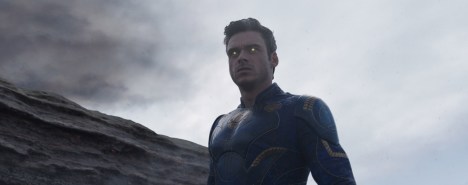
Red eyes in the morning…
There is tangible sense of opportunism at play in way that Marvel Studios has positioned Eternals as an auteur-driven project. After all, the studio has a long and complicated history with directors who have distinct visions; Patty Jenkins, Edgar Wright and Ava DuVernay have all suggested that the company’s culture is not particularly welcoming to creatives. In particular, Zhao’s assertion that she oversaw the movie’s action sequences exists in the context of Argentine director Lucrecia Martel, who recalls being told that if she chose to direct Black Widow, she would not be allowed to direct the action scenes.
Again, context is important here. Eternals is really the company’s first director-driven project since Black Panther, which is a big deal given the studio’s history of beginning pre-visualization of scenes and special effects “before the cinematographer or director has signed on to the project.” While movies like Avengers: Infinity War, Captain Marvel, Ant Man and the Wasp, Avengers: Endgame and Spider-Man: Far From Home are all varying degrees of entertaining, none of them feel like the work of a filmmaker who has something particularly pressing to say about the modern world.
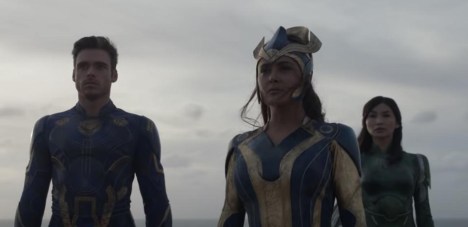
Superfriends.
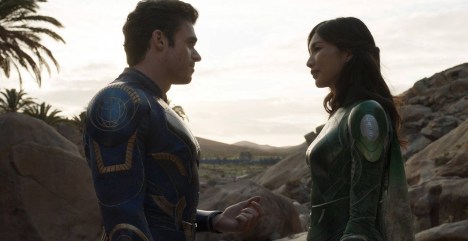
All this tension plays through Eternals, the fine balancing act between a director with a very distinctive artistic sensibility working with a studio that appears eager to launder its reputation by association, while also being anxious that this auteur doesn’t get to go too far. In some ways, Eternals feels like a limit case for the Marvel Cinematic Universe, an example of just how far the studio will allow a creative talent to stretch a rubber band before aggressively snapping it back into the default position.
This is the challenge facing Eternals. It goes further than any Marvel Studios film in recent memory, but that’s still not far enough.
I published a new In the Frame piece at The Escapist this evening. Last week, the cinematic wold was shaken by the announcement that Warner Bros. would be releasing their entire cinematic slate day-and-date on HBO Max. This drew a lot of discussion and debate, but also demonstrating one of the internet’s weird cinematic fault lines: the strong hatred of director Christopher Nolan.
Nolan is one of the most interesting directors working the day. He is the last director who can approach a major studio with an original idea and secure hundreds of millions of dollars to realise it with minimal interference. In his early career, Nolan was a critical and internet darling, with a strong online following. However, since around 2012, Nolan has become a figure of a vocal and persistent derision online, much of which is anchored in the portrayal of the director as an old-fashioned auteur with a distinct sensibility.
This hatred of Nolan – which seems to bubble over in relation to anything from Anne Hathaway sharing chat show anecdotes about working with him to his reasonable critique of Warner Bros. failing to inform any of their directors or collaborators about the move to HBO Max – is interesting because it tied to other cultural trends that overlap. The internet’s passionate dislike of Nolan reflects broader shifts in the embrace of an intellectual-property- and corporate-identity-driven fandom. This hatred of Nolan often feels like a hatred of what he represents as a filmmaker.
You can read the piece here, or click the picture below.
Hosted by Andrew Quinn and Darren Mooney, and this week with special guests Donal Smith and Donal Sweeney, The 250 is a (mostly) weekly trip through some of the best (and worst) movies ever made, as voted for by Internet Movie Database Users.
This time, James Nguyen’s Birdemic: Shock and Terror.
Software salesman Rod has the perfect life. He has just closed the biggest deal in the history of his company, which has itself just been bought out by a giant conglomerate. More than that, a chance encounter with an old school friend leads to a blossoming romance with a Victoria’s Secret model. Everything is going well, until death swoops in from above.
At time of recording, it was ranked 5th on the list of the worst movies of all time on the Internet Movie Database.
I published a new In the Frame piece at Escapist Magazine yesterday. Because it was a light week for geek culture, I actually got to write a little bit about something I’ve thought far too much about; Ridley Scott’s Alien: Covenant.
Covenant is not a great film. It’s not even a particularly good film. However, it is a fascinating film. A large part of that is because it emerged in the middle of a wave of compromised big budget blockbusters like Suicide Squad, Justice League and Solo: A Star Wars Story, films that often felt like watching a wrestling match between the director and the studio. Covenant feels the same way, trying to reconcile Fox’s desire for an Alien prequel with Scott’s desire for a Prometheus sequel. However, what’s most interesting about Covenant is how that conversation seems to play out within the movie itself.
You can read the piece here, or click the picture below.























 the m0vie blog