• Following Us

  • Categories

  • Check out the Archives


  • Awards & Nominations

New Escapist Column! On James Cameron’s “Aliens” as a Challenge to Ridley Scott’s “Alien”…

I published a new In the Frame piece at The Escapist this evening. James Cameron’s Aliens is thirty-five years old this July, so it seemed like a good opportunity to take a look back at one of the best sequels ever made.

Aliens works in large part because it’s smart enough to avoid directly challenging Alien, in that it avoids simply recycling the original formula with a shift in location or with a new cast. Instead, it offers a very different approach to the core material. More than that, James Cameron positions Aliens as a direct challenge to Alien, deliberately and pointedly inverting some of the core themes of the original film. This choice enriches both films, turning Alien and Aliens into a conversation.

You can read the piece here, or click the picture below.

241. Kimetsu no Yaiba: Mugen Ressha-Hen (Demon Slayer – Kimetsu no Yaiba – The Movie: Mugen Train) – This Just In (#238)

Hosted by Andrew Quinn and Darren Mooney, with special guests Graham Day and Bríd Martin, The 250 is a (mostly) weekly trip through some of the best (and worst) movies ever made, as voted for by Internet Movie Database Users. New episodes are released every Saturday at 6pm GMT.

This time, Haruo Sotozaki’s Demon Slayer – The Movie: Mugen Train.

Following a series of mysterious disappearances on a train from Tokyo to Mugen, three young demon slayers are dispatched to investigate possible supernatural influences. The three quickly team up with a veteran soldier in the battle against evil, and discover just how quickly their mission can go off the rails.

At time of recording, it was ranked 238th on the list of the best movies of all time on the Internet Movie Database.

Continue reading

New Escapist Column! On “Rick and Morty” Embracing Exponentiation Over Escalation…

I published a new In the Frame piece at The Escapist this evening. The fifth season of Rick and Morty is currently airing, a the most recent episode has been greeted as a modern classic, so it seemed like a good time to take a look at what makes the show work.

Rick and Morty is a science-fiction comedy. Both comedy and science-fiction thrive off the dramatic principle of escalation, of extrapolating from one iteration of an idea to the next. What is so interesting about Rick and Morty is how the show adopts an exponential approach to that philosophy. The comedy and the stakes of Rick and Morty often derive from starting with a straightforward science-fiction concept and then doubling down on it repeatedly.

You can read the piece here, or click the picture below.

Non-Review Review: Fear Street Part One – 1994

Nostalgia is a strange creature, by turns deceptive and revealing.

Netflix’s Fear Street trilogy, based on an original story inspired by the books written by R.L. Stine, is effectively a loving slice of horror nostalgia and a trip through slasher movie history. Fear Street Part Two: 1978 is very obviously an effort to take the genre back to its roots, evoking classics like Halloween or Black Christmas, and with its summer camp setting directly inviting comparisons to Friday the 13th and Friday the 13th, Part II. Similarly, Fear Street Part One: 1994 is clearly constructed as a loving homage to the slasher revival of the nineties, to films like Scream, Urban Legends or I Know What You Did Last Summer.
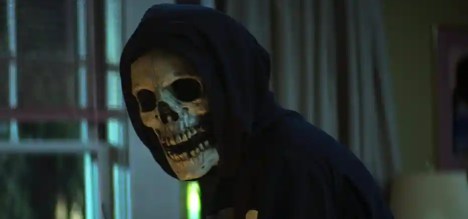
Skull Kill Crew…

In some ways Fear Street feels like a companion to that other big Netflix nostalgia property, Stranger Things. The three films are directed and co-written by Leigh Janiak, who is married to Stranger Things co-creator Ross Duffer. Like Stranger Things, there is a strong sense that Fear Street Part One: 1994 is aimed at a generation of viewers too young to remember the era firsthand. As such, Fear Street Part One: 1994 doesn’t feel like an attempt to accurately recreate the era so much as provide a cartoonish snapshot. It captures the pop memory of the period much more than the reality.

Fear Street Part One: 1994 is an appealing slice of genre nostalgia populated with a charming cast and an appealing high concept, albeit one that is occasionally so preoccupied by its broad brush strokes that it misses the final details. Then again, that is how nostalgia often works. Ironically, Fear Street Part One: 1994 probably has less to say about the genre than the movies that it is invoking.

“I have a bone to pick with you.”

Continue reading

New Escapist Video! “A Marvelous Escape” – Loki – “The Nexus Variant”…

With a slew of Marvel Studios productions coming to Disney+ over the next six months, The Escapist has launched a weekly show discussing these series

This week, I join KC Nwosu and Amy Campbell to talk about the fourth episode of Loki, streaming on Disney+.

New Escapist Video! “The Tomorrow War – Review”

I’m thrilled to be launching movie reviews on The Escapist. Over the coming weeks and months, I will be joining a set of contributors in adding these reviews to the channel. For the moment, I’m honoured to contribute a three-minute film review of The Tomorrow War, which is streaming on Amazon Prime this weekend.

Non-Review Review: The Tomorrow War

The Tomorrow War is a mess of a movie.

Rumour has it that Amazon paid $200m to acquire the movie from Paramount Pictures, which has taken the pandemic as an excuse to offload films like The Lovebirds, The Trial of the Chicago 7 and Coming 2 America. Blockbuster cinema is still something of a siren call for streaming services, with Paramount famously able to entice Netflix into buying The Cloverfield Paradox as a big post-Superbowl release. However, it’s notable that most major studios would be reluctant to part with a surefire financial hit.

“We need to have grown up conversation about how many deaths are acceptable in an alien invasion.”

The Tomorrow War feels very much like a streaming era blockbuster, something to fire up on television rather than to enjoy in cinemas, something that might be justified as a perk that comes with all the free shipping rather than a movie that is worth the audience’s time and attention (and the price of a ticket) on its own merits. The Tomorrow War is a clumsy misfire of a movie, essentially three different movies awkwardly stitched together with a bloated runtime and no internal coherence.

This would be a problem if any of the individual three movies were good. It’s somehow worse for the fact that all three are awful and are worse in combination.

Continue reading

Non-Review Review: @zola

The opening line of @zola is inevitable.

“Y’all wanna hear a story about why me and this b!tch here fell out?” asks Aziah King, the “Zola” of the title. “It’s kind of long but full of suspense.” There was simply no other way that the film was going to start. The line was foregrounded in the movie’s first trailer, and of course it was the opening tweet of the viral twitter thread (#TheStory) that inspired this cinematic adaptation. To put it simply, there was never any way that @zola was going to open any other way.

#NoTimeForReflection

However, the opening line is also a statement of purpose and a key to the film’s central joke. @zola positions that opening salvo as an iocnic statement of itself, a millennial riff on “it was the best of times, it was the worst of times…” and “call me, Ishmael.” The central conceit of Janicza Bravo’s adaptation of the twitter thread is to treat the work like a piece of some modern literary canon, a snapshot of modern America filtered through the prism of art, captured 140 characters at a time. It’s a clever approach, and the best part of @zola is how eagerly it commits to that wry framing.

@zola is an impressive piece of craft, a collision of a very classical formalism with a more modern sensibility to create something that exists in a striking and imaginative space. However, there are times when @zola commits too heavily to studying its characters through the prism of social media, making them feel more like macabre exhibits in some twenty-first century freakshow than actual human beings. Still, @zola sets out to capture an extremely online aesthetic and it largely succeeds – for better and for worse.

#FreaksAndGeeks

Continue reading

New Podcast! The Escapist Movie Podcast – “Censor is a Celebration of and Exploration into Classic “Video Nasty” Horror”

The Escapist have launched a movie podcast, and I was thrilled to join Jack Packard for the twentieth episode of the year. We discussed two interesting new horror releases: the restoration of George A. Romero’s long lost The Amusement Park and director Prano Bailey-Bond’s celebration of the “video nasty” era with Censor. We really enjoyed both of them.

You can listen to back episodes of the podcast here, click the link below or even listen directly.

New Escapist Column! On “Raiders of the Lost Ark” as a Theme Park Ride and a Cinematic Marvel…

I published a new In the Frame piece at The Escapist this evening. Given that Raiders of the Lost Ark turned forty years old this summer, it seemed like a good opportunity to take a look back at Steven Spielberg’s defining summer blockbuster.

In particular, Raiders of the Lost Ark is proof that it is possible for a “theme park ride” of a summer blockbuster to also function as a distillation of cinema. Everything in Raiders of the Lost Ark moves with singular purpose towards the same goal. It is a visceral and impressive technical accomplishment, but the craft involved in works in service of big ideas about the power of imagery and iconography. Form and function are indistinguishable, what the film is about becoming inseparable from how it is about it. Raiders of the Lost Ark is a triumph of filmmaking.

You can read the piece here, or click the picture below.