• Following Us

  • Categories

  • Check out the Archives


  • Awards & Nominations

It’s a Wonder They Stay On: Thoughts on Wonder Woman’s Wardrobe…

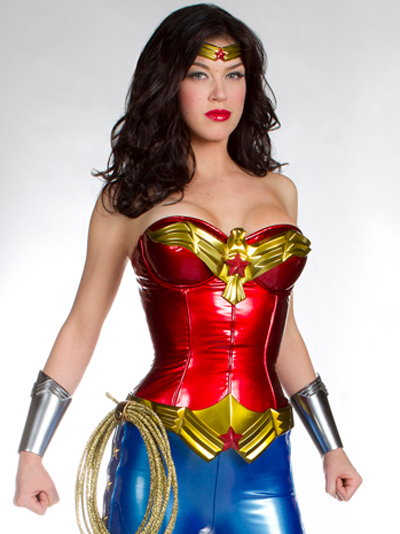
Well, the first pictures of David E. Kelley’s upcoming Wonder Woman adaptation have hit the web. Lynda Carter loves it and everyone else seems to hate it. Me, I really couldn’t care too much about the costume – I’m just worried about the very idea of a Wonder Woman television show from the creator of Ally McBeal. That’s not a putdown – well, it kinda is – but it’s a more fundamental problem than the outfit she wears (which will likely get retooled repeatedly over the course of the show – assuming the show has a course). Anyway, the outfit gives me an opportunity to wonder about Wonder Woman’s outfit. Is there something wrong with her traditional Lynda Carter look, and is this update an improvement?

Is it any wonder?

Continue reading

Non-Review Review: Superman Returns

March is Superman month here at the m0vie blog, what with the release of the animated adaptation of Grant Morrison’s superb All-Star Superman. We’ll be reviewing a Superman-related book/story arc every Wednesday this month, so check on back – and we might have a surprise or two along the way. I figured that, today, I’d take a look at Superman-related movies.

You know, Quentin Tarantino once boasted that he had a 20-page review of Superman Returns that the director had been drafting for some years now. This review is going to be long, but it’s – hopefully – not going to be that long. The film has divided fans, movie-goers and film critics since its initial release, killed an attempt to relaunch the “Superman” brand name in the new millennium, made a shedload of money (although not as much as Warner Brothers would have liked). It’s a movie that deserves a large amount of discussion and debate, and it sure has generated it. I’m not a staunch supporter of the film, but I don’t hate it, either. Superman as a character has endured far greater humiliation. Still, it’s a bit of a disappointing continuation to the on-going Superman mythology.

The weight of the world is on his shoulders...

Continue reading

Non-Review Review: Sin City

We’re currently blogging as part of the “For the Love of Film Noir” blogathon (hosted by Ferdy on Films and The Self-Styled Siren) to raise money to help restore the 1950’s film noir The Sound of Fury (aka Try and Get Me). It’s a good cause which’ll help preserve our rich cinematic heritage for the ages, and you can donate by clicking here. Over the course of the event, running from 14th through 21st February, I’m taking a look at the more modern films that have been inspired or shaped by noir. Today’s theme is “comics noir” – noir filtered through comic book panels.

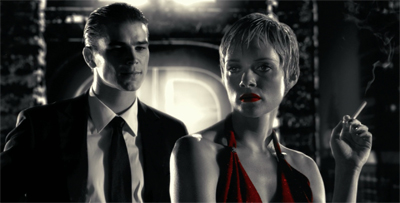
Sin City is, I suppose, one of those films that lives or dies based solely on its visual style. Although the heavy hardboiled atmosphere compliments the stark black and white contrast, it’s those beautifully and meticulously staged images which come into the mind when one thinks of the Frank Miller adaptation. Based on the writer and artist’s collection of noir-themed comic books set in (Ba)Sin City, Robert Rodriguez’s adaptation manages to faithfully capture the tone and style of its source material. Being honest, it’s one of those movies which can’t help but catch your eye – it’ll just follow up with a punch to the gut.

That little red dress...

Continue reading

Now That’s First Class: X-Men – First Class & Superhero Nostalgia

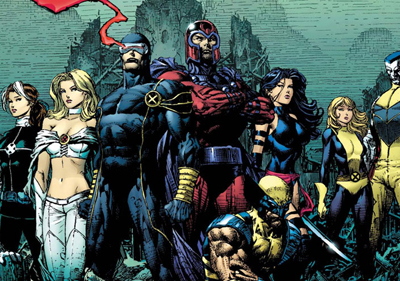
I have to admit that X-Men: First Class is a movie that I find myself in a wild state of flux over. At times, I’m delighted by the sensational casting, the fantastic director and the wonderful artistic design that we’re seeing. However, I am equally curious as to what the point of a prequel is, or why Bryan Singer jumped ship so quickly. At times, it’s one of my most anticipated movies of the coming year, while at others it’s just another film awaiting release. Somewhat lost amid the announcement that Bane and Catwoman would be the villains of The Dark Knight Rises, Fox released a slew of information about their newest X-Men film last week. looking at eth photos, I can’t help wondering whether the superhero movie genre is on the cusp of the nostalgia-fest which has swept their comic book counterparts in recent years.

He always had a magnetic personality...

Continue reading

Marvel Crossover Continuity

In August, I decided it would be… interesting to take a look at the event-driven storylines that Marvel was producing between 2005 and 2010. So, for sixteen weeks (and more, if you consider the occasional bonus back-up feature), I reviewed one of the many “events” Marvel produced during the period. I’ve grouped the particular strands of continuity together below for easy of browsing (also providing the original date of publication). I hoped that exploring this particular aspect of the medium might grant me some insight into why big events like this continually upset on-going stories being told by writers in individual characters’ books. It was an interesting experiment, even if I doubt I’ll be engaging with the core of the Marvel Universe so thoroughly any time soon.

Note: It is incomplete. I had planned to follow The Avengers through to Siege, but it looks like my reviewing schedule caught up with them – for the same reason I haven’t got around to The Thanos Imperitive yet. I will return to this thread in the future.

Avengers-Based Continuity
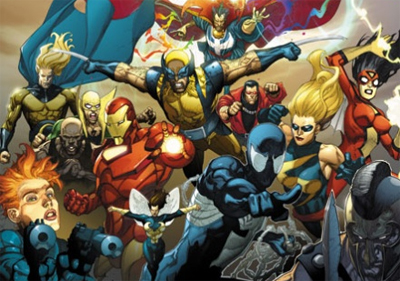
It was a good decade for The Avengers as a franchise, with Marvel consciously pushing the franchise to the forefront – not just in comics but in other media as well. If the nineties and early naughties belonged to the X-Men (with X-Men: The Animated Series on the airwaves, Bryan Singer’s X-Men in cinemas and crossovers like Age of Apocalypse in comic books), this was very clear attempt to take that back. Brian Michael Bendis was tasked with turning the Avengers into Marvel’s prime franchise and succeeded – most of the “big” comic book events of the decade revolved around them. That said it was certainly a controversial restructuring of the book, with a line-up crafted to feature more popular characters like Spider-Man and Wolverine instead of more obscure characters like Quicksilver or the Scarlet Witch.

The Avengers branched out into other media too. Iron Man demonstrated that Marvel’s “big three” could hold viewer interest in cinemas, and promised a series of crossovers on the big screen that would see The Avengers assemble under the direction of Joss Whedon. As a brand, Marvel made sure these characters were everywhere.

The stories featuring these characters over the decade form something of a larger meta-story which seems to reflect on the superhero genre as a whole. Although Bendis’ New Avengers opens with a supervillain breakout, the characters spent more time fighting each other than bad guys (Civil War, World War Hulk). When they did fight bad guys, they were more often than not corrupted mirrors of themselves, be it the Skrulls who had managed to so perfectly imitate heroes despite being villains (Secret Invasion) or government-sanctioned psychotic “Dark Avengers” (Siege). It was a story about how difficult it was to be a hero in the last few years – in the wake of the “dark age” of comic books – and a deconstruction of the effectiveness of a group of individuals like this to actually make a difference. You could even argue that this was a grim reflection of real world political and social uncertainty – particularly mistrust of authority (it’s telling how much time these heroes spend going “rogue”). Of course, this is open to interpretation, and many fans were less than pleased with the execution of this particular tale.

“Cosmic Marvel” Continuity

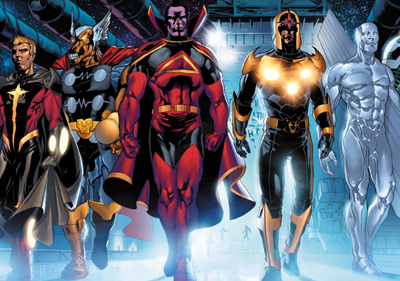
Marvel’s Cosmic Universe got a much-needed revitalisation this decade, offering perhaps a better-plotted and more straightforward avenue for Marvel’s crossover events. Although Jim Shooter had done great work with many of these characters in the nineties (with Infinity Gauntlet and so forth), they had mostly remained in relative obscurity before the relaunch.

The distinguishing aspect of these stories is the way that they are structured. Rather than a big event coinciding with countless tie-ins across countless books, most of these stories would open with a single prologue issue which would branch into a handful of miniseries running for a set number of issues, before dovetailing into a main series. This meant that every issue remotely connected with a series could be collected in a hardcover. Admittedly the titles become more entangled in continuity as they went on (with War of Kings tying in directly to Ed Brubaker’s The Rise & Fall of the Shi’ar Empire story arc in Uncanny X-Men), but by and large these series served to avoid pointless tie-ins and an exceptionally convoluted continuity (everything you needed was included in the books themselves).

They’re the best crossovers that you weren’t reading.

X-Men Continuity

The last decade has been an interesting one for the X-Men, as both the books and the characters have found themselves looking for purpose. Grant Morrison’s New X-Men posited a world where mutants would be the dominant species with a few generations and proposed to move the “mutants as oppressed minority” metaphor firmly into the twenty-first century, where the worries weren’t (at least for the most part) about government-sponsored genocide or legal rights, but cultural and social questions about the way that mutants and humanity live together. This was clearly a step too far, as Marvel decided to essentially wipe out the mutant population, feeling there were too many mutants in the Marvel Universe. This was done with three words from a psychotic Scarlet Witch rather than a more subtle approach (like simply reducing the number of mutants featured in various books).

Suddenly the X-Men found themselves facing extinction, and this became a driving narrative force for the book. It was as if the line was actively rebelling against the editorial mandate forced upon them. Instead of granting narrative clarity, the edict had instead complicated things. It also forced the X-Men away from their widely-loved position as a civil rights metaphor and towards a more straight forward “find the cure” narrative. It also served to isolate the franchise from the rest of the Marvel Universe (except for Wolverine, of course, who is everywhere) – the X-Men were always busy doing their thing and trying not to die out rather than assisting with Civil War or Secret Invasion. The solution to this narrative thread is entirely predictable, but it does offer a clear structure to the X-Men stories from the period.

It’s interesting to note that while all the major Avengers titles from this period (New/Mighty/Dark Avengers) have been consistantly collected, the X-Men books have not been. Ed Brubaker’s run is quite difficult to collect in one consistent format, as is Matt Fraction’s – and both are writing for what should be “the flagship book” of the X-Men publishing line, Uncanny X-Men. This makes it considerably harder to follow than the Avengers franchise, for example.

Aaronofsky to Wrestle “The Wolverine”: Are Independent Directors the Best Choices for Superhero Cinema?

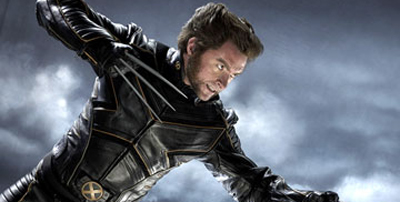
I’m going to be honest, I like it when relatively obscure film directors are handed the reigns to huge blockbuster properties. It seems that these “cult” film makers tend to bring something fresh from outside the studio system to their work. I might sound more than a bit pretentious, but it reminds me of the way that many of the blockbuster directors of the seventies – including Lucas and Spielberg – originated from outside the studio system before revolutionising it from inside. As a concept, would I rather watch Michael Bay’s Transformers: Revenge of the Fallen or Christopher Nolan’s Batman Begins? No choice there. Any film with the name “Jerry Bruckheimer” attached or Sam Raimi’s Spider-Man? Again, no choice. So, despite the fact that Gavin Hood’s X-Men Origins: Wolverine was a critical failure and an infuriatingly (but, sadly, not unpredictably) disappointing film, am I alone in getting a little excited about Darren Aaronofsky’s The Wolverine.

Against all odds, I might be feeling pretty Jack(man)ed about this...

Continue reading

Thoughts on Snyder’s Superman

It has been over a week since the news that Zack Snyder would be directing the Superman reboot was announced. And what a week it has been. No sooner was the movie announced than details started flooding in – Luthor would not be the main villain, it would be an origin story of sorts, it would not share continuity, Zod would be the primary antagonist, Brandon Routh would not return. That’s quite a bit of news to get straight out of the gate, and I took a while to really shape my opinion of it all. And I’m optimistic, just very cautiously so.

Look! Up in the sky!

Continue reading

Looking for Christopher Nolan’s Superman…

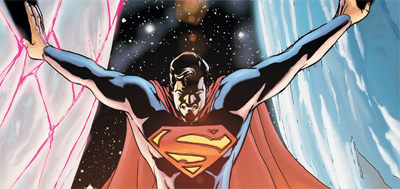
Superman is a tough character to get right. In any format. I remarked earlier in the week that there are very few truly classic stories featuring the character. While I’m more than a little delighted that Christopher Nolan has been handed the reigns to the franchise, I’m also a little bit nervous. Is there a way to make Superman a viable commercial franchise for the twenty-dirst century? I’d argue there is, if we look in the right place. Here’s my opinion: Look! Up in the skies! I think that the place to look to take the character back to his roots is the sort of wonderful ‘out there’ science fiction of the fifties. Batman does noir, so let Superman do hokey sci-fi.

"You will always be a child of two worlds..." Wait, sorry, wrong monologue...

Continue reading

Non-Review Review: X-Men

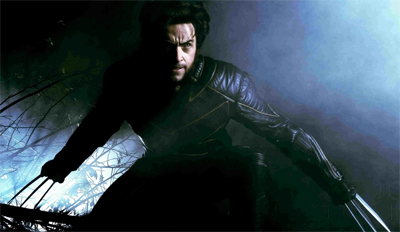
It’s the movie that started it all. We wouldn’t have this tight-spandex-wearing superhero craze in Hollywood today were it not for Bryan Singer’s ambitious adaptation of the Marvel wonder team (okay, Sam Raimi’s Spider Man played a part too). I don’t know what’s more surprising: that it worked at the time or that it still holds together quite well today.

No claws for alarm...
No claws for alarm…

Continue reading

Non-Review Review: The Usual Suspects

Wow. Neo-noir is a very tough genre to pull off. It really is. Think of how many dodgy movies you’ve seen about drug dealers and bent cops in the last year alone (I’ve even seen one this weekend). When it works, it works magically. It seems like the mid-nineties was the era for producing any number of classic modern noir-style tales. There’s Copland, L.A. Confidential and – of course – the movie that arguably started the whole trend. We’re looking at you, The Usual Suspects

Calvin Klein models just aren't trying anymore...

Calvin Klein models just aren't trying anymore...

Continue reading