• Following Us

  • Categories

  • Check out the Archives


  • Awards & Nominations

Star Trek: Voyager – Repentance (Review)

Repentance marks another example of the seventh season of Star Trek: Voyager groping clumsily and awkwardly towards an archetypal Star Trek plot.

The Star Trek franchise has cultivated a reputation for being a vehicle for progressive social commentary, largely on the back of episodes like Let That Be Your Last Battlefield or Plato’s Stepchildren. Of course, those episodes were decidedly less progressive and more complicated than the popular memory would allow, but there is an argument to be made that the idea of Star Trek as a voice for social progress is worth something even if the franchise did not always live up to those ideals. After all, the franchise also gave audiences The Omega Glory and Turnabout Intruder.

In the neck of time.

The seventh season of Voyager seems to recognise this social commentary as something essential to Star Trek‘s cultural identity, something that essentially defines Star Trek as Star Trek and distinguishes it from other popular science-fiction. This explains why the seventh season of Voyager is so preoccupied with the Prime Directive, which even gets name-dropped within Repentance; it is a major element in stories like Flesh and Blood, Part I, Flesh and Blood, Part II, Natural Law and Friendship One. It is seen as something identifiably Star-Trek-ian in nature.

The seventh season of Voyager builds a number of episodes around big social issues of the late nineties and the new millennium; Critical Care grappled with the healthcare crisis, while Lineage wrestled with anxieties about designer babies. Repentance is very much of a piece with those episodes, although it turns its gaze towards the issue of capital punishment. On paper, this is archetypal Star Trek storytelling, an allegorical exploration of a hot button issue through the prism of science-fiction. However, as with so many of these episodes, the archetypal Star Trek trappings feel superficial.

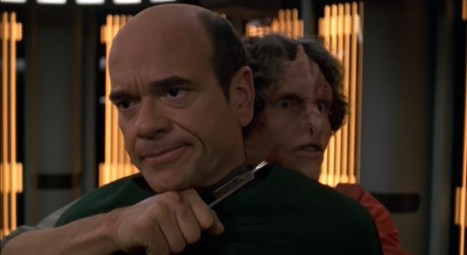
Hologram for a king’s ransom.

Repentance has very little to actually say about the death penalty. More than that, what it does have to say is deeply confused and unfocused. Voyager is perhaps the most consistently conservative of Star Trek shows in terms of political philosophy, which has led to a number of spectacularly poor decisions like the characterisation of the Kazon from Caretaker onwards or the false rape accusation paranoia underpinning Retrospect. It seems entirely predictable, if no less disappointing, that Voyager stumbles clumsily into an ill-judged take on the application of capital punishment in Repentance.

As with Critical Care and Lineage before it, Repentance is an episode that understands the importance of using a platform to say something important about one of the most pressing issues of the era while also extending a great deal of effort trying to avoid saying anything at all.

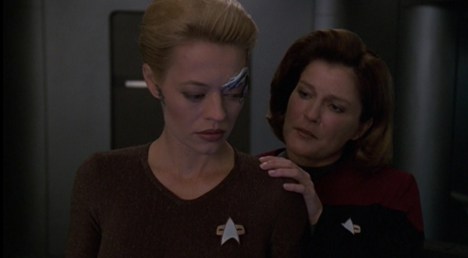
“Cue the women in prison fan-fic.”

Continue reading

New Podcast! Scannain Podcast (2019) #5!

It’s time for the latest Scannain podcast!

This week, I join Ronan Doyle, Jay Coyle and Alex Towers from When Irish Eyes Are Watching to discuss the week in film news. We have a broad and wide-ranging discussion of what we watched, including everything from John Carpenter’s The Fog to 3,000 Miles to Graceland to the work of Agnes Varda and some preemptive highlights of the upcoming Virgin Media Dublin International Film Festival. We also discuss a little bit about David Fincher’s Zodiac, which we all caught on 35mm at the Lighthouse.

In terms of film news, there is a lot to cover. The big story concerns the cinema-going habits of the Irish (and international) audiences. However, there’s also news from the European Film Market, including a number of prospective Irish films on sale.

The top ten:

  1. Second Act
  2. Escape Room
  3. Mary Poppins Returns
  4. Mary Queen of Scots
  5. Vice
  6. Glass
  7. The Mule
  8. A Dog’s Way Home
  9. Green Book
  10. How to Train Your Dragon III: The Hidden World

New releases:

You can download the episode here, or listen to it below.


117. Before Sunrise – “Two Guys Die Alone 2019” (#204)

Hosted by Andrew Quinn and Darren Mooney, The 250 is a fortnightly trip through some of the best (and worst) movies ever made, as voted for by Internet Movie Database Users.

This time, a Valentine’s treat. Richard Linklater’s Before Sunrise.

An arguing couple on a train unexpectedly bring two much younger people into contact; Jessie is a seemingly cynical American who has found himself bumming around Europe while waiting for a flight home while Celine is a student returning to Paris. On a whim, the two young people decide to spend one magical night together, knowing that it may well be the only time that they ever spend together.

At time of recording, it was ranked the 204th best movie of all time on the Internet Movie Database.

Continue reading

Non-Review Review: On the Basis of Sex

On the Basis of Sex is a sturdy, old-fashioned awards season film.

On the Basis of Sex is earnest, unshowy and very conventional in both concept and execution. All of its beats are familiar, all of its rhythms predictable. It’s not especially inventive or innovative. It is a meat-and-potatoes awards fare, a fascinating story that is told in an uncluttered manner. While there are still a handful of these sorts of films released every year, it often seems like the ground is shrinking out from under them. As awards season has leaned towards quirky indie films like Vice or The Favourite, it has left films like On the Basis of Sex and Can You Ever Forgive Me? sitting in the dust.

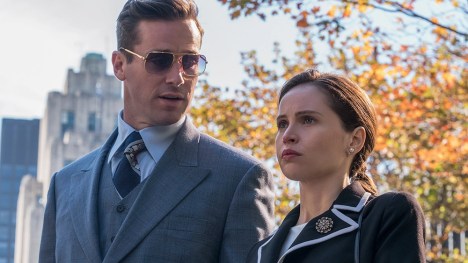
Ruthless litigation.

There is nothing wrong with old-fashioned awards fare, even if On the Basis of Sex occasionally feels conflicted about which particular mode of old-school biographical film it seeks to emulate; it starts like a conventional subject’s-life-in-two-hours piece in the style of films like Ghandi or Patton, and then shifts into the slightly more modern twist on the genre that tends to focus on one formative event like Frost/Nixon or The Queen or Elvis & Nixon. It is a strange shift, with On the Basis of Sex spending half an hour on a general introduction to Ruth Bader-Ginsberg before focusing on the meat of this particular story.

This lack of focus is not a major issue. Old-fashioned awards fare can work reasonably well with the right material and talent, despite seeming quaint by the standards of the time. On the Basis of Sex never stands out from the crowd in the same way as its central character, but then that might be expecting too much given that surprisingly long shadow cast by Ruth Bader-Ginsberg.

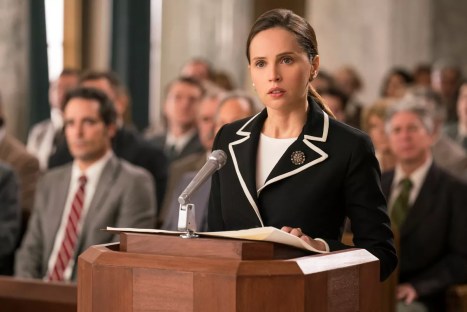
Courting controversy.

Continue reading

New Podcast! Scannain Podcast (2019) #4!

It’s time for the latest Scannain podcast!

This week, I join Jay Coyle and Graham Day from Speakin’ Geek to discuss the week in film news. It’s a fun and wide-ranging discussion, covering everything from the growth of Dreamworks as an animation studio to the extended cut of Terrence Malick’s Tree of Life. There’s also discussion of Dragonball Z and Destroyer. In film news, we mark the passing of Dick Miller, the coverage of Sundance, February at the Irish Film Institute and the thirtieth anniversary of the Cork French Film Festival.

The top ten:

  1. The Favourite
  2. Wreck-It Ralph 2: Ralph Breaks the Internet
  3. Stan and Ollie
  4. Second Act
  5. Mary Poppins Returns
  6. The Mule
  7. Vice
  8. Mary Queen of Scots
  9. Glass
  10. A Dog’s Way Home

New releases:

You can download the episode here, or listen to it below.

Non-Review Review: High Flying Bird

High Flying Bird is a quietly radical movie about a sports agent.

This should not be a surprise. Director Steven Soderbergh is a director fascinated with systems, particularly capitalist systems. Unsane might have taken the form of a trashy and tacky nineties thriller, but it was primarily interested in exploring the horrors of a psychiatric industrial complex. Side Effects touched upon the way in which pharmaceutical companies and legal systems work. Contagion was a story about structural responses to a viral infection that spread rapidly through an increasingly interconnected world.

Managing the situation.

With that in mind, it makes sense that Steven Soderbergh’s movie about the NBA lockout of 2011 would feature very little actual basketball. Sure, footage of games plays on several of the large flatscreens adorning bar or office walls, but it’s just window dressing. Just when it looks like Soderbergh might actually show a game, he cuts away dramatically to a shot of a billionaire’s daughter carrying her dog on board a private jet, flanked by two helpful staff holding umbrellas to protect her from the wind. High Flying Bird is about basket ball as an institution, but not a sport.

A cynic would argue that  High Flying Bird is about basket ball in the same way that the NBA is about basket ball, interested in institutions and structures more than the actual sport itself. Such a cynic would be right at home in the world of High Flying Bird, where characters talk freely and repeatedly about the  “game that’s been played behind the game”, “the game that they made over the game”, or “a game on top of a game.” Professional basket ball is not about basket ball, High Flying Bird argues coherently and consistently. Professional basket ball is about profiting off basket ball.

“What are you doing here?”
“Beatz me.”

High Flying Bird is drawn from a script by Tarell Alvin McCraney, who is perhaps best known for working on the story for Moonlight with Barry Jenkins. Indeed, the cast is anchored by Moonlight co-star André Holland. High Flying Bird recalls Moneyball, in that it is a film about sport that does not feature sport, understanding that the activity does not exist in a vacuum. For High Flying Bird, professional basket ball is about money and power and race, and the real game is being played away from where the camera and the audience is looking.

The only thing that keeps High Flying Bird from being a slam dunk is a lack of focus. High Flying Bird doesn’t entirely trust its cast and its premise to hold the audience’s attention through all of these conversations about abstract concepts layered upon abstract concepts placed over a game that the film only shows in the background. As a result, McCraney and Soderbergh crowd out the story with subplots designed to generate human interest; a tragic back story, an emerging romance. These elements ultimately distract from the most interesting aspects of the film.

This screenshot is also about capitalism. Somehow.

Continue reading

New Podcast! The Pensky File – Star Trek: Deep Space Nine, Season 5, Episode 9 (“The Ascent”)

I was thrilled to be asked back to join The Pensky Podcast to discuss Star Trek: Deep Space Nine, particularly as they hit the fifth season, which may well be the best season of Star Trek ever produced. So, no pressure talking about The Ascent, then.

Wes had a family emergency to take care of, so I joined Clay to discuss this mid-season double-buddy comedy episode in which Odo and Quark find themselves stranded on a hostile alien world while Nog and Jake discover that life as roommates is less than ideal. It’s a fun, broad discussion. We cover everything from the writers’ tendency to use subplots lifted directly from sitcoms to flesh out supporting characters through to debates about stakes in modern mass media, as well as the shift away from the twenty-odd episode season that has squeezed out episodes like The Ascent. It was great fun, and I hope you enjoy listening. I’ll let you decide which one of us is Quark and which one of us is Odo.

You can find more from The Pensky Podcast here, and listen to the podcast by clicking the link or just listening below.

Continue reading

Non-Review Review: Alita – Battle Angel

Alita: Battle Angel is the result of a creative union between James Cameron and Robert Rodriguez.

This partnership makes a certain amount of sense. Both Cameron and Rodriguez are genre film-makers, and one suspects that the two men would have been fast friends had they emerged at around the same time; Cameron came of age making films like Piranha 2 or Terminator, and those are certainly of a piece with Rodriguez’s filmography from Desperado through to Planet Terror and even Sin City. Cameron has arguably elevated his work into the mainstream, in that it is impossible to imagine Rodriguez producing a mass-appeal cultural smash like Cameron did with Terminator 2: Judgment Day Titanic or Avatar.

Slice o’ life.

However, allowing for that core similarity, Cameron and Rodriguez are still fundamentally different film-makers. Their interests might align when it comes to genre work, but they construct their movies in a very different manner, with a different emphasis on different aspects of their technique. Cameron is much more interested in bringing polish to his genre work, in finding a way to transform otherwise niche high-concept tales into crowd-pleasing blockbusters with mass appeal. In contrast, Rodriguez revels in the grottier aspects of his genre work, believing that the lack of sheen is part of the appeal.

Alita: Battle Angel finds these two aesthetics at odds with one another. The story at the heart of Alita is pure Cameron, dedicated to world-building and social commentary while relying on exposition and centring on big set pieces. However, the delivery of Alita is very much in the style of Rodriguez, stressing cool beats and individual sequences rather than the singular cohesive whole. The result is jarring and deeply fascinating, but it doesn’t quite come together. Alita is an intriguing piece of cinema, but a less than satisfying would-be blockbuster. Like its central character, it seems constructed of parts that don’t quite fit.

Red is dead.

Continue reading

Non-Review Review: The Lego Movie 2 – The Second Part

Appropriately enough, given the brand involved, The Lego Movie 2: The Second Part very skillfully builds on The Lego Movie.

Of course, The Second Part faces the typical challenges that haunt sequels to beloved and genre-bending films. A large part of what made The Lego Movie such a joy was the way in which it played with audience expectations of what it could be. More specifically, it built very cleverly and very consciously to a late development that was both entirely organic and very surprising, which is a difficult balance to strike. The Second Part starts with that late development baked into the premise, which means that it can’t pull the same twist again. It removes an important toy from the chest.

Bricking it.

However, while The Second Part lacks the novelty that made The Lego Movie so refreshing, it does have the advantage of building on what came before. In keeping with the nature of the toys depicted, The Second Part has the luxury of building upon an established template to tell its own story. The Second Part can trust that the audience understands the logic (both literal and metaphorical) that guided The Lego Movie, and so can develop that idea in interesting directions.

The result is a sequel that is fulfilling and satisfying, but which never quite matches the highs of the original film. The Second Part is clever, funny and canny. However, it is also – by its very nature – less innovative and creative. The results are impressive and affecting. While they don’t have quite the same impact as they did in The Lego Movie, the success of The Second Part is at least reassuring. That the template works so well even without disguising its twists offers proof that the fundamental building blocks are solid.

Piece in our time.

Continue reading

116. Green Book – This Just In (#170)

Hosted by Andrew Quinn and Darren Mooney, This Just In is a subset of The 250 podcast, looking at notable new arrivals on the list of the 250 best movies of all-time, as voted for by Internet Movie Database Users.

This time, Peter Farrelly’s Green Book.

At time of recording, it was ranked 170th on the list of the best movies of all time on the Internet Movie Database.

Continue reading