• Following Us

  • Categories

  • Check out the Archives


  • Awards & Nominations

155. The 250 Anniversary Special 2019

Hosted by Andrew Quinn and Darren Mooney, The 250 is a (mostly) weekly trip through some of the best (and worst) movies ever made, as voted for by Internet Movie Database Users.

This week, to mark the podcast’s three-year anniversary and passing the one-hundred-and-fifty-episode threshold, we decided to bring back as many of the guests from the third year as possible. So, joining Andrew and Darren on this podcast are:

We thought we’d take the opportunity to have a talk about the best and worst of this list, both in general and over the past year, and also take a nostalgic look back at the year 1999.

Continue reading

New Escapist Column! Rorschach, White Supremacy and “Watchmen”…

I published a new In the Frame piece at Escapist Magazine last Friday. One of the more interesting aspects of Watchmen has been the controversy that the series has demonstrated by looking at white supremacy head-on.

In particular, the show’s treatment of the legacy of Rorschach has been controversial to some fans, who have objected to the idea that his iconography would be adopted by a white supremacy group like the Seventh Kavalry. However, these concerns suggest a misreading of the graphic novel, which offers a very start view of Rorschach’s politics. Indeed, any close reading of Watchmen suggests it is almost inevitable that Rorschach would become a beacon for the sort of reactionary views that power the modern alt-right.

You can read the piece here, or click the picture below.

New Escapist Column! “The Shining” and the Perfect Haunted House…

I published a new In the Frame piece at Escapist Magazine last Friday. Because it was Halloween and because of the release of Doctor Sleep, it seemed like the perfect opportunity to take a look about at The Shining.

The Shining is my favourite horror movie ever. It is one of my favourite films ever. It is the rare piece of work that offers something new every single time I sit down to watch it. As I’ve thought more and more about it over the years, I’ve been drawn to the way in which the power of the Overlook is one of scale. It is big enough that it can serve as a fun house mirror to the anxieties of America itself, but also intimate enough that the familial anxieties of the Torrance family can play out within it. It is both large enough and small enough to work as the perfect haunted house.

You can read the piece here, or click the picture below.

Amazing.

Non-Review Review: Ford v. Ferrari (Le Mans ’66)

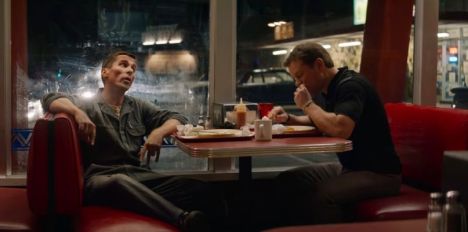
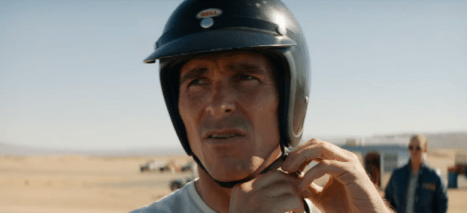
Ford v. Ferrari very much the Ford model of mid-budget adult-skewing awards fare.

It’s sturdy and reliable. It handles well. It also doesn’t have too many surprises under the hood. Ford v. Ferrari knows exactly what the audience wants from a film like this, and it often delivers right down to the shot. The camera is exactly where it needs to be, when it needs to be there – whether capturing the concerned expressions on a family nervously leaning in close to a radio or flying by the team manager as he watches his car cross the finish line on one of the last laps.

Food for thought.

It is easy to be cynical about all of this. Were somebody to approach Ford v. Ferrari cynically, they could argue that it is the product of a factory floor that is just as much a conveyor belt as those operated by Ford. However, there is a reason that this model of awards fare became an industry standard. Ford v. Ferrari constantly reminds its audience of the appeal underpinning this factory-built American craftsmanship. This sort of film was a staple of awards seasons for decades, and Ford v. Ferrari demonstrates just why that was.

Ford v. Ferrari is good, old-fashioned, crowd-pleasing awards fare.

Miles to go.

Continue reading

New Escapist Column! The Real Paradox at the Heart of the Post-“Judgment Day” Terminator Sequels…

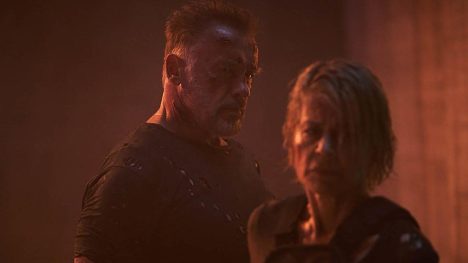
I published a new In the Frame piece at Escapist Magazine on Monday. This one is taking a look at Terminator: Dark Fate, the latest effort to produce a faithful and worthy sequel to Terminator 2: Judgment Day.

However, there’s an abiding irony to the four attempted sequels to James Cameron’s blockbuster classic. The four films all hope to position themselves as worthy successors to Judgment Day, while their very existence serves as a repudiation of its core themes. There is an inherent contradiction there, in that any attempt to honour or homage Judgment Day must – by its mere existence – invalidate the central thematic point. None of the four attempts to produce a workable sequel to Judgment Day have managed to square that particular circle.

You can read the piece here, or click the picture below.

Non-Review Review: The Nightingale

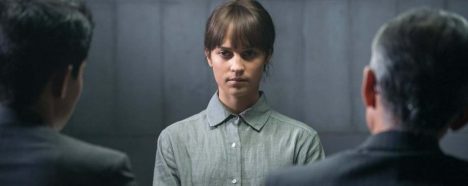
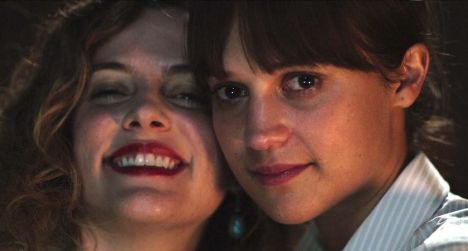
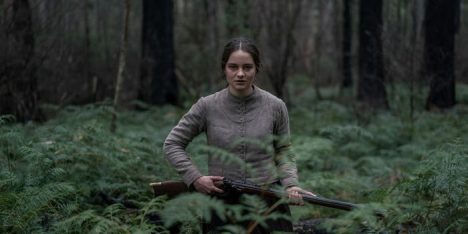
The Nightingale arrives as Jennifer Kent’s follow-up to The Babadook, and represents a slightly different sort of horror.

The Babadook was one of the best horror films of the decade, a creeping and unsettling look at a mother’s depression as she tried to work through her complicated feelings towards her own son. The Nightingale is something quite different, essentially a frontier western about a woman who sets out to avenge herself upon the British soldiers who inflicted a terrible suffering upon her and her family. As Clare tracks these men through the wilderness with an aboriginal guide named Billy, she finds herself confronted with the true nightmares of colonial Australia.

Eyes frontier.

The Nightingale belongs to a rich tradition of Australian westerns including modern classics like The Proposal, stories that play on the frontier myth and explore the country’s deeply troubled and unsettled history. Kent’s direction is tense and claustrophobic, refusing to ever let the audience look away from the horrors inflicted upon the continent by the European settlers who presumed to claim it as their own. The Nightingale is a bleak and cynical piece of film, one that is occasionally suffocating and dizzying in its portrayal of man’s capacity for inhumanity.

However, perhaps the most striking aspect of The Nightingale is how – for all its unflinching brutality and refusal to offer trite sentimentality – the film advances an argument for intersectionalism. As Clare journeys deeper and deeper into the heart of darkness, she discovers that the suffering inflicted upon her and her family is just one expression of a more primal and insidious violence, and that perhaps she has more in common with Billy than she might originally think.

Not so hot to trot.

Continue reading

New Escapist Column! How Disney Have Monetised Spoiler Culture…

I published a new piece at Escapist Magazine over the weekend. I’ve been thinking about this for a little while, since the release of Avengers: Infinity War and Avengers: Endgame, and it came bubbling to the surface with the announcement that the first episode of The Mandalorian would include “a dramatic Star Wars-universe spoiler in the first episode.”

This got me thinking about the way in which, more than any other mass media company, Disney have weaponised spoiler culture as a selling point, to create urgency among consumers and to use that to drive the market. They have also used it to shape the conversation, to control what can or cannot be said about their films and at what point. Spoiler culture has grant Disney a surprisingly strong control of the fandom-driven market. It’s an incredibly canny move from the company, one which has exploited a core part of current nerd culture.

You can read the piece here, or click the picture below.

154. Exorcist II: The Heretic – Halloween 2019 (-#94)

Hosted by Andrew Quinn and Darren Mooney, and this week with Doctor Bernice Murphy and Phil Bagnall, The 250 is a (mostly) weekly trip through some of the best (and worst) movies ever made, as voted for by Internet Movie Database Users.

This time, a Halloween treat. John Boorman’s Exorcist II: The Heretic.

At time of recording, it was ranked 94th on the list of the worst movies of all time on the Internet Movie Database.

Continue reading

New Escapist Column! The Flawed Redemption at the Heart of “Return of the Jedi”…

I published a new In the Frame piece at Escapist Magazine on Monday. This one has been kicking around inside my head for a little while, but came to the fore with the recent trailer for Star Wars: Episode IX – The Rise of Skywalker. Primarily, the flawed redemption at the heart of Star Wars: Episode VI – The Return of the Jedi.

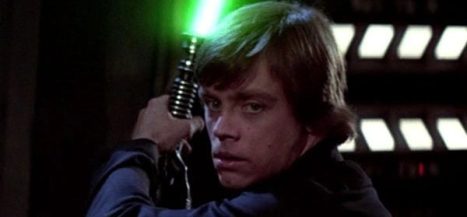
Look, everybody knows the basic arc of the Star Wars saga. Luke discovers that Darth Vader is his father, sets out to redeem him, manages to turn Vader away from the dark side before Vader dies. However, that’s never been quite how it works. The actual arc is a lot messier and more complicated, and a lot less conventionally heroic than it is remembered. Return of the Jedi never actually bothers to redeem Vader, instead focusing on redeeming Luke’s idea of Vader. At its core, Return of the Jedi is a story about how hard Luke wants to believe his father was a good man, in spite of all evidence to the contrary.

Along the way, Luke gambles the entire future of the Rebel Alliance and his sister’s fate on the assumption that there is goodness in Vader, while the film never actually bothers to demonstrate that there is any. It’s a fascinating incomplete arc, and one that hints at a gaping moral void at the heart of the larger Star Wars saga. It’s a story about how an individual’s redemption doesn’t matter, only other people’s idea of that redemption. In its own way, it marks Return of the Jedi as a quintessentially eighties movie; it is a story about how the most important thing to Luke is not the fate of the galaxy, but his own self-image.

You can read the piece here, or click the picture below.

New Escapist Column! “Watchmen” and the Limits of Textual Fidelity…

I published a new In the Frame piece at Escapist Magazine last Friday. With the release of Damon Lindelof’s Watchmen, it seemed appropriate to cast an eye back to Zack Snyder’s cinematic adaptation.

I have a huge amount of admiration for Snyder’s version of Watchmen, even if I don’t think it actually works. It is a Herculean effort to bring the story to the screen, one committed to directly transposing as much of the source material from page to screen, but often without really stopping to think about what the dialogue or imagery actually means. It is in many ways a demonstration of the limits of slavish devotion in adaptation. It is a counterpoint to the argument that all it takes to adapt a major work from one medium to another is literalism.

You can read the piece here, or click the picture below.