• Following Us

  • Categories

  • Check out the Archives


  • Awards & Nominations

Non-Review Review: The Aeronauts

At one point in The Aeronauts, reluctant partners Amelia Wren and James Glaisher open up to one another. High above the clouds, separated from the world below, Wren talks a little bit about her own departed husband and how she has struggled to come to terms with his absence. It isn’t a particularly in-depth conversation, coming about thirty minutes into a hundred-minute movie, so she stops rather abruptly. She is grateful for the tact and restraint of her conversational partner, the socially-awkward Glaisher. “Thank you,” she tells him. “Another would have pushed me further.”

This is more than just a small and inevitable moment of character development awkwardly signposted, a gesture that Wren and Glaisher are not as incompatible and oppositional as even they have come to believe. It is also a statement of purpose for Tom Harper’s The Aeronauts. It is a promise to the audience that The Aeronauts will never push its viewers or its characters in particularly uncomfortable or unconventional directions. Instead, it will offer a much gentler type of story that moves at its own pace and deals with various obstacles and developments well within its comfort zone.

On top of the world…

The Aeronauts is a clean, old-fashioned awards season drama. Two talented young actors are locked together in a confined space, playing characters who see the world in what initially appear to be two very different ways that gradually align over the course of the movie’s runtime. The costumes are spectacular. The music is triumphant. The special effects are impressive. There is tragedy, but it is overcome. There are complications, but they are handled. The Aeronauts is surprisingly conventional for a film that can be described as “the Victorian hot air balloon adventure starring Felicity Jones and Eddie Redmayne.

This isn’t a criticism. At least, not a particularly biting one. The Aeronauts understands it is pitching itself as broad crowd-pleasing entertainment, so never pushes too hard in any direction that might possibly jeopardise that. Anything that might possible put that at risk is hastily thrown overboard. This is at once the best and worst thing about The Aeronauts. “Your husband pushed too far,” Glaisher warns Wren at one point, both an example of the film’s complete aversion to subtext and an in-text justification for its careful moderation. The Aeronauts is aiming at “charming.” It lands squarely on target.

A triumph of scale.

Continue reading

New Podcast! The Time is Now – Season 2, Episode 6 (“The Curse of Frank Black”)

Because it’s Halloween, The Time is Now has a special treat. I was flattered to talk about The Curse of Frank Black with the one and only Tony Black. A perfect piece of Halloween viewing, it is one of my favourite episodes of Millennium, and so was a huge honour to be asked to sit in on this one.

I’ve gone on record about this before. The second season of Millennium is one of my favourite twenty-odd-episode seasons of television ever produced. It is hard to pick a single favourite from a season that features episodes like Jose Chung’s “Doomsday Defense”, Owls and Roosters, and The Fourth Horseman and The Time is Now. Nevertheless, The Curse of Frank Black is one of those episodes of television that has really stayed with me over the years. I have lost track of how many times I have watched it, and every time I still find something new. So this was a delight.

As ever, you can listen directly to the episode here, subscribe to the podcast here, or click the link below. I really hope you enjoy.

Continue reading

Non-Review Review: Doctor Sleep

Doctor Sleep finds itself caught between a rock and a hard place, between Stephen King and The Shining.

Of course, Stephen King wrote The Shining. The book belongs to King. It is a profoundly personal work, dealing with his own feelings of inadequacy as a young writer and father, and documenting his own struggles with addiction. Indeed, a large part of the tension between Stephen King and Stanley Kubrick over the cinematic adaptation of The Shining was the way in which it largely eschewed any interiority in its handling of Jack Torrance. In some ways, King has been awkwardly trying to reassert his authorship of The Shining for decades, through works like the television miniseries and the sequel Doctor Sleep.

It’s a hungry world…

Perhaps the most interesting aspect of Doctor Sleep is that it has found a director half way between the sensibilities of King and Kubrick. Flanagan is a very precise visual director, with an eye for compositions and an understanding of slow methodical build which makes him a good choice as a director to follow Kubrick’s work on The Shining. However, Flanagan is also a writer who is much more interested in the literary themes of King’s novel than Kubrick was, with Flanagan’s filmography dedicated to exploring the themes of trauma and addiction that wed King’s work on The Shining and Doctor Sleep.

The resulting film still occasionally feels caught between two masters, struggling to satisfy both King and Kubrick’s version of The Shining. It’s to Flanagan’s credit that the film strikes as effective a balance as it does, resulting in a film that manages to work both as a reasonably satisfying sequel to one of the best horror films ever made and as an engaging movie it its own right. Doctor Sleep has some minor problems, but succeeds make an impossible mandate look like child’s play.

Corridors of power…

Continue reading

Non-Review Review: Marriage Story

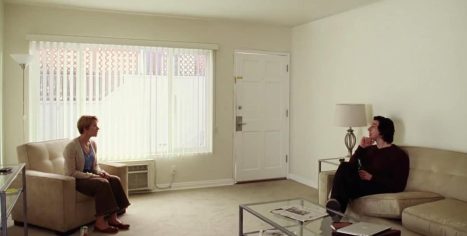
Towards the end of Marriage Story, divorced dad Charlie Barber decides to check in on his son, Henry.

Charlie has been absent from his son’s life for quite some time, the toll of familial separation weighing heavily on him. Arriving home before his ex-wife Nicole, he finds a strange man in his life. His former mother-in-law has accepted his replacement. When Nicole arrives, the conversation makes it clear just how quickly her life has moved on without him. When somebody mentions that she has been nominated for a prestigious award, Charlie can’t even guess what she was nominated for.

Marriage of inconvenience.

It is Halloween. The family are getting ready to go out together. They have theme costumes. They are going as Sergeant Pepper’s Lonely Hearts Club Band, which is itself a reflection of the level of subtlety at which the film is pitching itself. Of course, Charlie was an unexpected arrival; whether because he failed to signal ahead or simply because he has been so completely erased from the life of his ex-wife and son that nobody gave any serious consideration to the possibility that he might show up. Hastily, one character suggests an improvised costume. “You can be a ghost.”

This is simultaneously the best and worst moment in Marriage Story, and generally indicative of how the movie operates.

Getting off-track.

Continue reading

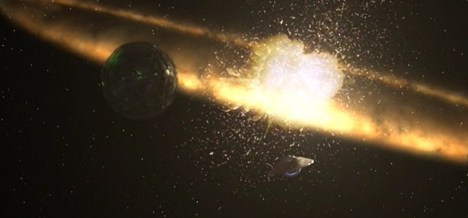
Star Trek: Voyager – Season 7 (Review)

The seventh season of Star Trek: Voyager is not the worst season of Star Trek ever. It isn’t even the worst season of this particular show.

It contains nothing as spectacularly ill-judged and tone-deaf as Alliances or Tattoo. None of its central characters are as insufferable as those presented in Parturition. There is nothing here quite as soul-crushingly boring as Twisted. Indeed, the seventh season of Voyager is a mostly competent season of television. Producer Brannon Braga had turned his attention to the launch of Star Trek: Enterprise, leaving the day-to-day running of the series to veteran Kenneth Biller. Biller approached that role as one of simple maintenance. He kept the trains running on time.
The result is that the seventh season of Voyager features no spectacular embarrassments. In its own way, this is an accomplishment for a Star Trek series. After all, final seasons tend to be filled with the kinds of episodes that reflect a production team desperately clutching for story ideas, leaving them open to mockery from a fandom with fixed ideas of what Star Trek should be. Final seasons tend to be home to misfires like Spock’s Brain, … And the Children Shall Lead, Interface, Dark PageForce of Nature, Journey’s End, Prodigal Daughter, The Emperor’s New Cloak.

The seventh season of Voyager largely avoids those sorts of embarrassments. Even episodes that threaten to tip over into high camp, like Drive or Repression, maintain an even keel. The seventh season of Voyager is much more consistent than the seventh seasons of Star Trek: The Next Generation or Star Trek: Deep Space Nine. There is a neatness to it, a stability. It feels like “business as usual” for the series in a way that those other final seasons did not. Episodes like Imperfection or Human Error could easily have come from any of the three prior seasons.
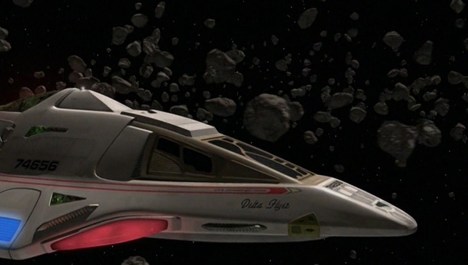
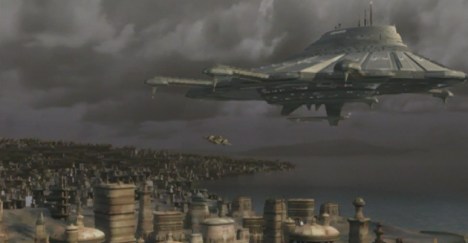
Of course, this is a double-edged compliment. As much as the seventh season of Voyager is more stable and more consistent than other final seasons, it is also much more modest. The final season of The Next Generation was incredibly inconsistent, but it was still playful and ambitious, resulting in gonzo delights like Masks or Parallels. The final season of Deep Space Nine might have sagged in the middle, but it still pushed the boundaries franchise, engaging in biting criticisms in Chimera and attempting to wrap up with a sprawling ten-part series finale.

The seventh season of Voyager is not the worst season of Star Trek ever. it is, however, one of the dullest.
Continue reading

Star Trek: Voyager – Endgame (Review)

Appropriately enough, Star Trek: Voyager ends with a betrayal of itself.

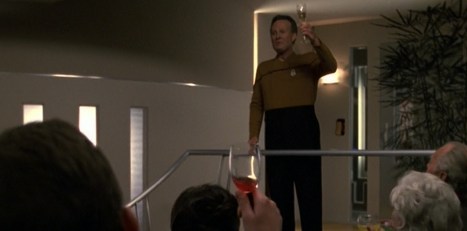
Endgame even frames that betrayal in terms of its own internal logic. The first scene after the teaser finds what remains of the crew attending a tenth anniversary reunion following the successful completion of their mission and their return to Earth. Reginald Barclay, “adopted” member of the family and veteran of Star Trek: The Next Generation, offers a toast. “Twenty three years together made you a family, one I’m proud to have been adopted by. Let’s raise our glasses to the journey.” The room toasts, “To the journey.”

Toast of the town…

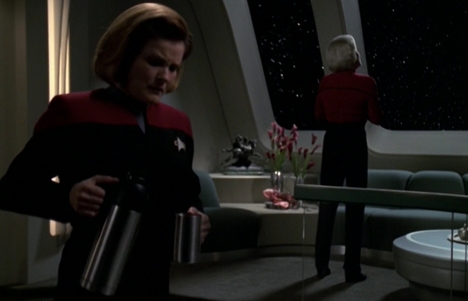
This is first point of betrayal. Her glass raised, Admiral Janeway suggests a modification of the toast. “And to those who aren’t here to celebrate it with us.” It is a fair toast given how many crew members Janeway had lost over the course of the journey. However, it also suggests the central thesis of Endgame, which is itself the central thesis of Voyager. It was never really about the journey, despite what any of the crew might say at any given point in the show’s run. It was never about the time spent together, or the family forged. It was never even about the people.

It was about getting home. It was about completing the journey. It was about reaching the end point at the designated time. The journey, the adventure, the exploration; these were never the focus. All that potential, all that possibility, was squandered. Endgame is the story of how Admiral Janeway erases sixteen years of exploration, sixteen years of growth, sixteen years of character development. Admiral Janeway does that so that Voyager can complete its journey after the designated seven years, the expected one-hundred-and-seventy-eight episodes.

Living with herself…

Continue reading

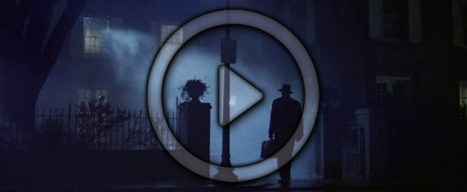
153. The Exorcist – Halloween 2019 (#–)

Hosted by Andrew Quinn and Darren Mooney, and this week with Doctor Bernice Murphy, The 250 is a (mostly) weekly trip through some of the best (and worst) movies ever made, as voted for by Internet Movie Database Users.

This time, a Halloween treat. William Friedkin’s The Exorcist.

At time of recording, it was not ranked the list of the best movies of all time on the Internet Movie Database.

Continue reading

Non-Review Review: Countdown

Countdown is a spectacular mess of a film, but also a surprisingly fun one.

Superficially, Countdown belongs to the modern school of low-budget high-concept horrors. It is build around an admittedly rather goofy premise, devotes considerable time to exploring and articulating its own internal logic, and is just flippant enough that it never entirely collapses under its weight. In terms of basic structures, Countdown is of a piece with films like Happy Death Day or Scary Stories to Tell in the Dark. It is preoccupied with the protagonists’ desire to figure out the rules of the macabre trap in which they have found themselves.

A killer app.

However, Countdown is so committed to that template that something interesting happens. Countdown never quite settles on a particular mode or genre, instead relying on the propulsive momentum of that central quest to hold the film together. So Countdown transitions wildly between various styles of horror films. It features a monster who looks like it just missed out on lead roles in The Curse of La Llorona or The Nun, leans into the fear of technology and identity that defined Cam or Unfriended, and even takes a late turn into the sort of gender-war tinged serial killer mayhem of a Halloween sequel.

None of these elements cohere. At all. However, there’s an infectious sense of fun to Countdown. It rarely feels like Countdown is motivated by anything more than the urge to get to the next scene or the next scare, which results in a very haphazard and uneven film, but also a delightfully surreal cocktail. Countdown might be pretty far from a good horror movie, but it’s an endearingly engaging one.

Nursing some legitimate fears.

Continue reading

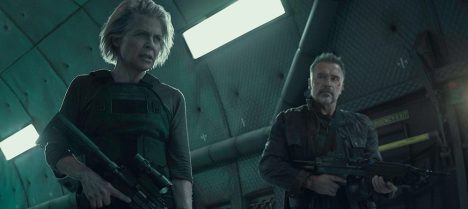
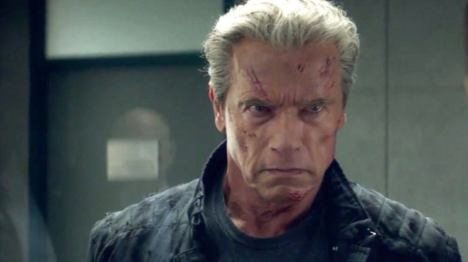
Non-Review Review: Terminator – Dark Fate

Terminator: Dark Fate is perhaps the second-best of the four attempts to make a third Terminator movie.

To be fair, the previous three efforts have all been exercises in figuring out how close or how far to hew to Terminator 2: Judgment Day. There has been a sense of watching various chefs trying awkwardly to replicate a signature dish. Does a Terminator sequel need Sarah Connor? Does Sarah Connor have to be played by Linda Hamilton? Is Arnold Schwarzenegger essential, and to what degree? James Cameron isn’t going to direct because he has his own projects, but what level of involvement is “just right”? Is it enough for him to do some press, to be a producer, or does he need a story credit?

Fight and flight.

The results have been as interesting as they have been frustrating. Few film franchises has branched quite as dramatically as the Terminator franchise, perhaps reflecting the series’ own preoccupation with time travel. Terminator 3: Rise of the Machines, Terminator: Salvation and Terminator: Genisys have all tried to figure out a way to make a sequel to Judgment Day, and have only really managed to agree that each of the others adopted the wrong approach. Dark Fate at least seems like the right Terminator sequel for its own time and place, tapping into a wave of nineties anxiety and franchise dominance.

Dark Fate is only moderately successful as a film in its own right, and as a follow on to one of the most beloved blockbusters of all-time. It says much more about the larger Terminator franchise than about Dark Fate that it counts as one of the best sequels to Judgment Day.

Hes back.

Continue reading

New Escapist Column! “Undone”, “Back to the Future” and Keeping Time Travel In the Family…

I published a new In the Frame piece at Escapist Magazine on Friday. This one takes a look at Amazon Prime’s really very wonderful Undone. Seriously, if you haven’t had a chance to check it out, give it a look right now. It’s only four hours long in total, and it’s one of the most beautiful things I’ve seen this year.

Anyway, the series is interesting in its use of its central time travel premise as a metaphor for exploring the relationship between parent and child. Freudian psychology and Campbellian storytelling argues that a parent must die for a child to become a completely independent person, that realisation of mortality standing as the most important marker on the journey to adulthood. However, like Back to the Future before it, Undone suggests a more nuanced idea. Maybe children don’t grow up when confront with the death of a parent, but instead when they realise that their parents were just ordinary human beings.

You can read the piece here, or click the picture below.