• Following Us

  • Categories

  • Check out the Archives


  • Awards & Nominations

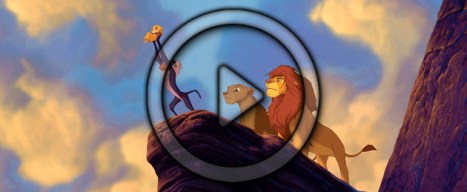
139. The Lion King (#45)

Hosted by Andrew Quinn and Darren Mooney, and this week with special guests Phil Bagnall and Graham Day, The 250 is a (mostly) weekly trip through some of the best (and worst) movies ever made, as voted for by Internet Movie Database Users. New episodes are released every Saturday at 6pm GMT.

This time, Rob Minkoff and Roger Allers’ The Lion King.

The Pridelands have enjoyed a period of sustained peace under the stewardship of the proud king Mustafa. However, Mustafa’s young son Simba finds himself embarking upon a journey of self-discovery and adventure as he learns just how fragile happiness can be and just how heavy responsibilities can weigh upon a king.

At time of recording, it was ranked 45th on the Internet Movie Database‘s list of the best movies of all-time.

Continue reading

Star Trek: Voyager – Q2 (Review)

Q2 is an episode very much in keeping with the ethos of Star Trek: Voyager, particularly at this point in its run.

It isn’t just the strange nostalgia that permeates the episode, opening with an extended oral presentation from Icheb on the heroic exploits of James Tiberius Kirk from the original Star Trek and extending through to the unnecessary return of a beloved recurring guest character from Star Trek: The Next Generation. Nor is it the awkwardness with which Q2 affects a half-hearted compromise in its final act, with the series paying lip service to the fact that its omnipotent (and mostly friendly) guest star could get the crew home with a click of his fingers, while refusing to do that because it would break the series.

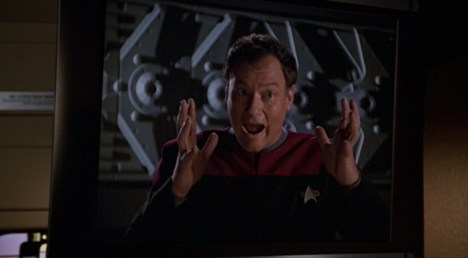
“Q2 ratings are way up!”

The essential Voyager-ness at the heart of Q2 is much more profound than all of that. It has to do with how the series treats is returning guest star. Q has been a part of the Star Trek universe dating back to Encounter at Farpoint. John de Lancie has been a recurring guest star on the franchise for thirteen-and-a-half years. Although de Lancie has aged relatively well, and although suspension of belief easily allows for it, even Q himself seems much older between his first and last appearances in the television franchise.

However, Q2 takes a character who was introduced as an immortal and all-powerful trickster god in The Next Generation, and transform him into a stressed middle-aged parent by the end of Voyager. This is a very Voyager approach to characterisation and development. It is how the series has approach many of its characters. In Caretaker, Chakotay was a rebel, Paris as a rogue, and Neelix was a free-wheeling trader; within the show’s first season, all of those rough edges have been filed off. The decision to do that with a character who is effectively a trickster god speaks a lot to the central philosophy of Voyager.

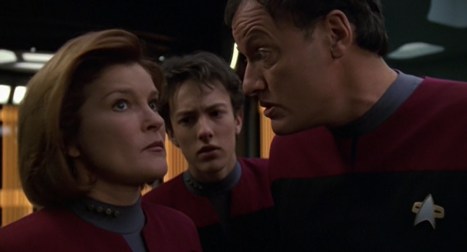
Not kidding around.

Continue reading

116. Green Book – This Just In (#170)

Hosted by Andrew Quinn and Darren Mooney, This Just In is a subset of The 250 podcast, looking at notable new arrivals on the list of the 250 best movies of all-time, as voted for by Internet Movie Database Users.

This time, Peter Farrelly’s Green Book.

At time of recording, it was ranked 170th on the list of the best movies of all time on the Internet Movie Database.

Continue reading

115. Roma – This Just In (#–)

Hosted by Andrew Quinn and Darren Mooney, and with special guests Aine O’Connor, This Just In is a subset of The 250 podcast, looking at notable new arrivals on the list of the 250 best movies of all-time, as voted for by Internet Movie Database Users.

This time, Alfonso Cuarón’s Roma.

At time of recording, it was not ranked on the list of the best movies of all time on the Internet Movie Database.

Continue reading

My 12 for ’18: “You Were Never Really Here” & What You Never Really Saw

It’s that time of year. I’ll counting down my top twelve films of the year daily on the blog between now and New Year. I’ll also be discussing my top ten on the Scannain podcast. This is number eight.

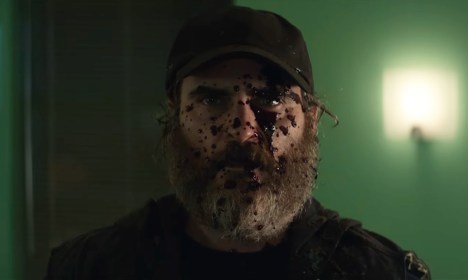
The premise of You Were Never Really Here suggests a certain type of film.

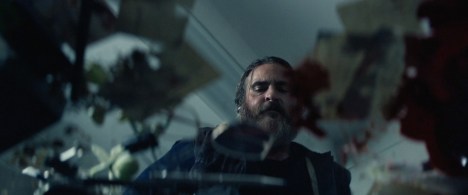
Joaquin Phoenix stars as Joe. The audience learns very little about Joe explicitly through exposition of dialogue, his back story and motivations suggested by quick cut flashbacks. As with a lot of You Were Never Really Here, director Lynne Ramsay understands something that may seem counter-intuitive to cinema, the notion that what is unseen might be as important as what is explicitly shown. Joe hunts down paedophiles and rescues children from their clutches.

That description suggests a thriller or an action movie, rooted in visceral and tangible violence. It might work as a direct-to-video exploitation film starring some actor with which mainstream audiences have no familiarity. It might also play well as a Liam Neeson release in early January, something akin to an even grittier Taken. At the more extreme end of the scale, it could play like a cousin to Joel Schumacher’s weird and overlooked 8mm.

What is so refreshing about You Were Never Really Here is that it doesn’t play like any of those, and is instead very much its own thing.

Continue reading

106. Fifty Shades of Grey (#-91)

Hosted by Andrew Quinn and Darren Mooney, and this week with Marianne Cassidy and Grace Duffy, The Bottom 100 is a subset of the fortnightly The 250 podcast, a trip through some of the worst movies ever made, as voted for by Internet Movie Database Users.

This time, Sam Taylor Johnson’s Fifty Shades of Grey.

Continue reading

84. Touch of Evil (#241)

Hosted by Andrew Quinn and Darren Mooney and this week with special guests Charlene Lydon and Grace Duffy, The 250 is a (mostly) weekly trip through some of the best (and worst) movies ever made, as voted for by Internet Movie Database Users. New episodes are released Saturday at 6pm GMT.

This time, Orson Welles’ Touch of Evil.

A murder in a small border town stokes local tensions, as Ramon Miguel Vargas finds himself drawn into an investigation overseen by Police Captain Hank Quinlan. As Quinlan pursues his lines of inquiry, Vargas quickly comes to realise that his would-be partner is not what he appears to be.

At time of recording, it was ranked the 241st best movie of all time on the Internet Movie Database.

Continue reading

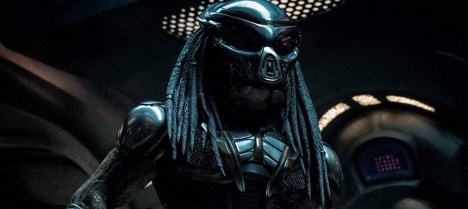
To Catch a Predator: Why Is It So Hard to Franchise the Predator?

The Predator is one of the most iconic creations of the past thirty-odd years.

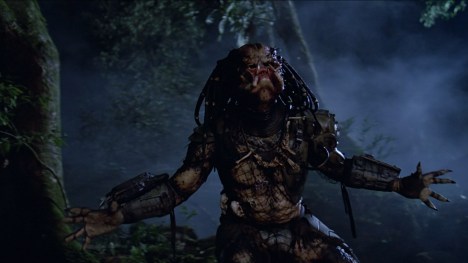
The creature created by Stan Winston for John McTiernan’s 1987 action blockbuster is instantly recognisable. It is striking and distinctive. Even people who have never sat down and watched a movie featuring the creature are familiar with the design. This is especially notable given that it could have been a disaster. The original design for the creature is something of an internet urban legend, part of the pop cultural folklore. Predator narrowly averted disaster when Stan Winston redesigned the monster from scratch, so it is all the more impressive that it became such a classic.

It is no surprise that the Predator was quickly franchised. After all, that is how the film industry works. Although modern prognosticators decry the modern era as one defined by sequels and remakes and reboots, but they have always been a feature of the landscape. So the Predator became the cornerstone of an impressive multimedia franchise; even outside of games and comic books, the creature anchored Predator 2, Alien vs. Predator, Aliens vs. Predator: Requiem, Predators and The Predator. That’s an impressive list, in terms of quantity and variety.

However, it is decidedly less impressive in terms of quality. Of those five sequels, Predators is the only one with a positive score on Rotten Tomatoes. Similarly, Predators is the only sequel with a vaguely positive rating on MetaCritic, scraping just over fifty percent. This is the kind of showing that audiences and critics expect from low-rent horror sequels like those starring Freddie Kreuger or Jason Voorhees. (Indeed, the latest sequel starring Michael Myers is critically outpacing The Predator.) It is not exactly an impressive track record for a reasonably big budget mainstream high-profile science-fiction franchise.

Indeed, the stock comparison for the Predator is the Alien franchise, and for good reason. The xenomorph from Alien is another iconic late twentieth-century alien design housed within an R-rated science-fiction action-horror franchise. Both properties are owned by Twentieth Century Fox, allowing them to intersect and crossover within a shared universe. Both have spawned a variety of sequels, and are loosely linked in the popular mind in the way that the Universal Studios films linked Dracula and Frankenstein’s monster with the Mummy or the Invisible Man.

However, this stock comparison does not flatter the Predator. After all, the xenomorph has been at the centre of a franchise that is consistently interesting and at best innovative. There are sequels to Alien that are rightly regarded as classics such as Aliens, while other have launched great careers such as Alien³, and some still cause fierce debates. For all the criticism of films like Prometheus and Alien: Covenant, they at least engender passion in their audiences, in a way that the sequels to Predator do not. Why is it so hard to make a good Predator sequel?

Continue reading

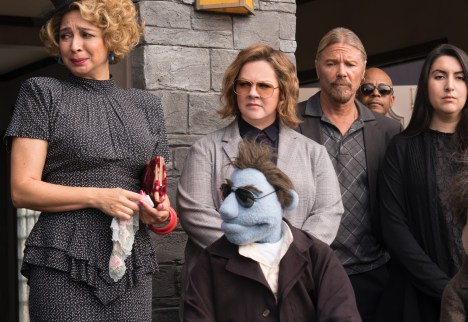
Non-Review Review: The Happytime Murders

The Happytime Murders may be the worst film of the year.

There are any number of issues with The Happytime Murders. The film is only ninety one minutes long, but feels interminable. The film has no idea what it is about in any meaningful sense, beyond assembling a number of familiar tropes in a very familiar way. Beyond that, the film seems to believe that rehashing familiar clichés is amusing of itself, some sort of self-aware postmodern ironic anti-comedy where the reference to the thing is enough of itself to become a joke.

It really blows.

A larger problem is that the film assumes that seeing puppets do “adult” things has greater novelty than it does. The Happytime Murders is a film that is consciously powered by the juvenile thrill of watching beloved children’s characters caught in inappropriate situations – swearing at one another, smoking cigarettes, engaging in vigorous sexual activity. This glosses over the fact that there are plenty of other media that has already covered this ground. The Happytime Murders runs on a joke that has already been repeated and rehashed several times.

However, all of these concerns distract from the biggest issue with The Happytime Murders. It is just not funny.

The boy in blue.

Continue reading

Non-Review Review: BlacKkKlansman

BlacKkKlansman is an American tragicomedy.

The past few years have seen a heightening of reality, a blurring of the boundaries between fact and fiction, an intrusion of the unreal into the real world. The President of the United States is effectively a reality television star, and is running the country as some sort of grotesque reality television show. “Truth is not truth”, to quote one administration figure, while another has peddled in the idea of “alternative facts” while alluding to a horrific terrorist attack that simply never happened while other supporters of the administration insist that other horrific events did not happen.

The two Ronnies.

With all of that going on in the background, soaking into the zeitgeist, BlacKkKlansman feels very much like a movie for the moment. It is – to quote the introductory text – “based on some fo’ real, fo’ real sh*t”, taking its inspiration from a memoir written by undercover police officer Ron Stallworth. However, it is also filtered through the hyperstylised cartoonish lens of a blackploitation buddy comedy, with Lee taking every opportunity to remind his audience that they are watching a piece of pop culture.

The premise of the film is so absurd that it’s almost impossible to play it as anything but comedy. The first black police officer in Colorado Springs launches an undercover sting on the KKK, using his own name to infiltrate the organisation through the telephone. Working with a fellow white police officer, this ambitious young go-getter manages to manoeuvre his way to the top of the organisation, fooling even the Grand Wizard himself. It’s a ridiculous story, one that seems inherently unreal. Even the name – “Stallworth” – sounds like something from a dimestore paperback.

Hitting all its marks.

Of course, in this era of unreality, it is entirely real. Indeed, the power of BlacKkKlansman comes crashing down on the audience in the final moments, when Lee brushes aside the heavy-handed references to contemporary politics that play through the narrative for something that is much more tangible and real, serving to throw the entire grim joke of the film into stark relief, suggesting that so much of the awkward squirming and ridiculous twists are all the foundation of the horror show through the audience are living.

BlacKkKlansman laughs in the face of horror and brutality. But only because the alternative is to cry.
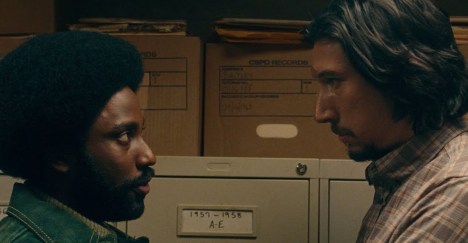
The historical record.

Continue reading