• Following Us

  • Categories

  • Check out the Archives


  • Awards & Nominations

The X-Files – 2Shy (Review)

This November (and a little of December), we’re taking a trip back in time to review the third season of The X-Files and the first (and only) season of Space: Above and Beyond.

A lot of the success of the third season of The X-Files came for learning what had worked earlier, and trying to hone that.

So, for example, the epic mythology of Colony and End Game enabled episodes like Nisei and 731 along with Piper Maru and Apocrypha. Shows like Die Hand Die Verletzt and Humbug had proven that the show could do comedy, so it wasn’t as big a risk to commit to stories like Clyde Bruckman’s Final Repose or Jose Chung’s “From Outer Space.” Even episodes like Fresh Bones had helped to define what a standard “monster of the week” should look like.
Freak like me...

Freak like me…

This approach to the third season had its drawbacks. It seemed like the first chunk of the first season was stuffed with supernatural revenge stories, to the point where it is surprisingly easy to confuse The List and The Walk on the basis of title and theme alone. However, it was a very effective way of producing television. It is very hard to fault any approach towards television production that could turn “fat-sucking vampire” into a premise that works.

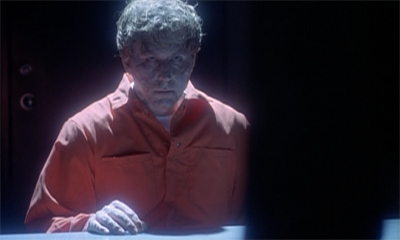
The genealogy of 2Shy is quite easy to trace. It is the obvious synthesis of Tooms and Irresistible, two of the more memorable and effective monster stories of the first two seasons. 2Shy may have some very serious problems, but it does what it says on the tin.
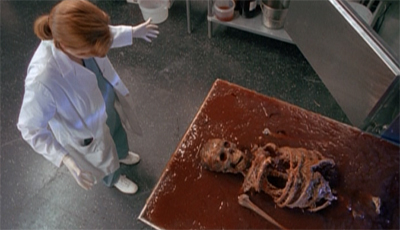
Fresh bones...

Fresh bones…

Continue reading

Star Trek: Voyager – Jetrel (Review)

This September and October, we’re taking a look at the jam-packed 1994 to 1995 season of Star Trek, including Star Trek: Deep Space Nine and Star Trek: Voyager. Check back daily for the latest review.

Jetrel is an interesting episode for a number of reasons. It’s another example of how the first season of Star Trek: Voyager seems anchored in the aftermath of the Second World War. The episode exists primarily as a meditation on guilt over the use of atomic weapon, with the Metreon Cascade attack on Rinax standing in for the dropping of the atomic bomb on Hiroshima and Negaska in 1945. Jetrel aired three months shy of the fiftieth anniversary of the bombing, and amid a national period of reflection about the morality of Harry S. Truman’s actions.

Whatever the context of Jetrel in 1995, it serves as another example of how Voyager seems like a relic from a bygone age, a snapshot of atomic age science-fiction. Cathexis was the show doing Invasion of the Body Snatchers. Faces was an old-fashioned monster movie. Jetrel wasn’t even the first time that the first season had traded in atomic imagery. The aftermath of the polaric detonation in Time and Again was very clearly designed to evoke the aftermath of an atomic blast.

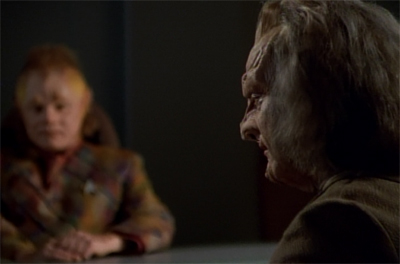
The devil in the pale moonlight...

The devil in the pale moonlight…

Even without all this baggage, Jetrel still feels like a mess of an episode. The heart of the story finds a member of the ensemble confronting a former war criminal while dealing with issues of war guilt and responsibility – a structure that evokes Duet the penultimate episode of the first season of Star Trek: Deep Space Nine. While that episode worked brilliantly, there’s a sense that Jetrel is burdened a little bit trying to offer a two-hander about guilt while tackling the issue of the atomic bomb.

The problem is compounded by a somewhat messy final act that eschews all the episode’s heavy character-based drama in favour of a contrived techno-babble climax that involves a lot of characters spouting nonsense while playing with light-emitting diodes. Jetrel begins as the strongest and boldest episode of the show’s first season, but ends as one of the prime examples of Voyager‘s preference for techno-babble over character work.

Burn with me...

Burn with me…

Continue reading

Star Trek: Deep Space Nine – Destiny (Review)

This September and October, we’re taking a look at the jam-packed 1994 to 1995 season of Star Trek, including Star Trek: Deep Space Nine and Star Trek: Voyager. Check back daily for the latest review.

The biggest problem with Destiny is that it doesn’t feel fully-formed. The show plays more like a series of vignettes than a single story. There are some nice character beats, and a sense that Star Trek: Deep Space Nine is an ensemble show, but Destiny meanders far too much. It seems like it wanders around without any singular purpose, any strong central point to tether it.

Is it about Sisko’s relation to the title of “Emissary”? Is about peace between Bajor and Cardassia? Is it about O’Brien and flirty Cardassians? Is it about Kira’s faith and her position on Deep Space Nine? Is it about end time prophecies?

It seems to be about all these things, but with no real commitment to any of them above the others. The end result is that it’s not about any of them particularly well.

Picture perfect...

Picture perfect…

Continue reading

Non-Review Review: A Walk Among the Tombstones

A Walk Among the Tombstones is an oddly nostalgic serial killer film.

The movie is an adaptation of Lawrence Block’s novel of the same name. Block originally published A Walk Among the Tombstones in 1992, around the time that pop culture’s fascination with serial killers was building to a crescendo. Thomas Harris had released Red Dragon and The Silence of the Lambs to universal acclaim. Jonathan Demme’s film adaptation of The Silence of the Lambs had managed to sweep the Oscars, despite the handicap of a February 1991 release.

Dead letters...

Dead letters…

Scott Frank’s feature film adaptation moves the action forward to 1999, towards the tail end of pop culture’s interest in serial killers. Morgan Freeman’s career in serial killer films offers perhaps the best illustration of the state of the genre. By this point, Freeman had already moved on from 1995’s stylish se7en towards 1997’s efficient Kiss the Girls and was on the cusp of 2001’s unnecessary Along Came a Spider. The serial killer’s stock was falling, and the serial killer would soon be replaced by another bogeyman.

This shift in the story’s setting makes it feel like A Walk Among the Tombstones is a funeral ode towards the serial killer.

Lives are on the line...

Lives are on the line…

Continue reading

Star Trek: Deep Space Nine – The Abandoned (Review)

The September and October, we’re taking a look at the jam-packed 1994 to 1995 season of Star Trek, including Star Trek: Deep Space Nine and Star Trek: Voyager. Check back daily for the latest review.

The Abandoned is a problematic episode.

It’s brave and provocative and challenging, but it’s also incredibly grim and cynical. In fact, it is probably the most relentlessly pessimistic episode of Star Trek: Deep Space Nine‘s third season. And, given the episodes surround it, that is quite an accomplishment. Deep Space Nine has subverted classic Star Trek storytelling before. The Maquis was really a watershed moment for the series, suggesting that paradise itself might be unsustainable – attacking Roddenberry’s utopia rather brutally.

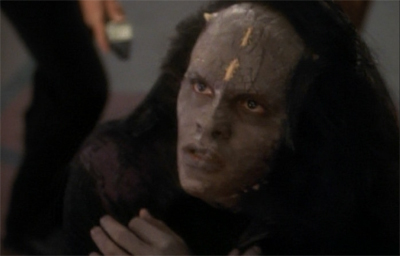
However, The Abandoned pushes things even further. There’s a social and racial subtext to this episode that grounds it in the racial politics of Los Angeles in the mid-nineties. The story of a young angry drug-addicted killer can’t help but feel associated with the increased profile of Los Angeles’ gangland in the early-to-mid-nineties. Casting the episode’s young Jem’Hadar soldier using African American actors invites this comparison, something that director Avery Brooks himself has conceded.

The racial politics of The Abandoned are decidedly uncomfortable, but they are clearly meant to be. Still, there’s something rather cynical and pessimistic about the episode’s conclusion that this young boy cannot be saved from a life of brutality and violence.

A Jem?

A Jem?

Continue reading

The X-Files – Fearful Symmetry (Review)

This August (and a little of September), we’re taking a trip back in time to review the second season of The X-Files. In November, we’ll be looking at the third season. And maybe more.

Fearful Symmetry is an embarrassing mess of an episode. It’s ambitious, but it’s clumsy and over-wrought. It aspires to great things, but is instead completely banal. For a show featuring an invisible elephant, that’s no small accomplishment.

Tyger, Tyger...

Tyger, Tyger…

Continue reading

Todd McFarlane’s Run on Spider-Man (Review/Retrospective)

This April, to celebrate the release of The Amazing Spider-Man 2, we are taking a look at some classic and modern comics featuring Spider-Man (and friends). Check back daily for the latest review.

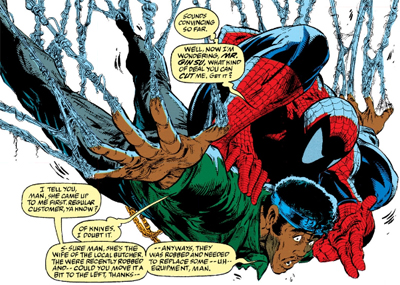
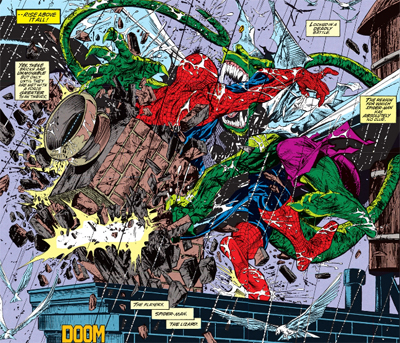
Todd McFarlane is undoubtedly one of the best artists ever to work on Spider-Man. His take on the character is iconic and influential. He really captures the sense of Spider-Man as a character who should be unnerving or disturbing – a character who is part insect, whose limbs are able to bend and contort in ways that would seem unnatural to a casual observer. His run on The Amazing Spider-Man with writer David Michelinie is one of the most underrated Spider-Man comics ever produced.

McFarlane was working at Marvel around the time that the company was investing more power in its artists. More and more, artists were becoming more essential to the creative process – whether credited as “plotters” or “writers.” Jim Lee was wresting control of the X-Men franchise from veteran writer Chris Claremont. Rob Liefeld was writing and drawing on his popular X-Force, launched from New Mutants.

Holding it together...

Holding it together…

In this context, it made sense to allow Todd McFarlane to branch out and write his own Spider-Man title. Launched to run alongside The Amazing Spider-Man, McFarlane’s adjectiveless Spider-Man remains one of the comic book success stories of the nineties, selling 2.5 million copied on initial release. It remains one of the best selling comic books of all time, with the original artwork recently selling for over $675,000.

As with many of its contemporary artist-drive series, McFarlane’s Spider-Man is a compelling read. It’s a glimpse inside the mindset of the comic book industry, a snapshot of trends that were still developing. McFarlane’s writing might be a little over-cooked, his plotting a little weak and he may not have the strongest sense of theme or structure. However, McFarlane’s artwork is absolutely spectacular, and there’s something very fascinating about McFarlane’s attempt to write Spider-Man as a horror comic starring the iconic web-slinger.

A sting in the tale...

A sting in the tale…

Continue reading

Star Trek: The Next Generation – The Offspring (Review)

This January and February, we’ll be finishing up our look at the second season of Star Trek: The Next Generation and moving on to the third year of the show, both recently and lovingly remastered for high definition. Check back daily for the latest review.

The Offspring is an absolutely wonderful piece of Star Trek. In many ways, it is a spiritual successor to The Measure of a Man, the breakout show of the second season. (This similarity was one of the factors that led writer and script editor Melinda Snodgrass to harshly dismiss it as “fairly obvious and tired and stupid” in Captains’ Logs: The Unauthorized Complete Trek Voyages.) Sitting between two of the more epic and sweeping stories in the third season, The Offspring is a touching little story about parenting and childhood, and a nice character episode for Data.

It remains one of the most touching episodes of Star Trek: The Next Generation ever produced, and a fitting debut for both future staff writer René Echevarria and soon-to-be-prolific Star Trek director Jonathan Frakes.

Building a loving family...

Building a loving family…

Continue reading

Star Trek (DC Comics, 1989) #19 – Once a Hero… (Review)

This January and February, we’ll be finishing up our look at the second season of Star Trek: The Next Generation and moving on to the third year of the show, both recently and lovingly remastered for high definition. Check back daily for the latest review.

We’ll be supplementing our coverage of the episodes with some additional materials – mainly novels and comics and films. This is one such entry.

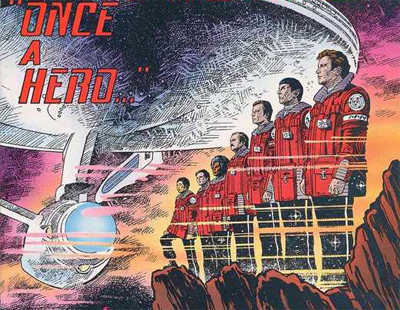
Once a Hero… is a notable story for a number of reasons. The most obvious is that it’s Peter David’s last issue of DC’s monthly Star Trek comic, departing the comic book after a pretty bitter disagreement with Richard Arnold, who was overseeing Star Trek licensing at the time. Given that David wrote The Incredible Hulk for twelve years and remains a prolific and well-liked comic book creator among the comic community, as well as a guiding light in Star Trek tie-in fiction, that’s a pretty damning indictment of Richard Arnold right there.

However, Once a Hero… is also notable for being an in-depth exploration and reflection on the “red shirt” narrative convention that the franchise loved so dearly.

A grave adventure...

A grave adventure…

Continue reading

Non-Review Review: Drop Zone

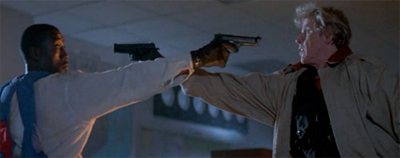
I’m going to level with you up front. I was born in the late eighties, so – in ways – I’m a child of the nineties. I grew up with cheesy action movies, and I have a certain fondness for that sort of outrageously cheesy nineties action thrillers. Hell, I’ll confess to being a huge fan of Demolition Man, for cryin’ out loud. So, in the interest of full and frank disclosure, you should know that I probably have some form of bias in favour of Drop Zone before you read this review. Don’t get me wrong, I don’t think it’s a great film – I’d struggle to even describe it as “good”– but, if you know what you’re going in for, it can at least be entertaining.

Oh, chute!

Continue reading