• Following Us

  • Categories

  • Check out the Archives


  • Awards & Nominations

Doctor Who: Robot of Sherwood (Review)

Shortly, I shall be the most powerful man in the realm. King in all but name, for Nottingham is not enough.

It isn’t?

After this, Derby.

Right.

Then Lincoln. And after Lincoln…

Worksop?

The world!

– the Sheriff outlines his plot to Clara

Robot of Sherwood is a functional piece of television, with a wonderful closing scene capping a very light forty-five minutes. Mark Gatiss is a writer who tends to trade on nostalgia, and who clearly holds a great deal of affection for the past. As such, Robot of Sherwood provides a fairly effective and straightforward counterpoint to the heavy moral questions of Deep Breath and Into the Dalek. Is the Doctor a hero? It doesn’t matter, because his story is that of a hero.

There is a sense that perhaps Gatiss is being a little bit too glib here, to the point where Robot of Sherwood almost plays defensively – a justification of the writer’s tendency to rose-tinted nostalgia and a rejection of critical approaches towards history or story. Nevertheless, Robot of Sherwood does pretty much what it sets out to do. It provides Peter Capaldi with a suitably light script and a chance to flex his comedic muscles, while providing a suitably fairy-tale-ish pseudo-historical.

Legendary outlaw...

Legendary outlaw…

This season is introducing a new lead actor, a risky proposition for any show. As a result, the first half of the season tends to play it rather safe. Robot of Sherwood is the only episode in the first half of the season not to credit Steven Moffat as writer or co-writer; however, it is still written by an established Doctor Who veteran. After all, Mark Gatiss wrote The Unquiet Dead, the first episode of the relaunched series not written by Russell T. Davies. He also wrote Victory of the Daleks, the first story of the Moffat era not written by Moffat himself.

Indeed, the season returns to the classic “home”/“future”/“historical” opening triptych structure that defined the Davies era; it is the first time that this structure has been seen since Matt Smith’s opening season. (For Davies, “home” was twenty-first century London; for Moffat, it is the Paternoster Gang.) Robot of Sherwood is the show’s first proper “celebrity historical” since Vincent and the Doctor in that same opening season. “Safe” is very much the name of the game for this stretch of the season. Robot of Sherwood is very safe.

"You'll ruin the paint work!"

“You’ll ruin the paint work!”

Continue reading

Star Trek III: The Search for Spock by Vonda N. McIntyre (Review)

This June, we’re taking a look at some classic Star Trek movie tie-ins. Check back daily for the latest reviews and retrospectives.

Star Trek II: The Wrath of Khan, Star Trek III: The Search for Spock and Star Trek IV: The Voyage Home form a loose trilogy following the death and resurrection of the franchise’s most iconic character. The events of each leads into the next, and there’s a very clear pattern of cause and effect that brings you from Saavik’s Kobayashi Maru test through to Kirk’s assignment to the Enterprise-A. The start of each of the three films picks up from the end of the last one. It brings the characters involved on a full arc.

However, despite this, there is a bit of a disconnect between the feature films – perhaps inevitable for three movies conceived separately one-after-another. The Wrath of Khan is a story about how Kirk is perhaps broken, too old and too reckless to keep doing the stuff that he does; The Search for Spock shrugs that off by having Kirk joyride on the Enterprise. The Wrath of Khan introduces a next generation of characters in the form of Kirk’s son David Marcus and Spock’s protégé Saavik; The Search for Spock kills David and The Voyage Home dismisses Saavik.

While The Search for Spock might begin with the Enterprise limping back to Earth following the confrontation with Khan, it seems to gloss over every part of The Wrath of Khan that isn’t directly related to the death of Spock. Genesis is carried over as Spock’s final resting place, but Khan isn’t mentioned, nor is the Reliant; Carol Marcus doesn’t appear; the deaths of the cadets on the cruise and the staff of Regula I are somewhat glossed over.

The most interesting aspect of Vonda McIntyre’s adaptation of The Search for Spock is the way that it makes a point to carry over elements from The Wrath of Khan into the story. Indeed, McIntyre is almost a third of the way into the book before reaching the actual plot. The result is an interesting novel that feels more like a sequel to The Wrath of Khan than a direct rebuttal, as the film had been.

startrekiii Continue reading

Brian Michael Bendis’ Avengers – Disassembled (Review/Retrospective)

April (and a little bit of May) are “Avengers month” at the m0vie blog. In anticipation of Joss Whedon’s superhero epic, we’ll have a variety of articles and reviews published looking at various aspects of “Earth’s Mightiest Heroes.” Today and tomorrow we’ll be taking a look at the two Brian Michael Bendis events that kick-started the writer’s work on the franchise.

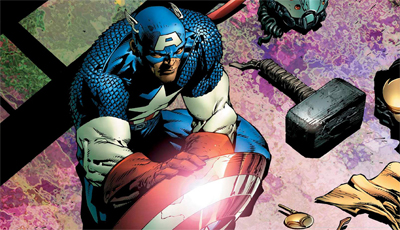
Avengers: Disassembled welcomed Brian Michael Bendis to the Avengers franchise. The super-star writer had enjoyed long and well-received runs on Ultimate Spider-Man and Daredevil, but his tenure on the Avengers franchise proved much more divisive. Taking over for a three issue arc on the main Avengers title, Bendis literally destroyed the team. Not only did he demolish a lot of the iconography associated with the bunch of superheroes, he also launched a fairly scathing deconstruction of the stalwart superhero team. Bendis wasn’t just going to adopt a caretaker position on the series, he clearly planned some very serious remodelling. That meant that some walls had to get knocked down. In many ways, Disassembled feels like a brutal demolition.

Things come apart…

Continue reading

Non-Review Review: Cabin in the Woods

Part of me wonders when it’s appropriate to start ranking the year’s films. I say that, because I’ve just had the pleasure of catching The Cabin in the Woods, which is easily one of the best films of the year so far, and the best horror movie I’ve seen in a long, long time. I know those sound like trite clichés, but Joss Whedon and Drew Goddard’s exploration of the horror genre just bristles with a raw energy that sweeps up the audience.

It’s a rare horror film that has you laughing when it wants you to laugh, while keeping you anticipating shocks that you know it knows you know are coming. In many ways, it seems like Cabin in the Woods comes from a very raw and personal place from both director and writer, one conflicted over the genre as a whole. From the outset it’s clear that Whedon and Goddard truly love the conventions and the thrills, while loathing the inherent voyeurism and nihilism that is almost inseparable from those aspects. It’s a weird dichotomy, and Cabin in the Woods is a weird film, but weird in that most brilliant of ways.

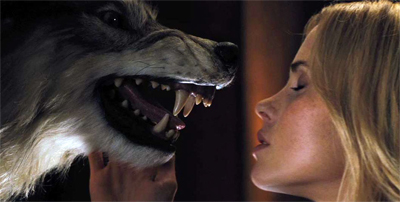
Who is afraid of the big bad wolf?

Continue reading

Non-Review Review: Scream 4 (Scre4m)

Alright, Kirby, then it’s time for your last chance. Name the remake of the groundbreaking horror movie in which the vill…

Halloween, uh, Texas Chainsaw, Dawn of the Dead, The Hills Have Eyes, Amityville Horror, uh, Last House on the Left, Friday the 13th, A Nightmare On Elm Street, My Bloody Valentine, When A Stranger Calls, Prom Night, Black Christmas, House of Wax, The Fog, Piranha. It’s one of those, right? Right?

(beat)

I got it right. I was &@#!ing right.

– Ghostface and Kirby redefine the frame of reference

In many ways, Scream 4 feels like a fitting end to the Scream franchise. In fact, it feels like it has come something of a full circle from the first film, which was envisaged as something of an obituary for the dying slasher genre. In the years since, prompted in a large part by the success of the original Scream, the genre has been resurrected. Watching the grind of horror films released, it seems that Hollywood has been churning out nothing but empty roman-numeral-denoted sequels and hallow remakes, with very little thought or creativity. Scream 4 feels a like a reflection on the “success” that the first film wrought, and actually feelings like a fitting closing act.

It's going viral...

Continue reading

Non-Review Review: Green Hornet

Green Hornet is an interesting film, if only because it’s hard to figure out the potential audience. It adopts a brutally cynical approach to the types of superhero films that have been released over the past few years, while remaining steeped in their trappings. It’s a comedy, but it doesn’t venture too far into slapstick or laugh-out-loud moments (though there are more than a couple). Instead, it seems to smirk its way through the movie, deconstructing the sort of plots, characters and dialogue that superhero films give us, but never completely tilting its hand. It’s hard to tell if this is a parody of a standard superhero film, or a straight-forward example of one – the movie fluctuates between the two extremes, but never really picks one and engages full throttle.

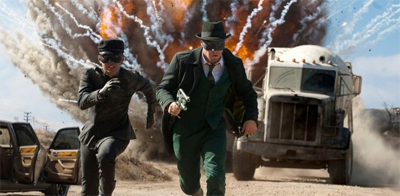
A bomb...

Continue reading

Absolute Identity Crisis (Review/Retrospective)

This January, I’m going to take a look at some of DC’s biggest “events.” This week I’ll be taking a look at Brad Meltzer’s impact on the DC universe.

Identity Crisis is the first in the trilogy of stories that built off the original Crisis on Infinite Earths to offer a fairly significant reevaluation of the modern DC universe, examining where the characters and the fictional landscape was as compared to where it had been decades before. I’ve argued that Marvel went through a similar period of introspection from House of M through to Siege, but DC seemed to engage with the concept on a more direct level. Written by best-selling novelist Brad Meltzer, Identity Crisis is an attempt to explore the rather fundamental changes that occurred in superhero comics during the nineties, often as a direct response to The Dark Knight Returns or Watchmen, giving us a more cynical depiction of the concepts and characters that we take for granted. It’s controversial – as any similar reimagining would be – and, to be frank, it’s a bit of a mixed bag.

However, it’s always fascinating, even if it is grimly so.

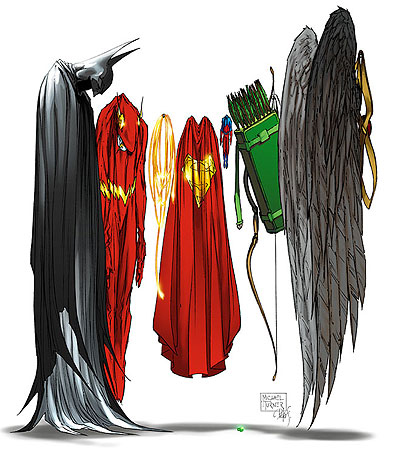
Time to hang it up?

Continue reading

The Absolute Authority, Vol. 2 (Review)

With Wildstorm being officially folded into the relaunched DCU (the “DCnU”), I thought I might take a look at some of the more successful and popular Wildstorm titles that the company produced. In particular, The Authority, the superhero saga that spun out of Stormwatch – a series that is getting its own post-relaunch book written by Paul Cornell, easily one of my more anticipated titles.

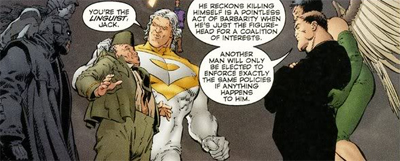
In many ways, it was The Authority that established Mark Millar and Frank Quitely as talents to watch in their own rights, rather than through their associations with Grant Morrison. As a concept, the series was launched by Warren Ellis and Bryan Hitch, but the duo picked their own replacements. I have to say, I think they chose rather wisely, even if the series has lost a rather considerable amount of its bite nearly a decade after its initial publication. That said, it’s still a highly entertaining superhero book, and one which had more than its fair share of influence on the mainstream titles over the last ten or so years.

There's a new Authority in town...

Continue reading

Non-Review Review: Tangled

Disney’s 50th animated feature film is something of a return to traditional values. Despite the surrounding discussion about whether this would be Disney’s last “princess” fairytale film or whether boys would respond to the story of Rapunzel, the movie is assuredly old school in its style. Although the way that it has been handled by the studio betrays a stunning insecurity about it, it’s self-assured a good old fashioned fairytale at heart. Though it moves away from hand-drawn animation to computer-generated imagery (though it’s reportedly heavily influenced by the old-school approach to animation), it couldn’t be more of a traditional Disney film if it tried. After so many attempts to update, subvert, revise, deconstruct or play with that classic formula, sometimes it’s nice to be served a traditional film, straight-up.

Go on, let your hair down!

Continue reading

Building a Better Batman: Is The Dark Knight a Deconstruction or a Reconstruction?

This article is part of the really wonderful Christopher Nolan Blogathon, which is being run by Bryce over at Things That Don’t Suck. It’s a week of Nolan-related madness in the run-up to the release of Inception this weekend. Pop on over you daily fix.

Christopher Nolan’s new film Inception is being released this week, and I’m pretty excited, I’m not going to lie to you. Anyway, I figured that the release of Nolan’s latest summer blockbuster justified a retrospective look back at his earlier summer success story, the rather wonderful The Dark Knight. In particular whether, whether the film, which stands as perhaps the most defining example of the superhero in cinema. However, is it a successful deconstruction of the genre, or an attempted reconstruction of the superhero on film?

Nolan certainly took Batman under his wing...

Continue reading