• Following Us

  • Categories

  • Check out the Archives


  • Awards & Nominations

New Podcast! The Spookies Podcast – “The Legacy of The X-Files”

I was thrilled to be invited to join the wonderful Michael and Stephanie Black for an episode of their new podcast, The Spookies Podcast.

It was a fun conversation, in which I got to chat a little bit about the legacy of The X-Files. In particular, we basically speedrun the X-Files filmography of writer John Shiban, who is perhaps the most controversial and divisive of the “classic” writers on the show. It’s an interesting and playful discussion about how the show has aged, some of its blindspots and why it feels so strange to revisit it today.

You can listen directly to the episode below or by clicking here.

Continue reading

New Escapist Video! On What Makes “The Suicide Squad” the Year’s Best Blockbuster…

So, as I have mentioned before, I am doing some film critic work at The Escapist. Part of that includes long-form video criticism, such as this piece which is now available to watch at YouTube, editted by the wonderful Matt Laughlin, looking at what makes The Suicide Squad the best blockbuster of the year to date.

249. Indiana Jones and the Kingdom of the Crystal Skull – Indiana Summer 2021 (#—)

Hosted by Andrew Quinn, Tony Black and Darren Mooney, The 250 is a (mostly) weekly trip through some of the best (and worst) movies ever made, as voted for by Internet Movie Database Users. New episodes are released every Saturday at 6pm GMT.

This time, wrapping up our Indiana Summer, Steven Spielberg’s Indiana Jones and the Kingdom of the Crystal Skull.

In the midst of the Red Scare, veteran archeologist Indiana Jones finds himself embroiled in a Communist plot involving Area 51. The mystery inevitably spirals outwards, the explorer finds himself roped into another adventure that reunites him with his lost love Marion Ravenwood and offers surprising revelations about the adventurer’s family.

At time of recording, it was not ranked on the list of the best movies of all time on the Internet Movie Database.

Continue reading

New Escapist Column! On How “Candyman” is About Art About Trauma…

I published a new In the Frame piece at The Escapist this evening. With the release of Nia DaCosta’s Candyman this weekend, it seemed like a good opportunity to take a look at the film and the larger franchise.

Much has been written in recent years about the recent explosion of African American horror, and the relationship between that horror and the very real trauma experienced by that community. What’s particularly interesting about Candyman is that the movie is very much engaged with that debate. In an era where so many movies and television shows purport to be “about trauma”, Candyman is explicitly a movie about art about horror, and the thorny questions that stem from that relationship.

You can read the piece here, or click the picture below.

New Escapist Video! “Candyman – Review”

I’m thrilled to be launching movie reviews on The Escapist. Over the coming weeks and months, I will be joining a set of contributors in adding these reviews to the channel. For the moment, I’m honoured to contribute a three-minute film review of Candyman, which is released theatrically in Europe and the United States this weekend.

“Let It Go, Indiana”: “Indiana Jones and the Last Crusade”, and the Necessity of Growing Up…

This August, the podcast that I co-host, The 250, is doing a season looking at all four Indiana Jones films as part of our “Indiana Summer.” This week, we’re looking at Indiana Jones and the Last Crusade, and I had some thoughts on the film.

The clue is in the title. Indiana Jones and the Last Crusade was clearly intended to be the last movie in the Indiana Jones series, the title character’s last adventure.

By the time it came to release Indiana Jones and the Last Crusade, both Lucas and Spielberg were clearly drawing down the shutters on the franchise. “Three is a nice number,” Lucas remarked. Contemporary reviews noted that the film was positioned as the “last romp” with the daring adventurer. Shortly after the film’s release, Harrison Ford donated the character’s iconic bullwhip to the Institute of Archeology at University College London. Spielberg would later reflect, “I thought the curtain was lowering on the series, which is why I had all the characters literally ride off into the sunset at the end.”
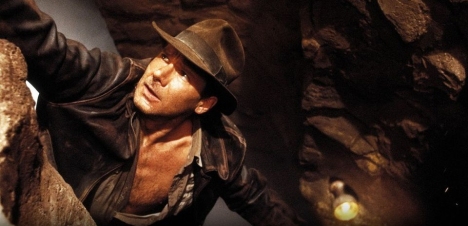
Hang in there.

There is a sense that the reaction to Indiana Jones and the Temple of Doom might have been a key factor here. After all, the basic premise of Raiders of the Lost Ark wasn’t something that demanded a neat three-movies-and-done structure, particularly when the second movie had actually be a prequel rather than a sequel and adopted a completely different style than its predecessor. As much as it drew from the same kinds of adventure serials that George Lucas and Steven Spielberg had loved as children, this franchise was not Star Wars. It didn’t set out to adopt the mythic triptych structure.

Indeed, contemporary critics made a point to read Indiana Jones and the Last Crusade as something of an apology for Indiana Jones and the Temple of Doom. Opening his review, Randy Lewis joked that Pauline Kael was “probably the only person on the planet” who preferred Indiana Jones and the Temple of Doom to Raiders of the Lost Ark. Early reports talked about Indiana Jones and the Last Crusade as something of a rebound after Indiana Jones and the Temple of Doom had “turned off many critics.”
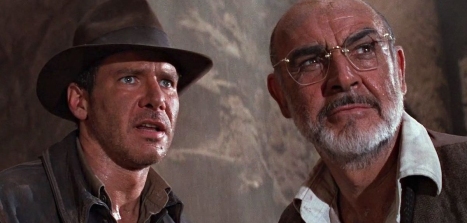
Bring Your Dad to Work Day was going great.

Certainly, it’s notable that the five year gap between Indiana Jones and the Last Crusade and Indiana Jones and the Temple of Doom was appreciably longer than the three year gap between Indiana Jones and the Temple of Doom and Raiders of the Lost Ark. It seems that there was enthusiasm to make the movie. More than that, while Spielberg had made Indiana Jones and the Temple of Doom following the critical and commercial success of E.T., he only returned to the franchise with Indiana Jones and the Last Crusade after the critical and commercial disappointment of Empire of the Sun.

This perhaps explains the conservative nature of Indiana Jones and the Last Crusade. If there is a criticism to be leveled at the film, it is that Indiana Jones and the Last Crusade feels like a retreat back to the comforts of Raiders of the Lost Ark as much as it feels like anything new. Indiana Jones and the Temple of Doom was bold and novel, but Indiana Jones and the Last Crusade is safe and familiar. Once again, there are Nazis. Once again, there is Sallah and there is Brody. Once again, there’s an erudite man selling out to work with the Nazis. Once again, there is a Judeo-Christian artifact with unlimited power.
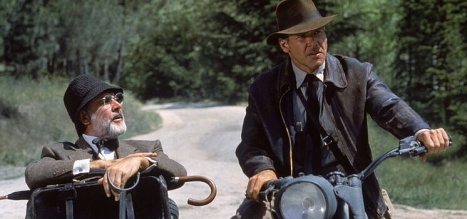
Everybody eventually finds themselves at a crossroads in their lives.

Indiana Jones and the Last Crusade is a very conventional and very straightforward sequel, at times even feeling like something of a remake of the first installment. In that way, it recalls Star Wars: Episode VI – Return of the Jedi, which was similarly predicated on reacting against a darker and weirder middle entry in a trilogy by instead serving the audience nostalgia for an original film that they loved. It’s vaguely disheartening, and it perhaps explains the sense of closure at work here. It often feels like Lucas and Spielberg are trying to end the series with a reminder of a widely-accepted past triumph.

It’s notable that Indiana Jones and the Last Crusade arrived in a summer dominated by the sorts of blockbusters and sequels that movies like Jaws and Star Wars had enabled, and which Raiders of the Lost Ark had helped to codify. It seemed somewhat appropriate that Indiana Jones and the Last Crusade arrived the same summer as movies like Lethal Weapon IIGhostbusters II, Star Trek V: The Final Frontier, License to Kill, Karate Kid III and Batman. In many ways, Indiana Jones and the Last Crusade was positioned as a victory lap for Spielberg and Lucas, a standard-bearer in a blockbuster era that they both helped create.
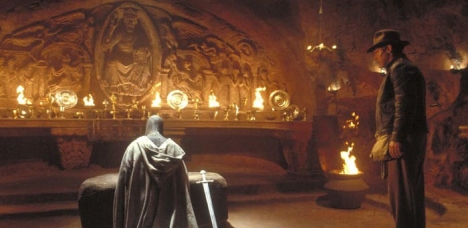
Eternal life or not, you should probably thoroughly disinfect any cup you find here before drinking from it.

Still, what distinguishes Indiana Jones and the Last Crusade from those other films is its not of finality. Indiana Jones and the Last Crusade is not a movie that begs for a sequel. In fact, with due respect to Indiana Jones and the Kingdom of the Crystal Skull, the movies seems structurally designed to all but rule out any substantial subsequent adventures. This is probably one reason, along with casting concerns, why the franchise’s next major film or television project was The Young Indiana Jones Chronicles. Allowing for occasionally appearances from an older Indiana Jones, the only way forwards was backwards.

There’s an endearing and surprising grace to Indiana Jones and the Last Crusade, a sense of the franchise making peace with itself and deciding to call it a day. There’s an interesting maturity in this, which feels arguably of a piece with where Steven Spielberg was at this point in his career.
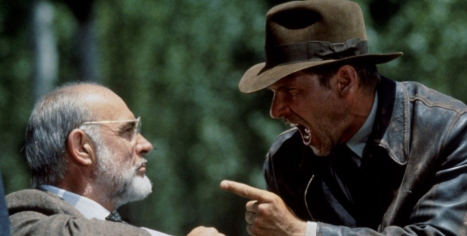
The original Getting Even With Dad

Continue reading

New Escapist Column! On “What If…?” and “Mary Sues”…

I published a new column at The Escapist today. I’ve been covering What If…? for A Marvelous Escape, and it’s been a very fun experience. However, I have noticed that’s there’s a weirdly pervasive school of criticism that argues that the show has turned characters like Peggy Carter and T’Challa into “Mary Sues”, a criticism that has become increasingly common in discussions of modern franchise media.

Of course, it’s often very hard to come with a clear definition of what a “Mary Sue” is that doesn’t manage to encompass characters that the person using the description would never describe using such a term. It often seems like an “I know it when I see it” accusation, which can apply to Rey Skywalker but not Luke or T’Challa but not Steve Rogers. More to the point it demonstrates how blind some observers are to the appeal of these sorts of empowerment fantasies, and the double-standard that they appear to hold in an era where most franchise media is effectively fan fiction.

You can read the piece here, or click the picture below.

New Podcast! The Escapist Movie Podcast – “Ted Lasso and the Onslaught of Optimism”

The Escapist have launched a movie podcast, and I was thrilled to join Jack Packard and Marty Sliva for the twenty-third episode of the year. Because Ted Lasso seems to be generating a lot of buzz and attention, we thought it might be fun to talk about the show, about optimism in popular culture and about the half-hour comedy format in general.

You can listen to back episodes of the podcast here, click the link below or even listen directly.

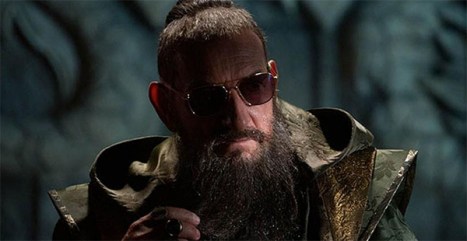
New Escapist Column! On Why the Mandarin from “Iron Man 3” Remains One of the Best Marvel Villains…

I published a new In the Frame piece at The Escapist this evening. With the release of Shang-Chi and the Legend of the Ten Rings next week, it seemed like a good opportunity to take a look back at Iron Man 3, and that movie’s attempt to update the Mandarin for the twenty-first century.

Long treated as Tony Stark’s arch-nemesis, the Mandarin is a complicated character with a very troubled history. The character is built around yellow peril stereotypes, and is easily recognisable as a classic Fu Manchu archetype. Part of what made Iron Man 3 so compelling and so interesting was the way in which the film wasn’t just built around the Mandarin as a character, but instead explored and interrogated the concept. It was a film about how pop culture, film and television, creates images of foreign enemies in service of the politic demands of the moment. Iron Man 3 explores that idea brilliantly.

You can read the piece here, or click the picture below.

New Escapist Video! “Reminiscence – Review”

I’m thrilled to be launching movie reviews on The Escapist. Over the coming weeks and months, I will be joining a set of contributors in adding these reviews to the channel. For the moment, I’m honoured to contribute a three-minute film review of Reminiscence, which is released theatrically in Europe and the United States this weekend and is now streaming on HBO Max.