• Following Us

  • Categories

  • Check out the Archives


  • Awards & Nominations

New Escapist Video! “The Witcher: Nightmare of the Wolf – Review”

I’m thrilled to be launching movie reviews on The Escapist. Over the coming weeks and months, I will be joining a set of contributors in adding these reviews to the channel. For the moment, I’m honoured to contribute a three-minute film review of The Witcher: Nightmare of the Wolf, which is releasing on Netflix tomorrow.

248. Indiana Jones and the Last Crusade – Indiana Summer 2021 (#124)

Hosted by Andrew Quinn, Tony Black and Darren Mooney, with special guest Deirdre Molumby, The 250 is a (mostly) weekly trip through some of the best (and worst) movies ever made, as voted for by Internet Movie Database Users. New episodes are released every Saturday at 6pm GMT.

This time, continuing our Indiana Summer, Steven Spielberg’s Indiana Jones and the Last Crusade.

When academic Henry Jones goes missing, it is up to his son Indiana to solve the case. However, as the intrepid archeologist digs into his father’s disappearance, Indiana finds himself confronting Nazis, unresolved family issues and the quest for the Holy Grail. The father and son forge an unlikely alliance and embark on an epic adventure, while struggling to rebuild their dysfunctional relationship.

At time of recording, it was ranked 124th on the list of the best movies of all time on the Internet Movie Database.

Continue reading

New Podcast! The X-Cast – Season 7, Episode 7 (“Orison”)

With The X-Cast moving on to coverage of the seventh season of The X-Files, and the legacy of Millennium lingering on, I was thrilled to be invited back on to talk about the episode Orison, which feels in many ways like Millennium folding back into The X-Files – it marks the first X-Files script from former Millennium showrunner Chip Johannessen and the return of the serial killer (“death fetishist”) Donny Pfaster.

Orison marks one of the rare times that The X-Files has returned to a pre-existing monster outside of the mythology; the only other major examples are the first season episode Tooms and the fifth season episode Kitsunegari. However, what’s particularly striking about Orison is that Donnie Pfaster is just one facet of an episode that has a lot going. In many ways, it feels like a companion piece to Johannessen’s third season scripts for Millennium, episodes like Saturn Dreaming of Mercury and Bardo Thodol.

You can listen to the episode here, or click the link below.

Continue reading

New Escapist Video! “A Marvelous Escape” – What If – “… T’Challa Became a Star Lord?”

With a slew of Marvel Studios productions coming to Disney+ over the next six months, The Escapist has launched a weekly show discussing these series

This week, I join KC Nwosu and Amy Campbell to talk about the second episode of What If…?, streaming on Disney+.

New Escapist Column! On “The Animatrix”, “Into the Spider-Verse”, “Star Wars: Visions” and “What If…?” and the Potential of Animated Spin-Offs…

I published a new In the Frame piece at The Escapist this evening. With the release of What If…? on Disney+ and the trailer for the anime series Star Wars: Vision, it seemed like a good opportunity to take a look at how best to approach the idea of an animated spin-off.

Animation is a unique medium, with its own particular strengths and weaknesses that distinguish it from live action filmmaking. The best animated films and shows understand and exploit this distinction, and it’s frustrating how committed What If…? is to trying to emulate live action rather to take advantage of the opportunities that animation provides like Spider-Man: Into the Spider-Verse or The Animatrix.

You can read the piece here, or click the picture below.

New Escapist Video! On What Makes “The Suicide Squad” the Year’s Best Blockbuster…

So, as I have mentioned before, I am doing some film critic work at The Escapist. Part of that includes long-form video criticism, such as this piece which is now available to watch at The Escapist, editted by the wonderful Matt Laughlin, looking at what makes The Suicide Squad the best blockbuster of the year to date.

“Anything Goes!” The Curious, Qualified Appeal of “Indiana Jones and the Temple of Doom”…

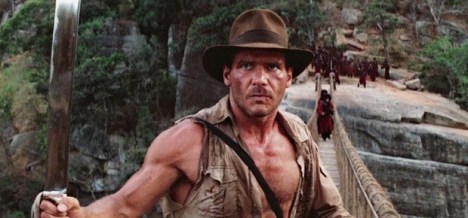
This August, the podcast that I co-host, The 250, is doing a season looking at all four Indiana Jones films as part of our “Indiana Summer.” This week, we’re looking at Indiana Jones and the Temple of Doom, and I had some thoughts on the film.

Indiana Jones and the Temple of Doom occupies an interesting space in the cultural consciousness.

Released as a sequel to Raiders of the Lost Ark, the film was generally considered something of a disappointment. Despite a higher profile and a higher budget, the film grossed slightly less than its direct predecessor. The reviews were generally unkind. People Magazine decried the movie as “an astonishing violation of the trust people have in Spielberg and Lucas’ essentially good-natured approach to movies intended primarily for kids.”
A bridge too far?

Many of those involved with the film seem to have accepted this criticism and taken it to heart. Kate Capshaw quipped that Indiana Jones and the Temple of Doom only really endured because it was packaged as part of trilogy re-releases, joking, “Thank goodness it’s a three-pack, or we wouldn’t have made the cut.” Spielberg was already apologising for the movie in the pre-release publicity for Indiana Jones and the Last Crusade, admitting, “I wasn’t happy with the second film at all.”

To be clear, there are a lot of valid criticisms of Indiana Jones and the Temple of Doom. It would almost be a cheat to concede that the film “has not aged well”, as that would imply that its portrayal of the Indian subcontinent was not horribly dated on its initial release in the mid-eighties. However, accepting and allowing for these very real problems, there is still something interesting and engaging about Indiana Jones and the Temple of Doom. It’s not a movie that is appealing in spite of its darkness, but one that is appealing precisely because of it.

Fortune and glory.

Indiana Jones and the Temple of Doom is a messy and brutal movie. It’s angry and it’s unpleasant. However, it is interesting for precisely that reason. It stood out in the context of Steven Spielberg’s career at the time because Spielberg had cultivated an image of himself as a wholesome and wondrous filmmaker. Indiana Jones and the Temple of Doom marks the first real challenge to that image, perhaps paving the way for the director’s later forays into darkness and cynicism with movies like The Lost World: Jurassic Park, A.I. Artificial Intelligence, Minority Report, War of the Worlds, Munich and more.

Indiana Jones and the Temple of Doom feels like the work of Steven Spielberg at his most unguarded, cutting completely loose and working through a lot of stuff. It’s a very candid and very explicit film, lacking a lot of the polish and the cleanliness of Spielberg’s other major works from around this time. That’s what makes it such a fascinating artifact.

“Why did it have to be snakes?”

Continue reading

Non-Review Review: Reminiscence

Reminiscence is an intriguing concept in desperate need of a stronger execution.

Reminiscence marks the feature film directorial debut of Lisa Joy, the co-creator of Westworld. In some ways, this is revealing. It often seems like the best version of Reminiscence might be a television pilot, a two-hour feature-length exploration of a futuristic dystopia that lays a lot of groundwork to be explored by later episodes and seasons. It’s very clear that Joy has put a lot of thought into the world of Reminiscence, about how it works and how it developed, and why it turned out the way it did. All of that work is either on-screen or blasted over the audio system via helpful voiceover exposition.

On the record.

Unfortunately, Reminiscence struggles to devote any real energy to its actual narrative or characters. Reminiscence is clearly constructed as an affectionate homage to classic film noir, in everything from its production design to its plot structure to its thematic concerns. However, it lacks the richness and the complexity that distinguishes the best of the genre. Instead, because so much time is spent explaining and re-explaining the mechanics of the world, everything else feels like a thinly-drawn sketch.

Reminiscence often feels like the faded memory of a much more engaging film.

Shining a light on it.

Continue reading

New Escapist Video! On How “The Suicide Squad” Uses Idris Elba…

So, as I have mentioned before, I am launching a new video series as a companion piece to In the Frame at The Escapist. The video will typically launch with every second Monday’s article, and be released on the magazine’s YouTube channel the following week. This is kinda cool, because we’re helping relaunch the magazine’s film content – so if you can throw a subscription our way, it would mean a lot.

With the release of The Suicide Squad last week, it seemed like a good opportunity to take a look at one of the things that the film did very well. In particular, the movie used its lead actor to great effect. The Suicide Squad is a movie that understands Idris Elba’s movie star persona and understands how it enhances the general mood of the film around it.

New Escapist Column! On How “The Suicide Squad” Uses Idris Elba…

I published a new In the Frame piece at The Escapist this evening. With the release of The Suicide Squad, it seemed like a good opportunity to take a look at one of the keys to the film’s success. James Gunn understands how to use Idris Elba as a leading man.

Movie stardom is a fascinating concept. So much of what makes a particular person a movie star is ineffable. It is hard to quantify or gauge. It can also be difficult to harness with intent and purpose. This is particularly true in an era where Hollywood seems to be moving away from movie stars, and films like Jungle Cruise seem to struggle against their leads’ screen personas. However, part of what makes The Suicide Squad so effective is that it understands exactly what makes Idris Elba so compelling as a screen presence, and finds a way to play into that to the movie’s benefit.

You can read the piece here, or click the picture below.