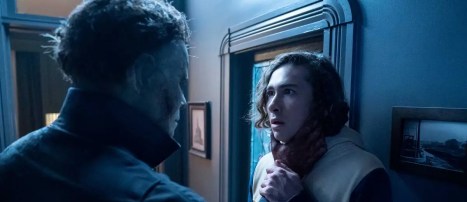
I’m thrilled to be launching movie reviews on The Escapist. Over the coming weeks and months, I will be joining a set of contributors in adding these reviews to the channel. For the moment, I’m honoured to contribute a three-minute film review of Halloween Kills, which released theatrically and on Peacock this weekend.
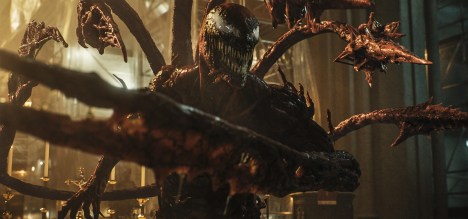
I published a new column at The Escapist today. With Venom: Let There Be Carnage releasing in Irish cinemas this weekend, it seemed like as good an opportunity as any to take a look at the film.
Like its predecessor, Let There Be Carnage isn’t really a functional superhero movie, at least in the sense that modern audiences understand the genre. It’s lumpy, it’s irrational, it’s more interested in immediate thrills than world building. However, despite this, Let There Be Carnage is a surprisingly effective romantic comedy. It’s built around many of the same conventions and adheres to many of the same beats, telling a heart-warming story of an alien symbiote and its parasite.
You can read the piece here, or click the picture below.
Hosted by Andrew Quinn and Darren Mooney, and this week with special guest Joe Griffin, The 250 is a weekly trip through some of the best (and worst) movies ever made, as voted for by Internet Movie Database Users. New episodes are released Saturdays at 6pm GMT.
So this week, John Suits’ Breach.
Earth is dying. Mankind’s last hope lies in the stars. On board one of the last colony ships ferrying the handful of survivors to their new world, something inhuman is stirring. The vessel’s maintenance crew find themselves in a battle against an alien entity, with the fate of mankind in the balance.
At time of recording, it was ranked 69th on the list of the worst movies of all time on the Internet Movie Database.
I published a new In the Frame piece at The Escapist this evening. With the announcement that Will Poulter has been cast in Guardians of the Galaxy, Vol. 3, it seems like a good opportunity to take a look back at Guardians of the Galaxy, Vol. 2.
The Star Wars franchise was a frequent point of comparisons in discussions of the original Guardians of the Galaxy. However, it’s arguably the sequel that engaged most heavily with the core themes of George Lucas’ work. In particular, Guardians of the Galaxy, Vol. 2 was a story about fathers and sons. However, it is notable for taking that archetypal and generation-defining story, and filtering it through a twenty-first century lens. In doing so, it was a valid companion piece to both Blade Runner 2049 and Star Wars: Episode VIII – The Last Jedi.
You can read the piece here, or click the picture below.
Halloween Kills is an ambitious sequel, if a little messy – and not just in the way that one expects a slasher movie to be messy.
Halloween Kills is a direct sequel to David Gordon Green’s Halloween. It picks up in a very similar place to where the two other direct sequels to a movie named Halloween start. Like Rick Rosenthal’s Halloween II and Rob Zombie’s Halloween II, the film follows Laurie Strode to hospital as Michael Myers continues his rampage through Haddonfield, Illinois. Although Zombie’s Halloween II takes a sharp turn in its second act, all three direct sequels extend the eponymous night into the early morning that follows.
Gripping stuff.
There is a lot going on in Halloween Kills. The film effectively splits across three main plot threads that only intermittently overlap with one another. One of these threads centres on Laurie’s recovery in the hospital, while the second follows the reaction of the local community to the carnage, and and the third focuses on Myers’ continuing rampage through an Illinois suburb. The film is disjointed, with Green inheriting a lot of continuity and character baggage from his previous film while heaping even more connections back to the original film upon it.
Still, perhaps the best and worst thing that can be said about Halloween Kills is that it marks a return to the grim nihilism that defined John Carpenter’s original.
I published a new column at The Escapist today. With the end of the second season of Ted Lasso, and with the ongoing discussion around the show, it seemed like a good opportunity to take a look back at the evolving conversation around the series.
The discussion around Ted Lasso has followed an interesting arc. It premiered to lukewarm reviews, that seemed almost grudgingly positive. However, the first season seemed to find its audience in hindsight. Once it was completed, the season drew both serious consideration and enthusiastic praise from a variety of outlets. Many viewers came to the first season as a complete object, a collection of episodes that they could binge at their own pace. In contrast, this growing audience watched the second season week-on-week. It’s interesting to wonder if this shaped the more divisive response to the second season.
You can read the piece here, or click the picture below.
I’m thrilled to be launching movie reviews on The Escapist. Over the coming weeks and months, I will be joining a set of contributors in adding these reviews to the channel. For the moment, I’m honoured to contribute a three-minute film review of Dune, which is released theatrically in Europe and the United States next weekend.
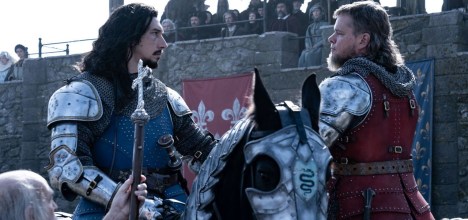
The Last Duel is a thorny and compelling medieval epic. It’s a little rough around the edges, but that’s undeniably part of the appeal.
The Last Duel is adapted from the book of the same name by historian Eric Jager. As its title implies, the film offers an account of the last judicial duel permitted by the Parlement of Paris. That duel was fought between two noblemen: Jean de Carrouges and Jacques Le Gris. The challenge was offered over allegations that Le Gris had raped de Carrouges’ wife, Maguerite. The assumption was that divine authority would ultimately determine where the truth lay in the matter, that the victor in this mortal combat would ultimately be vindicated.
Duel narratives.
Naturally, the events that inspired The Last Duel remain contentious. Historians are not entirely sure what happened, and how much of the various accounts reflect the truth of what happened or have been shaped by the convenient narratives of the victors. The film, with a screenplay from Matt Damon, Ben Affleck and Nicole Holofcener, leans into this ambiguity. The film is structured similarly to Akira Kurosawa’s Roshomon, outlining three separate accounts of the events leading up to the trial from the perspective of each of the key figures: Jean, Jacques and Maguerite.
The result is a film that touches on the blurred boundaries between history and narrative, and explores the way in which these sorts of stories are shaped by wounded pride and vain ego. It’s an uncomfortable and unsettling film, occasionally a little clumsy in its execution, but which grapples with big ideas.
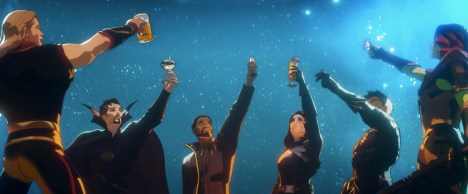
I published a new In the Frame piece at The Escapist this evening. Because What If…? wrapped its first season last week, it seemed like a good opportunity to take a look at the show.
In particular, What If…? demonstrates one of the tensions within modern pop culture. How does modern pop culture measure the worthy or value of a particular story? Historically, stories have been judged on their own quality, making arguments for their own value. However, with the emergence and evolution of shared universes like the Marvel Cinematic Universe, it increasingly seems like audiences are being told that they should measure the value of a given story by how it “matters” to the continuity of the larger franchise. A story no longer has worth because it is good, but because it promises a return down the line.
You can read the piece here, or click the picture below.