• Following Us

  • Categories

  • Check out the Archives


  • Awards & Nominations

Non-Review Review: Maze Runner – The Death Cure

Maze Runner: The Death Cure feels like a movie that has arrived several years too late, a belated epilogue to the young adult boom.

The Death Cure is the last in the trilogy, the culmination of a journey that began with The Maze Runner in 2014. By that point, the young adult adaptation boom was already winding down. The Twilight Saga – Breaking Dawn, Part II had been released two years earlier, and Harry Potter and the Deathly Hallows, Part II had been released the year before that. There was a clear sense that The Maze Runner was starting when everybody else was ending.

“So, it turns out that the Death Cure is… not dying. Whudda thunk it?”

Of course, there were still faint signs of life in the genre when the series began, but those sparks have largely been extinguished. The Hunger Games: Mockingjay, Part II was released the year after The Maze Runner. One year later, The Divergent Series: Allegiant underperformed to such a degree that it has been suggested that the series might be resolved on television. Even in the context of The Death Cure, there is a sense that the production team understand the fatigue; there is no over-extended duology to bring the series to a close; no lingering Part II.

The Death Cure is mostly an efficient film, one that keeps moving well enough for the bulk of its two-hour-and-twenty-two-minute runtime, although the bloat eventually becomes too much in the final act. There is something very functional about The Death Cure, a sense that everybody involved the film – and every character within the film – has adopted a “let’s get stuff done” attitude towards the production. There is all the expected angst, betrayal, insecurity and hesitation expected of a young adult novel, but surprisingly little wallowing in those emotions.

After initial trials proved unsuccessful and disappointing third quarter returns, WCKD moved on to producing “The Death Treatment.”

The result is something of a mixed blessing. Very few young adult adaptations had the benefits and strengths that defined the Harry Potter or Hunger Games franchises. Those two heavy-weight franchises had the luxury of several built-in advantages denied to many of their imitators; the strong ensemble cast, the compelling source material and the distinctive-within-limits voice. The Death Cure seems cognisant of its limitations, and so structures itself in a way to avoid exposing them too readily and too often.

However, this efficiency hinders The Death Cure. The film only rarely stumbles, and never falls flat on its face. However, it never manages to soar either.
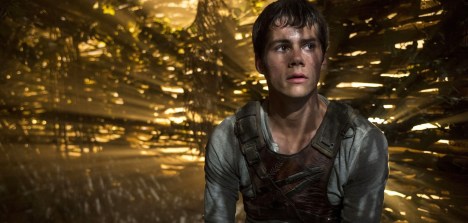
Runner, runner.

Continue reading

New Podcast! Scannain Podcast (2018) #1!

New year, new Scannain podcast!

The wonderful folk over at Scannain, spearheaded by the fantastic Niall Murphy, are relaunching the Scannain podcast. I was lucky enough to appear as a guest and panelist on some of the older episodes, and was thrilled to be invited back for the launch of the new and improved Scannain podcast that will see a rotating pool of guests discussing the week in film – what we watched, film news, the top ten and new releases.

I’m thrilled to be part of a panel including Niall Murphy, Jay Coyle and Grace Duffy. Give it a listen below.

Star Trek: Voyager – Barge of the Dead (Review)

There is some small symmetry in Barge of the Dead.

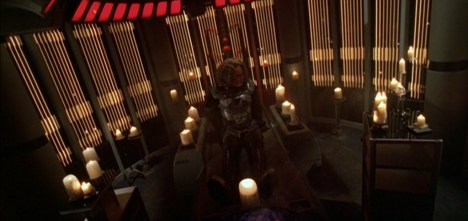
When Bryan Fuller first pitched to Star Trek, he pitched to Star Trek: Deep Space Nine. The first idea that he sold was The Darkness and the Light, which felt like something approaching a gothic serial killer horror about a deformed killer stalking his victims using the franchise’s hyper-advanced technology. That original idea was heavily re-written by franchise veteran Ronald D. Moore, who also brought a more substantial thematic weight to the story by focusing on themes of violence and retribution.

Barging in.

In contrast, Barge of the Dead is the last television story that Ronald D. Moore would pitch for the franchise, coming at the very end of his time on Star Trek: Voyager. The episode has its roots in an earlier pitch by the writer, the original idea for Soldiers of the Empire. However, Moore would depart the franchise before he could finish work on Barge of the Dead, and so the writing of the script fell to Bryan Fuller. Much like Moore had subtly shifted the emphasis of The Darkness and the Light to his own thematic interests, Fuller embraces his own sensibilities in reworking Barge of the Dead.

Moore had re-written Fuller’s last story, and Fuller would re-write Moore’s last story. There is some sense of poetry in this.

Tom’s idea of a romantic evening certainly needed some work.

Continue reading

62. Call Me By Your Name – This Just In (#175)

Hosted by Andrew Quinn and Darren Mooney, This Just In is a subset of The 250 podcast, looking at notable new arrivals on the list of the 250 best movies of all-time, as voted for by Internet Movie Database Users.

This time, Luca Guadagnino’s Call Me By Your Name.

Continue reading

Star Trek: Voyager – Survival Instinct (Review)

Survival Instinct marks the beginning and the end of Ronald D. Moore’s involvement with Star Trek: Voyager.

Moore had been one of the most influential writers on Star Trek: The Next Generation and Star Trek: Deep Space Nine. Moore had famously been drafted into the Star Trek franchise with no outside experience; The Bonding was based upon a speculative script that he wrote, and he had been invited to join the staff when The Defector proved that he was not a one-script wonder. Moore had inspired producer Michael Piller to open the franchise to speculative scripts, a decision which led to the recruitment of writers like Bryan Fuller and Rene Echevarria.

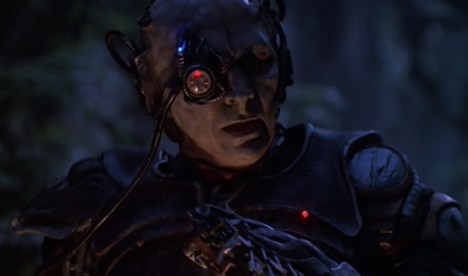
Drone warfare.

Moore had consistently pushed the envelope in terms of what Star Trek could be. Several of Moore’s scripts feel like trailblazers, expanding the storytelling language of an established science-fiction franchise; the Klingon-centric script for Sins of the Father, the quieter character drama of Family, the epic scale of Redemption, Part I and Redemption, Part II. Paired with Ira Steven Behr on Deep Space Nine, Moore really pushed the boundaries of what Star Trek could be; Soldiers of the Empire looked at life on a Klingon ship, In the Pale Moonlight stretched (and maybe broke) Star Trek morality.

All of the other writers on Deep Space Nine chose to bow out gracefully with What You Leave Behind, to part ways with the franchise having provided their own unique take on the Star Trek mythos. However, Moore was convinced to migrate across from Deep Space Nine to Voyager. There are any number of reasons why Moore might have chosen to stay when writers like Behr and Echevarria chose to take their exit; Moore was the longest continuous-serving writer on the Star Trek franchise to that point. In terms of second-generation Star Trek, only Rick Berman could have claimed to have a deeper impression.

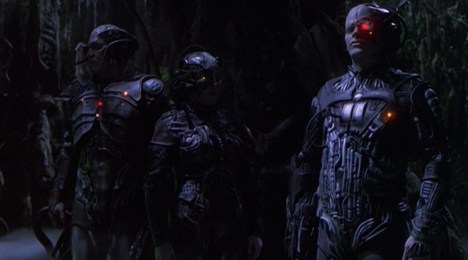
Armed and dangerous.

Moore arrived on the sixth season of Voyager and immediately looked to make his mark. Like Brannon Braga, Moore had always been an extremely productive Star Trek writer. He was typically credited on six or seven scripts in a season of The Next Generation and Voyager, while also scripting Star Trek: Generations and Star Trek: First Contact. Although not credited on the script, Moore was actively involved in the back-and-forth over the script to Equinox, Part II. He scripted the second episode, Survival Instinct. He was working on the story to third, Barge of the Dead.

And then the unthinkable happened. Like so much of Voyager, Moore’s arrival proved to be something of a false dawn. In early July 1999, Ronald D. Moore left Star Trek. This was within a month of the broadcast of What You Leave Behind, and nearly three months before the premier of the sixth season of Voyager. Even before Moore and Braga elaborated upon the particulars of what had happened, it was clear that something had gone disastrously wrong.

What We Left Behind.

Continue reading

Star Trek: Voyager – Equinox, Part II (Review)

Equinox, Part II works worse than it should.

Equinox, Part II is undercut by three key factors. The most obvious is the premise itself. Equinox, Part I and Equinox, Part II tell a story that is baked into the DNA of Star Trek: Voyager, but there is a sense that the production lacks the will to tell that story. Secondly, Equinox, Part I and Equinox, Part II struggle with consistent characterisation and clear narrative arcs. The third factor is a sense of inevitability, with Equinox, Part I and Equinox, Part II feeling like they reveal nothing insightful about Voyager before concluding, and that the show will no lasting impact.

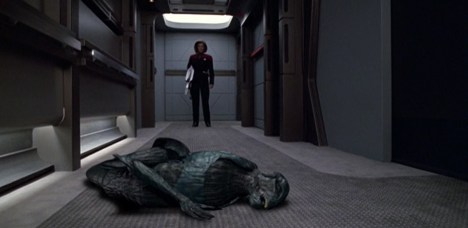
Fish out of fluidic space.

These three factors squander a lot of raw potential. Equinox, Part II is telling a story that feels essential to Voyager, a story that the franchise arguably should have been telling immediately after Caretaker. This season premiere represents the chance for Voyager to have a full and frank discussion with itself, particularly in the context of its sixth season. Star Trek: Deep Space Nine had concluded at the end of its seventh season. For the first time in its run, Voyager was the only Star Trek series on television. This was the perfect opportunity for introspection.

Equinox, Part II is an episode that fails to deliver upon a fantastic opportunity.

“What are you looking at?”

Continue reading

Black Mirror – USS Callister (Review)

What is Space Fleet? I’ll tell you what it is. It is a belief system founded on the very best of human nature. It is a goal for us to strive towards for the betterment of the universe, for the betterment of life itself.

And you assholes are f%$king it up!

Black Mirror originated in the United Kingdom, broadcast on Channel 4 and written by Brass Eye and The 11 O’Clock Show writer Charlie Brooker.

The first two seasons of Black Mirror tended to focus on British talent, drawing in a wealth of talent from the British Isles to tell a set of stories about technology run amok: Daniel Kaluuya, Rory Kinnear, Jodie Whittaker, Toby Kebbell, Domhnall Gleason, Lindsay Duncan, Jessica Brown Findlay, Rupert Everett, Hayley Atwell, Rafe Spall and Oona Chaplin. Jon Hamm appeared in White Christmas, but Hamm is arguably an honourary citizen of British television, having appeared in shows like Toast of London and A Young Doctor’s Notebook, and the film Absolutely Fabulous.

In contrast, the third and fourth seasons of Black Mirror moved over to America. This shift was most obvious in the change in locations and talent employed by the series: Bryce Dallas Howard, Jodie Foster, Wyatt Russell, Mackenzie Davis, Rashida Jones, Mike Schur and Cherry Jones. However, it is also quite clear from a shift in emphasis in the stories being told. In particular, the two stories being told that bookend the fourth season of Black Mirror feel uniquely American. Black Museum plays as an allegory for one of America’s foundational sins, its exploitation of its racial minorities.

The feature-length season premiere, USS Callister is transparently a riff on the larger Star Trek franchise and a broader cultural war raging over ownership of established franchises like Ghostbusters or Star Wars. There are undoubtedly ways in which this story could be told with an emphasis on British experience, but USS Callister is very firmly a story about the ownership of one of America’s most beloved and abiding pop cultural mythologies. It is at once a deconstruction of certain strains of fandom and a love letter to the idealism at the heart of such stories.

Continue reading

61. Three Billboards Outside Ebbing, Missouri – This Just In (#122)

Hosted by Andrew Quinn and Darren Mooney, and this week with special guest Stacy Grouden, This Just In is a subset of The 250 podcast, looking at notable new arrivals on the list of the 250 best movies of all-time, as voted for by Internet Movie Database Users.

This time, Martin McDonagh’s Three Billboards Outside Ebbing, Missouri.

Continue reading

Non-Review Review: The Commuter

The Commuter is the best Neeson Season movie since The Grey and the best movie about the financial crisis since The Big Short.

On paper, The Commuter is a mildly interesting premise that feels very much of a piece with the typical January awards-fare counter-programming. It is very much a high-concept action film that feels populated from a mad lib. [Liam Neeson/Bruce Willis/Gerard Butler] is a [former cop/current cop/law enforcement official] who finds himself embroiled in a race against time to [protect/rescue/expose/defeat] a [loved one/conspiracy].

McCauley took the instruction not to fire the gun inside the carriage a little… literally.

The Commuter is very much of piece with Liam Neeson’s other collaborations with director Jaume Collet-Serra; Unknown, Non-Stop, Run All Night. It is a movie about a weary protagonist embroiled in a situation beyond his control, the perfect fodder for a midweek movie to be enjoyed with a bucket of pop corn and a soft drink of choice. However, what elevated The Commuter above these earlier collaborations is similar to what elevated Collet-Serra’s The Shallows above so many familiar shark movies.

The Commuter has the look and feel of a big dumb action movie, a film inviting the audience to engage on its own terms rather than theirs. However, there is a very knowing and self-aware quality to The Commuter, an understanding of what the audience expects of the film and what the film can expect from the audience in return. The result is a film that always feels smarter and better than it needs to be, very carefully calibrated; just serious enough to work, just self-aware enough to charm. The result is a delightfully enjoyable action film.

Dial “C” for Commuter.

Continue reading

Deep Space Nine at 25 – The Most Humanist of (Star) Treks

On Earth, there is no poverty, no crime, no war. You look out the window of Starfleet Headquarters and you see paradise. Well, it’s easy to be a saint in paradise. but the Maquis do not live in paradise. Out there in the Demilitarized Zone, all the problems haven’t been solved yet. Out there, there are no saints — just people.

– Benjamin Sisko, The Maquis, Part II

Star Trek: Deep Space Nine is contentious.

Writer Ronald D. Moore has talked about the franchise as the bastard stepchild of the Star Trek franchise. Star Trek: The Next Generation actor Marina Sirtis has described it as little more than a hotel in space and not worthy of the franchise name. While the show was still on the air, Majel Barrett Roddenberry took the time to write a public letter denounced the show and its perceived connection to her husband’s legacy. This argument rages on-line even today, as fans argue about the series’ legacy and its place in the broader canon.

The charges against Deep Space Nine are clear. It is generally regarded as the most cynical of Star Trek spin-off shows, the series most likely to question and interrogate the underlying assumptions of the Star Trek universe. Deep Space Nine was the series that introduced and developed the Maquis, terrorists who splintered off from Starfleet. Deep Space Nine introduced the concept of Section 31, and the idea that Starfleet might be dangerous if left to its own devices. Deep Space Nine devoted its final two seasons to a war arc, a rejection of Roddenberry’s utopia.

However, these arguments are all based upon awkward presuppositions that reveal a lot about the assumptions of Star Trek fandom, and which tend to miss the forest for the trees. Deep Space Nine is a deeply humanist and optimistic piece of television, one has a great deal of faith in its cast and in people. As wary as Deep Space Nine might be about institutions and authority, Deep Space Nine fundamentally believes that people are good and that it is possible to peacefully coexist. The show simply acknowledges that this takes work, but believes it can happen.

Continue reading