• Following Us

  • Categories

  • Check out the Archives


  • Awards & Nominations

Non-Review Review: Black Panther

Black Panther is something special.

In a lot of ways, it is a very typical Marvel blockbuster. The familiar formula is in place, and the movie follows the rhythms that audiences have come to expect from these films. There is a certain tempo and structure to the film, the sort of clean efficiency that delineates most of the movies produced under the banner of Marvel Studios. For a film advertised using a remix of The Revolution Will Not Be Televised, it is striking how conservative Black Panther is.
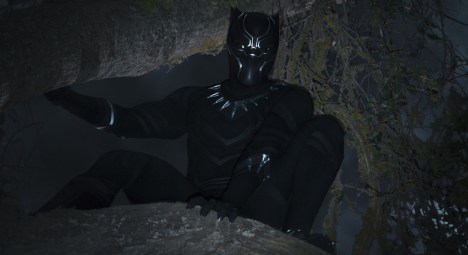
The Panther Strikes!

However, there is a lot to be said for the film’s more understated revolutionary qualities, the depth of understanding that the production team bring to the adaptation. Black Panther is acutely aware of what it means to construct a superhero fantasy epic about an African prince who leads a utopian society in the context of 2017, and there is something reassuring in how confidently and efficiently the film works within that framework. It is not merely that the existence of Black Panther is important, it is that Black Panther‘s assertion of its identity is important.

Black Panther is superior blockbuster by any measure, constructed with a great deal of care and thought about what it means. Much like its title character, there is a sense that the weight of expectation is upon Black Panther, and the most remarkable thing about the film is how seriously it takes that obligation without ever feeling burdened.
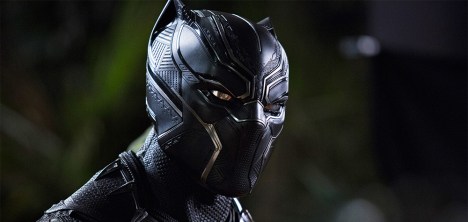
Heavy lies the head that wears the cowl.

Continue reading

The Netflix Paradox: New Media and Old Methods…

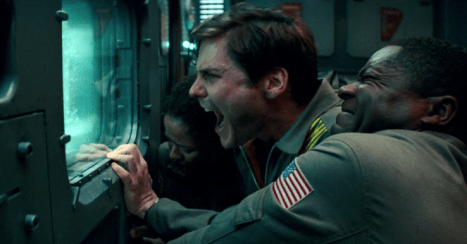
Last night, Netflix released The Cloverfield Paradox.

The release of the film was announced in a Superbowl advertisement, promising audiences that the film would be available direct to them “after the game.” It was a striking move, particularly because so little was known about the film. It was, in many ways, an unexpected Christmas present, particularly as hyped and teased by director Ava DuVernay on Twitter. On the surface of it, this looked like a game-changing paradigm, a film released with only a few hours’ notice, directly bypassing critics and hype in a way that rendered it accessible to casual movie-goers.

Never too far a (Clover)field.

However, it also feels like a publicity coup for Netflix. The company has pulled off something truly remarkable with this release, in pulling off one of the oldest tricks in the film distribution playbook, while making it seem fresh and exciting. More than that, Netflix took a tactic that is traditionally associated with the release of bad films, and presented it as something revolutionary and democratic. Twitter commentators argued that this was the future of film releasing. Peeling back the layers on the release of The Cloverfield Paradox, it looked to be something quit different.

This was simply an old trick being cast in a new light.

#FilmTwitter right now.

Continue reading

64. Крым (Crimea) – This Just In (-#–)

Hosted by Andrew Quinn and Darren Mooney, This Just In is a subset of the fortnightly The 250 podcast, looking at notable new arrivals on the list of the 250 (and the 100 worst) best movies of all-time, as voted for by Internet Movie Database Users.

This time, Aleksey Pimanova’s Крым.

Continue reading

Non-Review Review: Phantom Thread

Phantom Thread is certainly a beautiful film.

In many ways it resembles the dresses designed by the artist at its centre. It is elegant, well-composed, stylish. It looks perfect and has just the right texture. Phantom Thread is a meticulously-produced piece of work, with every technical aspect of the film delivered to the highest possible standard. More than that, Phantom Thread is a very clever and incisive film, one that arguably feels much more suited to this particular cultural moment than Three Billboards Outside Ebbing, Missouri.

Tailored to the role.

However, Phantom Thread feels like one of Reynolds Woodcock’s dresses in another manner. As fantastic as it might look, it is not designed for living. There is one memorable sequence in the middle of the film where Woodcock actually confiscates the dress from a patron because it is not being treated with the pomp and ceremony that he expects. These are dresses for display, designed to leave observers breathless. It never ignites the same passion as Three Billboards Outside Ebbing, Missouri, never feeling as anchored in appreciable human emotion.

Phantom Thread often feels too much like strolling through Woodcock’s parlour, the audience invited to examine the sheer craft and cleverness of what is being done, but warned in the starkest possible terms not to touch anything. There is beauty, but no feeling.

Make it sew.

Continue reading

New Podcast! Scannain Podcast (2018) #3!

Continuing the revival of the Scannain podcast!

A weekly podcast looking at events in the world of Irish and international film, the Scannain podcast is the perfect way to start the weekend. Discussing everything from what the hosts watched this week to the top ten and new releases, the team also discuss the Irish Film Board’s funding initiatives for the new year and access to film via streaming services.

I’m thrilled to be part of a panel including Jay Coyle, Ronan Doyle and Alex Towers. Give it a listen below.

Star Trek: Voyager – Alice (Review)

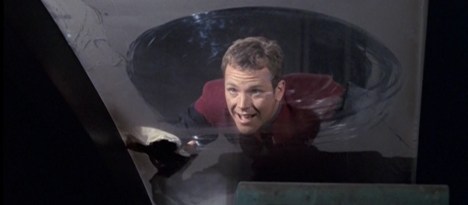
Alice is a misfire.

To be fair, the episode seemed doomed from its original set of premises. Star Trek: Voyager has never been particularly good at capturing the sense of Tom Paris as a restless unreliable rebel. The episodes of Voyager focusing on the character’s rebellious tendencies tend to be spectacular misfires; Ex Post Facto, Investigations, Vis à Vis, Thirty Days. These stories do not play to the strengths of either the writing staff or Robert Duncan McNeill, feeling largely incompatible with the character of Tom Paris as he developed in the wake of Caretaker.

I’ll never get used to not living inside of Alice.

However, Alice literally weds this familiar and unsuccessful premise to another recurring Voyager trope with a less-than-impressive rate of success. It is not enough for Alice to be another story about Tom Paris proving that he has a rebellious streak, that premise has to be woven into a broad science-fiction gothic horror in the style of Threshold or Macrocosm. Indeed, Alice is explicitly a psycho-sexual horror in the mode of Blood Fever or Darkling, inevitably butting up against the difficulties of constructing an episode that is about sex but can never discuss sex.

Alice is flawed from the ground-up, but those flaws are only further revealed in the clumsy execution and the disappointing storytelling. Alice is a very bad piece of television.

A deep-space dust-up.

Continue reading

Non-Review Review: Den of Thieves

Heat was not the first cops and robbers film to parallel the opposite sides playing for control of the board, suggesting lives on a collision course inside a gritty crime epic.

However, Heat did it better than most. Heat inspired an entire generation of film fans, and arguably an entire subgenre of heist movie. Los Angeles had always lent itself to operatic crime sagas, with triumph and tragedy playing off against one another in the City of Angels, but Heat redefined the game. The movie developed a style of storytelling, both in terms of actual technical craft and in terms of storytelling construction.

Mann of Today.

Success breeds imitation, and there have been far too many crime films inspired by Michael Mann’s classic, to the point that many film fans were disappointed to discover that Mann himself had not adhered to the template in making Public Enemies. Almost every year, there seems to be another example of a movie constructed in the image of Heat, from Takers to The Town. The quality varies from film to film, as does the level of innovation and inspiration.

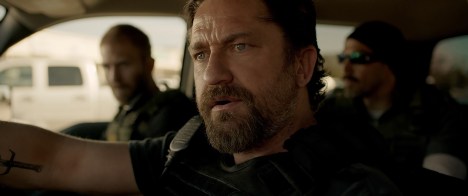
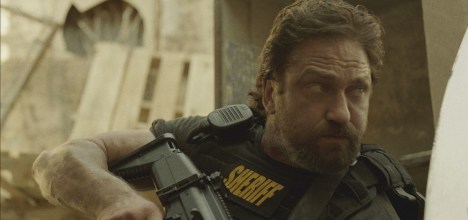
Den of Thieves is rather brazen in how much it takes from Heat, lifting both the crime classic’s cinematic language and even direct scenes. The result is a lukewarm reHeat of an exquisite meal, something to which the movie cheekily alludes towards the end of its climactic heist when one character literally serves up days-old leftovers. It isn’t anywhere near as filling or satisfying as the original meal, but it can satisfy a craving.

You definitely feel the Heat around the corner.

Continue reading

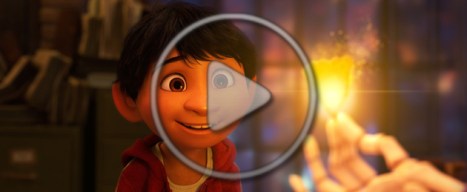
63. Coco – This Just In (#37)

Hosted by Andrew Quinn and Darren Mooney, This Just In is a subset of The 250 podcast, looking at notable new arrivals on the list of the 250 best movies of all-time, as voted for by Internet Movie Database Users.

This time, Lee Unkrich and Adrian Molina’s Coco.

Continue reading

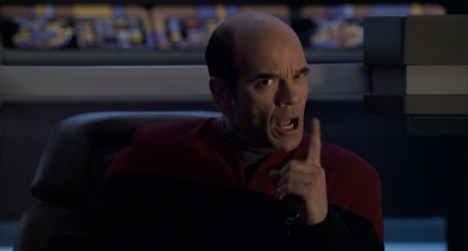
Star Trek: Voyager – Tinker, Tenor, Doctor, Spy (Review)

With Tinker, Tenor, Doctor, Spy, Star Trek: Voyager is back to business as usual.

The first episode produced after the departure of Ronald D. Moore, Tinker, Tenor, Doctor, Spy is in many ways an archetypal Voyager story. Equinox, Part II was the second part of a season-bridging two-parter; Survival Instinct was a dark fable about consequences and trauma that was the last script credited to on the franchise’s most beloved writers; Barge of the Dead was a surreal and ambiguous adventure into the Klingon afterlife. As such, it is strange that an episode that opens with a playful operatic number about Tuvok’s pon farr should mark a return to normality.

“My Delta Quadrant TripAdvisor review is going to be scathing!”

Nevertheless, Tinker, Tenor, Doctor, Spy is a very neat standalone episode with a clear beginning, middle and end. It is built around the character of the EMH, leaning into actor Robert Picardo’s comedic chops. It is very much in keeping with Voyager‘s recurring fascination with the notion of fractured reality as expressed in Projections or Deadlock or Retrospect, and also in using a technologically-derived character to literalise the process of a psychological breakdown as in Darkling, Infinite Regress or Latent Image.

Tinker, Tenor, Doctor, Spy story has its own themes and ideas, and everything is neatly resolved by the closing credits. It is a reminder that the serialisation that defined Star Trek: Deep Space Nine would remain the exception, rather than the rule, that it would not be inherited by its surviving sibling. Tinker, Tenor, Doctor, Spy could almost be watched at any point in the show’s run, although the involvement of Seven of Nine would suggest the final four seasons. Nevertheless, the episode never feels particularly tethered to this moment or this season.

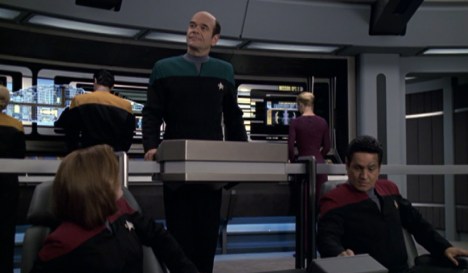
Fantasy figure.

However, Tinker, Tenor, Doctor, Spy is also an example of how this approach can work. Voyager received (and deserves) a lot of criticism for failing to evolve with the times, for allowing the Star Trek franchise to fall behind the curve of contemporary television science fiction. However, the series was occasionally capable of demonstrating the merits of standalone episodes, the appeal of being able to transition from one self-contained story to another twenty-six times in the course of a season.

Of course, the issue was that a lot of Voyager episodes were bland and forgettable. However, every once in a while the series would produce a self-contained episode that demonstrated the appeal of this narrative model; Remember, Distant Origin, Concerning Flight, Living WitnessSomeone to Watch Over Me. Appropriately enough, coming after another turbulent period in the history of the show, Tinker, Tenor, Doctor, Spy is another fine example of this capacity to construct satisfying and engaging stand-alone narratives.

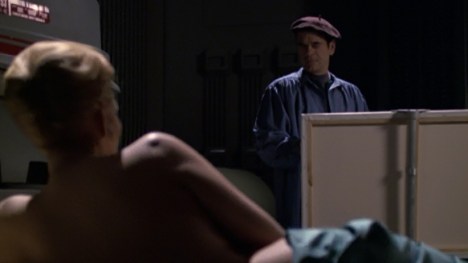
Painting a pretty picture.

Continue reading

New Podcast! Scannain Podcast (2018) #2!

And we’re back to doing it almost weekly!

The new and improved Scannain podcast continues. A one-stop shop to talk about the week that has been in Irish and world cinema, the Scannain podcast features a rotating pool of guests discussing the week in film – what we watched, film news, the top ten and new releases. This week we’re celebrating both the Oscar nominations and the announcement of the line-up for this year’s Audi Dublin Internation Film Festival.

I’m thrilled to be part of a panel including Phil Bagnall, Jay Coyle, Ronan Doyle and Stacy Grouden. Give it a listen below.