• Following Us

  • Categories

  • Check out the Archives


  • Awards & Nominations

New Escapist Column! On Understanding “Twin Peaks” Emotionally, Rather than Intellectually…

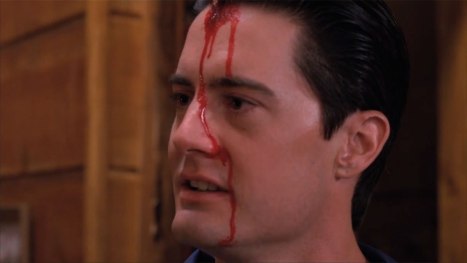
I published a new In the Frame piece at Escapist Magazine yesterday. With the thirtieth anniversary of Twin Peaks, I got to talk a little bit about the show and David Lynch.

Lynch has a reputation as a “difficult” artist for audiences, a filmmaker whose art is challenging and provocative. It’s easy to see why. On a simple mechanical level, it can be very difficult to explain what happens during a David Lynch film or television show. More to the point, two different audience members might provide two very different descriptions. However, that’s always been what I admired about Lynch. As a critic, he forces me to engage emotionally with his work because an intellectual understanding is never enough. I feel Lynch’s work, even if I don’t comprehend it.

You can read the piece here, or click the picture below.

New Escapist Column! On “The Last Jedi”, “The Rise of Skywalker” and What Makes a Good Sequel…

I published a new In the Frame piece at Escapist Magazine on Friday.

It seems like the arguments over Star Wars: Episode IX – The Rise of Skywalker have at least entered that “justification” stage. This week, editors Maryann Brandon and Mary Jo Markey reopened the conversation by trying to shift the blame on to Star Wars: Episode VIII – The Last Jedi, claiming that it represented a betrayal of Star Wars: Episode VII – The Force Awakens. This is nonsense, of course, but it does invite a larger debate about what exactly makes for a good sequel. What does a follow-up owe to an original?

You can read the piece here, or click the picture below.

177. Portrait de la jeune fille en feu (Portrait of a Lady On Fire) – This Just In/World Tour 2020 (#226)

Hosted by Andrew Quinn and Darren Mooney, and this week with special guests Aoife Barry, Rioghnach Ní Ghrioghair and Charlene Lydon, The 250 is a (mostly) weekly trip through some of the best (and worst) movies ever made, as voted for by Internet Movie Database Users.

This time, Céline Sciamma’s Portrait de la jeune fille en feu.

Marianne is a portrait artist who is summoned to a remote island and assigned a strange task. The Contessa would task Marianne with preparing a portrait of her daughter Héloïse, which might be sent to a waiting suitor in Milan. There is just one complication; Héloïse has refused to sit for any portrait painter, and so Marianne must paint the young woman without her knowledge. However, as Marianne studies her subject more intensely, she finds herself more and more drawn to this isolated and lonely soul.

At time of recording, it was ranked 226th on the list of the best movies of all time on the Internet Movie Database.

Continue reading

Non-Review Review: Butt Boy

Butt Boy is a single joke stretched over one hundred minutes. However, the film is elevated by its sheer and unrelenting commitment.

At its core, Butt Boy is a piece of surrealist comedy. Chip Gutchell is a middle aged man who works a deadend job “in computers” and lives with a wife who seems actively hostile to the idea of intimacy with him. His life is empty and meaningless, until he has a spiritual experience in the middle of a proctology exam. Chip becomes obsessed with placing objects in his butt, indulging those urges whenever he is left unattended. Gradually, those desires grow in intensity with catastrophic results.
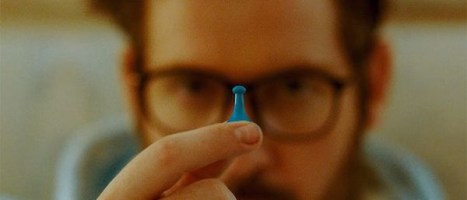
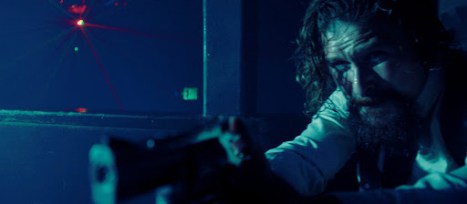
It is a naturally absurd set-up, one that simultaneous offers broad riffs on heterosexual masculine anxieties and the escalating horrors of addiction. After several people go missing, alcoholic police officer Russel Fox begins to put the pieces together with no idea about where it might end. Butt Boy is an ultra low budget independent film, and unapologetically so. Everything is hypersaturated, props and locations often seem improvised, and the quality of performance varies wildly from scene-to-scene. More than that, the film is essentially an extended riff on one comedic set-up.

And yet, in spite of all of that, Butt Boy works surprisingly well. The key is the film’s single-minded focus on that single absurd premise, on the image of a man who has developed an anal fixation so strong that he at point tries to consume an entire police car. Butt Boy never flinches. It never breaks eye contact. It never corpses, not matter how far it follows that premise down its various rabbit holes. There is something strangely appealing in that, which suggests a bright future for writer, director and lead actor Tyler Cornack.
Continue reading

Non-Review Review: Trolls World Tour

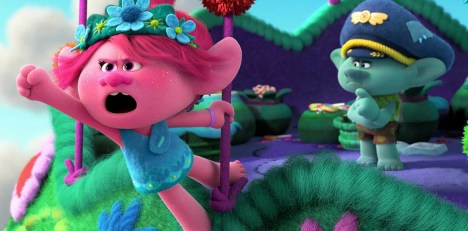
If nothing else, Trolls World Tour demonstrates how far animated American films have come in the past few decades.

Modern family audiences have come to expect – and not unreasonably – a certain amount of polish and sophistication in terms of the stories being told. It’s common to credit Pixar with this evolution of expectation, given the narrative and thematic sophistication of films like Toy Story or Finding Nemo. However, the truth is that this was a movement across the medium, with Dreamworks also making significant contributions with films like Shrek, How to Train Your Dragon and even Kung-Fu Panda.

Keep Trollin’, Trollin’, Trollin’, ya!

Children have always been more sophisticated media consumers than people credit them, and it’s notable that younger children increasingly process information and storytelling in more concentrated bursts; platforms like Vine and Tik Tok spoke more to younger audiences than older ones, often hypercompressing narratives with an impressive efficiency. As an audience, kids are both smart and shrewd, and often capable of handling whatever film or television can throw at them. It seems like only recent have film and television begun to catch up to them.

This is part of what makes Trolls World Tour so disheartening, particularly in the context of this revolution in family films. Trolls World Tour believes that all it needs to do to distract children is to confront them with bold colours and familiar music. Maybe that’s correct, and it seems likely that Trolls World Tour will be suitably soothing to younger viewers. However, there’s something slightly cynical and patronising in the movie’s commitment to the philosophy of “just enough.”

Ballooning problems.

Continue reading

New Escapist Column! On “The Good Place”, “Brooklyn 99” and “Parks and Rec” as the True Successors to “Star Trek: The Next Generation”…

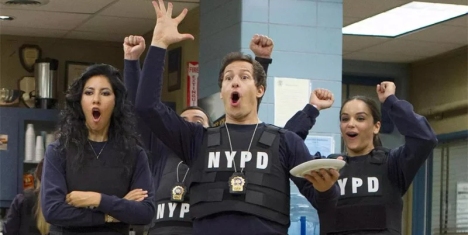
I published a new In the Frame piece at Escapist Magazine this evening. With self-isolation, I’ve been taking the opportunity to binge some light, feel-good television including Parks and Rec and Brooklyn 99, and I’ve come to the shocking realisation that these network sitcoms are probably the closest thing in the modern television landscape to Star Trek: The Next Generation.

Of course, there are a variety of reasons for this. Most obviously, it seems like the only viable space for that sort of utopian humanism in the modern world is within the narrative trappings of the familiar sitcom, a space where audiences are inherently more accepting of a fundamentally functional world. More than that, there’s a sense in which The Next Generation is perhaps closer to an idealised workplace show than its science-fiction trappings would attest; at its core, The Next Generation is about a band of hopeful and hyper-competent people working together for the common good. That’s admittedly a much harder sell these days than it was a quarter of a century ago, but shows like Parks and Rec and Brooklyn 99 offer a very similar vibe.

You can read the piece here, or click the picture below.


176. Mou Gaan Dou (Infernal Affairs) – World Tour 2020 (#—)

Hosted by Andrew Quinn and Darren Mooney, The 250 is a (mostly) weekly trip through some of the best (and worst) movies ever made, as voted for by Internet Movie Database Users.

This time, Alan Mak and Andrew Lou’s Mou Gaan Dou.

Trouble is brewing in Hong Kong. Crime boss Hon Sam has managed to evade the clutches of Superintendent Wong Chi-shing once too often. There can only be one explanation: Sam has a mole buried within the police department. However, as the police close in around him, Sam becomes convinced that Wong has is own embedded operative. What follows is a tense game of cat-and-mouse as the lines between cop and criminal – and self and other – blur

At time of recording, it was not ranked on the list of the best movies of all time on the Internet Movie Database.

Continue reading

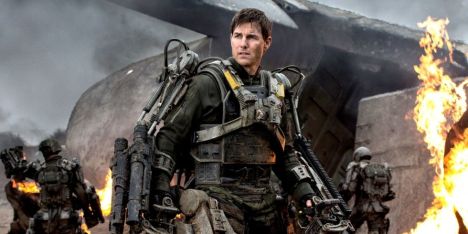
New Escapist Column! On “The Edge of Tomorrow” as the Perfect Video Game Movie…

I published a new In the Frame piece at Escapist Magazine yesterday. With the release of Sonic the Hedgehog, I figured it was the perfect chance to revisit the best video game movie ever: The Edge of Tomorrow.

Look, I freely concede that there are maybe some slight issues with that argument, given that The Edge of Tomorrow isn’t actually or literally based on an established video game franchise. However, there’s something very compelling in the way that The Edge of Tomorrow embraces the aesthetics and sensibilities of video games in order to tell its story, offering a much more faithful replication of the experience of playing a video game than films like Street Fighter or Super Mario Brothers.

You can read the piece here, or click the picture below.

New Podcast! The X-Cast – Season 5, Episode 20 (“The End”)

It’s season finale time on The X-Cast, so it was a privilege to be invited back on to talk about the fifth season finale The End. And it was a delight to join Tony Black for that discussion.

The end of the fifth season was the end of an era for The X-Files. The series would light up the multiplex over the summer with The X-Files: Fight the Future, and would return to the airwaves later that year as a changed show, with the production team having moved from Vancouver to Los Angeles. It was a transition that fundamentally altered the core dynamics of the show, and remains highly contested to this day. The End would be the last episode of The X-Files to be produced in Vancouver until My Struggle I, and a large part of the episode is about bidding a fond farewell to the show’s extended family in that area.

Appropriately enough, it seems like this episode marks a similar turning point for The X-Cast. I was caught completely off-guard by it, so I’ll let you listen and year for yourself. You can listen to the episode here, or click the link below.

Continue reading

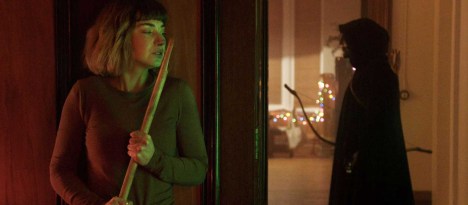
Non-Review Review: Black Christmas (2019)

Black Christmas is an interesting misfire.

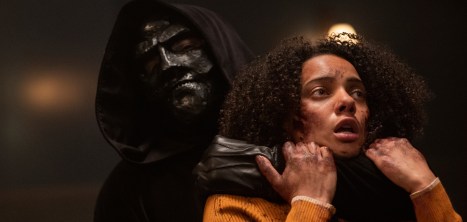
There’s something inherently clever about using the familiar template of a slasher movie to engage with the idea of toxic masculinity and the horrors of campus culture. Sophia Takal and April Wolfe certainly have a lot to say, and producer Jason Blum deserves a great deal of credit for positioning a film like this as part of the larger “social thriller” milieu that includes films like The Invisible Man or Get Out or Us. There’s a lot bubbling through Black Christmas, and it’s great to see a slasher film dabbling in these ideas.

Take a bow.

The biggest problem with Black Christmas is that it simply doesn’t work as a horror film. In terms of basic narrative mechanics and pacing, Black Christmas is a mess. The film suffers from many of the same structural problems that haunt so many disposable horror movies; the characters are thinly sketched, the film’s slow build-up feels a little too slow and its climactic confrontations feel a little too rushed and its internal logic is close to non-existent. These problems are compounded by the fact that actually positioning this movie as a remake creates an extra level of extraction.

Black Christmas has good ideas, but is somewhat lacking in the execution.

Don’t choke.

Continue reading