• Following Us

  • Categories

  • Check out the Archives


  • Awards & Nominations

Non-Review Review: Deadpool 2

Like the original, Deadpool 2 is being talked about as a deconstruction or comedy. It’s not really. At least, not primarily.

Deadpool 2 is most effective as a very simple and straightforward superhero narrative with a shade more violence and a dash more awareness. There are laughs in Deadpool 2. And a few truly great jokes. There are even occasionally moments where Deadpool 2 will take a montage or a couple of scenes specifically to set up a later pay-off. However, these are the exception rather than the rule. And it’s no coincidence that this set-up leads to the biggest laugh in the film.

Not basic Cable.

More to the point, Deadpool 2 never opts for a joke over an efficient plot beat. Deadpool 2 never even distorts its plot in order to cram a few more laughs into the runtime. The gags are largely there to decorate the plot, not to direct it. They’re fun, but they aren’t especially brutal or pointed. There’s never a sense that Deadpool 2 exists as a deconstruction or critique of superhero movies, that it has anything especially insightful to say about the genre beyond accepting that modern audiences are genre-literate.

To be clear, this is not an issue with Deadpool 2. In fact, what’s most remarkable about Deadpool 2, particularly in the age of superhero bloat and franchising, is the relative efficiency with which it tells a simple story. For all the jokes about genitalia and all the pop culture references that crowd the narrative, there is more genuine emotion in Deadpool 2 than there is in Avengers: Infinity War. The characters are better defined, their arcs and motivations clearer, their agency repeatedly affirmed. There is an endearing and infectious earnestness beneath the dick jokes.

Just Joshing.

Continue reading

New Podcast! Scannain Podcast (2018) #17!

A busy Scannain podcast, covering the week in film and other news.

This week, I’m joined by Grace Duffy, Jason Coyle, Ronan Doyle, and Alex Towers to discuss the week in film – both Irish and international. The news includes coverage of Cannes, of Irish success at other international film festivals, and the upcoming release dates of notable Irish films. As usual, we also talk about what we watched, what is being released next week and what is currently in the top ten.

Check it out here, or give it a listen below.

Star Trek: Voyager – Memorial (Review)

Memorial is a great example of Star Trek: Voyager doing a generic Star Trek story.

The episode has a very basic premise that allows for the construction of a science-fiction allegory, the kind of storytelling associated with the franchise dating back to early adventures like The Devil in the Dark or Errand of Mercy. Despite its unique premise and set-up, Voyager had largely embraced the archetypal mode of Star Trek storytelling in its third season. A lot of Voyager episodes feel very broad and very generic, and could easily be adapted for another series – whether inside or outside the franchise.

The real devil in the dark.
Spoiler: It’s us.

There any number of episodes that are not rooted in the specific premise of Voyager, that could easily have been reworked or reinvented for another crew at another point. The Chute was a harrowing story about the horrors of mass incarceration and its capacity to turn people into animals. Nemesis was a meditation on killology, in the way that militaries turn soldiers into killing machines. Scientific Method was a treatise on the horrors of animal testing. Random Thoughts was paranoia about “political correctness gone mad” translated into forty minutes of television.

Memorial belongs to a very specific subset of these episodes, something of a bridge between the more generic Star Trek storytelling to which Voyager aspires and a slightly more specific area of thematic interest. Voyager is a series very much engaged with the idea of memory and history, perhaps befitting the Star Trek series that straddles the twentieth and twenty-first century. Episodes like Remember, Distant Origin and Living Witness are all archetypal Star Trek stories, but they are built around ideas of particular interest to Voyager.

The past never remains buried.

As the title implies, Memorial belongs to that very specific subset of episodes. It is easy to imagine a version of Memorial starring James Tiberius Kirk, Jean-Luc Picard, Benjamin Lafayette Sisko or Jonathan Beckett Archer. It is a generic Star Trek episode that could work with any crew, perhaps meaning something slightly different in each context. (On Star Trek: Deep Space Nine, it would be an “O’Brien must suffer!” episode. In fact, Hard Time is quite close.) However, it is an episode that engages overtly with ideas that are of great interest to Voyager.

Memorial is about the importance of memory and history, even in a world where time seems to have lost all meaning.

Standing watch over history.

Continue reading

78. The Grand Budapest Hotel (#192)

Hosted by Andrew Quinn and Darren Mooney and this week with special guests Stacy Grouden and Charlene Lydon, and featuring Phil Bagnall, The 250 is a (mostly) weekly trip through some of the best (and worst) movies ever made, as voted for by Internet Movie Database Users. New episodes are released every Saturday at 6pm GMT, with the occasional bonus episode thrown in.

This time, Wes Anderson’s The Grand Budapest Hotel.

The Grand Budapest Hotel is a glorious ruin on the continent of Europe. A visiting author happens to strike up a conversation with the establishment’s owner, who crafts an epic and heartwarming tale of love, murder and scandal against the backdrop of the chaotic mid-twentieth century.

At time of recording, it was ranked the 192nd best movie of all time on the Internet Movie Database.

Continue reading

New Podcast! Scannain Podcast (2018) #16!

A somewhat smaller and more intimate Scannain podcast than previous weeks.

This week’s episode features the return of Niall Murphy on hosting duties, while I am joined by Alex Towers on the panel. The news includes coverage of the Fastnet Film Festival, The Image You Missed screening in New York and the latest appointments to the Irish Film Board. As usual, we also talk about what we watched, what is being released next week and what is currently in the top ten.

Check it out here, or give it a listen below.

Star Trek: Voyager – Virtuoso (Review)

Virtuoso is an interesting companion piece to Blink of an Eye.

Blink of an Eye was in many ways an exploration and reflection of Star Trek as a multimedia franchise, looking at the way in which the franchise has touched and shaped contemporary culture in the thirty-odd years since its inception. As part of this, the episode touched on fandom in a variety of ways, whether the abstract fandom of those individuals inspired by the series to accomplish great things or the more specific fandom including merchandise. Blink of an Eye was very much an episode about loving Star Trek.

Music to our ears.

As a result, Virtuoso feels like a very strange choice to directly follow Blink of an Eye. The two episodes are not connected by plot, outside of the basic idea that the EMH might spend an extended period of time on an alien planet without access to Voyager. After all, Star Trek: Voyager had committed itself to producing standalone episodic storytelling. However, Virtuoso is also something of a metaphor for Star Trek fandom, a look at what it is to love a piece of popular entertainment and to eagerly embrace it.

Unfortunately, the proximity to Blink of an Eye does no favours for Virtuoso, emphasising the script’s weaknesses and tone-deafness. Virtuoso is an episode that feels very pointed and cynical in its portrayal of fandom, very broad and very unpleasant. It is a clumsy and muddled piece of television, on that struggles to hit the right notes.

Small pleasures.

Continue reading

Non-Review Review: On Chesil Beach

On Chesil Beach is a messy and awkward adaptation of Ian McEwan’s story, adapted by the writer from his own work.

McEwan’s source material might be better described as a “novella” than as a “novel”, with the writer describing it as such and the book generating some small controversy when shortlisted for the Booker Prize. Indeed, the film strains when it tries to extend the novella’s core idea out into a feature-length film, often struggling to find focus and to hold its attention. The result is a very uneven piece of work.

Love on the rocks.

However, On Chesil Beach provides an intriguing mess of interesting ideas and solid performances. Saoirse Ronan and Billy Howle cannot hold the film together, but provide a set of interesting characters that provide the closest thing that the film has to a throughline. The film works best when it is willing to focus on these two characters together, when it moves away from its free-association aesthetic towards something more concrete.

On Chesil Beach never quite coheres into a fully-formed film, often feeling more like a televison movie or a stage play than a theatrical release. Still, there is something interesting playing beneath the surface, often lost in heavy-handed writing or awkward segues.

It ain’t no picnic.

Continue reading

77. Avengers: Infinity War – This Just In (#10)

Hosted by Andrew Quinn and Darren Mooney, and this time with Tony Black, This Just In is a subset of The 250 podcast, looking at notable new arrivals on the list of the 250 best movies of all-time, as voted for by Internet Movie Database Users.

This time, Anthony Russo and Joe Russo’s Avengers: Infinity War.

Continue reading

May the Fourth Be With You! 25% “Opening The X-Files” at McFarland Books, May 4-11!

Quick post to announce that my publisher McFarland Books are having a massive sale on their pop culture books to mark the week of May 4th. Using the coupon PopCulture25, readers can get a discount of one quarter off the retail price of a wide range of books covering film, television and pop culture. If you’ve been waiting for an excuse to pick up a book, this is a good one.

I have a bit of a vested interest in the sale, given that McFarland published my book. Opening the X-Files offers a critical history of the original run of The X-Files, all the way from The Pilot through to I Want to Believe. I’m very proud of the book, and very grateful of the opportunity that McFarland gave me. And the reviews have been quite kind.

It has been described as “an informative and engrossing critical history of the series”, “one of the most confident, assured and enlightening reads on Chris Carter’s seminal show ever produced”, and “one of its essential texts.” To quote the great Jose Chung, I’m going to call those an unqualified rave!

You can visit the company’s website here. You can view all the books included in the offer here. You can order my book, Opening the X-Files, here.

All you need to need to do is just enter the code PopCulture25 when you reach the check-out. No muss, no fuss.

May the fourth be with you!

Non-Review Review: Entebbe

Entebbe is an ambitious, and very messy, hostage drama.

The events that took place in Entebbe Airport in Uganda during June and July 1976 are fascinating. The crisis been adapted for the screen on several occasions already. Anthony Hopkins, Elizabeth Taylor and Richard Dreyfuss starred in Victory at Entebbe later that same year. The following year, Irvin Kershner directed Raid on Entebbe with Charles Bronson and Yaphet Kotto. That same year, Israel produced its own take on the tale in Operation Thunderbolt, which earned an Academy Award nomination for Best Foreign Language Film.

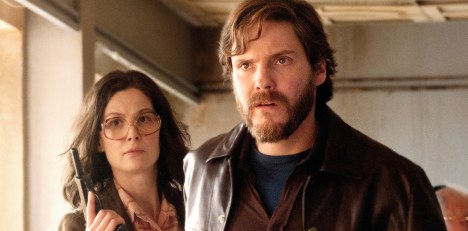
A Brühl-tal experience…

The events leading up to the daring recovery mission are deeply fascinating, with any number of interesting angles on the larger story. It is tempting to look at the events in terms of the tenure of General Idi Amin, who made Uganda a base of operations for these terrorists, much like Last of King of Scotland did. It is possible to look at the Israeli soldiers who trained to mount the rescue mission, knowing the dangers into which they were venturing. It might be reasonable to treat the events as a formative experience for the (then) young state of Israel.

Entebbe attempts to tell the story through all these different prisms at the same time, to offer a holistic perspective on the events that captures the surreal nature of events and the absurd stakes for all of the players caught up in this perilous game. Entebbe bites off a lot more than it can chew, never quite managing to balance the competing demands of the objects of its focus. Entebbe is an intriguing film, but one that feels fractured and unfocused.

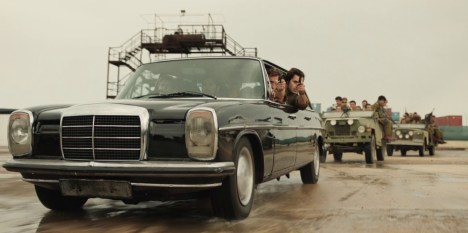
Merc task force.

Continue reading