• Following Us

  • Categories

  • Check out the Archives


  • Awards & Nominations

New Podcast! Scannain Podcast (2018) #23!

We’re now completely caught up on the Scannain podcast. And with new and improved sound design, thanks to the wonderful Donnacha Coffey.

This week, I join a fantastic panel including Grace Duffy, Jason Coyle, Ronan Doyle, and Donnacha Coffey from Filmgrabber. As ever a wide-ranging discussion took place, including talk about Set It Up and Netflix’s niche, the incredibly vibrant world of Streets of Fire, the continuing disaster that is Star Wars fandom after the release of Solo: A Star Wars Story and whether Lady Bird is the best film of the year so far. New releases include The Happy Prince, Kissing Candice and Ocean’s 8.

Give it a listen at the link, or check it out below.

Sound Off: Settling the Score on “Last Jedi’s” Soundtrack-Only Version

The score-only version of Star Wars: Episode VIII – The Last Jedi is marvelous for a number of reasons.

Announced by director Rian Johnson as a special feature available on certain digital releases of the feature film, the premise is remarkably simple. The score-only version of The Last Jedi presents the feature film complete and uneditted, but without any dialogue or sound effects. The sound mix is completely dominated by John Williams’ score for the film, from the opening Star Wars fanfare to the music playing over the closing credits. Over the course of the movie’s two-and-a-half hour runtime, not a single word is spoken and not a single laser blast is heard.

As such, the score-only version of The Last Jedi is the closest thing imaginable to a blockbuster silent movie in the current market. After all, silent films are at best a curiousity in the modern market place, often relegated to retrospectives and festival screenings, with the occasional nostalgic release like The Artist. In fact, black and white films are noticeably more common than silent films in the current market. As such, the score-only version is an intriguing piece of work. It obviously showcases John Williams’ score, and the way in which that score shaped and informs the images on the screen.

But it also demonstrates that Rian Johnson is the best director to have worked on the Star Wars franchise, from a purely technical standpoint.

Continue reading

57. Star Wars: Episode VII – The Force Awakens (#244)

Hosted by Andrew Quinn and Darren Mooney, this week joined by special guest Grace Duffy, The 250 is a (mostly) weekly trip through some of the best (and worst) movies ever made, as voted for by Internet Movie Database Users. New episodes are released every second Saturday at 6pm GMT, with the occasional bonus episode between them.

This time, J.J. Abram’s Star Wars: Episode VII – The Force Awakens.

A long time ago in a galaxy far away, the First Order and the Rebellion struggle for control of the cosmos. Against this backdrop, three unlikely heroes ascend, embarking upon a mythic journey that will reveal dark secrets and promise new hope.

At time of recording, it was ranked the 244th best movie of all time on the Internet Movie Database.

Continue reading

Non-Review Review: Star Wars – Episode VIII: The Last Jedi

Star Wars: Episode VIII – The Last Jedi is visually sumptuous, thematically rich, but narratively clumsy.

There is a lot to love in The Last Jedi. Most notably, the gamble that Disney took on director Rian Johnson has paid off. The Last Jedi looks and feels like no other Star Wars movie. It is not simply the intimacy with which Johnson stages conversations separated by half a galaxy, nor the high quality visual effects. There is an endearing and appearing sense of wonder to The Last Jedi, as if watching a small child playing with action figures and humming the lightsabre noise to himself. The Last Jedi feels like the work of somebody continuing and expanding a story, more than just recreating it.
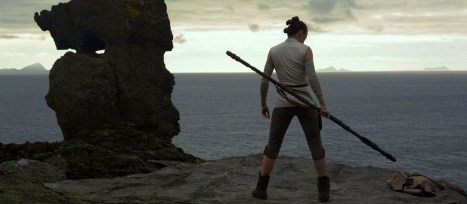
Rey of Hope.

Indeed, the best moments in The Last Jedi struggle to reach beyond what audiences have come to expect from the franchise. Some of this is inherited from the ambition of Rogue One: A Star Wars Story, particularly in early scenes that emphasise the human cost of this galactic struggle. However, there are other more ponderous moments in The Last Jedi when it seems like Johnson and his characters are asking profound questions of the franchise itself, poking at the underlying assumptions that power this box office behemoth.

This was essential for the success of The Last Jedi. Star Wars: Episode VII – The Force Awakens was an exercise in nostalgia that worked so well because of three factors; it was a palette cleanser after the prequels, it innovated by pushing background characters to the narrative foreground, and it was released more than a decade after Star Wars: Episode III – Revenge of the Sith. Nostalgia is not enough to sustain a franchise that will be releasing one major motion picture a year for the foreseeable future. The Last Jedi needs to find something interesting to say about a forty-year-old franchise.
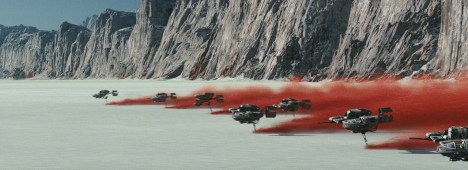
Seeing red.

In its best moments, it seems like The Last Jedi is lining up its arguments. It looks at the Star Wars universe through new sets of eyes, often in a literal sense. Johnson is not a director in the vein of Lucas or Abrams. Johnson is not a director who feels entirely comfortable with spectacle and scale. Instead, Johnson offers a tighter and closer glimpse at the universe and the people who inhabit it. There is a lot of focus on faces in The Last Jedi, shadows moving across them, eyes either focused or trying desperately to look away.

However, The Last Jedi ultimately lacks the courage of its convictions. The bolder and more provocative suggestions at the heart of the narrative remain just that, nothing more than implications or subtext. The Last Jedi has intriguing and bold ideas, but lacks the resolve to follow them through to their logical conclusions. Although undoubtedly less nostalgic than The Force Awakens, The Last Jedi remains too trapped by its own past to fully chart its own course and map its own destiny.

Shore thing.

Continue reading

11. Rogue One: A Star Wars Story – This Just In (#152)

Hosted by Andrew Quinn and Darren Mooney, This Just In is a subset of the fortnightly The 250 podcast, looking at notable new arrivals on the list of the 250 best movies of all-time, as voted for by Internet Movie Database Users.

This time, Gareth Edwards’ Rogue One: A Star Wars Story.

podcast-rogueone1

Continue reading

Non-Review Review: Rogue One – A Star Wars Story

Rogue One: A Star Wars Story feels torn between two extremes.

On one extreme, it is an epic war movie about a universe that is caught in turmoil. Through the lens of science-fantasy, Rogue One can tease out all manner of interesting ideas about the conflict at the heart of the Star Wars franchise. What does an interstellar war look like in the early years of the twenty-first century? What is the view of this epic confrontation from outside the cockpit of an X-Wing or the Millennium Falcon? There are points at which Rogue One almost plays as a war film that just happens to be set within the Star Wars universe.

Too TIE-d to continuity?

Too TIE-d to continuity?

On the other extreme, Rogue One often feels like a collection of deleted scenes intended to bridge Star Wars: Episode III – Revenge of the Sith to Star Wars: Episode VI – A New Hope. The basic premise of the film involves the theft of the Death Star plans that propel the plot of A New Hope, which should be enough to connect it to the parent franchise. Instead, the film is saturated with cameos and callbacks. While it makes sense for a number of minor characters to overlap, Rogue One contorts to include two of the franchise’s biggest characters.

So Rogue One is trapped between being an exciting and exhilarating glimpse of an existing franchise from a new perspective, and feeling just a little bit too much like fan fiction. It is no surprise that the former is much more interesting than the latter.

Watered down?

Watered down?

Continue reading

Star Trek: Voyager – Fair Trade (Review)

In theory, Fair Trade is precisely the episode that Star Trek: Voyager needs right now.

From the outset, the show has struggled with several major problems. Superficially, Voyager has struggled to distinguish the Delta Quadrant from the Alpha Quadrant, to the point that the Kazon felt like low-rent Klingons and the various aliens-of-the-week seemed largely indistinguishable from the aliens-of-the-week featured on the sibling shows. More fundamentally, the show failed to conjure an air of mystery and intrigue about the region. Everything about the show felt too safe, right down to the characters. This was a show where terrorists became model officers.

Venting plasma...

Venting plasma…

Fair Trade feels like it should offer the perfect remedy to all of this. The opening scenes find Voyager brushing up against “the Nekrit Expanse.” It is a region of space that is pointedly different and alien. Neelix has no idea what lies beyond. The sensors cannot penetrate it. Voyager is forced to dock at a local space station to take supplies, one crowded with aliens of multiple species engaged in shady dealings. More than that, the episode hinges on the neglected character of Neelix. It returns to early undeveloped suggestions the Neelix is not all he claims to be.

However, in practice, Fair Trade is disappointing. The episode lacks the courage of its convictions, both as a script of itself and as clear demarcation within the third season. It is a show rich with promise that offers up any number of intriguing ideas, but lacks the courage necessary to follow through on them.

In a bit of a Wix.

In a bit of a Wix.

Continue reading

Star Trek: Deep Space Nine – Shattered Mirror (Review)

This February and March, we’re taking a look at the 1995 to 1996 season of Star Trek, including Star Trek: Deep Space Nine and Star Trek: Voyager. Check back daily Tuesday through Friday for the latest review.

Shattered Mirror and The Muse represent the nadir of the fourth season of Star Trek: Deep Space Nine.

To be fair, it could be worse. Neither episode is Let He Who is Without Sin or Profit and Lace or The Emperor’s New Cloak. Neither is a good episode by any measure, and they certainly rank among the weakest episodes in the show’s seven year run. However, they are more misbegotten lumps of clay than spectacular disasters. Still, as critical defenses go, that is a fairly unconvincing effort. “It could be a lot worse” is hardly the most ringing of critical endorsements.

A close shave...

A close shave…

On the other hand, the fourth season of Deep Space Nine is a fairly spectacular piece of television when taken as a whole. There is a strong argument to be made for the fourth season as the most consistently entertaining season of Deep Space Nine, which stands it in good stead when placing it in the context of the franchise as a whole. The fourth season of Deep Space Nine is one of the best seasons that the franchise ever produced, right alongside the third season of Star Trek: The Next Generation.

However, even the third season of The Next Generation had its weaker moments; The Price and Ménage à Troi come to mind. The realities and demands of television production mean that a perfect twenty-six episode season without any duds is an aspirational object rather than an achievable goal. The constant churn required to produce twenty-six forty-five minute blocks of television within nine or ten months means that not every episode is going to end up perfectly sculpted. Some will be great, some will be bland. Some will be bad.

ds9-shatteredmirror11a

Yanking his chain…

Continue reading

Non-Review Review: Star Wars – Episode VII: The Force Awakens

Star Wars: Episode VII – The Force Awakens is the Star Wars film you’re looking for. Mostly.

In many respects, Star Wars was the film the helped to launch the modern “blockbuster” model of cinema, and a large part of The Force Awakens is the reassurance that not too much has changed in the intervening years. Sure, there are a few script tweaks to reflect more modern tastes for the post-Dark Knight era, but the basic storytelling engine is still the same underneath. If The Force Awakens is a hybrid, it is a hybrid fashioned from the parts of the three original Star Wars films and just a dash of something more twenty-first century.

The Force is strong with this one...

The Force is strong with this one…

After the issues with the prequels, it is reassuring to know that the engine still runs. The franchise’s history as one of the forerunners of blockbuster cinema makes it perfectly suited to JJ Abrams’ nostalgic stylings. Abrams gets a lot of flack for his evocation of seventies and eighties blockbuster cinema, but he does have a fundamental understanding of how (and why) it works. Ever the keen student of Spielberg and vintage Hollywood blockbusters, director JJ Abrams is able to effortlessly blend that classic aesthetic with a contemporary sensibilities.

There are moments when The Force Awakens threatens to suffocate under the weight of what came before, but it largely succeeds on its own terms as a doorway to something new and exciting.

Handover from one generation to the next...

Handover from one generation to the next…

Continue reading

Star Trek: Enterprise – Precious Cargo (Review)

Next year, Star Trek is fifty years old. We have some special stuff planned for that, but – in the meantime – we’re reviewing all of Star Trek: Enterprise this year as something of a prequel to that anniversary. This April, we’re doing the second season. Check back daily for the latest review.

Precious Cargo is a disaster. It is a spectacularly terrible piece of television. It is the kind of episode that fans point towards when they want to belittle or diminish Star Trek: Enterprise.

To be fair, it isn’t as if the show has the monopoly on bad episodes of the franchise. After all, the original Star Trek gave us And The Children Shall Lead, The Way to Eden and The Apple. Star Trek: The Next Generation gave us Code of Honour, Angel One, The Child and Up the Long Ladder. Star Trek: Deep Space Nine produced Let He Who Is Without Sin, Profit and Lace and The Emperor’s New Cloak. Star Trek: Voyager is responsible for Fair Haven and Spirit Folk. When you produce twenty-something episodes of television a year, terrible episodes happen.

We are Trip, of Bored...

We are Trip, of Bored…

Indeed, they will keep happening. Precious Cargo cannot even make an indisputable claim to being the weakest story of the troubled second season. There are fans who will argue that A Night in Sickbay or Bounty deserve that accolade. Nevertheless, it seems like everyone is agreed that Precious Cargo is a disaster from start to finish. It is a collection of pulpy science-fiction clichés that feels overly familiar, a lazy comedy without any solid jokes and a complete lack of chemistry between the two leads.

Precious Cargo is a spectacular misfire, an ill-judged and poorly-constructed addition to the franchise.

"Wait, another Trip comedy episode?"

“Wait, another Trip comedy episode?”

Continue reading