• Following Us

  • Categories

  • Check out the Archives


  • Awards & Nominations

426. Kill Bill, Vol. 2 (#—)

Hosted by Andrew Quinn and Darren Mooney, this week with special guest Darcie Faccio, The 250 is a (mostly) weekly trip through some of the best (and worst) movies ever made, as voted for by Internet Movie Database Users. New episodes are released every second Saturday at 6pm GMT, with the occasional bonus episode between them.

This week, Quentin Tarantino’s Kill Bill, Vol. 2.

Having crossed two names off her list, the Bride continues her rip roaring rampage of revenge against the people who put her in a coma. As she finds herself on a collision course with her mentor and lover Bill, the Bride races towards a revelation that she could not possibly predict.

At time of recording, it was not ranked on the list of the best movies of all time on the Internet Movie Database.

.

Continue reading

425. Kill Bill, Vol. 1 (#151)

Hosted by Andrew Quinn and Darren Mooney, this week with special guest Darcie Faccio, The 250 is a (mostly) weekly trip through some of the best (and worst) movies ever made, as voted for by Internet Movie Database Users. New episodes are released every second Saturday at 6pm GMT, with the occasional bonus episode between them.

This week, Quentin Tarantino’s Kill Bill, Vol. 1.

A brutal mass murder at a wedding in El Paso, Texas, leaves a sole survivor: an anonymous pregnant woman, a former assassin who tried to escape her life of murder and mayhem for something more tranquil and serene. However, her old life was not finished with her. Four years later, the would-be bride wakes up and embarks on a roaring rampage of revenge driven by a single objective. She is going to Kill Bill.

At time of recording, it was ranked 151st on the list of the best movies of all time on the Internet Movie Database.

Continue reading

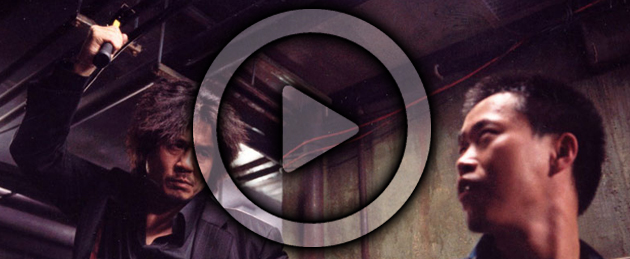
379. Oldeuboi (Oldboy) (#74)

Hosted by Andrew Quinn and Darren Mooney, and this week with special guests Grace Duffy and Andy McCarroll, The 250 is a weekly trip through some of the best (and worst) movies ever made, as voted for by Internet Movie Database Users. New episodes are released Saturdays at 6pm GMT.

This week, Park Chan-wook’s Oldboy.

One night in 1988, Oh Dae-su is snatched off the street. He is taken to a mysterious hotel room, where he is locked away without any human contact. Then, fifteen years later, he is just as suddenly released. Forced to adjust to life outside his prison, Oh Dae-su sets out to discover why he was imprisoned for fifteen years. And, perhaps just as importantly, why he was suddenly released.

At time of recording, it was ranked 74th on the list of the best movies of all time on the Internet Movie Database.

Continue reading

New Escapist Column! On the Morality Plays that Ground Quentin Tarantino’s “Reservoir Dogs” and “Pulp Fiction”…

I published a new In the Frame piece at The Escapist this evening. Yesterday was Thanksgiving and Christmas is fast approaching, so it seemed like as good a time as any to talk about the heartwarming morality of director Quentin Tarantino.

Tarantino arrived in the early nineties as something of a provocateur, and caused no shortage of outrage among older and more traditional audiences. One of the more frequent criticisms thrown at Tarantino suggested that the director was nihilistic, that he presented worlds without meaning or sense beyond violence and chaos. While this might superficially appear to be true in that many of Tarantino’s films feature both violence and chaos, it fundamentally misunderstands the director.

On the contrary, Tarantino is arguably one of America’s most morally conscious filmmakers. His films present characters with worlds in which arbitrary forces sweep through their lives, reflecting the reality of living in a world outside of an individual’s control. However, many of Tarantino’s protagonists react to that chaos by fashioning their own order out of it – discerning their own meaning, constructing their own reasons. Although obscured by Tarantino’s preference for non-linear structure, his stories are often miniature morality plays.

You can read the piece here, or click the picture below.

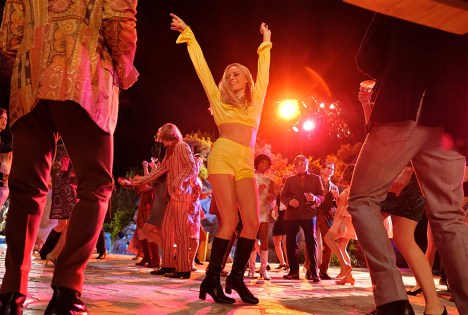
143. Once Upon a Time… in Hollywood – This Just In (#127)

Hosted by Andrew Quinn and Darren Mooney, and this week with special guest Phil Bagnall, The 250 is a (mostly) weekly trip through some of the best (and worst) movies ever made, as voted for by Internet Movie Database Users. New episodes are released every Saturday at 6pm GMT.

This time, Quentin Tarantino’s Once Upon a Time… in Hollywood.

It’s February 1969. Everything is changing. Hollywood itself seems to be facing an inevitable collision with the turmoil that has engulfed the rest of the world. Against this backdrop, lives intersect and collide. Returning from the United Kingdom, Sharon Tate moves in next door to washed up fifties western star Rick Dalton, both completely unaware of how profoundly their lives will impact one another.

At time of recording, it was ranked 127th on the Internet Movie Database’s list of the best movies of all-time.

Continue reading

“Ladies, That Was Fun”: What’s Happening Under the Hood in “Death Proof”…

Okay… Warren’s sending over shots, and you know the house rules. If he sends over shots, you gotta do them.

What?

Hey, them’s the rules, baby.

Warren says it, we do it!

I love that philosophy! “Warren says it, we do it.”

The filming of Kill Bill, Vol. 1 and Kill Bill, Vol. 2 took nine arduous months. There were a variety of reasons for this, most obviously that the film represented a departure from the stylistic sensibilities and aesthetic associated with Quentin Tarantino. A director best known for his snappy dialogue and vivid characters was pushing himself outside of his comfort zone, building a movie that would incorporate elaborate action sequences and even an animated interlude. In fact, the films came after something of a short break in the director’s career. The six year gap following Jackie Brown was the longest in his career to that point.

As shooting was winding down, an incident occurred on the set. Details of that incident would not be made public for more than a decade and a half, although it would have a profound impact on all involved. By all accounts, Tarantino pressured Uma Thurman into driving a stunt car herself, leading to an accident. Thurman recalls, “The steering wheel was at my belly and my legs were jammed under me. I felt this searing pain and thought, ‘Oh my God, I’m never going to walk again.’” Thurman was not paralysed, but she was scarred by the experience, with a “permanently damaged neck and […] screwed-up knees.”
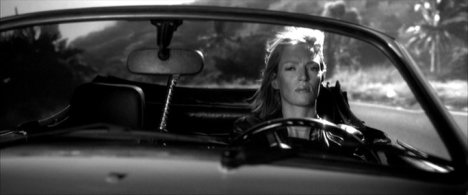
It was an act of reckless malfeasance from a director who had – with Reservoir Dogs and Pulp Fiction – announced himself as one of the preeminent directorial voices of his generation. Tarantino is remarkable among directors of his generation for establishing a cult of personality, being as effective on the chat show circuit as behind the camera. Tarantino has been known for making brass pronouncements and asserting his authority, from his famous assertion that he is god within his fictional universes to his insistence on shutting down lines of questioning in interviews to rejecting reporters’ questions outright.

The case involving Tarantino and Thurman is perhaps more complicated than a lot of the similar stories of directorial abuse that have entered the spotlight since the #metoo movement rippled through Hollywood. This complexity is compounded by the fact that Thurman has publicly forgiven Tarantino for his part in the accident, and for Tarantino’s contrition on that point. (Tarantino’s public support of progressive causes like Black Lives Matter also plays a part, even if there is still a larger debate to be had about Tarantino’s relationship with African American culture.)
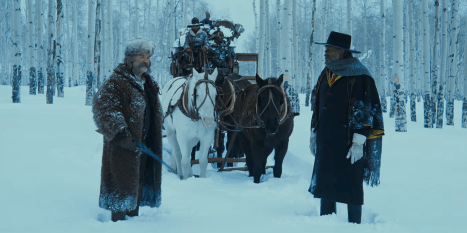
Even if none of this was made public until after the release of The Hateful Eight, these details hang over a lot of Tarantino’s work since the accident. Tarantino has conceded, “Beyond one of the biggest regrets of my career, it is one of the biggest regrets of my life.” It is notable that Tarantino had always been particularly close to Thurman. The story for the Kill Bill films is credited to “Q and U”, the pair practically living together during the development of the story. (Tarantino allegedly promised the script to the actor as a thirtieth birthday present.)

The tragedy echoes through a lot of Tarantino’s subsequent work. It is notable, for example, that a lot of Tarantino’s later work focuses explicitly on the idea of rewriting history. Inglourious Basterds famously offers an alternate ending to the Second World War, a striking piece of historical revisionism. There are also shades of the tragedy to be found in Once Upon a Time… in Hollywood, which features two protagonists that are – to quote actor Brad Pitt – “two sides of the same coin.” Rick is a washed-up has-been who worries he is out of touch. However, his best friend is a reckless stuntman who may have killed his wife.
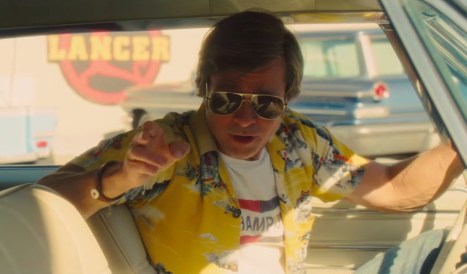
A lot of the discussion around Once Upon a Time… in Hollywood has likened it to Inglourious Basterds. This makes a great deal of sense. Both stories are effectively historical revisionist fairy tales. Notably, the opening chapter of Inglourious Basterds is even helpfully subtitled “Once Upon a Time in Nazi-Occupied France.” It is a logical point of comparison, but one that conveniently glosses over an even more obvious reference point for Once Upon a Time… in Hollywood within Tarantino’s filmography.

That point of comparison is Death Proof.
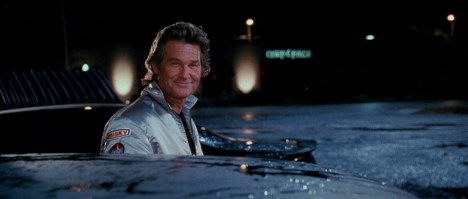
Continue reading

Non-Review Review: Once Upon a Time… In Hollywood

Once Upon a Time… in Hollywood is a fairy tale, for better and for ill.

Continue reading

New Podcast! The X-Cast – Season 4, Episode 13 (“Never Again”)

I had the pleasure of popping by The X-Cast again, this time to discuss Never Again with the wonderful Deana Ferrer.

Long-time readers of the blog will know (or at least suspect) that Never Again stands out as one of my favourite episodes of The X-Files. Most days, it’s a toss up between that and One Breath. There are a lot of reasons for that, but I think the most obvious is that – as I’ve gotten older – I’ve found myself identifying more with Scully than with Mulder. Scully’s anxieties and uncertainties here, her self-doubt and her insecurity, all resonate with me more and more as I get older. More than any other X-Files episode, I understand the feelings that drive Never Again.

Of course, there’s more to it than that. It is also a fantastically constructed episode of television, an interesting illustration of how continuity is an external construct in long-form narratives, and something that pushes very strongly at certain ideas of what The X-Files is and what The X-Files is about. So it was a pleasure to join Deana to discuss the episode, to break it down and to try to make sense of it all. I know it’s a controversial episode, so I simply hope that we make a relatively coherent argument for it.

As ever, you can listen to the episode here, or click the link below.

Continue reading

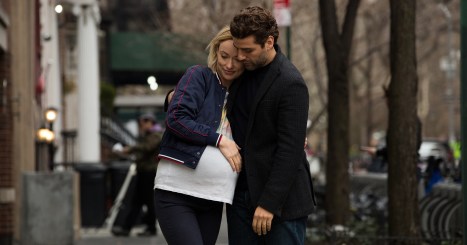
Non-Review Review: Life Itself

Life Itself is a spectacular disaster.

There’s an incredible amount of ego on display in Life Itself, which makes a certain amount of sense. It is an auteur project from Dan Fogelman, written and directed by the guy responsible for This is Us. It is the kind of adult-centric drama that people don’t really make anymore, from the mind responsible for one of the biggest television hits of the decade. On paper, it is easy to see why there was a bidding war over Life Itself on the festival circuit, major studios tripping over one another to offer the largest cheque.

A pregnant pause.

Watching the film, of course, it is easy to see why Life Itself ended up as a cinematic footnote. It was dumped at the United States box office, dead on arrival. It limped into the United Kingdom with a simultaneous theatrical and television release on Sky One, a strategy usually reserved for enjoyable nonsense like Final Score. There is a reason for this. In Life Itself, ego gives way to indulgence. There is an incredibly and obnoxious smugness to Life Itself, the confidence of a truism scrawled clumsily on a beer mat, punctuated by several exclamation marks and underlined for emphasis.

Life Itself watches like the work of an over-eager film student motivated primarily by the profundity of their own insight, having assembled an impressive cast and offering a globetrotting story. Unfortunately, Life Itself is decidedly less fun than the best of those pseudo-profound philosophical treatises, delivered with a suffocating sense of its own self-importance.

Some significant (An)tonal issues.

Continue reading

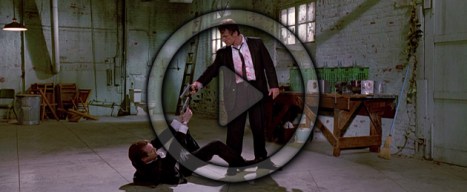
93. Reservoir Dogs (#76)

Hosted by Andrew Quinn and Darren Mooney, The 250 is a (mostly) weekly trip through some of the best (and worst) movies ever made, as voted for by Internet Movie Database Users. New episodes are released every Saturday at 6pm GMT, with the occasional bonus episode thrown in.

This time, Quentin Tarantino’s Reservoir Dogs.

Following a disastrous botched jewellery heist, what remains of a criminal gang meets at an abandoned warehouse. Unsure of who to trust and unable to determine what went wrong, these violent men quickly turn on one another while navigating a complex web of shifting loyalties.

At time of recording, it was ranked the 76th best movie of all-time on the Internet Movie Database.

Continue reading