• Following Us

  • Categories

  • Check out the Archives


  • Awards & Nominations

Absolute Identity Crisis (Review/Retrospective)

This January, I’m going to take a look at some of DC’s biggest “events.” This week I’ll be taking a look at Brad Meltzer’s impact on the DC universe.

Identity Crisis is the first in the trilogy of stories that built off the original Crisis on Infinite Earths to offer a fairly significant reevaluation of the modern DC universe, examining where the characters and the fictional landscape was as compared to where it had been decades before. I’ve argued that Marvel went through a similar period of introspection from House of M through to Siege, but DC seemed to engage with the concept on a more direct level. Written by best-selling novelist Brad Meltzer, Identity Crisis is an attempt to explore the rather fundamental changes that occurred in superhero comics during the nineties, often as a direct response to The Dark Knight Returns or Watchmen, giving us a more cynical depiction of the concepts and characters that we take for granted. It’s controversial – as any similar reimagining would be – and, to be frank, it’s a bit of a mixed bag.

However, it’s always fascinating, even if it is grimly so.
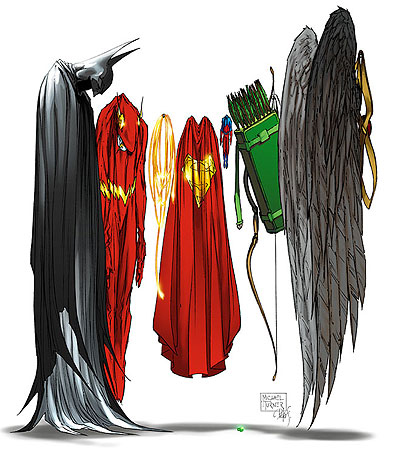
Time to hang it up?

Continue reading

Geoff Johns’ Run on The Flash – The Dastardly Death of the Rogues & The Road to Flashpoint (Review)

This January, I’m going to take a look at some of DC’s biggest “events.” I’ll be starting with the most recent one, Flashpoint, following a week full of Flash stories.

It’s hard not to look at Geoff Johns’ return to The Flash and wonder what might have been. After all, his original run solidified Johns as a talent to watch in the superhero field, fed into his iconic Green Lantern run and paved the way to his ascent up the DC food chain. And it’s quite clear that DC were putting a lot of energy into pushing The Flash as the next “breakout franchise”, clearly hoping that Johns could find an angle on the character and mythos that would push the book up the sales charts to match the Batman and Green Lantern franchises. That obviously didn’t happen, but it feels like a shame because it very nearly could have happened, had things gone a little differently.

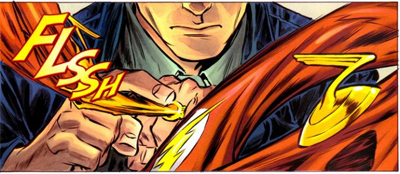
Flash! A-ha! He saves every one of us!

Continue reading

Flash: Rebirth (Review/Retrospective)

This January, I’m going to take a look at some of DC’s biggest “events.” I’ll be starting with the most recent one, Flashpoint, but – in the spirit of the character – we’re going to have a marathon run through Flash stories before we get there. Check back daily this week for more Flash-ified goodness…

From the outset, Flash: Rebirth was going to be an infinitely more complex endeavour for writer Geoff Johns than Green Lantern: Rebirth had been. Both miniseries aimed to firmly establish an older legacy character (in both cases, the iteration of the character active in the late fifties/early sixties) as the core of that particular franchise, replacing their replacements, as it were. However, Hal Jordan had been absent for about ten years, and had been hovering around the DC Universe in various guises during his absence from the role of Green Lantern. Barry Allen, on the other hand, had been gone twenty years and his appearances had been far scarcer. There had been a whole generation of fans (including the author of this miniseries) who grew up with Wally West as the Flash. Bringing Barry back was always going to be tricky, but here it becomes evident just how tricky.

A darker shade of red?

Continue reading

Geoff Johns’ Run on Justice Society of America – The Next Age, Thy Kingdom Come (Parts I, II & III) & Black Adam and Isis

With the Justice Society of America perhaps the most high-profile title excluded from DC’s upcoming relaunch, I thought I’d bid them farewell by taking a look at writer Geoff Johns’ second run on the title.

The Justice Society of America is one of those titles that DC does so well, one based on legacy. Admittedly Marvel has made some attempts in recent years (The Immortal Iron Fist stands out as a big example, as does Ed Brubaker’s Marvels Project – focusing on the World War II heroes adopted into Marvel’s pantheon), but DC have always handled the nostalgia so well. In fact, the relaunch of the Justice Society of America was prompted by the outstanding success of James Robinson’s original superhero generational saga, Starman. This collection represents the first set of arcs from the third volume – writer Geoff Johns was a veteran from the second volume, which (along with his writing on Flash) brought him to mainstream attention. So he knows the cast of characters and their world inside out.

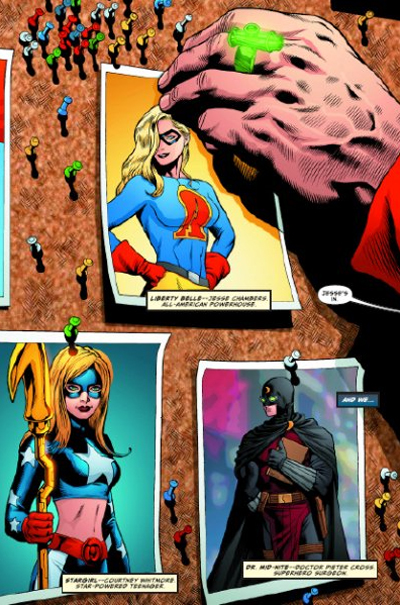
Pin-ups...

Continue reading

Geoff Johns’ Run on The Flash – Rogues, Crossfire & Blitz

What with Geoff Johns returning to write The Flash, I figured I’d dig out some of the old collections of his first run on the title – arguably the run which brought the writer to the attention of comic book readers everywhere. In a run spanning five years, Johns managed to not only offer a suitably impressive successor to Mark Waid’s run on the title, but also tell his own boldly unique story. In a way, the writer’s time on the title can be broken down into two distinct halves – in fact, the final issue collected here is consciously a transition, with the universe being massively re-written and the status quo irrevocably altered. This collection represents the end of that first half, in which Johns was paired with artist Scott Kolins. I think it’s fair to say that the pair made magic on the title.

The Rogues take the opportunity to chill out...

Continue reading

Final Crisis (Review/Retrospective)

This post is part of the DCAU fortnight, a series of articles looking at the Warner Brothers animations featuring DC’s iconic selection of characters. I’ll be looking at movies and episodes and even some of the related comic books. Later on today, we’ll be reviewing Superman/Batman: Apocalypse, so I thought I might take a look at a comic book tale which was heavy on Superman, Darkseid and Batman…

This epic elegy for a doomed civilisation, declining from splendor to squalor. This Final Crisis. This last ditch attempt to save creation itself from a loathing and greed beyond measure.

– Grant Morrison outlines the whole point of the book, in case you weren’t paying attention… in a narration which deserves to be read in the most pompously ridiculous style possible

Look, I could hitch a ride back with you. I have a real talent for gritty drama no one’s ever thought to exploit.

– Merryman makes a pitch for “relevance” in the hopes of escaping comic book “limbo”

Destruction or creation. Everything or nothing. A universe full or a universe empty. Life or anti-life. Grant Morrison certainly lives up to his reputation as a frustrating and challenging author – is Final Crisis the statement of a genre looking to make peace with itself, or nonsensical Silver Age surrealism repackaged for a modern world? Is it pretentious or profound? Insightful or devoid of interest? Can’t it be both, or are these mutually exclusive states?

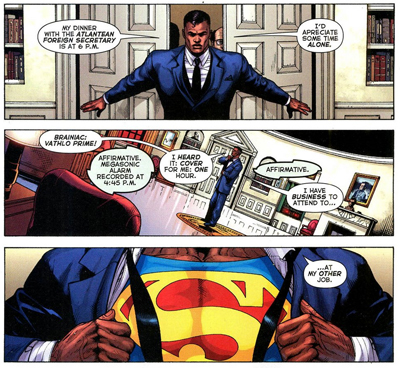
We all knew Obama was Superman…

Continue reading

Justice League: A Better World

This post is part of the DCAU fortnight, a series of articles looking at the Warner Brothers animations featuring DC’s iconic selection of characters. I’ll be looking at movies and episodes and even some of the related comic books. Tomorrow I’ll be reviewing Justice League: Crisis on Two Earths, so I thought it might be worth a look at what a world run by an evil Justice League might look like.

One of the central challenges that the iconic Justice League characters have had to face over the years has been the way that the comic book world has slow and sometimes subtly morphed into something far more sinister than the bright-coloured origin stories of the forties, fifties or even sixties. There was a time when supervillains were a relatively harmless sort, the hero would always save everyone’s life and there would be a “happy ever after” ending thrown on – most obviously in the Silver Age, which produced characters like the modern Flash and Green Lantern. Even the characters who were originally somewhat darker and edgier – Superman and Batman, for example, were originally relatively indifferent to human life – passed through this phase with a healthy respect for a game based around rules – the first being “thou shalt not kill”. However, times changed. Villains went from being theives and irritations to being murderers and rapists. Naturally, the fact that no prison could hold a popular bad guy long enough kinda undermines the good that these heroes do – the Joker is always going to kill more people unless he is eventually killed.Sure, there’s comic book logic at play here – the same way that having genius heroes hasn’t altered the way normal people live too much – but at some point the old fashioned values seem a little outmoded. Somebody suggests that a line should be crossed. Various iterations of the characters have tackled the issue in multiple ways, and A Better World is the attempt by Bruce Timm and the writers of the DC animated universe to address it. 

Being the group's plucky comic relief isn't without risks...

Continue reading

Justice League Unlimited – Flash and Substance (Review)

This post is part of the DCAU fortnight, a series of articles looking at the Warner Brothers animations featuring DC’s iconic selection of characters. To tie into the review of Green Lantern: First Flight today, we thought we’d take a look at an episode centred on that other iconic Silver Age DC hero, the Flash.

Justice League and its spin-off Justice League Unlimited were two very strange shows, at least from a structural perspective. They both featured expansive casts (the latter more than the former, admittedly) – most of which were crammed full of characters new to the DC animated universe. Batman: The Animated Series and Superman: The Animated Series had done a great job establishing the two biggest names, but the bulk of the characters were pretty much blank slates heading into the crossover series. So characters like the Martian Manhunter and Green Lantern relied on episodes centring on them to grow and develop character – although the focus was very much on the ensemble cast. However, my own favourite episode of the show is a more intimate character profile of a character frequently overlooked: the Flash.

Frenemies…

Continue reading

Wednesday Comics: The Flash

Earlier this week I reviewed Wednesday Comics, a rather spanking anthology from DC Comics. I kinda figured, however, it might be worth my while to break out some of those fifteen stories on their own (but not all of them) and discuss them, as it’s easy to lose sight of a particular writer/artist’s work in an anthology. So I figured I’d start with the best of the bunch, The Flash.

I think it’s safe to say that the Flash is on a road to reinvention. Writer Geoff Johns, who pioneered the resurrection of Green Lantern as one of the company’s most successful properties (and one of the most impressively consistent books), is currently working on a relaunched Flash series, that looks to follow the pattern set by Green Lantern. There are rumours of Warner Brothers greenlighting a movie. The scarlet speedster is definitely in an upswing. Still, one of the best things to happen to the character in… quite a while, actually, is this twelve-page comic in Wednesday Comics, written and illustrated by Karl Kerschl, with some help from Brenden Fletcher. It’s easily the best comic of the collection, but it also stands as a proud testament to the possibilities of the character, one of the original Silver Age heroes.

Quit monkeyin' around...

Continue reading

Wednesday Comics

Hawkman unsheathes his knife and crawls into the gasping T-Rex’s jaws, thinking “Sadly, this is not the craziest thing I’ve ever done.”

– Hawkman

Wednesday Comics is an amazing little experiment, a bit of comic book nostalgia delivered by some of the most talented people in the business with a smile on their face and a skip in their step. For those who don’t know, DC Comics – always the more boldly experimental of the two major companies – ran a twelve-week collection of newspaper comic strips. Fifteen strips bundled together, the reader was offered one page of a given comic at a time on a super-sized newspaper sheet, with a full story told week-on-week. It was a bold little experiment and while the whole is almost certainly greater than the sum of its parts, there’s much to love here.

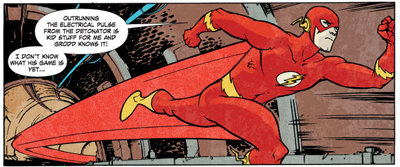
There in a Flash...

Continue reading