• Following Us

  • Categories

  • Check out the Archives


  • Awards & Nominations

Star Trek: Enterprise – The Forgotten (Review)

Next year, Star Trek is fifty years old. We have some special stuff planned for that, but – in the meantime – we’re reviewing all of Star Trek: Enterprise this year as something of a prequel to that anniversary. This August, we’re doing the third season. Check back daily for the latest review.

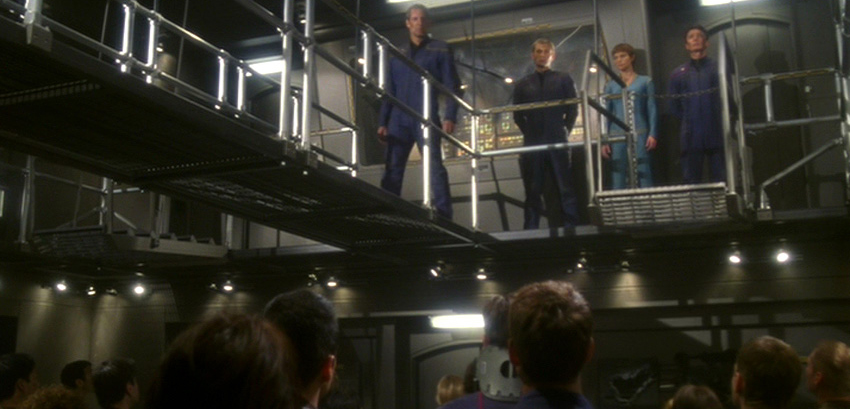
The Forgotten opens with a funeral service.

It is nominally a service for the eighteen people who died in the Xindi attack. (The total was given as seventeen in Damage, but it is possible that Archer is counting the death of Fuller from Anomaly or that another crew member died in the interim from their wounds.) It is a nice illustration of just how strongly the final stretch of the third season embraces serialisation, with the episode’s teaser serving as a coda to the events of the previous two episodes. It is a nice, small touch that sets the mood for the episode ahead.
Funeral for a friend...

Funeral for a friend…

However, it also seems like a very self-aware sequence. Archer is nominally talking about the death of eighteen characters, but he might as well be talking about the looming death of this iteration of the Star Trek franchise, or of the death of innocence that featured in Damage. “We’re in bad shape, I can’t deny that,” Archer tells his crew. He could just as easily be talking about the show, which seemed practically under siege at this point. “But we’re still in one piece. Enterprise is a tough ship. She took more than anyone could ask her to and then some.”

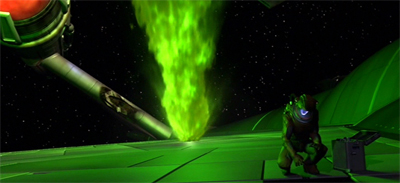
In many ways, the beating that the Enterprise took in Azati Prime reflects the beating that Star Trek: Enterprise had taken over its three year run: from a fandom hostile to the idea of a prequel and unsatisfied with an overly familiar storytelling structure; from a network that had changed hands during the first season of the show; from an eager Hollywood press that could smell blood in the water that had been ripely aged eighteen years; even from former allies like Majel Barrett, William Shatner and Ronald D. Moore.
Tripping over his emotional state...

Tripping over his emotional state…

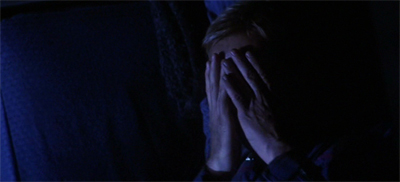
The Forgotten is a story that is very consciously symbolic and metaphorical. It is also something of an oddity. In a way, it feels like a more successful version of what the show attempted with Harbinger, offering a light character-driven story falling between two bigger beats in the larger plot arc. With its fixation on sex and violence, Harbinger was goofy and pulpy in equal measure. In contrast, The Forgotten is an episode that is morose and sombre. It is an episode that very clearly articulates where the third season is going – and where it always has been going.

If Damage was a show about how Star Trek could easily get lost in a grim and gritty War on Terror metaphor, The Forgotten reveals that the third season was never about rationalisation or justification. The Forgotten is a show about how the Star Trek franchise needed to find a way back to its more traditional values.
A massive breach...

A massive breach…

Continue reading

Non-Review Review: Big Game

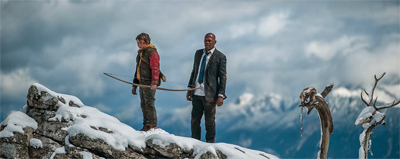
Big Game is a rather unlikely combination. Jalmari Helander’s comedy action movie plays as a cocktail of Airforce One and E.T., a coming of age film blended with a old-fashioned action adventure film. It is a combination that works surprisingly well, allowing Big Game to be both playful and charming. Big Game feels like an homage to classic eighties and nineties cinema – the emotional beats are broad, the action is absurd, the irony is layered on pretty heavy. Big Game is always wry and self-aware, but never quite breaks character.

It is a potent mixture, and one that manages to hold itself together remarkably well across the film’s ninety-minute runtime. Big Game never takes itself too seriously, providing a light and exciting action adventure treat.

“I’m king… er… leader of the free world!”

Continue reading

Star Trek: The Next Generation – The Vengeance Factor (Review)

This January and February, we’ll be finishing up our look at the second season of Star Trek: The Next Generation and moving on to the third year of the show, both recently and lovingly remastered for high definition. Check back daily for the latest review.

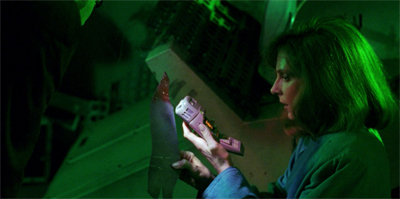
The Vengeance Factor is an ambitious little episode that never quite manages to follow through on its potential. Something of a Riker-centric romance to compliment the Troi-centric romance in The Price, the episode is an exploration of vengeance and generational strife – the cost of feuds that last decades, even centuries. It’s a story where Yuta’s thirst for revenge keeps her young, and one that opens with Crusher tracking the acts of piracy back to the Gatherers using a blood stain on a shard of metal. Subtle, it is not.

However, there’s something almost endearing about The Vengeance Factor, from its very eighties leather Mad Max reject space pirates through to the way that channels the optimism of Star Trek quite well. Although the ending is unbelievably forced, at least it is striking and effective. Far from perfect, and not among the high points of this third season, The Vengeance Factor still marks a sharp improvement from The Price.

There will be blood...

There will be blood…

Continue reading

Star Trek: The Next Generation – Shades of Grey (Review)

This January and February, we’ll be finishing up our look at the second season of Star Trek: The Next Generation and moving on to the third year of the show, both recently and lovingly remastered for high definition. Check back daily for the latest review.

Well. That’s over now. Star Trek: The Next Generation limps across the finish line of its second season with a compilation clip show designed to save money and keep the season’s episode count up. Shades of Grey is frequently cited as the worst episode not just of the second season of The Next Generation, but of the show as a whole. While it’s hard to entirely agree with this assessment – Shades of Grey is cynical and lazy, but it’s neither as sexist as Angel One or The Child nor as racist as Code of Honour or Up the Long Ladder – it is possible to see where that argument comes from.

Like the first season before it, there’s a sense that the second season of The Next Generation might have been better had it ended an episode earlier. Indeed, the second season could have ended with Q Who? and the only episode anybody would really miss would be The Emissary. Unfortunately, one imagines the syndication agreements and network policy made this impossible. While one suspects many of those involved would be happy if Shades of Grey simply faded from existence, it remains part of the show’s syndication package.

This is a little like what this episode feels like...

This is a little like what this episode feels like…

Continue reading

Star Trek: Deep Space Nine – Babel (Review)

Star Trek: Deep Space Nine is twenty years old this year. To celebrate, I’m taking a look at the first season. Check back daily for the latest review or retrospective.

With Babel, we hit the most significant flaw in the first season of Star Trek: Deep Space Nine. Put frankly, Babel is the first story that could easily have worked as an episode of the original Star Trek or of Star Trek: The Next Generation. Indeed, Michael Piller concedes in Captains’ Logs Supplemental – The Unauthorized Guide to the New Trek Voyages that Babel had a history longer than that of Deep Space Nine itself:

We had this premise for over five years at Next Generation. It was written by the same person who wrote “Hollow Pursuits” for us, and we had always been attracted to the idea that you could suddenly lose the ability to use language and communicate, and how people are able to communicate with each other.

This isn’t necessarily a bad thing, but it’s worth noting that the first season of Deep Space Nine was airing concurrently with the sixth season of The Next Generation. If people wanted to see stories that could work on The Next Generation, it made more sense to see them executed on that show by a production team with experience in these sorts of plots.

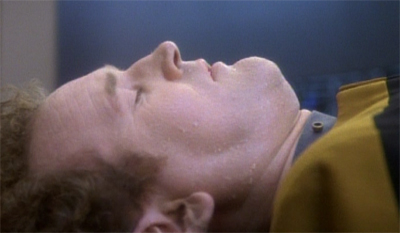
While Babel isn’t a bad episode by any means, there’s a sense that it has been cobbled together from leftovers at another table, and the result isn’t nearly as satisfying as it should be.

Chief concerns...

Chief concerns…

Continue reading

Star Trek – The Return of the Archons (Review)

To celebrate the release of Star Trek: Into Darkness this month, we’ll be running through the first season of the classic Star Trek all this month. Check back daily to get ready to boldly go. It’s only logical.

It is really hard to believe that this is the first time we’ve really had one of these plots, with the Enterprise visiting an alien civilisation, meddling thoroughly and freeing the population from oppression. Of course, that’s probably because the universe seemed so vast an empty in the first few episodes. The only planets seemed to be either lifeless rocks or human colonies. From this point on, the galaxy is going to seem a whole lot busier.

Return of the Archons is a little bit like an expansion of the archetypal Star Trek plot established in What Are Little Girls Made Of? The Enterprise visits an alien world following up on the disappearance of Federation personnel. When they arrive, they discover sinister plans afoot involving evil artificial intelligences that plan on stomping out free will. Kirk promptly uses his humanity to talk the machines into destroying himself.

However, Return of the Archons deals with a whole civilisation trapped in the midst of this sinister robotic plot. Kirk and his crew aren’t strolling through an alien graveyard. This is a living, breathing society. And this is the first time that Kirk would save an entire civilisation.

Some men just want to watch the world burn...

Some men just want to watch the world burn…

Continue reading

Non-Review Review: Three Colours Red

This week we’re taking a look at Krzysztof Kieślowski’s celebrated “Three Colours” Trilogy. We’ll be publishing reviews on Tuesday, Wednesday and Thursday, so check back and sound off.

Three Colours Red has been described as “the best film among equals”, and it’s a position I can’t quite bring myself to disagree with. While I adore the beautiful synergy between the colour, the imagery and the mood of Three Colours Blue, I think that the final film in the trilogy perfectly captures the essence of what director Krzysztof Kieślowski seems to have been trying to accomplish. Three Colours Red beautifully ties together his central themes about the way that people relate to and interact with each other. It’s a film that works well be itself, viewed in isolation, but it’s also a fitting end to a piece of cinematic history. And, like so much of Kieślowski’s work, it’s dense without being oblique and elegant without being exclusive. For all we talk about the depth of meaning in the work, it’s just an astoundingly well-made piece of cinema.

A model citizen?

Continue reading

Non-Review Review: The Three Musketeers (2011)

“Guilty pleasure.” That’s a phrase that feels strangely appropriate when referring to Paul W.S. Anderson’s The Three Musketeers. It’s silly and daft, and has two fairly fundamental flaws, on top of the cheesiness that’s going to divide audiences straight down the middle. However, despite these fairly central and hard-to-avoid problems, it also features a knowing self-awareness, an appealingly straight-forward approach to the fact that is so very silly, a (mostly) great cast and some rather wonderful steam-punk production design. It’s not going to appeal to everybody, but I actually warmed quite a bit to it.

Four of a kind?

Continue reading

Non-Review Review: Transformers 3 – Dark of the Moon

Here’s the thing: I don’t really expect a lot from Transformers: Dark of the Moon. It’s a movie about two rival factions of robots who engage in civil war on Earth. It’s not the stuff of epic tragedy or cinematic masterpieces. It’s designed to offer knock-down brawls, superb CGI, stunning action and a handful of fist-pumping moments. I’m cool with that. I don’t expect any more than that, and – to a certain extent – the movie meets my basic needs. However, despite a superb supporting cast and some superb special effects, the movie feels a little too self-important and po-faced to ever really engage. The final forty minutes are something to behold, but there’s just too much mundane plotting and pompous pseudo-philosophical rambling in the first two hours to really justify it.

Jump in my car...

Continue reading

Non-Review Review: Centurion

I have to admit, I’m a bit disappointed with Neil Marshall. I’ll concede that I genuinely enjoyed Dog Soldiers and The Descent, while acknowledging their flaws. His movies have a tendency to start in the absurd and just keep amping things up until they get unbelievably ridiculous. Even the over-the-top and quite-crap-actually Doomsday still had a lot of energy to carry it through as it gleefully veered through camp straight out into uncharted realms of gratuitous nonsense. On the other hand, Marshall’s latest, Centurion, seems relatively tame. It’s fairly mediocre throughout, which perhaps seems less entertaining because it never has the energy to go too far. And that’s a bit of shame.

The last Fassbender?

Continue reading