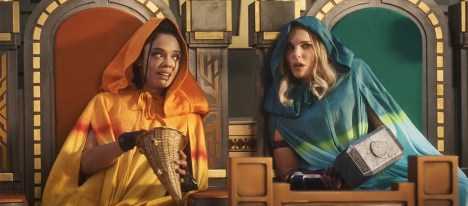
I’m thrilled to be launching movie reviews on The Escapist. Over the coming weeks and months, I will be joining a set of contributors in adding these reviews to the channel. For the moment, I’m honoured to contribute a three-minute film review of Thor: Love and Thunder, which is in theatres this weekend.
I published a new In the Frame piece at The Escapist this evening. With the looming release of Thor: Love and Thunder, it seemed like as good an excuse as any to take a look back at the character of Thor within the Marvel Cinematic Universe, and what makes him unique within the shared universe.
Interestingly, Thor is perhaps the only major character within the shared universe who feels like an old-fashioned superhero rather than a product of the military industrial complex. This is particularly apparent within Kenneth Branagh’s Thor and Taika Waititi’s Thor: Ragnarok, both of which are essentially stories about Thor being exiled from or rejecting the structures of Asgardian society. The result of all this is interesting. In a universe where so many heroes are defined by their relationship to the armed forces, Thor actually feels like a superhero.
You can read the piece here, or click the picture below.
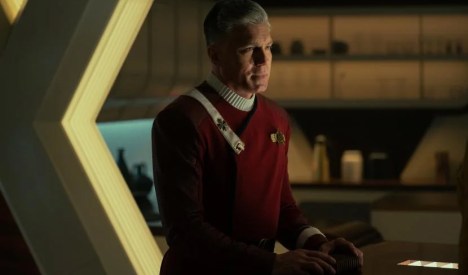
I published a new piece at The Escapist this evening. We’re doing a series of recaps and reviews of Star Trek: Strange New Worlds, which is streaming weekly on Paramount+. The ninth and penultimate episode of the first season released this week, and it seemed like a good opportunity to take a look at the series.
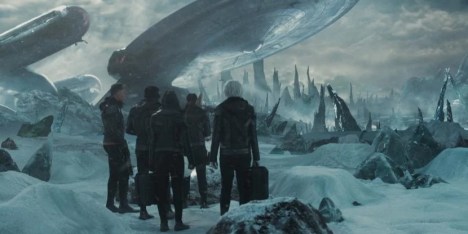
All Those Who Wander is an interesting genre experiment, effectively providing an intersection between Star Trek and Alien. It’s an interesting approach, and very much in keeping with how the franchise has approached other iconic works of science-fiction. However, it also demonstrates the limitations of the approach taken by Strange New Worlds, which seems frustratingly uninterested in what it means to juxtapose the humanism of the Star Trek franchise with the bleak nihilism of the Alien franchise.
You can read the piece here, or click the picture below.
I published a new piece at The Escapist this evening. With the release of the third season of The Umbrella Academy last week, it seemed like an opportunity to take a look back at the show.
The third season of The Umbrella Academy is not about the pandemic, but it stands as an interesting cultural marker of the moment. The show’s production has obviously been impacted by pandemic restrictions, with a lot of shoot on closed sets with a tight cast, and a recurring sense that the show’s world has become empty and withdrawn. While the third season of The Umbrella Academy is not explicitly about the pandemic, it is the rare genre show that manages to translate the experience of the pandemic into a more general mood or tone.
You can read the piece here, or click the picture below.
I published a new piece at The Escapist this evening. We’re doing a series of recaps and reviews of The Boys, which is streaming weekly on Amazon Prime. The third season’s penultimate episode released this week, and it seemed like a good opportunity to take a look at the series.
Herogasm is a show that the production team have wanted to make since the show premiered, and it represents an interesting acknowledgement of the show’s success: the series has been successful enough for Amazon to trust the creatives to build an episode around a superhero orgy. That said, it also demonstrates one of the key strengths of The Boys. Underneath the show’s cras and vulgar exterior, it is a show that loves being a superhero show. It is a deconstruction of the genre’s uncritical power fantasies, but a celebration of the genre’s pulpy potential.
You can read the piece here, or click the picture below.
Hosted by Andrew Quinn and Darren Mooney, and this week with special guest Aoife Barry, The 250 is a weekly trip through some of the best (and worst) movies ever made, as voted for by Internet Movie Database Users. New episodes are released Saturdays at 6pm GMT.
So this week, Rob Reiner’s The Princess Bride.
As a young kid lies sick in bed, wasting time on video games, his grandfather decides to pay a visit. Taking the opportunity to indulge in a timeworn family tradition, the grandfather decides to share a timeless tale of romance and adventure that has been passed down from one generation to another: S.W. Morganstern’s The Princess Bride.
At time of recording, it was not ranked on the list of the best movies of all time on the Internet Movie Database.

I published a new piece at The Escapist this evening. With the broadcast of the final episode of Obi-Wan Kenobi this week, it seemed like an opportunity to take a look back at the show.
Despite a promising start, Obi-Wan Kenobi descended into a mess of content. The final episode was not a story so much as a collection of demands compiled from what the studio assumed that the internet might want. There were gratuitous callbacks to memetic lines. There were largely redundant cameos. There were battles that just ended in stalement because of the understanding of what had to follow. There was the return of characters who last appeared in the premiere, with the assumption that audiences would care about them because they were “important.”
You can read the piece here, or click the picture below.
I published a new piece at The Escapist this evening. With the release of Jurassic World Dominion, it seemed like a good opportunity to take a look back at the best sequel to Jurassic Park, The Lost World: Jurassic Park.
The Lost World was somewhat maligned on initial release, with much of the criticism hinging on how dark and how cynical the movie was perceive to be. This was seen as something of a betrayal of the audience, with Spielberg sacrificing wonder and majesty for terror and horror. However, this is the most interesting thing about the movie. It is Spielberg playing with horror in a very deliberate and conscious way. If the original Jurassic Park was a movie about the majesty and spectacle of blockbuster filmmaking, The Lost World can feel like a horror movie about turning such a project into a sequel.
You can read the piece here, or click the picture below.
I published a new piece at The Escapist this evening. We’re doing a series of recaps and reviews of Star Trek: Strange New Worlds, which is streaming weekly on Paramount+. The seventh episode released this week, and it seemed like a good opportunity to take a look at the series.
The Serene Squall is an episode that demonstrates the limits of the old-fashioned allegorical-driven approach to Star Trek, particularly when it comes to treating aspects like race and gender as metaphor or allegory rather than simply as facets of existence. Recent spin-offs like Star Trek: Discovery and Star Trek: Picard might have been uneven, but they made huge steps forward for the franchsie by acknowledging queer leads. In its attempt to nostalgically evoke nineties Star Trek, Strange New Worlds effectively pushes all of that back into the closet.
You can read the piece here, or click the picture below.
I’m thrilled to be launching movie reviews on The Escapist. Over the coming weeks and months, I will be joining a set of contributors in adding these reviews to the channel. For the moment, I’m honoured to contribute a three-minute film review of Jurassic World Dominion, which is in theatres now.