• Following Us

  • Categories

  • Check out the Archives


  • Awards & Nominations

144. La Vita è Bella (Life is Beautiful) – Summer of ’99 (#26)

Hosted by Andrew Quinn and Darren Mooney, and this week with special guests Ethan Shattock and Gerard Rooney from Disconnected Talk, The 250 is a (mostly) weekly trip through some of the best (and worst) movies ever made, as voted for by Internet Movie Database Users. New episodes are released every Saturday at 6pm GMT.

This time, continuing our Summer of ’99 season, Roberto Benigni’s La Vita è Bella.

1999 was a great year for movies, with a host of massively successful (and cult) hits that would define cinema for a next generation: The Matrix, The Blair Witch Project, The Sixth Sense, 10 Things I Hate About You, Fight Club. The Summer of ’99 season offers a trip through the year in film on the IMDb‘s 250.

In mid-century Italy, lovable fool Guido embarks on a courtship of the beautiful Dora, a woman far outside of his station. As Italy descends into fascism, Guido hopes that his optimism will allow himself – and his family – to endure in the face of unimaginable evil.

At time of recording, it was ranked 26th on the Internet Movie Database‘s list of the best movies of all-time.

Continue reading

143. Once Upon a Time… in Hollywood – This Just In (#127)

Hosted by Andrew Quinn and Darren Mooney, and this week with special guest Phil Bagnall, The 250 is a (mostly) weekly trip through some of the best (and worst) movies ever made, as voted for by Internet Movie Database Users. New episodes are released every Saturday at 6pm GMT.

This time, Quentin Tarantino’s Once Upon a Time… in Hollywood.

It’s February 1969. Everything is changing. Hollywood itself seems to be facing an inevitable collision with the turmoil that has engulfed the rest of the world. Against this backdrop, lives intersect and collide. Returning from the United Kingdom, Sharon Tate moves in next door to washed up fifties western star Rick Dalton, both completely unaware of how profoundly their lives will impact one another.

At time of recording, it was ranked 127th on the Internet Movie Database’s list of the best movies of all-time.

Continue reading

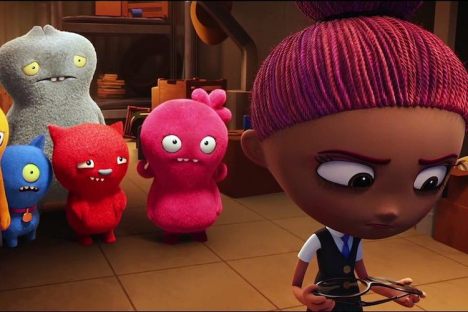
Non-Review Review: UglyDolls

UglyDolls exists in the “uncanny valley” of modern children’s animated films.

Films like UglyDolls are a reminder of how profoundly Pixar has altered the cinematic landscape, and shifted expectations in terms of what audiences – young and old – expect from these sorts of films. Most obviously, the basic premise of UglyDolls echoes that of Toy Story; in much the same way that, say, The Emoji Movie mirrors Inside Out. This is a film about sentient toys trying to find an existential justification for their existence, often defined in terms of their relationship to a child. UglyDolls is a movie aout misfit toys cast out from the factory assembly line, wondering if they will ever be worth of love.

All dolled up with nowhere to go.

To be fair to UglyDolls, it is much better than The Emoji Movie. At the very least, UglyDolls understands that the film needs to be ordered around a strong central theme. UglyDolls has a solid conceptual basis, a familiar children’s movie allegory, and a very straightforward narrative structure. That said, although somewhat less crass in its materialist ambitions than The Emoji Movie, the film feels cynically calculated in other ways. The casting of performers like Kelly Clarkson, Nick Jonas, Janelle Monáe and Blake Sheldon seems designed to move the film’s soundtrack album. And the premise is obviously toyetic.

Still, UglyDolls comes closer than most of these sorts of films to working, largely failing because it ultimately underestimates the maturity and intelligence of its target audience.

A glass apart.

Continue reading

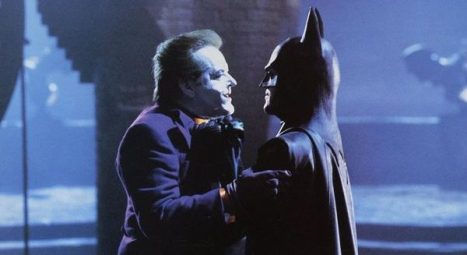
“… You Wanna Get Nuts?” The Unique Legacy of Tim Burton’s “Batman”…

Tim Burton’s Batman is thirty years old this year, having opened in Irish cinemas thirty years ago this weekend. It leaves a complicated and underappreciated legacy.

To be fair, at least part of that is down to how the series ended. Joel Schumacher’s Batman Forever and Batman and Robin count among the worst blockbusters of the nineties and the worst comic book movies ever made. Taken together, they were responsible for killing not only that iteration of the cinematic Batman franchise, but also for effectively killing the superhero as a blockbuster genre until the triple whammy of Blade, X-Men and Spider-Man kick-started it again at the turn of the millennium.

Continue reading

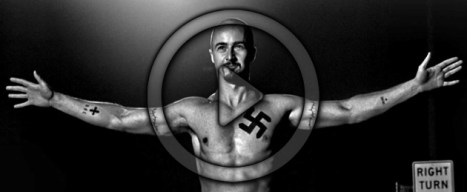
142. American History X – Summer of ’99 (#34)

Hosted by Andrew Quinn and Darren Mooney, and this week with special guest Charlene Lydon, The 250 is a (mostly) weekly trip through some of the best (and worst) movies ever made, as voted for by Internet Movie Database Users. New episodes are released every Saturday at 6pm GMT.

This time, kicking off our Summer of ’99 season, Toby Kaye’s American History X.

1999 was a great year for movies, with a host of massively successful (and cult) hits that would define cinema for a next generation: The Matrix, The Blair Witch Project, The Best Man, Cruel Intentions, Fight Club. The Summer of ’99 season offers a trip through the year in film on the IMDb‘s 250.

Danny Vinyard finds himself called to the principal’s office after submitting a salacious and controversial essay citing Adolf Hitler as a civil rights hero. There, the school principal Doctor Sweeney sets Derek another assignment: a personally essay exploring his relationship with his white supremacist brother Derek. Derek Vinyard was just released from prison that morning, and is about to discover that putting his life back together will not be as easy as he might have hoped.

At time of recording, it was ranked 34th on the Internet Movie Database‘s list of the best movies of all-time.

Continue reading

“Ladies, That Was Fun”: What’s Happening Under the Hood in “Death Proof”…

Okay… Warren’s sending over shots, and you know the house rules. If he sends over shots, you gotta do them.

What?

Hey, them’s the rules, baby.

Warren says it, we do it!

I love that philosophy! “Warren says it, we do it.”

The filming of Kill Bill, Vol. 1 and Kill Bill, Vol. 2 took nine arduous months. There were a variety of reasons for this, most obviously that the film represented a departure from the stylistic sensibilities and aesthetic associated with Quentin Tarantino. A director best known for his snappy dialogue and vivid characters was pushing himself outside of his comfort zone, building a movie that would incorporate elaborate action sequences and even an animated interlude. In fact, the films came after something of a short break in the director’s career. The six year gap following Jackie Brown was the longest in his career to that point.

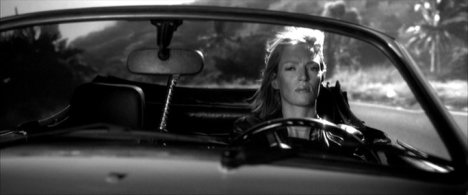
As shooting was winding down, an incident occurred on the set. Details of that incident would not be made public for more than a decade and a half, although it would have a profound impact on all involved. By all accounts, Tarantino pressured Uma Thurman into driving a stunt car herself, leading to an accident. Thurman recalls, “The steering wheel was at my belly and my legs were jammed under me. I felt this searing pain and thought, ‘Oh my God, I’m never going to walk again.’” Thurman was not paralysed, but she was scarred by the experience, with a “permanently damaged neck and […] screwed-up knees.”
It was an act of reckless malfeasance from a director who had – with Reservoir Dogs and Pulp Fiction – announced himself as one of the preeminent directorial voices of his generation. Tarantino is remarkable among directors of his generation for establishing a cult of personality, being as effective on the chat show circuit as behind the camera. Tarantino has been known for making brass pronouncements and asserting his authority, from his famous assertion that he is god within his fictional universes to his insistence on shutting down lines of questioning in interviews to rejecting reporters’ questions outright.

The case involving Tarantino and Thurman is perhaps more complicated than a lot of the similar stories of directorial abuse that have entered the spotlight since the #metoo movement rippled through Hollywood. This complexity is compounded by the fact that Thurman has publicly forgiven Tarantino for his part in the accident, and for Tarantino’s contrition on that point. (Tarantino’s public support of progressive causes like Black Lives Matter also plays a part, even if there is still a larger debate to be had about Tarantino’s relationship with African American culture.)
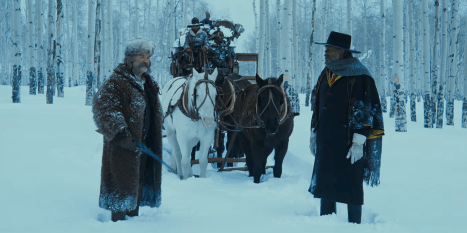
Even if none of this was made public until after the release of The Hateful Eight, these details hang over a lot of Tarantino’s work since the accident. Tarantino has conceded, “Beyond one of the biggest regrets of my career, it is one of the biggest regrets of my life.” It is notable that Tarantino had always been particularly close to Thurman. The story for the Kill Bill films is credited to “Q and U”, the pair practically living together during the development of the story. (Tarantino allegedly promised the script to the actor as a thirtieth birthday present.)

The tragedy echoes through a lot of Tarantino’s subsequent work. It is notable, for example, that a lot of Tarantino’s later work focuses explicitly on the idea of rewriting history. Inglourious Basterds famously offers an alternate ending to the Second World War, a striking piece of historical revisionism. There are also shades of the tragedy to be found in Once Upon a Time… in Hollywood, which features two protagonists that are – to quote actor Brad Pitt – “two sides of the same coin.” Rick is a washed-up has-been who worries he is out of touch. However, his best friend is a reckless stuntman who may have killed his wife.
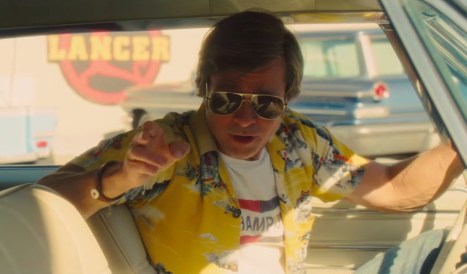
A lot of the discussion around Once Upon a Time… in Hollywood has likened it to Inglourious Basterds. This makes a great deal of sense. Both stories are effectively historical revisionist fairy tales. Notably, the opening chapter of Inglourious Basterds is even helpfully subtitled “Once Upon a Time in Nazi-Occupied France.” It is a logical point of comparison, but one that conveniently glosses over an even more obvious reference point for Once Upon a Time… in Hollywood within Tarantino’s filmography.

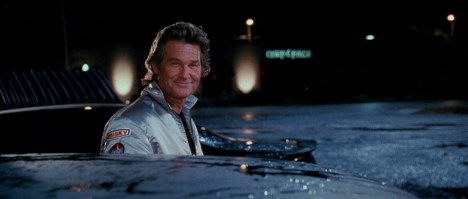
That point of comparison is Death Proof.
Continue reading

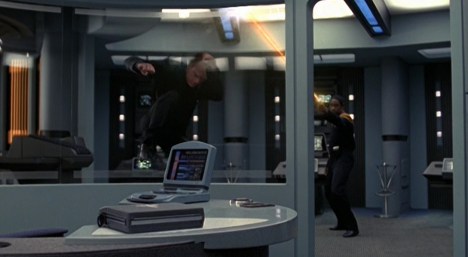
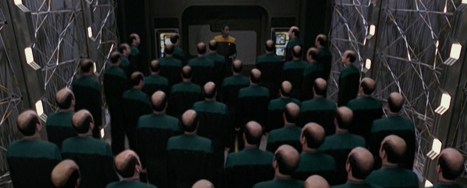
Star Trek: Voyager – Renaissance Man (Review)

Renaissance Man is a poor episode of television. However, it is not an especially misguided one.

The flaws with Renaissance Man are largely structural and familiar. They are the flaws that define Star Trek: Voyager, from a storytelling point of few. The plotting is loose. The characterisation is threadbare. There are good ideas, but the manner in which those ideas are developed and explores leaves a lot to be desired. There are flashes of a much better episode, but it is unclear that even the production team realise what those flashes are. The pacing is awkward, with act breaks positioned very poorly. There is an unnecessary secondary climax that muddies the episode.

Leaps and bounds ahead.

However, Renaissance Man largely avoids the more fundamental philosophical problems that have haunted so much of the seventh season before it. Renaissance Man seems cobbled together from stray ideas seeded in earlier episodes of the season, but those ideas are not inherently toxic or bad. Following on from the deeply uncomfortable isolationist and xenophobic triptych of Friendship One, Natural Law and Homestead, there is something refreshing in the fact that Renaissance Man is not explicitly about how people should keep to themselves.

Renaissance Man is underwhelming, but it is not a spectacular misfire. At this point in the season, that counts for much more than it really should.

I, EMH.

Continue reading

Non-Review Review: Animals

Animals lacks any real bite.

At its core, Animals is the story of the unhealthy relationship that exists between Laura and Tyler. Laura is a Dublin girl, with close ties to her extended family. Tyler is an American abroad, a young woman who seems to be running as far away from her family as possible. A chance encounter on a night out brought the two together in their twenties, and they have since become inseparable. Laura lives with Tyler in her lavish city centre apartment, while Tyler is a welcome guest at all of Laura’s family gatherings. The two seem to share a single life.

Putting the matter to bed.

Naturally, that relationship has begun to strain and fray as the women enter their thirties – Laura is about two years older than her best friend, while Tyler’s thirtieth birthday is a significant event in the context of the film. Laura seems to want to move on, to embrace adulthood and responsibility; she courts a young professional pianist named Jim and tries desperately to work on the novel she’s been picking over for the last decade. Tyler pushes back against this, terrified at the prospect that her best friend might leave her behind to wallow in her own hedonistic insecurities.

Animals is too generic to make a meaningful impression. Its major character and narrative beats are all helpfully signposted from the get-go, its destination obvious from the end of the first few scenes. However, there’s not enough substance present to justify that sense of inevitability, the leisurely-paced journey towards a foregone conclusion that hits every expected plot point and character moment along the way. Animals feels very much like every other “young person has a life crisis and has to find a way to be comfortable with themselves” narrative of the past decade, with little to distinguish it.

At home on the (G)rainger.

Continue reading

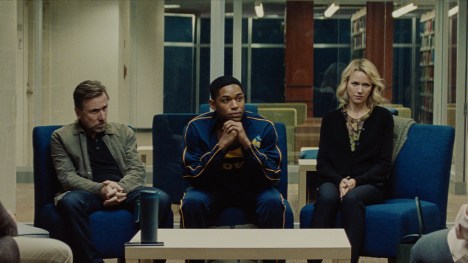
Non-Review Review: Luce

Luce is a compelling dialogue-driven thriller, anchored in a set of impressive performances and a meaty script.

At its core, Luce is a study of integration and idealism. It touches on the question of identity, that established by an individual and that imposed by the people around them. Luce derives its title and its tension from its lead character, a promising young African American student. Adopted by an upper-middle class white couple and rescued from his past as a child soldier, Luce has become an exemplar. He is an all-star debater, an impressive academic student, a successful athlete. He is loved by both the faculty and his fellow students. To hear the other characters talk about him, Luce is just about perfect.

Getting schooled.

Naturally, Luce challenges that idea. Luce invites the audience to wonder whether the title character really is everything that everybody else believes him to be. More than that, the film interrogates why so many people seem to need Luce to be an exemplar. The film is a fraught push-and-pull as questions are raised about Luce. When the honours student turns in an inflammatory essay and when fireworks with the explosive power of a shotgun are found in his locker, the characters around Luce find themselves asking if they understand the teenager, or if they ever could.

The result is a tense and claustrophobic drama, as the characters navigating these accusations and insinuations try to constantly reconfigure their understanding of the title character. It’s a remarkable push-and-pull, elevated by some very potent themes and a wealth of strong performances.

Keeping track.

Continue reading

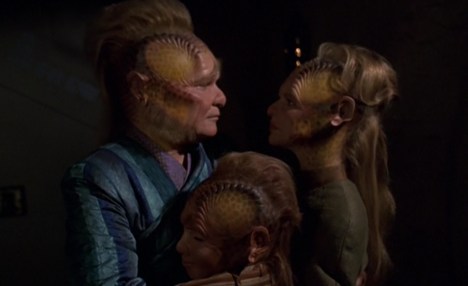
Star Trek: Voyager – Homestead (Review)

Homestead represents the culmination of certain impulses within Star Trek: Voyager.

To be fair, some of those impulses were baked into the show from the outset. The end of Caretaker immediately and effectively established the central premise of the series. Voyager was to be a story about a crew trying to get “home.” Of course, the question of what “home” actually meant was always up for debate. Perhaps “home” could be the unlikely bond that this crew formed with one another, a strange alliance of misfits who found a way to belong together in a way they never could apart; the idea of “home” at the heart of Star Trek: Deep Space Nine, for example.

“Home.”

However, over the following seven seasons, the idea of “home” came into sharp focus. “Home” was not so much about finding an abstract place where a person might belong. “Home” was about returning to a point of origin. “Home” was a not place that could be created or developed, it was a nostalgic ideal. “Home” was not somewhere that could be found on “the final frontier.” In fact, it was the exact opposite. It was a fixed place that was (by definition) as far from the frontier as possible. This theme was heavily articulated in the show’s seventh and final season.

Of course, this very narrow and rigid definition of “home” creates a problem for one member of the cast. Voyager repeatedly and consciously assumes that all of its cast belong in the Alpha Quadrant, because they originated there. It does not matter that Tom Paris never fit in at home, or that the Maquis characters never integrated into Starfleet. It does not matter that Seven of Nine cannot remember Earth. These characters are going back to their point of origin, because that is what “home” means. What, then, of Neelix? How does Neelix get to go “home”?

“Home.”

Continue reading