• Following Us

  • Categories

  • Check out the Archives


  • Awards & Nominations

Non-Review Review: Horse Girl

Horse Girl is certainly an ambitious work, if not an entirely successful one.

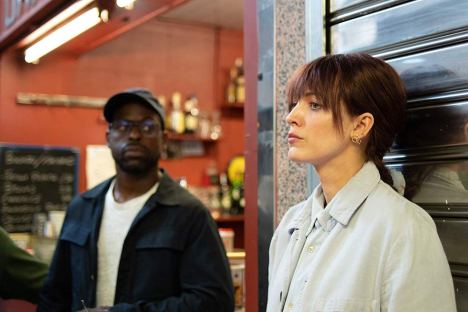
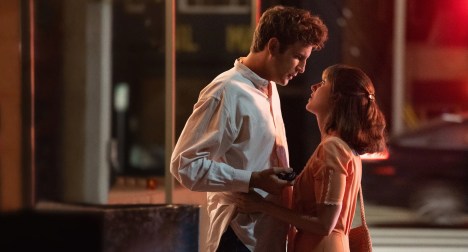
Directed by Jeff Baena and co-written with star Alison Brie, Horse Girl is essentially a study of a socially awkward young woman who gradually loosens her grip on reality. Sarah is a charming and isolated young woman. She works a steady job at an arts and crafts shop, to which she seems quite suited – she’s immediately able to identify the best paint for a classroom setting. She lives with a roommate who clearly harbours some affection for her. She assists at the local stables. She even attends weekly dance fitness classes.

Horsing around.

However, beneath the surface, Sarah is increasingly isolated. She lives in a world of her own, absorbed in her supernatural procedurals, lying about the extent of her social circle, and haunted by dreams that don’t seem quite right. Sarah increasingly begins to feel that there is something very wrong with the world, as she experiences lost time and lucid dreams. Naturally, things only escalate from there.

Horse Girl plays with some interesting ideas, and approaches its subject matter in interesting ways, but it suffers a little bit too much from a suffocating sense of forced whimsy. Horse Girl premiered at Sundance, and for all its ambition, it is very much a “Sundance indie.” There is constantly a sense of a more interesting film bubbling beneath the surface, waiting to get out, but never quite able to materalise beneath the trappings of its own particular brand of independent cinema.

Getting it all back to front.

Continue reading

New Escapist Column! On the Franchise Revanchism in “Star Wars”, “Doctor Who” and “Star Trek”…

I published an In the Frame piece at Escapist Magazine on Friday, looking at one of the more interesting (and frustrating) trends in modern franchise storytelling.

New ideas in existing franchises have always been controversial. After all, fans were taken aback by the changes made to existing properties in films like Star Trek II: The Wrath of Khan and Star Wars: Episode V – The Empire Strikes Back. So the controversy around things like the first season of Star Trek: Discovery or Star Wars: Episode VIII – The Last Jedi are nothing new. What is new, however, is the way in which these properties now seem to be swayed by fan anxieties, retreating from bold ideas into the safety of familiarity. This leads an emptiness, and runs the risk of letting these properties stagnate.

You can read the piece here, or click the picture below.

Non-Review Review: Uncut Gems

Uncut Gems is a two-hour panic attack. And it’s brilliant.

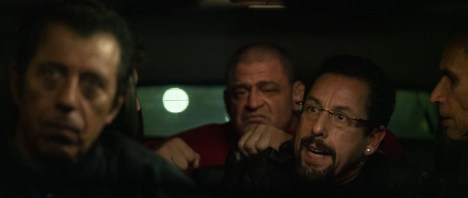
Uncut Gems is a propulsive tension engine. The film follows the wheeling and dealing of Howard Ratner. Ratner operates a jewellery story in Manhattan’s Diamond District, but his real passion is gambling. Have accrued considerable debts, Howard concocts a simple plan to clear the slate. Smuggling in a rare black opal from East Africa, Howard plans to auction it and use the proceeds to settle up with his creditors. Naturally, things quickly spiral out of control as Howard’s impulsiveness and competitiveness get the better of him, pushing him to greater and greater lengths.

Off the chain.

Anxiety permeates Uncut Gems. Howard is a free-wheeling opportunist defined largely by his recklessness and his resilience, but his self-assuredness stands in contrast to the experience of watching Uncut Gems. As the film unfolds, the audience (and Howard) understands how fragile Howard’s elaborate improvisations truly are. Almost every scene in Uncut Gems threatens to bring Howard’s house of cards around his ears. Even the film’s triumphant and celebratory moments feel uncomfortable, as the audience and the protagonist wrestle with how precarious it all is.

Uncut Gems is a triumph, a shining diamond.

This diamond is about to get roughed up.

Continue reading

Doctor Who: Fugitive of the Judoon (Review)

“Is there even word for how dumb you are?”

“… Doctor?”

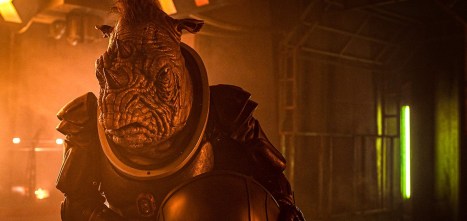
Fugitive of the Judoon is a breath of fresh air. The only question is whether it is blowing in the right direction.

There are obvious problems with Fugitive of the Judoon. The episode is overloaded with fan service, just starting with the returning monsters in the title and bubbling over into an entire subplot that seems to exist to give three quarters of the primary cast something to do. More than that, the episode is deliberately and purposefully ambiguous in a way that makes it impossible to properly assess its more audacious and ambitious twists. Fugitive of the Judoon is an episode that relies heavily on context, context that will be derived from the rest of the season.

The devil you Rhino.

And, yet, there is something exhilarating in Fugitive of the Judoon. This is the most ambitious that Doctor Who has felt since World Enough and Time and The Doctor Falls. This is an episode bursting at the seams with ideas that seem designed to upend what the audience think they know about Doctor Who, while also boldly reassuring viewers at home that showrunner Chris Chibnall actually has some sort of vision of where he wants the show to go. Fugitive of the Judoon suggests an impressive jigsaw puzzle, even if the pieces are yet to be assembled.

It helps that the episode is fast on its feet and breezy, probably managing to balance the “overstuffed Chibnall era plot” better than any episode since It Takes You Away. If Spyfall, Part I and Spyfall, Part II suggested that the season was going to take its cues from Russell T. Davies third season, then Fugitive of the Judoon might represent the best expression of this approach. Fugitive of the Judoon is not so much “season three redux” as “season three remix.” While hopefully there’s more to it than that, it is enough to elevate the episode above most of its contemporaries.

Space police stop.

Continue reading

166. Aladdin (#246)

Hosted by Andrew Quinn and Darren Mooney, this week joined by special guest Graham Day, The 250 is a (mostly) weekly trip through some of the best (and worst) movies ever made, as voted for by Internet Movie Database Users. New episodes are released every Saturday at 6pm GMT.

This time, Ron Clements & John Musker’s Aladdin.

A thief in ancient Agrabah finds his fortunes changing for the better when he is recruited to recover a precious treasure. With fame and fortune at his fingertips, Aladdin sets about trying to seduce the beautiful Jasmine, but soon discovers that there’s more to love than power and wealth.

At time of recording, it was ranked the 246th best movie of all time on the Internet Movie Database.

Continue reading

Non-Review Review: Richard Jewell

Richard Jewell is a paradox of a film, a narrative so propelled with righteous fury that it somehow misses its own point.

Clint Eastwood’s latest is his tightest and leanest narrative since Sully: Miracle on the Hudson, and this is not a coincidence. There’s considerable thematic overlap between Richard Jewell and Sully, both of which speak to themes that interest Eastwood as one of the defining American filmmakers. Like Sully, Richard Jewell is the story of an exception person who heroically saves lives only to witness the bureaucratic institutions of the state (and the press) turn upon them.

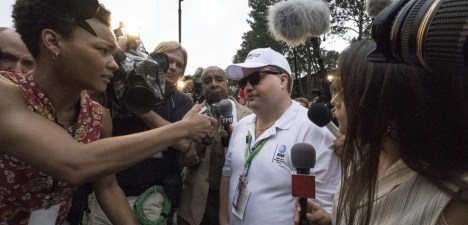
Pressing on.

Of course, Richard Jewell is quite distinct from Sully. Eastwood trades out “America’s Dad” Tom Hanks for the more ambiguous figure of Paul Walter Hauser. While Hanks is the embodiment of American decency, a clear-cut spiritual successor to Jimmy Stewart, Hauser has largely been defined by more muddy and murky roles with fantastic turns in films like I, Tonya and BlackKklansman. Indeed, the opening act of Richard Jewell leans into Hauser’s inscrutability, suggesting a more ambiguous interrogation of masculine heroism.

Unfortunately, Richard Jewell does not develop in that direction. Its early suggestions of moral complexity and anxieties about individual as much as collective authority give way to a stirring condemnation of a conspiracy to “railroad an innocent man.” This righteous fury is entirely justified, after all. The press and the authorities demonised Jewell, arguably hounding him to an early grave. However, Richard Jewell winds up so caught up in its righteous fury that it winds up “railroading” another innocent, abusing its power in the same way it accuses the press and authorities.

Lawyer up.

Continue reading

Doctor Who: Nikola Tesla’s Night of Terror (Review)

“Don’t worry. This ain’t our first rodeo.

“We’ve never been to a rodeo.”

“You’re not helping, Ryan.”

As with Orphan 55 last week, there is a sense that Nikola Tesla’s Night of Terror is pushing at the edge of Chris Chibnall’s Doctor Who, trying to take the era’s underlying assumptions and make them work within a compelling narrative structure.

Orphan 55 attempted to write around the Thirteenth Doctor’s narrative passivity by dropping her in a plot that took place long after calamity had befallen Earth, and so cannily avoiding another story that hinged on the Doctor’s general uselessness. (Of course, it also ended with the Doctor abandoning Kane and Bella to their deaths, so mileage varies.) Nikola Tesla’s Night of Terror offers an interesting spin on the era’s approach to historicals – telling a story that hinges not on building an affirming narrative from a hopeless future, but instead mourning the loss of a potential future.

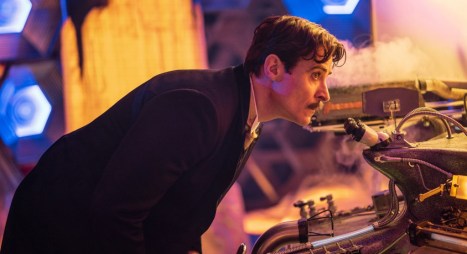
Tesla recoils.

To be fair, Nikola Tesla’s Night of Terror is still haunted by a lot of the familiar problems of the show around it. As a showrunner, Chris Chibnall is nowhere near as good with characterisation or humour as Russell T. Davies and Steven Moffat. More than that, the episode seems have largely been built in homage to the villainous Skithra, as a collection of spare parts and leftover pieces. Like Arachnids in the U.K., the extent to which Nikola Tesla’s Night of Terror is an engaging piece of television is the extent to which it feels like a flat mid-season episode from the Davies era.

Nikola Tesla’s Night of Terror is a mixed bag. Indeed, it’s interesting how much Orphan 55 and Nikola Tesla’s Night of Terror feel like the belong in the first season of a new era, trying to figure out the basic mechanics of the new way that Doctor Who tells stories. This is something that Doctor Who should have been doing last season, and it’s frustrating to see it only really trying now.

“Elon who?”

Continue reading

165. Gisaengchung (Parasite) – This Just In (#34)

Hosted by Andrew Quinn and Darren Mooney, and this week with guests Graham Day and Bríd Martin, The 250 is a fortnightly trip through some of the best (and worst) movies ever made, as voted for by Internet Movie Database Users.

This time, Boon Joon Ho’s Gisaengchung.

Drafted in to tutor the daughter of a rich South Korean family, the lower-class Kim Ki-woo enacts a cunning plan that will allow his entire family to infiltrate the lavish Park household. However, things quickly spiral out of control, leading to unpredictable chaos and disaster.

At time of recording, it was ranked the 34th best movie of all time on the Internet Movie Database.

Continue reading

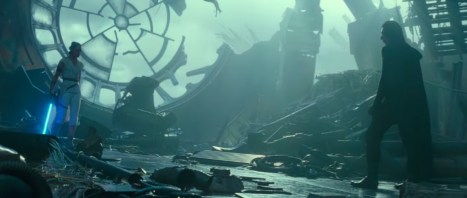
New Escapist Column! On Colin Trevorrow’s “Duel of the Fates” and JJ Abrams’ “Rise of Skywalker”…

I published an In the Frame piece at Escapist Magazine yesterday, looking at the leaks around director Colin Trevorrow’s plans for Star Wars: Episode IX – The Rise of Skywalker.

Of course, there are a lot of variables involved. Are the leaks authentic? Even if the leaks are authentic, how much faith do you place in the director of Jurassic World and Book of Henry to realise them? More than that, though, there’s a sense in which the proposed “Duel of the Fates” is so appealing precisely because it will never actually exist. It will never disappoint anybody, because their imagined version of the film will never brush up against harsh reality. It’s interesting in this age of “alternative facts” that we long so strongly for “alternative movies.”

You can read the piece here, or click the picture below.

New Escapist Column! On the Oscar Success of “Joker”…

I published a piece at Escapist Magazine earlier this week, looking at the success of Joker at this week’s Oscar nominations.

Joker is an interesting film, primarily because of the passion and enthusiasm that it generates on both sides of the debate. It is a film with a strong following and a very strong opposition, and it seems that every observer must pledge allegiance to one side or the other. This is ironic, because it’s arguably the most interesting thing about a film that is largely remarkable for how safe it plays most of its creative choices – the irony only enhanced by how that modesty seems almost dignified amid the cacophony around it.

As such, it’s easy to miss how successful Joker has been, and how it has positioned itself as an obvious choice for the Oscar-nominee frontrunner. Of course, the polarisation around the film makes it highly unlikely to actually win the prize, but any sensible assessment of the film – its performance, its influences, its pedigree, its impact – would concede that it is very much the definition of a slam dunk for the Oscar nominations. More than that, the fact that it swept up the Oscar nominations is arguably a good thing for the Academy Awards, a welcome a long overdue reminder that big and popular films can succeed.

You can read the piece here, or click the picture below.