• Following Us

  • Categories

  • Check out the Archives


  • Awards & Nominations

New Escapist Column! On Kat as the Emotional Heart of “TENET”…

I published a new piece at The Escapist on Sunday. With the release of TENET, Christopher Nolan has been subject to the familiar criticisms of his work: that he is humourless, cold, emotionless. However, these criticisms miss the fact that Nolan’s films are often underpinned by deep reservoirs of emotion.

Elizabeth Debicki’s Katherine Barton is the beating heart of TENET. She also represents a clear evolution of how Nolan writes female characters. If TENET is a James Bond pastiche, than Kat is introduced as a disposable love interest – the character that the hero seduces to get closer to the villain, and is ultimately killed for her betrayal. She is also positioned in Nolan’s filmography so as to suggest one of Nolan’s “dead wives.”

However, as the film progresses, Kat becomes the emotional protagonist of TENET. It is her story that drives TENET. More than that, she assumes the narrative space that is usually reserved for Nolan’s male protagonists like Cooper in Interstellar and Cobb in Inception: that of a parent fighting desperately to be reunited with their lost children. As such, Kat is a fascinating character in Nolan’s filmography, both a deconstruction of the way that Nolan writes his women characters and a clear step forward.

You can read the piece here, or click the picture below.

New Escapist Video! On Disney’s Chinese Gambit with “Mulan”…

So, as I have mentioned before, I am launching a new video series as a companion piece to In the Frame at The Escapist. The video will typically launch with the Monday article, and be released on the magazine’s YouTube channel the following week.

With that in mind, here is last week’s episode, covering Disney’s ambitions to bring Mulan to China and the story of how Hollywood became so fascinated with that market. You can watch the pilot video here, and read the companion article here.

New Escapist Column! On “Black Panther” and Childlike Wonder…

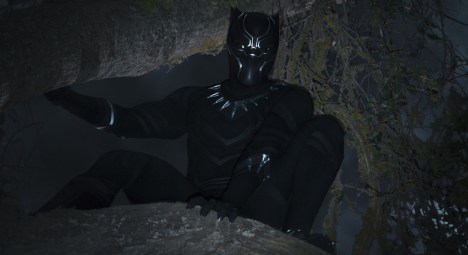
I published a new In the Frame piece at The Escapist this evening. With the tragic passing of Chadwick Boseman over a week ago, I have been thinking a lot about Black Panther. In particular, what makes it special.

It isn’t simply that Black Panther was the first superhero movie on this scale to feature a predominantly black cast from a black director. It was also the extent to which director Ryan Coogler understood the power of superheroes. Very few superhero movies are written with an understanding of what superheroes represent and why they are important, instead often falling into the trap of power fantasies rather than empowerment fantasies. Black Panther is the rare superhero movie that dares to see its world through the eyes of a child, and is more powerful for that.

You can read the piece here, or click the picture below.

Non-Review Review: Enola Holmes

Enola Holmes is a movie with a lot of charm, anchored in a sense of playful enthusiasm and a winning central performance.

Adapted from Nancy Springer’s The Enola Holmes Mysteries series of novels, the basic premise of Enola Holmes is straightforward enough. The classic Victorian detective Sherlock Holmes is given a younger sister, who inevitably finds herself forced to navigate the wider world while solving mysteries and avoiding the best efforts of her older brothers to ship her off to a suffocating and restrictive boarding school where she might be taught to be a lady.

Make yourself at Holmes…

Enola Holmes moves quickly and cheerfully through its starting premise and central mystery, bouncing from one sequence to another with considerable grace. However, it’s lead actor Millie Bobby Brown who carries the film. Brown is probably best known for her work on Stranger Things and a prominent role in Godzilla: King of the Monsters, but Enola Holmes suggests a long and promising career ahead of the young actor. It is impossible to imagine the movie seeming as effortless without her at its centre.

In fact, Enola Holmes suffers most when it moves away from its protagonist and makes room in her story for less compelling (but more nominally “important”) characters that wind up sapping the film’s energy. Enola Holmes has a surprisingly slow start for a film that breezes along once it finds its footing, and that is largely because it is initially reluctant to give its central character the breathing room that she needs. Still, once the film gets past that, it is a highly enjoyable adventure.

Enola that look…

Continue reading

New Escapist Column! On Ridley Scott’s Science-Fiction Sensibility in “Raised by Wolves”…

I published a new In the Frame piece at The Escapist on Friday. With the launch of Raised by Wolves on HBO Max, I thought it was worth taking a look at the streaming science-fiction series.

The most striking thing about Raised by Wolves is the extent to which it feels like a Ridley Scott production. Scott did not write or create the show, the was Aaron Guzikowski. However, Scott directed the first two episodes, and they often feel like an extension of Scott’s work. There are obvious echoes of Scott’s iconic science-fiction work in classics like Alien and Blade Runner, but also shots and sequences that seem to have been lifted from Prometheus and Alien: Covenant.

This works rather well, as Raised by Wolves delves into some of Scott’s core thematic preoccupations. Like Prometheus, Exodus: Gods and Kings and Covenant, this is a story about religion. Like Prometheus, Gods and Kings, Covenant and All the Money in the World, it is also a story about parenthood and the responsibility of caring for a younger life. However, because Raised by Wolves is not tied to any existing intellectual property, it gives Scott a lot of space to work. More than that, it suggests that Scott is a brand unto himself.

You can read the piece here, or click the picture below.

New Podcast! The Escapist Movie Podcast – ” Mulan, Dune and The Academy”

The Escapist have launched a movie podcast, and I was thrilled to join Jack Packard and Bob Chipman for the third episode, primarily discussing Disney’s release of Mulan, the first trailer for Dune and the new changes to eligibility for the Best Picture award at the Academy Awards.

You can listen to the episode here, back episodes of the podcast here, click the link below or even listen directly.

199. Raging Bull – Summer of Scorsese (#146)

Hosted by Andrew Quinn, Jay Coyle and Darren Mooney, and this week with special guest Grace Duffy, The 250 is a (mostly) weekly trip through some of the best (and worst) movies ever made, as voted for by Internet Movie Database Users. New episodes are released every Saturday at 6pm GMT.

This time, continuing our Summer of Scorsese season, Martin Scorsese’s Raging Bull.

Martin Scorsese is one of the defining directors in American cinema, with a host of massively successful (and cult) hits that have shaped and defined cinema across generations: Taxi Driver, Goodfellas, CasinoGangs of New York, The Departed, Shutter Island, The Wolf of Wall Street. The Summer of Scorsese season offers a trip through his filmography via the IMDb‘s 250.

Jake LaMotta is a boxer who dreams of a shot at the big time. However, Jake does not play by the rules of the game. Over the course of his life and career, Jake struggles to tame the violence inside himself as he proceeds to push those closest to him further and further away.

At time of recording, it was ranked 146th on the Internet Movie Database‘s list of the best movies of all-time.

Continue reading

“I’m Not an Animal!” Raging Bull and Pushing the Boundaries of the Empathy Machine…

The podcast that I co-host, The 250, launched a belated Summer of Scorsese last week with a look at Taxi Driver. This week, we’re looking at Raging Bull. It is a fun and broad discussion that is well worth your time, but it spurred some of my own thoughts about Martin Scorsese’s 1980 black-and-white boxing film.

“So, for the second time, [the Pharisees]
summoned the man who had been blind and said:

‘Speak the truth before God.
We know this fellow is a sinner.’

‘Whether or not he is a sinner, I do not know.’
the man replied.

‘All I know is this:
once I was blind and now I can see.’
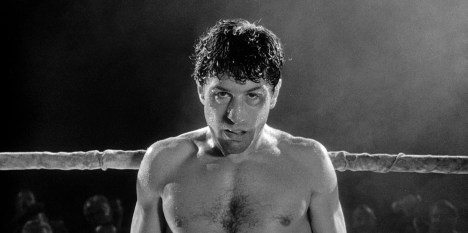
By Scorsese’s own admission, Raging Bull was a “kamikaze” film.

By the end of the seventies, Scorsese was personally and professionally wiped out. The director had just gone through his second divorce. He was recovering from a cocaine addiction that had almost killed him. Scorsese had attempted to capitalise on the critical and commercial success of Taxi Driver by making New York, New York. The film was intended as an update of the classic MGM musicals shot in a New Hollywood style, but it was a critical and commercial failure.
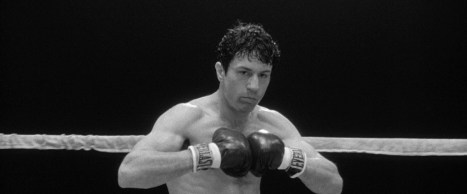
The New Hollywood era was ending around Scorsese. William Friedkin had been brought down to earth by the critical and commercial failure of Sorcerer, which had the misfortune to open opposite Star Wars. While Apocalypse Now had become a hit, the film’s troubled production was already the stuff of Hollywood legend. Indeed, it has been suggested that Scorsese was able to sneak Raging Bull through United Artists because its production overlapped with the attempts to fight fires on Michael Cimino’s studio-killing flop Heaven’s Gate.

Scorsese was committed to seeing through his vision of Raging Bull. He wanted to make a film that satisfied him, even if it was to be the last film that he ever made. The result is a singularly abrasive piece of work. It is a biography of the boxer Jake LaMotta that paints a harrowing and horrifying sketch of an innately violent man who succeeds in alienating everybody close to him and destroying every opportunity that he has to build a better life for himself.
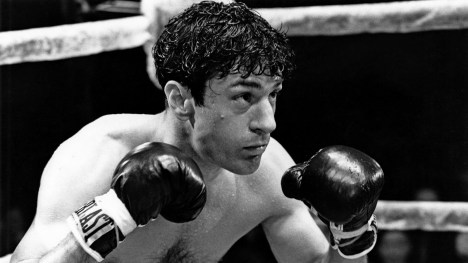
Even watched forty years after its original release, Raging Bull is an uncompromising and unflinching portrayal of a protagonist who is deliberately and aggressively unlikable. This is a bold and daring move. Studio biographies are often designed to soften the rough edges of their subjects, to temper biting commentary with glimpses of humanity. Even Oliver Stone’s Nixon offers a surprisingly sensitive study of a subject that the audience might expect the director to skewer.

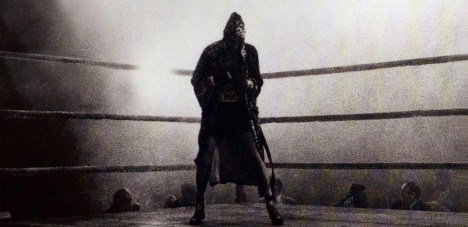
However, this is the power of Raging Bull. Roger Ebert famously described film as an “empathy machine”, and Raging Bull seems to probe the limits of that idea. The audience spends two hours inside the head of Jake LaMotta, and sees the man with his all his flaws and through all his failings. The film then asks its audience, having subjected them to that brutality and violence, to look on Jake as a human being deserving some measure of compassion and empathy. Raging Bull accomplishes this, one of the most remarkable feats in Scorsese’s filmography.
Continue reading

Non-Review Review: The Roads Not Taken

There are two different, decent competing movies tucked away inside The Roads Not Taken. Sadly, the whole is much less than the sum of its two largest parts.

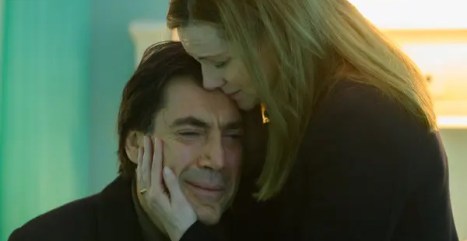
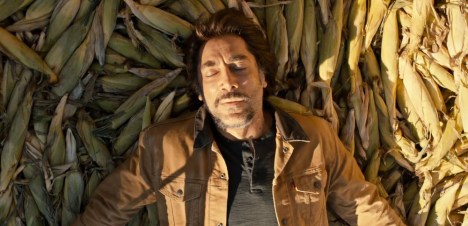
The first  of these movies is a fairly conventional study of a daughter coping with her father’s neurological degeneration. It is a fairly standard template, tapping into recognisable anxieties about growing old, and the realisation that many children will have to act as caregivers for their parents in old age. This is a solid basis for a movie on its own terms. Indeed, it seems like a film that could easily net an awards nominations for actors Javier Bardem and Elle Fanning.

Holding it together.

The second film is a more abstract and ambitious work, in which an older man reflects on the life that he has lived and – trapped inside his own head with a slipping sense of reality – allows himself to play out fantasies of how his life might have been different. This a more philosophical work, a more reflective and introspective film. It seems like something from a stranger and more unusual movie, something like The Fountain or even Cloud Atlas.

The problem is that these two angles on the story do not fit together. In cutting across them, director Sally Potter undercuts and undermines both narratives. Neither thread has enough room to breath and build momentum, and both are driven by fundamentally different stakes. One movie is about the experiences of an aging writer named Leo, while the other is about his daughter Molly, and shifting back and forth causes the movie to lose its emotional footing. The result is an interesting and well-intentioned curiosity, but an underwhelming film.

Baby, I’m a-maize-d by you.

Continue reading

New Escapist Column! On Disney’s Chinese Gambit with “Mulan”…

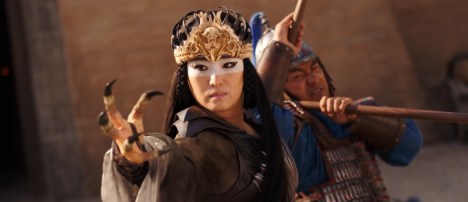
I published a new In the Frame piece at The Escapist this evening. With the release of Mulan as a premium video on demand this weekend, it seemed like the perfect opportunity to take a look at what the film represents in terms of Disney (and larger Hollywood’s) relationship with China.

The streaming release of Mulan is just one prong of Disney’s rollout strategy for a film that reportedly has a larger budget than The Lion King or Beauty and the Beast. The company has an eye on the Chinese box office, which makes sense given that China has become a global powerhouse in terms of box office. Mulan has been consciously tailored to appeal to Chinese audiences, but this is really just the culmination of Hollywood’s long-running courtship of Chinese censors and audiences, a trend that has been in motion for over a quarter of a century.

You can read the piece here, or click the picture below.