• Following Us

  • Categories

  • Check out the Archives


  • Awards & Nominations

Star Trek: Deep Space Nine – The Ship (Review)

It seems we’re approaching an impasse.

We’ve already arrived.

– Kilana and Sisko sum up the fifth season

Under siege.

Under siege.

Continue reading

Star Trek: Deep Space Nine – Apocalypse Rising (Review)

Apocalypse Rising stands quite apart from the other Star Trek: Deep Space Nine season premieres.

Most obviously, it the only single-part season premiere across the entire seven seasons of Deep Space Nine. Emissary and Way of the Warrior were two-hour television movies. The Homecoming fed into the franchise’s first official three-part story. The Search, Part I and The Search, Part II were obviously a two-part episode, while Image in the Sand and Shadows and Symbols provided a two-part introduction to the seventh season. A Time to Stand segued directly into Rocks and Shoals while also setting up a six-episode arc.
The times, they are a-changeling...

The times, they are a-changeling…

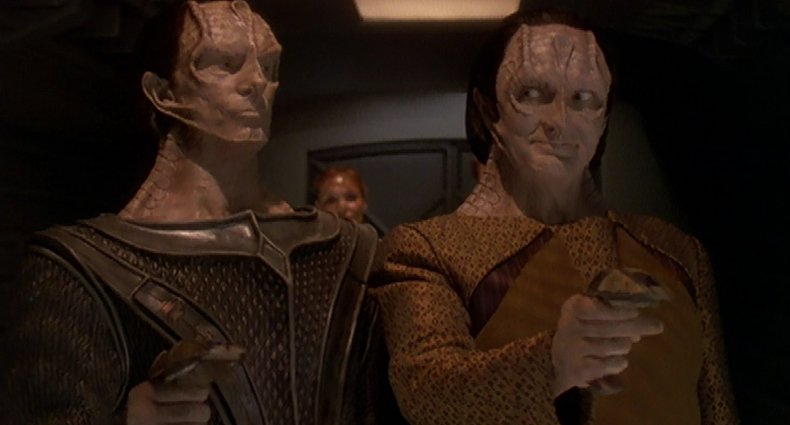
This is not to suggest that Apocalypse Rising is a more typical Star Trek season premiere. It is not a continuation of Broken Link in the same way that The Best of Both Worlds, Part II is a direct continuation of The Best of Both Worlds, Part I or that Basics, Part II is a direct follow-on from Basics, Part I. While Apocalypse Rising does resolve a cliffhanger left dangling by Broken Link, that cliffhanger was only really set up in the final two minutes of the episode. Indeed, the cliffhanger dangling from Broken Link recalls the endings of The Jem’Hadar or The Adversary.

Apocalypse Rising is also notable for being the first season premiere that is not positioned as a jumping on point, that is not intended to either expand the scope of the show or recruit new viewers. One of the luxuries of avoiding the traditional cliffhanger structures to bridge seasons was the freedom to begin each season with a relatively clean slate and introduce new elements. The Search, Part I and The Search, Part II introduced the Defiant and retooled the show to focus on the Dominion. The Way of the Warrior brought Worf over and shifted emphasis to the Klingons.

Klingon to the status quo...

Klingon to the status quo

While Apocalypse Rising does represent a slight shift in the tone of the show, it is not a radical new departure. More than that, it leans rather heavily on the show’s established mythology and in some ways indicates a desire to get the show back on track following an extended detour into war with the Klingons during the fourth season. Apocalypse Rising confirms what was made clear during the fourth season of the show, that Deep Space Nine has eventually evolved into its final form. Apocalypse Rising is a show so comfortable with itself that there’s no need to reinvent.

Although a little cramped and rushed in places, Apocalypse Rising represents a strong start to a stellar season. It is an efficient and effective piece of television, one that demonstrates the clarity of focus driving the season that will follow.

Drinking games...

Drinking games…

Continue reading

Non-Review Review: Triple 9

Triple 9 looks great.

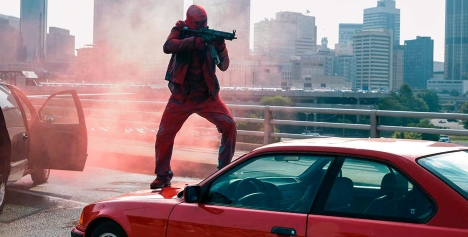
Although it set in modern day Atlanta, director John Hillcoat seems to frame Triple 9 as a grim companion piece to The Road. Hillcoat captures the horrors of urban decay, creating a world that seems to teeter on the edge of the abyss. The camera pans through abandoned tenement buildings and lingers on graffiti; bodies are found in shopping trolleys while tinted windows serve to conceal immediate dangers. As filmed by Hillcoat and filtered through the lens of cinematographer Nicolas Karakatsanis, Atlanta seems to be composed of slums and overpasses.

Traffic stop...

Traffic stop…

From the impressive opening heist set piece, Hillcoat saturates the film with red, as if our heroes are only glimpsed through the light of hellfire. That red comes from multiple sources; a red dye pack that explodes at the worst possible moment, the boots worn by one of the characters, the lights from a police car, the fire from a distant (and somewhat anticlimactic) explosion. Triple 9 is oppressive and grim, with Hillcoat threatening to bring the world collapsing down upon his protagonists.

The problem with Triple 9 has nothing to do with Hillcoat’s aesthetic. Instead, the film suffers from a generic and unfocused script populated by characters who lack agency and identity. The main figures in Triple 9 often feel like pieces of paper caught in a breeze, moving in any given direction at the whim of the plot rather than through any essential quality of their own. Things happen not because they are organic (or even inevitable), but because they are convenient. There are points at which it seems like maybe the characters are not in hell; maybe the audience are.

Married to the mob...

Married to the mob…

Continue reading

Star Trek: Deep Space Nine – Hippocratic Oath (Review)

This February and March, we’re taking a look at the 1995 to 1996 season of Star Trek, including Star Trek: Deep Space Nine and Star Trek: Voyager. Check back daily Tuesday through Friday for the latest review.

Hippocratic Oath represents a return to normality for Star Trek: Deep Space Nine. The Way of the Warrior was a feature-length war epic tasked with introducing a new regular character and a new status quo, while The Visitor was an intimate character study that stood quite apart from the show around it. With Hippocratic Oath, the show gets back to business as usual. It even has a classic a-story/b-story split with Bashir and O’Brien’s Gamma Quadrant hijinx juxtaposed with Worf learning his place on the station (and the show).

This is not to suggest that Hippocratic Oath is a bland hour of Star Trek. Indeed, it is a tightly-constructed story that hits on some of the show’s core themes and most interesting dynamics. One of the problems with the third season of Deep Space Nine was the fact that it had a strong start but no idea on how to build from that. Hippocratic Oath seems to serve very much as a “business as usual” episode of the fourth season, helping to set a baseline of quality of the show going forward.

Awkward bromantic moment...

Awkward bromantic moment…

Continue reading

Star Trek: Deep Space Nine – The Way of the Warrior (Review)

This February and March, we’re taking a look at the 1995 to 1996 season of Star Trek, including Star Trek: Deep Space Nine and Star Trek: Voyager. Check back daily Tuesday through Friday for the latest review.

The third season of Star Trek: Deep Space Nine was really just a dress rehearsal for what lay ahead.

The third season had been a tumultuous time for the show, with Michael Piller departing the franchise to pursue opportunities outside Star Trek. It was the year directly after the end of Star Trek: The Next Generation, and all attention was focused on the pending release of Star Trek: Generations and the launch of Star Trek: Voyager. On top of that, the third season suffered from a great deal of confusion and disorganisation throughout the year, making it very hard for the production team to set an end goal for themselves.

"This could be the start of a beautiful friendship..."

“This could be the start of a beautiful friendship…”

In fact, the third season of Deep Space Nine was such a mess that the production team had not even managed to hit the end of season cliffhanger that they wanted. The Adversary had been drafted at the last possible minute when the studio vetoed the idea of ending the year with a Vulcan withdrawal from the Federation. This is not to discount the long list of impressive episodes produced during the season, but it does illustrate that the third season of Deep Space Nine had not progressed according to plan.

At the same time, it was a vital learning experience for the show. It provided a clear framework for what followed, providing producer Ira Steven Behr with a foundation from which he would build the rest of the run. The work put in during the third season would pay dividends in the fourth and fifth seasons, as the show began to play with and pay off ideas that had been carefully and meticulously established during that most chaotic of seasons. In fact, the show begins paying off those dividends with The Way of the Warrior, the first episode of the fourth season.

Klingons woz 'ere...

Klingons woz ‘ere…

Continue reading

Non-Review Review: The Hunger Games – Mockingjay, Part II

As with the rest of the series, The Hunger Games: Mockingjay, Part II has an admirable sense of ambition.

There some bold ideas here for a young adult series, some of which are increasingly relevant to twenty-first century political realities. The Hunger Games: Mockingjay, Part II feels like very old-school science-fiction, tackling big issues through metaphor and allegory. While the final film in the series is very much an action spectacular, the script offers any number of observations about terrorism and state power, about media and revolutionary politics. It is nice to see such a big-budget high-profile film tackling these ideas.

Straight arrow...

Straight arrow…

At the same time, The Hunger Games: Mockingjay, Part II feels a little too clean and tempered for its own good. The script is willing to engage with complicated questions of moral relativity, but the problems frequently feel superficial. The movie frequently suggests that political and military realities are not as clear-cut as they might appear, before offering a rather clear-cut solution to what was presented as a moral quagmire. The Hunger Games: Mockingjay, Part II does not follow the path of least resistance, but it follows the path of second-least resistance.

Oddly enough for a story that has been split across two films, The Hunger Games: Mockingjay, Part II feels rather incomplete and rushed in places. Certain sections of the expansive ensemble are casually brushed aside towards the end, with the film tying its major plot threads up quite hastily and efficiently. Still, The Hunger Games: Mockingjay, Part II is impressively produced and anchored in a few great performances from a very experienced cast. The result is a smooth-running film that perhaps might have been better to embrace a few more bumps and hiccups.

As the world burns...

As the world burns…

Continue reading

Harsh Realm – Cincinnati (Review)

This November, we’re taking a trip back in time to review the seventh season of The X-Files and the first (and only) season of Harsh Realm.

Cincinnati finally gives Terry O’Quinn something to do.

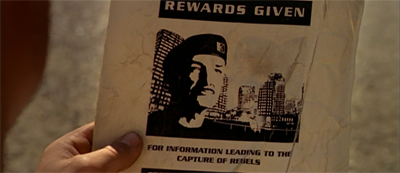
Despite the fact that O’Quinn is credited as a series regular on Harsh Realm, he has appeared about as frequently in the first nine episodes as he did during the equivalent episodes of Millennium. With his “and…” credit at the end of the opening title sequence, it felt like O’Quinn might be forgotten by the show. His face might appear on posters and propaganda, but he was not going to play a particularly dynamic role in the events of the first season. After all, Hobbes is trying to assassinate Santiago; there are reasons why the writers would want to keep them separate.

Walk softly, but carry a big stick...

Walk softly, but carry a big stick…

Nevertheless, Cincinnati is a story that unfolds from Santiago’s perspective. Hobbes and Pinochio play a major part in unfolding events, but they largely reacting. The bulk of Cincinnati concerns a conflict between Santiago’s forces and the Native American population of Ohio. When a military strike goes horribly wrong, Santiago is forced to survive on his own terms. He infiltrates the eponymous city and sets about furthering his own agenda with ruthless efficiency.

A lot of Cincinnati is pure nonsense; the plot is barely held together by contrivance and coincidence, hinging on a final twist that manages to be both obvious and completely unearned. At the same time, it is hard to hate an episode that is carried by Terry O’Quinn and offers the actor a chance to sink his teeth into a juicy part.

It's all in ruins...

It’s all in ruins…

Continue reading

Harsh Realm – Kein Ausgang (Review)

This November, we’re taking a trip back in time to review the seventh season of The X-Files and the first (and only) season of Harsh Realm.

So, what does an average episode of Harsh Realm look like?

After all, the show was cancelled after only three episodes had been broadcast. Those three episodes were all written by the creator, and formed something of a loose introduction to the show. Inga Fossa ended with our protagonist finally accepting his place in the virtual world and his mission to defeat General Omar Santiago before the dictator can destroy the real world. There is a sense that the show had yet to even demonstrate what a regular episode of Harsh Realm might look like. It was over before it had even begun.

Jumping into action...

Jumping into action…

Kein Ausgang is the first episode of Harsh Realm to be written by somebody other than Chris Carter. As such, it is an important milestone in the development of the series. It is also the first of two episodes written by Steven Maeda, who would prove to be a pretty reliable set of hands in the life of the young show. Based on his contributions to Harsh Realm, it is easy to see why Carter drafted Maeda over to The X-Files in the wake of Harsh Realm‘s cancellation, even if his contributions to that show were a little more uneven.

Kein Ausgang offers an interesting glimpse of what Harsh Realm might have looked like going forward, if Fox had waited more than three episodes to cancel the show.

Shining a light on it...

Shining a light on it…

Continue reading

Harsh Realm – Inga Fossa (Review)

This November, we’re taking a trip back in time to review the seventh season of The X-Files and the first (and only) season of Harsh Realm.

Inga Fossa is a noteworthy episode of Harsh Realm for a number of reasons.

In production terms, it closes out the loose three-episode introduction to the series. The Pilot, Leviathan and Inga Fossa were all written by Chris Carter and served as an introduction to the world and rules of Harsh Realm. Perhaps owing to the relative complexity of the show’s premise, Carter takes a bit of time to lay out and establish the core ideas of the show. It isn’t until the end of Inga Fossa that characters like Thomas Hobbes and Sophie have reached the status quo that will carry them through the rest of the first season.

Game on...

Game on…

However, all of this is ultimately irrelevant. Inga Fossa will always be notable for being the final episode of Harsh Realm to air on Fox. Chris Carter’s new show was infamously cancelled after only three episodes were broadcast. The six episodes that had been produced before cancellation were quietly shuffled off Fox’s 1999 schedule; they eventually aired on FX in mid-2000, to little fanfare. The cancellation was a shocking development. The ratings were spectacularly terrible, but Harsh Realm had been intended to establish Carter as the network’s idea-generating machine.

Something was very wrong.

"You can't $@!# in here, this is the war room!"

“You can’t $@!# in here, this is the war room!”

Continue reading

Harsh Realm – Leviathan (Review)

This November, we’re taking a trip back in time to review the seventh season of The X-Files and the first (and only) season of Harsh Realm.

The first three episodes of Harsh Realm are an interesting combination, and not just because they were the only three episodes of the show to air before cancellation.

All three episodes are written by Chris Carter. The first two are directed by Daniel Sackheim. Taken together, they form a loose triptych. They are effectively three separate stories that come together to form a three-part pilot for the show. It is only by the end of Inga Fossa that Thomas Hobbes (and the audience) fully accept the virtual world into which they have been placed, embracing the hero’s journey that lies ahead. It isn’t until Kein Ausgang that the show really offers the audience a sense of how it might work on a weekly basis.

Fading out...

Fading out…

This is not to suggest that the events of The Pilot flow elegantly into Leviathan, nor that the events of Leviathan bleed over into Inga Fossa. All three episodes of television are discreet and individual; foreshadowing the format that the show would take in its relatively brief life. Interestingly, Carter does not take advantage of the show’s video game structure to enforce more rigid serialisation. If anything, most the nine episodes (particularly the back six) are rigidly episodic.

Leviathan is particularly relaxed in its structure. The Pilot offered all the spectacle and exposition necessary to establish Harsh Realm. In contrast, Leviathan is a bit more focused on mood and atmosphere. There is an impressive action sequence to close out the episode, but there is a larger sense that Leviathan is about establishing what day-to-day existence must be like in this virtual world.

General problems...

General problems…

Continue reading