• Following Us

  • Categories

  • Check out the Archives


  • Awards & Nominations

New Escapist Column! On the Superhero Genre’s Existential Crisis…

I published a new In the Frame piece at The Escapist this evening. With no major new releases this week, and with the recent release of both Secret Invasion and The Flash, it seemed like a good opportunity to take a look at the state of the modern superhero genre.

While there are ongoing debates about whether “superhero fatigue” has set in, these are largely besides the point. Watching contemporary superhero films, there is a palpable anxiety underpinning these blockbusters. Increasingly, these superhero films are about superhero films. In particular, they are movies and television shows that make an existential argument for their continued importance and necessity.

You can read the piece here, or click the picture below.

New Escapist Column! On Why Supergirl is the Best Part of “The Flash”…

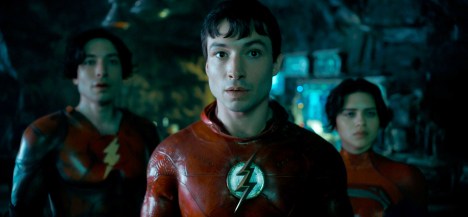
I published a new piece at The Escapist at the weekend. With the release of The Flash, it seemed worth considering the best part of the movie: Sasha Calle’s Supergirl.

For decades, Warner Bros. has struggled with the character of Superman, trying to find a way to make that character relevant for the modern world. What’s interesting about The Flash is that it finds a unique and compelling answer to this question with its take on Supergirl, presenting an immigrant who arrives to a world that is inherently hostile and xenophobic, which treats her as less than a person, and yet somehow finds the strength to fight for that planet anyway. It’s just a shame that she’s ultimately wasted and discarded by the film.

You can read the piece here, or click the picture below.

New Escapist Column! On “The Flash” as a Movie About the Horror of “The Flash”…

I published a new In the Frame piece at The Escapist this evening. With The Flash releasing this weekend, it seemed like as good an opportunity to talk about the themes of the movie, and how those ideas exist in direct opposition to its central purpose.

Thematically, The Flash is a story about how the idea of a “reset” is fundamentally pointless. It is a tale about how individuals are often the sum total of their life experiences, including the traumatic ones, and that any attempt to erase those traumas would be to erase the person that they created. However, this is very much at odds with what the film functionally is. It is an opportunity for Warner Bros. to shift around their established continuity and intellectual property, to reset characters and to recast actors. In short, The Flash is a movie about its own monstrosity.

You can read the piece here, or click the picture below.

New Escapist Column! On “The Flash” as a Two-Hour-Long Shareholders’ Memo…

I published a new In the Frame piece at The Escapist on Friday. With the release of The Flash in cinemas, it seemed like a good opportunity to consider the movie.

What is interesting about The Flash is that it is a movie almost entirely devoid of any artistic sentiment whatsoever. It is a movie that does not exist because anybody working on it had a brilliant idea that needed to be realised. It exists largely because Warner Bros. decided that they needed a Flash movie, and so – against all laws of nature and reality – simply willed that movie into existence.

You can read the piece here, or click the picture below.

New Escapist Video! “The Flash Isn’t a Film, It’s a Corporate Mandate”

I’m thrilled to be launching movie and television reviews on The Escapist. Over the coming weeks and months, I will be joining a set of contributors in adding these reviews to the channel. For the moment, I’m honoured to contribute a five-minute film review of The Flash, which was released in cinemas this weekend.

New Escapist Column! On “Zack Snyder’s Justice League” and Superman as an Inspiration…

I published a new In the Frame piece at The Escapist this evening. With the release of Zack Snyder’s Justice League last week, it seemed like a good opportunity to dig into the movie’s portrayal of Superman.

Snyder’s portrayal of Superman has always been controversial among more hardcore fans of the character, particularly in Man of Steel and Batman v. Superman: Dawn of Justice. There are those who claim that Snyder misunderstands the Man of Steel, and that his films fail to grasp the most compelling aspect of his character. Instead, Zack Snyder’s Justice League offers a fascinating and rounded view of the superhero, one not defined by nostalgia for past iterations – but instead by hope for the generations inspired by him.

You can read the piece here, or click the picture below.

226. Zack Snyder’s Justice League (#86)

Hosted by Andrew Quinn and Darren Mooney, and this week with special guest Graham Day, The 250 is a fortnightly trip through some of the best (and worst) movies ever made, as voted for by Internet Movie Database Users.

This time, Zack Snyder’s Zack Snyder’s Justice League.

Following the death of Superman, Batman sets about putting together a team of superheroes to fight a threat that is charging at Earth from across the cosmos.

At time of recording, it was ranked the 86th best movie of all time on the Internet Movie Database.

Continue reading

New Escapist Column! On the Horror of Joss Whedon’s “Justice League”…

I published a new column at The Escapist this evening. With the release of Zack Snyder’s Justice League this week, it seemed like an appropriate opportunity to take a look at the original theatrical cut of Justice League, which remains one of the worst blockbusters of the past decade.

What makes the theatrical cut of Justice League such an insidious film isn’t just what it is, although it is terrible on its own terms. It’s what the film represents. It’s a very conscious and very deliberate erasure of a distinct vision of an expensive creative project, in the hope of serving reheated nostalgic leftovers that fans might gorge themselves upon. It’s pure, empty, vacuous content – a pale imitation of what other companies do better, without a single unique perspective of its own.

You can read the piece here, or click the picture below.

The Flash (1987-2009) #12-14 – Velocity 9/Savage Vandalism/Wipe Out (Review)

So, I’m considering reviewing this season of The Flash, because the pilot looks interesting and I’ve always had a soft spot for the Scarlet Speedster. I’m also considering taking a storyline-by-storyline trek through the 1987-2009 Flash on-going series as a companion piece. If you are interested in reading either of these, please let me know in the comments.

Does anything date a mainstream superhero comic worse than the almost obligatory anti-drug issue?

In the wake of Crisis on Infinite Earths, DC made a rather conscious effort to engage with younger readers. Some of these worked, but quite a few were cringe-induncing in execution. On paper, introducing more diversity into the shared universe via New Guardians was a good idea; in practice, these diverse characters were little more than stereotypes. On paper, killing Barry Allen and replacing him with the younger Wally West was worth doing; in practice, it seemed like the company had no idea how to make him relatable.
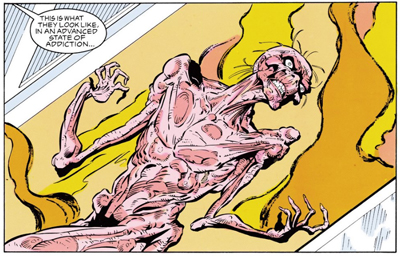
Drugs are bad, m'kay?

Drugs are bad, m’kay?

Quite a few of the comics published around this time have dated poorly. They seem like awkward attempts to reengage with the cultural zietgeist, without understanding that zietgeist at all. Mike Baron had given fans a younger and more grounded version of the Flash, but immediately had the character win the lottery and move to the Hamptons. There was a sense that the comic wanted to dispel criticisms that DC was old-fashioned or stuffy, but had no idea of how to actually go about that.

This leads to stories like Velocity 9, the obligatory “winners don’t use drugs” story that tries to be timely and cutting edge, but simply doesn’t work.
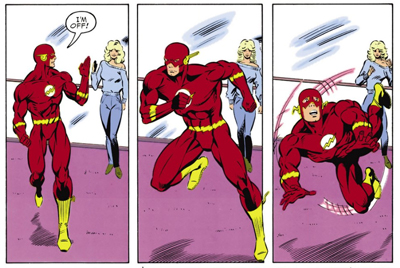
Tripping himself up...

Tripping himself up…

Continue reading

The Flash – Plastique (Review)

So, I’m considering reviewing this season of The Flash, because the pilot looks interesting and I’ve always had a soft spot for the Scarlet Speedster. I’m also considering taking a storyline-by-storyline trek through the 1987-2009 Flash on-going series as a companion piece. If you are interested in reading either of these, please let me know in the comments.

Plastique demonstrates that we are still in the early days of The Flash as a television show. We are still working through all the stock elements and trying to figure out what works, while also using fairly stock plot lines to help the show find its feet. Going Rogue was a massive step forwards for the show, but Plastique can’t quite maintain the forward momentum. It feels more like The Fastest Man Alive or Some Things You Can’t Outrun, episodes using a fairly episodic format with generic guest stars and familiar plots to help get things moving.

Plastique is a nice demonstration of what works and what doesn’t work about The Flash at this stage in its life-cycle. It is light and bubbly, and more than a little silly. It is very consciously a CW show, to the point where it seems to wryly winking at the audience. It is also endearingly earnest, embracing a lot of its core superhero tropes even as the characters within the narrative remain reluctant to latch on to “the Flash” as a superhero code name. The Flash is a show that is unashamed about its comic book roots; Plastique even teases the appearance of a psychic gorilla.

Boom!

Boom!

However, there are problems. The ensemble is uneven at best. The stand-out performers – whether part of the main cast or simply guest stars – skew older. The younger actors tend to be a bit more hit-and-miss. It is more exciting to watch actors like Jesse Martin, Clancy Brown and Tom Cavanagh interact than to spend any time with Kelly Frye or Carlos Valdes. While a lot of that is down to the quality of the casting, the writing is also to blame. The Flash is at its best when it seems to treat characters as adults, rather than young people doing young people stuff.

Plastique is a solid enough episode, but it is one that demonstrates where the strengths and weakness of the show lie. The Flash needs to start compensating and adjusting for that.

A flash of inspiration...

A flash of inspiration…

Continue reading