• Following Us

  • Categories

  • Check out the Archives


  • Awards & Nominations

Grant Morrison’s Seven Soldiers of Victory (Review/Retrospective)

December is “Grant Morrison month” here at the m0vie blog, as we take the month to consider and reflect on one of the most critically acclaimed (and polarising) authors working in the medium. We’ve got a special treat for you this week, which is “Seven Soldiers Week”, so check back each day for a review of one of the Seven Soldier miniseries that Morrison put together.

Seven Soldiers of Victory is perhaps the strangest comic book “event” that we’ve ever seen. It’s essentially two issues, with a series of seven four-issue miniseries unfolding between them. The idea is that the seven books each follow one of the eponymous seven members of the superhero team destined to save the world from an evil invasion. Of course, this is a Grant Morrison story, so there’s far more to it than that, but perhaps the most fascinating aspect of the crossover is that (with one exception) none of the seven members of the team actually meet each other.
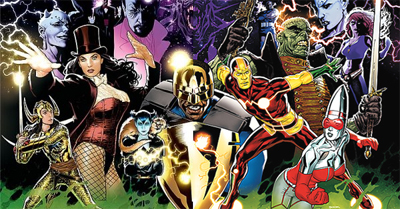
Seven is a magic number...

Continue reading

Grant Morrison’s Seven Soldiers of Victory: The Bulleteer (Review/Retrospective)

December is “Grant Morrison month” here at the m0vie blog, as we take the month to consider and reflect on one of the most critically acclaimed (and polarising) authors working in the medium. We’ve got a special treat for you this week, which is “Seven Soldiers Week”, so check back each day for a review of one of the Seven Soldier miniseries that Morrison put together.

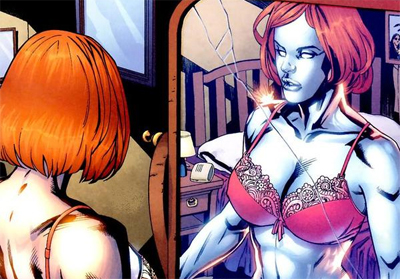
There’s a whole class of people in hospital wards, Mrs. Harrower, people who’d do just about anything to hang out with the skintight crowd. They expose themselves to radioactive materials or drink home-made potions… They interact with venomous insects and dangerous animals in the expectation of receiving some totem power.

There’s not a lot of sympathy among medical staff who have to clean up the mess.

The Bulleteer is a wonderful deconstruction of the superhero world we see so often reflected in the comics of Marvel and DC. These characters were created decades ago, in a different world. Writing elsewhere last year, I wondered if the very concept of a secret identity is outdated, a genre convention which doesn’t reflect the modern world. Clark Kent is a modest cover for Superman, a creation which afford him the opportunity to pretend to be normal, a humble camouflage that seemed perfectly quaint in the thirties. These days, I wonder if people would even bother. After all, in this era of instant celebrity and reality television, with the entire world aspiring to become “special”, why would you ever want to be normal?

What happens when the shine comes off?

Continue reading

All This Flying is Making Me Tired: Superhero Fatigue…

Well, blockbuster season is really kicking into swing at the moment. Next week will see the release of X-Men: First Class, which will be the second major superhero movie of the summer, following Branagh’s superb Thor. There are two more due to touch down before the end of the blockbuster season, Green Lantern and Captain America: The First Avenger. It’s fascinating how large the superhero genre has grown in recent years, to the point where one might legitimately argue that it has subgenres. Part of me wonders if this particular blockbuster fad is approaching its climax – if the superhero movie might out-stay its welcome, and go the way of the Western.

Is the superhero genre's blackest night ahead?

Continue reading

It’s a Wonder They Stay On: Thoughts on Wonder Woman’s Wardrobe…

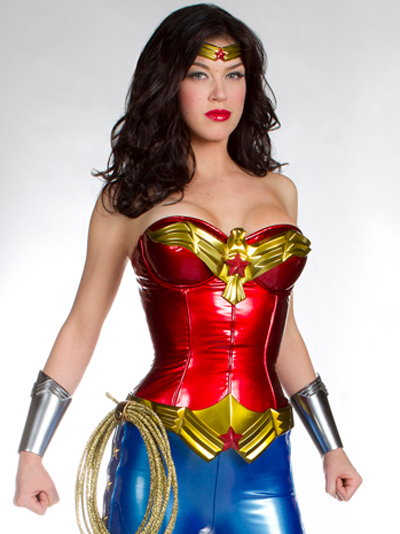
Well, the first pictures of David E. Kelley’s upcoming Wonder Woman adaptation have hit the web. Lynda Carter loves it and everyone else seems to hate it. Me, I really couldn’t care too much about the costume – I’m just worried about the very idea of a Wonder Woman television show from the creator of Ally McBeal. That’s not a putdown – well, it kinda is – but it’s a more fundamental problem than the outfit she wears (which will likely get retooled repeatedly over the course of the show – assuming the show has a course). Anyway, the outfit gives me an opportunity to wonder about Wonder Woman’s outfit. Is there something wrong with her traditional Lynda Carter look, and is this update an improvement?

Is it any wonder?

Continue reading

Non-Review Review: Wonder Woman

This post is part of the DCAU fortnight, a series of articles looking at the Warner Brothers animations featuring DC’s iconic selection of characters. I’ll be looking at movies and episodes and even some of the related comic books. This is one of the animated feature films involving the characters from the creators of the original animated shows.

Did you… did you stop Ares?

No. I didn’t. I couldn’t.

What? Why not?

I had to save you.

(slap!)

Ow!

– Diana clarifies to Steve that she isn’t a damsel in distress

I have to confess, I’ve never been grabbed by Wonder Woman as a concept. Is she a feminist? A socially conscious superhero? A female superman? A superhero who is willing to take a life if it’s necessary? A diplomat? She’s been all these things and many more, which is perhaps why it’s hard to get a handle on her – which is perhaps why it’s difficult to care for her. Her origins cannot be summed up in a single sentence like Batman (an orphaned “rich kid with issues… lots of issues”) or Superman (who Grant Morrison managed to sum up in eight words) – her origin will likely eat up at least a paragraph of this review. As such, you can understand my surprise that Wonder Woman is perhaps the best DC comics animated adaptation they have produced to date.

Taking a swing at the character...

Continue reading

Justice League: A Better World

This post is part of the DCAU fortnight, a series of articles looking at the Warner Brothers animations featuring DC’s iconic selection of characters. I’ll be looking at movies and episodes and even some of the related comic books. Tomorrow I’ll be reviewing Justice League: Crisis on Two Earths, so I thought it might be worth a look at what a world run by an evil Justice League might look like.

One of the central challenges that the iconic Justice League characters have had to face over the years has been the way that the comic book world has slow and sometimes subtly morphed into something far more sinister than the bright-coloured origin stories of the forties, fifties or even sixties. There was a time when supervillains were a relatively harmless sort, the hero would always save everyone’s life and there would be a “happy ever after” ending thrown on – most obviously in the Silver Age, which produced characters like the modern Flash and Green Lantern. Even the characters who were originally somewhat darker and edgier – Superman and Batman, for example, were originally relatively indifferent to human life – passed through this phase with a healthy respect for a game based around rules – the first being “thou shalt not kill”. However, times changed. Villains went from being theives and irritations to being murderers and rapists. Naturally, the fact that no prison could hold a popular bad guy long enough kinda undermines the good that these heroes do – the Joker is always going to kill more people unless he is eventually killed.Sure, there’s comic book logic at play here – the same way that having genius heroes hasn’t altered the way normal people live too much – but at some point the old fashioned values seem a little outmoded. Somebody suggests that a line should be crossed. Various iterations of the characters have tackled the issue in multiple ways, and A Better World is the attempt by Bruce Timm and the writers of the DC animated universe to address it. 

Being the group's plucky comic relief isn't without risks...

Continue reading

Secret Invasion (Review/Retrospective)

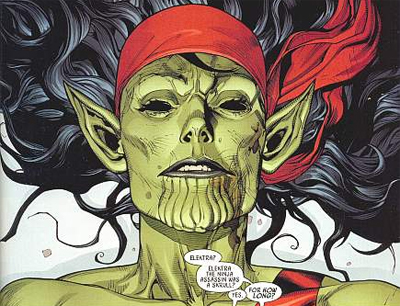
This is the twelfth in a series of comic book reviews that will look at the direction of Marvel’s shared universe (particularly their “Avengers” franchise) over the past five or so years, as they’ve been attempting to position the property at the heart of their fictional universe. With The Avengers planned for a cinematic release in 2012, I thought I’d bring myself up to speed by taking a look at Marvel’s tangled web of continuity.

Well… that was anti-climactic.

Well, at least green and red go together...

Continue reading

World War Hulk (Review/Retrospective)

This is the sixth in a series of comic book reviews that will look at the direction of Marvel’s continuity (and particularly their “Avengers” franchise) over the past five or so years, as they’ve been attempting to position the property at the heart of their fictional universe. With The Avengers planned for a cinematic release in 2012, I thought I’d bring myself up to speed by taking a look at Marvel’s tangled web of continuity. Get an overview of what I’m trying to take a look at here.

Forget sides. They’re all screwed when the Hulk gets back.

– a popular internet meme which puts Civil War in perspective

I have to admit, World War Hulk reads like something of a guilty pleasure. The fantastic artwork from John Romita Jr. (whose fantastical character designs work much better here than in Kick-Ass or even Enemy of the State) certainly helps, as does the relative brevity of the miniseries. It’s a relatively self-contained five-issue storyline, as opposed to the large House of M or Civil War which directly preceded it and Secret Invasion which would follow – it also helps that the tie-in issues seem a lot less essential (and certainly less omni-present) than they did for any of those series. World War Hulk is pretty far from perfect, but it’s an enjoyable little arc from a writer who is clearly familiar with the Incredible Hulk.

Hulk makes quite an impact...

Continue reading

House of M (Review/Retrospective)

This is the third in a series of comic book reviews that will look at the direction of Marvel’s “Avengers” franchise over the past five or so years, as they’ve been attempting to position the property at the heart of their fictional universe. With The Avengers planned for a cinematic release in 2012, I thought I’d bring myself up to speed by taking a look at Marvel’s tangled web of continuity. Get an overview of what I’m trying to take a look at here.

The X-Men represent the oddball of mainstream superhero comic books. In a genre and medium dedicated offering a static setup – things never really change or resolve – the X-Men are built upon the very idea of evolution. The whole basis of the franchise is the pursuit of equality by the genetically distinct mutant population, the idea that they and mankind can grow together. It has even been frequently suggested that these super-powered individuals represent out future or our replacements. However, the only way to actually tell a story like that is to follow it through to its logical conclusion – to let the ball roll and to let the world change. It feels a little counterproductive for Charles Xavier and his students to still be fighting for the same rights as everyone else nearly fifty years on – it might even seem a little stale. Grant Morrison’s superb New X-Men run offered a solution of sorts – it gave us a world where humanity would be extinct in a couple of generations and showed the growth and relationship between human and mutant subculture. Gone was the minority struggling against an oppressive majority – a more complex example of race relations had come into play with “mutant music” and “mutant slang” making their impression on the youth, amid a silent and almost invisible middle-class backlash. This was an ingenious approach which demonstrated the relevance of the franchise. Unfortunately, Marvel were not quite pleased with this – some people even, ridiculously, accused Morrison of telling all the remaining X-Men stories – and decided to set things right. They did that through House of M.

Dive in...

Continue reading

Why Nolan Saying ‘No’ To The Justice League Is A Good Idea…

An interesting snippet of news came out during the week regarding Christopher Nolan, the director of the two recent Batman films and now godfather to a to-be-relaunched Superman franchise (we’re hoping he can figure out how to make it a good film). The director, usually unbelievably coy about his work (he’ll flat out refuse to answer any particularly prying questions, which is great in an era of spoilers and speculation and so on), gave a succinct answer on whether his Batman and Superman will exist within the same universe. His answer was a flat-out ‘no’. And I think that’s great.

This looks like a job for Christopher Nolan!

Continue reading