• Following Us

  • Categories

  • Check out the Archives


  • Awards & Nominations

House of Cards (US, 2013): Chapter 3 (Review)

Dammit, Frank! You can’t just roll up on my property like you own it!

Oh but I can.

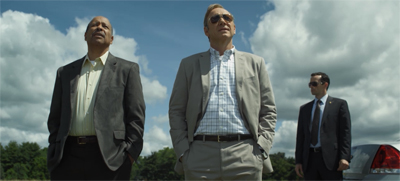
And we’re back to square one. I suppose this is inevitable in the transition to American television, but House of Cards is beginning to feel strangely episodic. The British version ran ran for four episodes, moving at an incredible pace as Francis Urquhart manipulated his way to the position of Prime Minister. The American version, running thirteen episodes, seems to be more about stopping and starting. Indeed, there’s relatively little traction here on the Secretary of State subplot, or Frank Underwood’s plan for political revenge against those who he feels wronged him.

Instead, this third episode feels like something of a breather episode, the kind of character-orientated piece that might have worked a bit later in the year, after the show had built up a decent momentum. Instead, it seems like we accelerated last time only to pump the breaks this time around.

Just peachy...

Just peachy…

Continue reading

Doctor Who: The War Games (Review)

To celebrate the fiftieth anniversary of the longest-running science-fiction show in the world, I’ll be taking weekly looks at some of my own personal favourite stories and arcs, from the old and new series, with a view to encapsulating the sublime, the clever and the fiendishly odd of the BBC’s Doctor Who.

The War Games originally aired in 1969.

Well, what was happening? Why was it so difficult to move?

It was the Time Lords.

But they’re your own people, aren’t they, Doctor?

Yes, that’s right.

Why did you run away from them in the first place?

What? Well, I was bored.

What do you mean, you were bored?

Well, the Time Lords are an immensely civilised race. We can control our own environment, we can live forever, barring accidents, and we have the secret of space time travel.

Well what’s so wrong in all that?

Well we hardly ever use our great powers. We consent simply to observe and to gather knowledge.

And that wasn’t enough for you?

No, of course not. With a whole galaxy to explore? Millions of planets, eons of time, countless civilisations to meet?

Well, why do they object to you doing all that?

Well, it is a fact, Jamie, that I do tend to get involved with things.

– Jamie, the Doctor and Zoe

The War Games represents the end of the era. It is the last appearance of Jamie as a regular companion. It is the last show featuring Patrick Troughton as the Doctor, although he would return for the occasional guest spot, celebration or charity episode. It was also the last of the series to be shot in black and white. The transition from Troughton to Pertwee would arguably be one of the most dramatic shifts in the history of the show. Not only would the show suddenly be broadcast in colour, and not only would it feature a new lead actor, but it would also have a new focus, grounded on Earth, and with that a new status quo and new rules. The show was only six years old at the time, but the change must have seemed radical to those watching.

The War Games isn’t the perfect episode – it’s too long and too plodding – but it is a lot more entertaining than some of the longer adventures, and it serves as a fond farewell to the “cosmic hobo” interpretation of the Doctor. Indeed, the episode probably seems a great deal harsher than it did in hindsight, with the specifics of regeneration not quite codified, the Doctor’s forced transformation seemed less like a formal execution than it does to modern audiences who watched the Tenth Doctor plead for more time.

The War Games is an effective and fond farewell to not only a particular iteration of the title character, but also a version of the show as a whole.

Run!

Run!

Continue reading

Non-Review Review: Lincoln

Steven Spielberg’s Lincoln might just be the most fascinating exploration of the overlap between legal, moral and democratic power ever produced. Abraham Lincoln’s name might brand the film, and Daniel Day-Lewis’ sensational performance might hold it together, but there’s a very clear sense in watching Lincoln that the film is more preoccupied with lofty philosophical questions about the role of a ruler in a democracy. The Civil War and the 13th Amendment provide a backdrop, but Lincoln seems more concerned with how those elected must wield the mandate given from the people. Must they always represent the views of the people who elected them, or is their job to lead?

Note: Not a Vampire Hunter...

Note: Not a Vampire Hunter…

Continue reading

The Spirit Archives, Vol. 25 (Review/Retrospective)

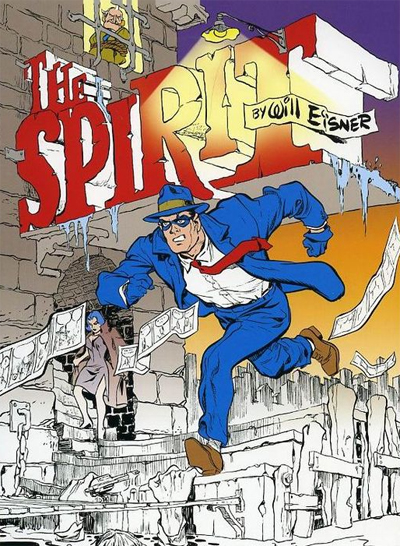
DC have done a tremendous job with their Spirit Archives collection. Twenty-four volumes collecting the twelve years of the Sunday strip is quite an accomplishment, and they’d be forgiven for stopping there. No other character in DC’s back catalogue has such a consistent collection of their early years. (Batman and Superman might have similar volumes of material collected, but somewhat haphazardly.) It’s to the company’s credit that they decided to close out their collections of Eisner’s work on the character with what might be considered two appendices. The next collection will include most of Eisner’s post-1952 work on the character, but this hardcover collects each and every daily Spirit strip published between 1941 and 1942. While it might not be the most essential collection every published (whether in terms of the character or in the history of daily newspaper strips), but it’s still nice to see it collected with the rest of Eisner’s work.

Continue reading

The Spirit Archives, Vol. 13 (Review/Retrospective)

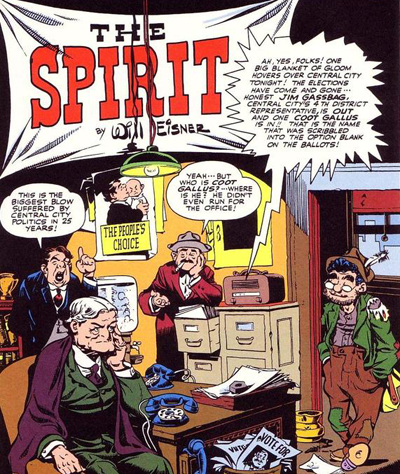
With Eisner now back on the strip for over half-a-year, The Spirit is forging ahead into the middle part of its run. Many commentators and pundits would argue that the few years following Eisner’s return from military service were among the best in the strip’s history, and it’s hard to disagree. While Eisner took the time in his first six months to tidy up loose ends – killing the Squid, sending Satin home with a daughter – here we see the creator building up the world he has created. This collection includes the strips introducing (and a number of subsequent appearances from) both P’Gell and the Octopus, arguably two of the most important characters introduced into the strip following the Second World War. There’s also a sign that Eisner is branching out a bit, and pushing the strip out from the shadow of the Second World War. After all, a new era of prosperity and a Cold War were both just around the corner, very fertile ground for the creator to explore.

A banner year?

Continue reading

The Spirit Archives, Vol. 12 (Review/Retrospective)

The Spirit Archives, Vol. 12 marks Will Eisner’s return to the strip. To be fair, the writer and artist had returned for the last two entries in the previous volume, but this is the first book entirely composed of Eisner’s post-war Spirit stories. While I don’t think Eisner had quite found his groove yet – the best was still yet to come – it’s amazing how dynamic the comic feels after reading the non-Eisner material. It’s easy enough to point to the Eisner-esque tropes and tricks, the techniques and the plot devices and the philosophy that faded from the strip in has absence, but there’s also something much less tangible here. There’s certain energy, a je ne sais que, that had been absent for the previous couple of years, returning in force.

Eisner is back. And, in a way, so is The Spirit.

It’s like he was never gone…

Continue reading

Star Trek: The Next Generation – Where No One Has Gone Before (Review)

To celebrate the twenty-fifth anniversary of Star Trek: The Next Generation, and also next year’s release of Star Trek: Into Darkness, I’m taking a look at the recent blu ray release of the first season, episode-by-episode. Check back daily for the latest review.

I remember that I never really like Where No One Has Gone Before when I was younger. Even now, I have a bit of a tough time counting it among the best episodes of Star Trek: The Next Generation. However, despite that, I’ve actually warmed to it quite a bit on this rewatch. It’s not brilliantly constructed as an hour of television, and I wouldn’t even count it as the best produced in this first season of the second Star Trek series. However, it does something that a lot of other episodes in this run try to do, and fail to accomplish.

It manages to evoke the spirit of Star Trek.

Into the wild purple yonder…

Continue reading

Non-Review Review: Red Riding – The Year of Our Lord 1974

This is the North. We do what we want.

– Craven explains how things work to Eddie

Red Riding is certainly an ambitious effort. David Peace wrote four books exploring violence and corruption in Yorkshire, centring around the morbid history of brutality in the North. Occupying a strange ethereal realm between fact and fiction, sometimes those crimes are fictionalised, but sometimes real murders and murderers intersect. The child murders of this first instalment, Red Riding: 1974, evoke the infamous Moors murders in Manchester during the sixties, while the arrest of an innocent party calls to mind the case of Stefan Kiszko. Adapting the series of four books into a trilogy of films, Red Ridingmakes for a fascinating – if gloomy – exploration of the darker pages in the region’s cultural history.

He’s gone far (Gar)field…

Continue reading

Infinite Crisis: Rann-Thanagar War (Review)

This month I’m taking a look at DC’s massive “Infinite Crisis” Event. Although it was all published in one massive omnibus, I’ll be breaking down the lead-in to the series to tackle each thread individually, culminating in a review of the event itself. Check back for more.

I’ve always been a fan of the “hokey science-fiction” corner of the DC Universe. Adam Strange is perhaps my second-favourite Silver Age DC hero (behind the Flash). I loved Alan Moore’s trip to the stars during his Swamp Thing run. While many thought that Stars my Destination, the penultimate mega-arc of James Robinson’s Starman, went on far too long, I loved every page. Geoff Johns’ Green Lantern is one of my favourite modern comic book runs. I confess all this so that my bias is upfront, when I admit that Rann-Thanagar War is one of my favourite Infinite Crisis tie-ins, even though it’s one of those least directly connected to the event itself.

All the Strange, Strange heroes…

Continue reading

Tomb of Dracula Omnibus, Vol. II (Review/Retrospective)

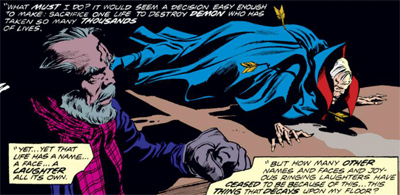
It’s fantastic that Marvel have gone to such pains to collect all of the classic seventies Tomb of Dracula. The main title is collected in the first of three volumes, with this second oversized hardcover rounding out Marv Wolfman and Gene Colan’s run on the on-going series. Indeed, with Colan’s consistent pencils and Wolfman’s long-form plotting, Tomb of Dracula feels remarkably close to a single long-form story, one massive epic in seventy-odd chapters, with ideas hinted and developed years before they would eventually pay off. As such, the collection holds up remarkably well, and is a joy to read. While the second half of the series might not be as solid as Wolfman and Colan’s work on the first thirty-odd issues, it still makes for a satisfying conclusion to this chapter of Dracula’s story.

Out for the Count?

Continue reading