• Following Us

  • Categories

  • Check out the Archives


  • Awards & Nominations

Star Trek: Enterprise – Zero Hour (Review)

Next year, Star Trek is fifty years old. We have some special stuff planned for that, but – in the meantime – we’re reviewing all of Star Trek: Enterprise this year as something of a prequel to that anniversary. This August, we’re doing the third season. Check back daily for the latest review.

There was a very real chance that Zero Hour might have been the last episode of Star Trek: Enterprise to air.

In fact, it was entirely possible that Zero Hour‘s distinctive (and downright provocative) closing shot of an evil!alien!space!Nazi might have been the last shot of Star Trek to air on television for quite some time.

Time is running out...

Time is running out…

Continue reading

Star Trek: Enterprise – Stratagem (Review)

Next year, Star Trek is fifty years old. We have some special stuff planned for that, but – in the meantime – we’re reviewing all of Star Trek: Enterprise this year as something of a prequel to that anniversary. This August, we’re doing the third season. Check back daily for the latest review.

With Stratagem, the third season of Star Trek: Enterprise gets its head back in the game.

The recent stretch of third season episodes seemed to lose sight of what made this such an intriguing premise. Although Rick Berman had conceded that there was an escape hatch in place in case the Xindi arc could not sustain a full season of television, it was increasingly clear that the third season of Enterprise would be a single extended arc exploring Archer’s attempts to find the source of a deadly threat against mankind. It was a bold experiment for a show that had been quite rigidly episodic to this point. At least in theory.

Archer's on candid camera...

Archer’s on candid camera…

In practice, the third season of Enterprise seemed to flounder a little bit once it got past the initial burst of speed powering it into the third season. All of a sudden, the crew found themselves involved in a number of increasingly stand-alone adventures with superficial ties to the larger arc. Episodes like Extinction and Chosen Realm could easily have been produced and broadcast during the show’s first two seasons, with minor alterations. Exile and North Star were only loosely connected to the season’s plot. Carpenter Street was a time travel episode.

Proving Ground had suggested that the show was ready to re-focus its attention on the matter at hand and get back to the imminent threat posed by the Xindi. At the same time, the episode was also keen to stress its episodic nature – most notably in its role as the show’s annual check-in with the Andorians. Stratagem is very much its own self-contained story, but it is a lot more confident about how it fits in the larger scheme of things, and where it fits in the broader arc of the season.

Engineering a convincing set-up...

Engineering a convincing set-up…

Continue reading

Star Trek: Enterprise – Cold Front (Review)

Next year, Star Trek is fifty years old. We have some special stuff planned for that, but – in the meantime – we’re reviewing all of Star Trek: Enterprise this year as something of a prequel to that anniversary. This January, we’re doing the first season. Check back daily for the latest review.

It is customary, these days, for television shows to map out their mythologies years in advance. Depending on when you ask him, executive producer Bryan Fuller boasts of having a six- or seven-year plan for Hannibal, despite the fact that the show spends each cancellation period on the bubble line for NBC. Indeed, the move away from the standard television pilot format means that shows are encouraged to have long-form plots and arcs mapped out.

However, that isn’t always the case. The X-Files was very much made up as it went along, with little real thought put into how the show’s sprawling alien mythology hung together beyond the immediate future. Even heavily serialised shows like Lost or 24 were plotted as they went along, with plans radically changing as the show evolved. Unlike film, where you (mostly) need a finished story before you start filming, television is a medium where you don’t really need an ending in mind as you begin telling the story.

There's a lot on the (time) line...

There’s a lot on the (time) line…

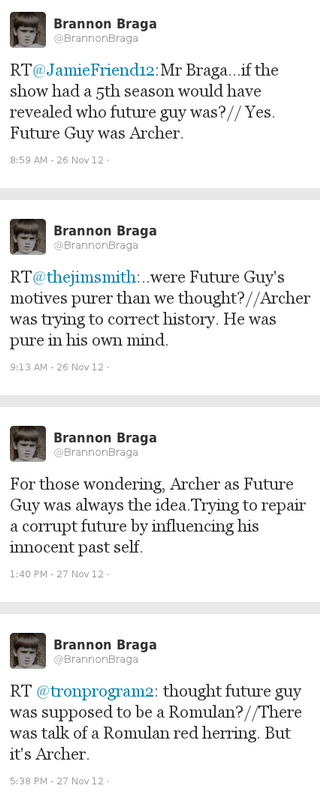
So it really shouldn’t be a surprise that Star Trek: Enterprise introduced the idea of the “Temporal Cold War” without any real idea of how the story was meant to develop or conclude. Although structured as something of a serialised arc among a (mostly) episodic couple of seasons, the Temporal Cold War is something that makes very little sense in the context of the show. Even years after the fact, the Temporal Cold War is a mystery, with Brannon Braga casually dropping the reveal that, well… Archer did it.

Of course, that plot development doesn’t make a lot of sense… but that’s par for the course. It is very hard to tie the various Enterprise time travel episodes together into a logical and cohesive narrative. Cold Front doesn’t even bother to answer questions immediately relevant to its own narrative, let alone hint at logical future developments for the series’ recurring time-travel plot line. It’s a story that seldom makes sense within individual episodes, let alone when they are strung together.

In space, all warriors are (temporal) cold warriors...

In space, all warriors are (temporal) cold warriors…

And yet, despite that, Cold Front is a pretty great episode. Part of that is down to the Temporal Cold War plot line, with Cold Front introducing a welcome sense of ambiguity to the conflict and selling the idea that Archer has wandered into something much larger than he can comprehend. On an otherwise quiet mission, Enterprise finds itself embroiled in a conflict between two forces that Archer does not fully understand, as if the ship and its crew have found themselves engaged on one front of a war in heaven.

However, Cold Front works just as well with the elements that exist outside the Temporal Cold War. As with Breaking the Ice, the episode plays like a regular day on board the Enterprise, as Archer and his crew find themselves welcoming religious pilgrims on board and making friendly first contact as they gather to watch some beautiful interstellar phenomenon. It’s an episode that draws attention to the quiet wonder and majesty of deep space exploration, elegantly and effectively.

Hang on in there...

Hang on in there…

Continue reading

Space: Above and Beyond – Level of Necessity (Review)

This November (and a little of December), we’re taking a trip back in time to review the third season of The X-Files and the first (and only) season of Space: Above and Beyond.

Coming hot on the heels of Who Monitors the Birds?, Level of Necessity was almost destined to be a little disappointing. Who Monitors the Birds? is perhaps the quintessential episode of Space: Above and Beyond, encapsulating the show’s core themes and utilising its world in a clever and constructive manner. In contrast, Level of Necessity seems almost rote. It is an episode that might have been written for any other nineties science-fiction show.

There are some nice ideas here, but Level of Necessity feels far too generic. In fact, it seems like the episode is centred around Damphousse not because the story makes any more sense for her than it does for any other character, but because she is the only character who has yet to occupy the centre of a story. Thomas J. Wright directs quite well, and Richard Kind makes for a solid guest star. However, Level of Necessity suffers from the fact that it could be an episode of any other show.

Stars in his eyes...

Stars in his eyes…

Continue reading

The X-Files – Clyde Bruckman’s Final Repose (Review)

This November (and a little of December), we’re taking a trip back in time to review the third season of The X-Files and the first (and only) season of Space: Above and Beyond.

Clyde Bruckman’s Final Repose is a masterpiece.

It is one of the best episodes that The X-Files ever produced. It is the only episode of The X-Files to win the Emmy for Outstanding Writing in a Drama Series. It was the first episode to take home an Emmy for a performance on the show, with Peter Boyle winning the Emmy for Outstanding Guest Actor in a Drama Series. It was Boyle’s only Emmy win of ten nominations. It was the only episode of The X-Files to air on the 13th October, a symbolically important date for Carter (“1013”). It was also Friday the 13th.

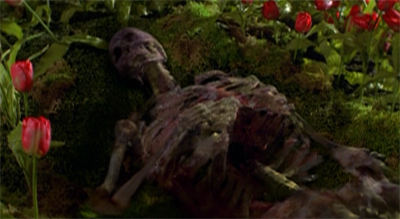
No bones about it...

No bones about it…

As part of the recent resurgence in interest in The X-Files, the story has enjoyed even more focus. It was one of three episodes voted by fans to air as part of the Los Angeles Times Hero Complex Film Festival in 2013 as part of the series’ twentieth anniversary celebrations. Chris Carter himself chose it to represent The X-Files at the Austin Film Festival in 2012. It is very frequently ranked among the best the show ever produced.

And all of that praise is very well earned.

Crystal clear...

Crystal clear…

Continue reading

Star Trek: Deep Space Nine – Visionary (Review)

This September and October, we’re taking a look at the jam-packed 1994 to 1995 season of Star Trek, including Star Trek: Deep Space Nine and Star Trek: Voyager. Check back daily for the latest review.

Visionary confirms that “O’Brien must suffer” is to become an annual tradition on Star Trek: Deep Space Nine. The second season of the show had made a good start with episodes like Whispers and – to a lesser extent – Armageddon Game, but Visionary confirms that this will really be O’Brien’s niche in the ensemble from this point on. Visionary sees O’Brien randomly jumping forward through time, inevitably glimpsing some horrible tragedy that must be avoided. (Boy, it sure is lucky that he started jumping at this point, isn’t it?)

Visionary should feel contrived and convenient, hinging on a pretty flimsy plot hook. That said, the episode ultimately works quite well, even if it doesn’t stand out as a classic piece of Star Trek. Watching Visionary, there’s very much a sense that Visionary only really works as well as it does because Deep Space Nine has built up a larger mythology of characters and long-form plotting that can support what might otherwise be a fairly flimsy premise.

"Why the hell doesn't this ever happen to Julian?!"

“Why the hell doesn’t this ever happen to Julian?!”

Continue reading

Doctor Who: The Beast Below (Review)

To celebrate the fiftieth anniversary of the longest-running science-fiction show in the world, I’ll be taking weekly looks at some of my own personal favourite stories and arcs, from the old and new series, with a view to encapsulating the sublime, the clever and the fiendishly odd of the BBC’s Doctor Who.

The Beast Below originally aired in 2010.

What are you going to do?

What I always do. Stay out of trouble. Badly.

So is this how it works, Doctor? You never interfere in the affairs of other peoples or planets, unless there’s children crying?

Yes.

– Amy and the Doctor reiterate the way things work

Steven Moffat’s first season producing Doctor Who owes a conscious debt to the rigid structure of the seasons produced by Russell T. Davies. There’s an opening episode in contemporary Britain, followed by one episode visiting the past, one visiting the future. There are three two-parters – the season finalé, a “monster”-driven two-parter and a more atmospheric and moody piece. There’s even a brief spell in the middle of the season where Moffat spices up the TARDIS dynamic by adding in a temporary companion.

This approach worked quite well. It’s worth noting that Moffat’s first season was the only point following the departure of Russell T. Davies that Doctor Who was able to deliver thirteen episodes of the show on thirteen consecutive weeks. It struck something of a happy middle between Davies’ more episodic approach to the show that the more arc-driven storytelling favoured by Moffat. Still, there are moments when it seems like this approach isn’t quite the perfect fit, with Moffat’s voice struggling to fit into the structure established by Davies.

Essentially Steven Moffat’s impression of Russell T. Davies’ update of Andrew Cartmel’s social allegory stories, The Beast Below is an interesting – if slightly unsuccessful – experiment. Moffat’s second season would feature much more effective attempts to evoke the Cartmel era of the classic show, without the sense that Moffat was trying a little too hard to emulate his predecessor.

The space in-between...

The space in-between…

Continue reading

Doctor Who: The Hungry Earth (Review)

To celebrate the fiftieth anniversary of the longest-running science-fiction show in the world, I’ll be taking weekly looks at some of my own personal favourite stories and arcs, from the old and new series, with a view to encapsulating the sublime, the clever and the fiendishly odd of the BBC’s Doctor Who.

The Hungry Earth originally aired in 2010.

Oh look! Big mining thing! Oh, I love a big mining thing. See, way better than Rio. Rio doesn’t have a big mining thing.

– the Doctor looks on the bright side of arriving in not!Rio

The Hungry Earth represents the biggest structural shift of Steven Moffat’s first season of Doctor Who. The writer would indulge in a number of radical structural changes over his time running the show, but his first season as showrunner conforms to the pattern of Russell T. Davies’ four full seasons. There’s the introductory present/past/future trilogy, the two mid-season two-parters and the gigantic two-part season finalé. The content of Moffat’s season might have been markedly different (actual romantic snog! a season building an arc that isn’t just references and easter eggs!), but the format was carried over faithfully.

Moffat’s following two seasons would get more experimental. For one thing, both seasons would be split in half. This allowed Moffat to offer the first genuine cliffhanger in the revival’s history to last more than a week, with a gap of several months between A Good Man Goes to War and Let’s Kill Hitler. His second season would feature the first two-part season opener (and first one-part season finalé) of the revived television show. His third season would feature no two-part episodes, spread across two calendar years.

However, sitting at the tail end of his first season, The Hungry Earth feels like the strangest structural element of Moffat’s first year in charge of Doctor Who. It’s what would traditionally be the first two-parter of the season, pushed back towards the end of the year.

Balancing the scales...

Balancing the scales…

Continue reading

Non-Review Review: Minority Report

I don’t love Minority Report. Don’t get me wrong, it’s a well-made film – perfectly entertaining and cleverly directed by a director who is one of the best living today – but it just doesn’t feel consistent for me. The whole doesn’t necessarily add up to the sum of its parts, as it were.

They should probably screen their officers better...

Continue reading

Non-Review Review: Demolition Man

I love Demolition Man. I know I shouldn’t, but I do.

Eye see you...

Continue reading