• Following Us

  • Categories

  • Check out the Archives


  • Awards & Nominations

Non-Review Review: Set It Up

Set It Up is a loving ode to the classic romantic comedies of the nineties, harking back even further to their antecedents, the screwball comedies of the forties.

The basic premise of Set It Up is straightforward. Zoey Deutch is Harper, the personal assistant to Lucy Liu’s Kirsten. Kirsten is a cutting-edge sports journalist, and Harper is an aspiring writer who found herself working as a personal assistant and has been unable to extricate herself from that situation. Glen Powell is Charlie, the personal assistant to Taye Diggs’ Rick. Charlie hopes to leverage his experience with Rick into a successful and prosperous career, if he can survive Rick’s temper tantrums.

Their chemistry is through the roof.

Following a chance encounter while picking up a delivery late one night, Charlie and Harper hit upon a cunning plan to escape the ridiculous demands of their bosses. Charlie and Harper will use the positions of trust afforded to them as personal assistants in order to trick their bosses into a relationship. Their logic is that a potential romance would eat into Kirsten and Rick’s free time, and thus afford Charlie and Harper more personal time. Charlie can reconnect with his increasingly estranged girlfriend, while Harper can try to become the writer that she always wanted to be.

It is perhaps churlish to describe Set It Up as formulaic, as the primary appeal of the movie is in watching a charming cast navigate a modern spin on a variety of classic romantic comedy tropes. There are perhaps moments when Set It Up leans a little too heavily into its genre trappings, and there are moments when its attempts to update genre conventions for the twenty-first century don’t exactly land. Nevertheless, the film is elevated by charming central performances and breezy yet witty script that understands the mechanics of the genre enough to know when to play with them and when to play them straight.

Will we see some PDAs from the PAs?

Continue reading

Irony, Thy Name Is Gump: “Forrest Gump” and the Art of Earnest Irony…

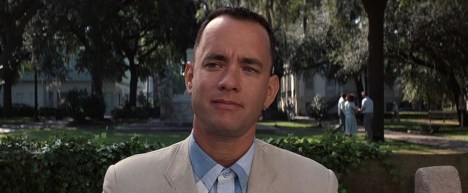
Forrest Gump is a movie that I’ve never quite been able to wrap my head around.

On one level, it’s an incredibly sacchrine and simplistic exploration of the first fifty years of the so-called “American Century”, the turbulent second half of the twentieth century as navigated by a dim-wit with nothing but good intentions to guide his way. The eponymous character floats on the winds of history like a feather, a metaphor that bookends the film in a manner that is incredibly cloying. There is something undeniably condescending and overly simplistic in the notion of history in Forrest Gump, as a force that sweeps up men and nations without any rhyme or reason.

As such, it’s easy to be wary of Forrest Gump and its approach to history. Forrest Gump presents a very clean and sanitised accounting of the second half of the twentieth century, one in which there is absolutely nothing happening beneath the surface of American life, and in which there is no point even attempting to comprehend the myriad of forces at work on the country and its inhabitants. In this way, Forrest Gump plays as a trite moral fable. There is no point in even trying to understand the chaos that is the modern world. It is enough to be decent and oblivious, and things will work out fine.

At the same time, there has always been something lurking at the edge of the frame in Forrest Gump, beneath all the folksy trappings and the simplistic history lessons. It is too much to suggest that Forrest Gump has an edge, but it certainly has a point. Forrest Gump in many ways presents an avatar of the final fifty years of the twentieth century in its central character. The eponymous character is an embodiment of a certain American ideal, a personification of the American public that has been bewildered and confused by the speed and pace with which history seemed to move in that turbulent half-century.

With that in mind, there is something vaguely self-aware in Forrest Gump, something that perhaps simmers beneath the surface of the film. Gump is a likable and charming protagnonist, brilliantly brought to life by Tom Hanks in a performance that (deservedly) won him his second Best Actor Oscar. However, there has always been something uncanny in the film’s presentation of Gump as the character most ideally suited to the twentieth century, in contrast to supporting characters like Lieutenant Dan or Jennie. Forrest Gump is a movie that argues the only way to survive the twentieth century is as a fool and an idiot.

There’s always seemed something very wry and very cynical in that idea, buried beneath the film’s cotton-candy exterior.

Continue reading

Non-Review Review: Adrift

Adrift is a visceral and powerful survival thriller, based on the remarkable true story of Tami Oldham.

In the mid-eighties, Oldham became a figure of note following a disastrous journey into the Pacific with her fiancé Richard Sharp. Sailing from Tahiti to San Diego, their luxury yacht is caught in the middle of Hurricane Raymond. The ship is damaged, the pair separated. Waking up in the flooding living compartment, Oldham is forced to improvise in order to survive. It is a harrowing scenario, a story of a woman essentially wrestling against the elements in a desperate attempt to stay alive in a seemingly impossible situation.

Sail away with me…

The basic premise of Adrift is familiar. It recalls any number of powerful lost-at-sea narratives, from All is Lost to Cast Away to The Mercy. Director Baltasar Kormákur wrings as much tension as possible from the premise, perhaps drawing on his experience working on similar ocean-themed movies like The Sea or The Deep. At certain points in Adrift, the audience is liable to feel claustrophobic, to gasp for breath as the camera whirls and struggles against the oppressive force of nature.

Adrift suffers slightly from a sense of over-familiarity, and from a clumsy plot development that it chooses to play as a big twist rather than an organic narrative element. Nevertheless, Adrift is a tense story of survival in impossible circumstances.

Mast-er and commander.

Continue reading

Non-Review Review: Hereditary

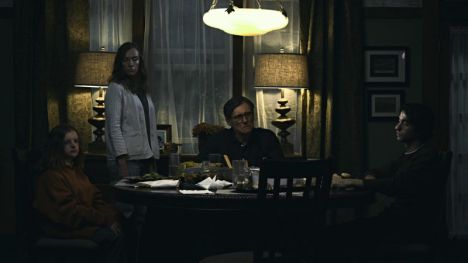
Perhaps what is most striking about Hereditary is how all the comparisons to The Exorcist seem off base.

To be fair, every movie deserves to be judged on its own terms unless it expressly demands otherwise, whether through a preexisting relationship or an inviting homage. Nevertheless, The Exorcist has been a touchstone for Hereditary in the run-up to the film’s release, a critical cliché employed to underscore just how effective Hereditary is. Rolling Stone has pitched the film as “this generation’s The Exorcist.” TimeOut described it as “a new generation’s The Exorcist.” Titlemag acknowledged the use of such critical shorthand.

Something to chew over.

It’s easy to see why this comparison has been made. The Exorcist is public short-hand for scary, a famously controversial film that shocked audiences upon release and which many members of the current generation first heard discussed in hushed tones. More than that, there’s significant thematic overlaps between Hereditary and The Exorcist, with both films serving as unsettling explorations of a tightly-knit family dynamic that use supernatural horror as prism through which these dynamics might be interrogated.

However, there is a major tonal difference between Hereditary and The Exorcist. In many ways, The Exorcist represents a very broad and populist strand of seventies horror, with an accessible central narrative that plays off easily understood fears in a very direct manner. The Exorcist was a cultural phenomenon, earning almost two hundred million dollars at the United States box office on initial release, and becoming a touchstone for an entire generation of horror fans. It is a movie that has inspired parodies and references, which can be used casually as shorthand with non-cinephile audiences.

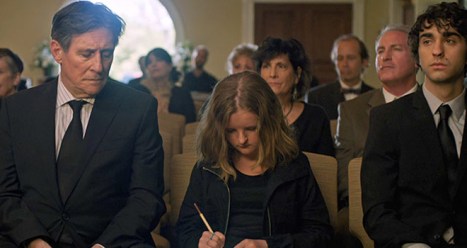
Putting the ‘fun’ in ‘funeral.’

Hereditary is a very different sort of beast. Hereditary is not a descendant of that sort of broad crowd-pleasing horror spectacle. The narrative is dense and layer, its symbolism abstract and its storytelling often allegorical. Hereditary is full of ambiguities and lacunas, with tension simmering beneath the surface before exploding dramatically towards the climax. If Hereditary is a descendant of sixties and seventies horrors, it is a closer relation of more abstract nightmares like Nicolas Roeg’s Don’t Look Now or Roman Polanski’s Rosemary’s Baby.

This is perhaps the most interesting thing about the film, and one which perhaps goes a long way towards explaining some of the more contradictory aspects of its theatrical release.

Do look now.

Continue reading

Non-Review Review: Ocean’s 8

Ocean’s 8 is mostly a charming and inoffensive heist movie that coasts off the charisma of its central cast.

This isn’t necessarily a criticism of itself. There’s nothing wrong in watching an ensemble including Cate Blanchett and Sandra Bullock bounce off one another, performers who are both talented screen and genuine old-fashioned movie stars. As with the series of films that obviously inspired (and named) Ocean’s 8, the cast have an easy chemistry with one another. Star power goes a long way, and there’s something almost refreshing in seeing a movie that runs almost exclusively on it in this age where these sorts of high-profile movies are largely driven franchising, high concepts and intellectual property.

Properly trained for this.

Of course, there’s some small complication in that in that Ocean’s 8 feels at times like an effort to split the difference between being a star-driven caper movie and also the latest installment in a larger recognisable franchise. Indeed, some of the movie’s weakest moment lean most heavily on nods and winks to the trilogy of Steven Soderbergh movies that provided a launching pad for this female-star-driven caper. The title character is Debbie Ocean, revealed to be the sister of Danny Ocean; that is the least of it. (Even the choice of “8” in the title seems designed to leave room for two more installments making a trilogy.)

Still movie stars are a dying breed, so it’s a novelty to see so many of them congregating in the same place and to see a movie that understands the appeal of watching confident performers playing competent characters who are constantly in motion. Ocean’s 8 lacks some of the more undervalued elements of the earlier films, the problems created by their absence here underscoring their importance, but it mostly succeeds as a light and breeze caper movie without a clear antagonist, without a strong directorial vision and with an over-extended third act.

Getting the gang together.

Continue reading

Non-Review Review: The Happy Prince

“I am my own Judas,” explains Oscar Wilde around the midway point of The Happy Prince.

Just in case the audience doesn’t get the point, The Happy Prince is saturated with religious iconography and constant reminders of how Oscar Wilde was his own worst enemy. At one early point, Wilde confronts a group of homophobes in a church. At another, Wilde reflects on the local church that he visits for solace and how it reminds him what it is to suffer. Towards the end of the film, a priest is summoned to deliver the last rites, the splashing of holy water juxtaposed with the spit and venom of a mob in flashback.

Wilde at heart.

The Happy Prince is not an especially subtle or nuanced film, which is somewhat ironic for a biography about the life and times of one of the greatest witticists in history. Wilde was one of the most eloquent writers in the English language, as much in his personal correspondence as in any of the plays or stories that he wrote. As such, there is something strange in the bluntness of The Happy Prince, perhaps most transparently in the way that the film bends over backwards to construct a portrait of the writer’s final days that conforms to the eponymous story.

The Happy Prince is a story about a fascinating subject with a compelling central performance, but constructed in such a clumsy manner that the performance of Everett the actor cannot anchor the film of Everett the director.

It could use some fine tuning…

Continue reading

Non-Review Review: China Salesman

China Salesman is fascinating disaster.

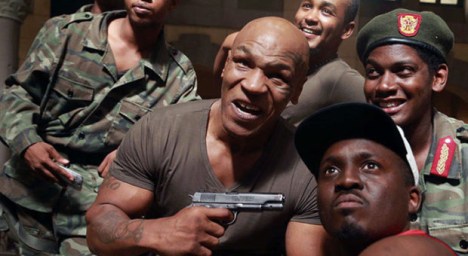
China Salesman is not a good film by any measure, but it is strangely compelling. There is something intoxicating about the film, in spite of its myriad flaws – the awful script, the atrocious dubbing, the clumsy editing, the terrible performances, the muddled storyline, the abundance of nonsensical technobabble. Part of this is down to the sheer abundance of energy that director Tan Bing brings to proceedings. China Salesman whips and whirls, cranks and zooms, pans and swirls with a kinetic energy that renders these flaws almost bedazzling, offering an effect that in some ways evokes a bad trip.

The gun show.

However, China Salesman is perhaps most interesting as a mirror and a prism. It is, like Wolf Warrior II, very much the Chinese equivalent to those old patriotic eighties American action movies like Delta Force or Iron Eagle, the kind of populist nationalist cinema that is currently channeled through franchises like Transformers. As such, there is something intriguing in seeing the image that China Salesman projects into the world, as an assertion of multinational intent to the rest of the world and as a statement of patriotic self-image to the country itself.

China Salesman is terrible. It is also terribly interesting.

The old man and the Seagal.

Continue reading

Non-Review Review: Fahrenheit 451

Fahrenheit 451 certainly makes a strong case for being “the movie of the moment.”

Adapted loosely from Ray Bradbury’s iconic and beloved science-fiction novel, a piece of source material that famously bewildered François Truffaut during his first and only interaction with Hollywood movie-making, writer and director Ramin Bahrani perfectly positions Fahrenheit 451 as a piece of pop culture for the Trump era. Bahrani smartly retains almost as much of the aesthetic of the source material as he updates, making a strong case that Fahrenheit 451 is more than just an opportunistic broadside at the current political moment.

“I’m going to burn it all.”

Nevertheless, Bahrani makes a number of changes to the story, and turns up the volume on particular story elements, to align his televisual adaptation for the current cultural moment. Ray Bradbury famously claimed that he wrote Fahrenheit 451 as a criticism of television, creating an engaging irony within this adaptation. Bahrani shifts the emphasis slightly to position his adaptation as a criticism of the internet, in particular modern internet subcultures and the way it decreases the audience’s attention span. There are live streams, in-home assistants that are always listening, emojis, and online “fans.”

This is certainly a valid approach to the material, and it’s to the credit of Bahrani as a writer and a director that he manages to build a world that is obviously of a piece with that created in the source material written sixty-five years ago and which works as a pointed commentary on modern cultural discourse. With its brutalist architecture, its cold digital cinematography, its compelling central performances, its suggested alternative history, and its ominous ambient lighting providing the occasional splash of vivid colour, Fahrenheit 451 creates a fictional world that is compelling and engaging.

Lighting a spark…

Unfortunately, the film’s narrative is nowhere near as engaging as its setting. Bahrani cannily borrows characters, premises and sequences from the source novel, but he largely reworks the story. Fahrenheit 451 is restructured as a more conventional science-fiction narrative than the original book, complete with apocalyptic stakes and a macguffin to drive the plot. The plot of Fahrenheit 451 is generic science-fiction fluff, a pale imitation of the familiar rhythms of movies like The Matrix or Equilibrium or Aeon Flux. It is almost as though Bahrani has internalised Bradbury’s critique of television as dumb and simple and broad.

As a result, Fahrenheit 451 doesn’t work nearly as well as it should. It is a beautiful piece of work from an aesthetic perspective, but one employed in a very crude and unsatisfying manner.

Television film.

Continue reading

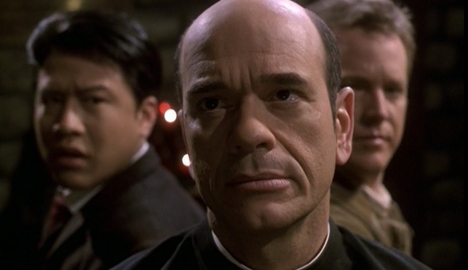
Star Trek: Voyager – Spirit Folk (Review)

The holodeck is horrifying.

This is nothing new. It has been this way since Star Trek: The Next Generation. The holodeck has been an unsettling concept from almost the very beginning, not least because of the kinds of stories that the holodeck suggests. From the moment that the Enterprise updated the holodeck in The Big Goodbye, there has been a creeping sense that the holographic creations are capable of comprehending the nature of their existence; in fact, that episode ends with the horrifying notion of McNary wondering what would happen to him when Picard turned off the program.

It’s the poster for the least exciting action movie of the late nineties.

This anxiety simmered in the background of the next few holodeck-centric episode, albeit less directly. Both Minuet in 11001001 and the Comic in The Outrageous Okona seemed to grasp their nature as computer constructs designed to serve specific purposes. They lacked the existential angst that McNary expressed in his final moments, but there was still something lurking just beneath the surface. If these entities were self-aware, could their creation and destruction be ethical? In Elementary, Dear Data, Moriarty brought the question to the fore; a hologram who wished to escape his captivity.

Star Trek: Deep Space Nine largely stayed away from the holodeck (or the holosuite) for most of its run, barring small recurring gags about the crew’s recreational use of the facilities. Our Man Bashir cleverly side-stepped the issue of holographic self-awareness by casting the lead actors in the role of holographic supporting players. Nevertheless, the introduction of Vic Fontaine in His Way introduced yet another self-aware holographic character, his self-awareness taken for granted and only really articulated in episodes like It’s Only a Paper Moon.

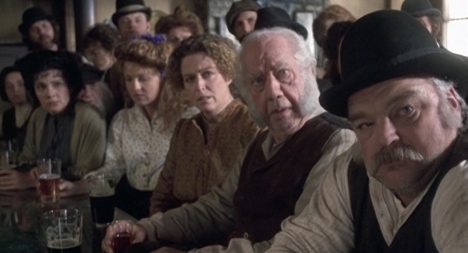
A public (house) meeting.

In contrast, Star Trek: Voyager has only doubled-down on this idea that holographic characters are self-aware. This is most obvious with the EMH, the holographic doctor who struggled for recognition as a person in early episodes like Eye of the Needle and who made a long and gradual journey towards self-actualisation in episodes like Lifesigns and Real Life. However the show engaged with the idea of holographic self-awareness even outside of the EMH, with characters like Dejaran in Revulsion, Leonardo DaVinci in Concerning Flight, the aliens in Bride of Chaotica! and the town in Fair Haven.

To be fair, some of the arguments made by Voyager have been treated with the weight which they deserve. The EMH consciously asserts his personhood in Author, Author, a clumsy but well-intentioned final-season homage to The Measure of a Man. There is a sense that Voyager is capable of treating holograms with the same dignity that The Next Generation afforded Data on his own journey towards self-actualisation. There is something genuinely moving, for example, in the way that the degradation of his program in The Swarm is treated with the same gravity as the neurological decline of a flesh-and-blood character.

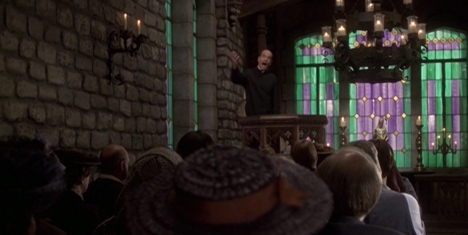
Mass appeal.

However, this also creates a strange dissonance in the episodes that don’t use the holodeck for high drama, and instead treat it as the setting for a romp or an adventure. Voyager seems to argue that every hologram is capable of reaching self-awareness, which means that every use of the holodeck to create new characters should be a momentous occasion. In the world of Voyager, every holodeck program, with the right combination of time and experience, can become a sentient being. This means that use of the holodeck should be something treated with weight and respect.

Fair Haven and Spirit Folk are nowhere near as charming as the production team seem to think that they are, but in the broader context of how Voyager approaches holographic characters, they are downright horrifying.

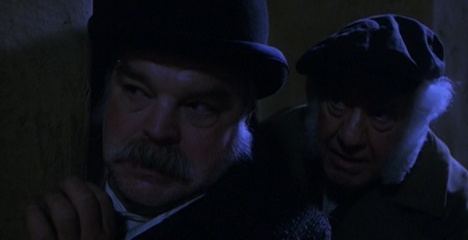
High spirits.

Continue reading

79. Mandariinid (Tangerines) – This Just In (#247)

Hosted by Andrew Quinn and Darren Mooney and with special guests Jason Coyle and Ronan Doyle, This Just In is a subset of The 250 podcast, looking at notable new arrivals on the list of the 250 best movies of all-time, as voted for by Internet Movie Database Users.

This time, Zaza Urushadze’s Mandariinid.

At time of recording, it was ranked the 247th best movie of all time on the Internet Movie Database.

Continue reading