












It is suggested that hell is other people. Perhaps not so much. Perhaps hell is the absence of other people. Towards the end of The Drop, a character ruminates on the idea of eternal damnation – suggesting that hell is nothing but eternal emptiness, a cosmic echo chamber where the damned are left with nothing but their own sense of isolation. Maybe that is what damnation is, nothing but an individual’s own loathing and self-doubt reflected back them, amplified through the darkness.
The Drop is a tense and claustrophobic thriller. The bulk of the action unfolds around the small world as Bob knows it. Bob is a simple man. He works at a small dive, “Cousin Marv’s Place.” When asked tough questions, he simply answers, “I just tend bar.” As Bob explains, the dive bar occasionally serves as a “drop” for all the money laundered through local crime. Bob doesn’t know where it comes from or where it goes. He is only aware of it when it comes into his care and when it leaves.

It’s a dog’s life…
The Drop is a story about isolation and loneliness. Characters reflect on their place in the world, trying to make sense of what unfolds around them. Most are unknowable to each other, mysteries and enigmas. Asked a personal question, Bob replies, “That’s my business.” When his friend Nadia asks why Bob never inquired about her own very obvious scars, Bob simply answers, “I figure that’s your business.” The world as Bob knows it is a small place. Maybe it’s constantly getting smaller.
Adapted by Dennis Lehane from his own short story Animal Rescue, The Drop wallows in its own sense of lost direction and impending doom. Michaël R. Roskam’s direction never rushes the story or the actors, allowing the film time to take in the emptiness and hollowness in this small world that briefly intersects with something much bigger and more unpleasant. Perhaps a little too stately and relaxed in places, The Drop is nevertheless an atmospheric delight.
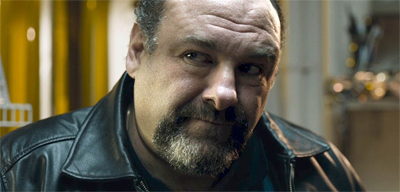
Just Cous…
Filed under: Non-Review Reviews | Tagged: america, animal rescue, Bronx, dennis lehane, james gandolfini, Movie, multiculturalism, new york, non-review review, Noomi Rapace, review, the drop, tom hardy, United States, World | 2 Comments »







 the m0vie blog
Star Trek: Deep Space Nine – Equilibrium (Review)
The September and October, we’re taking a look at the jam-packed 1994 to 1995 season of Star Trek, including Star Trek: Deep Space Nine and Star Trek: Voyager. Check back daily for the latest review.
Equilibrium is another troubled Dax episode. Dax is probably the hardest character on the Star Trek: Deep Space Nine cast to write for, if only because of the character’s central premise. “Well-adjusted functionally immortal alien slug inside a young woman’s body” is a nice character description, but it’s hard to ground a character-driven story in that. It’s tempting just to turn the Dax symbiote into a convenient macguffin that can drive various plots.
To date, Playing God is really the only Dax-centred episode of Deep Space Nine that has placed the emphasis on Jadzia rather than the slug inside here. (Although Blood Oath did at least try to deal with how a current Trill host deals with obligations incurred by past lives.) In Dax, the symbiote was a gateway to a pretty conventional and generic murder mystery story. In Invasive Procedures, the symbiote was something particularly valuable to be stolen and exploited.
The biggest problem with Equilibrium is that – like Dax and Invasive Procedures before it – the episode uses the Dax symbiote as a springboard to a story that is more driven by Sisko and Bashir than it is by Jadzia Dax. While Equilibrium does have a great hook and some biting social commentary, Dax feels more like a plot point than a character in her own right.
Shocking behaviour…
Continue reading →
Filed under: Deep Space Nine | Tagged: 1994, 1995, america, Anger, bitterness, class, Dax, deep space nine, ds9, ennui, equilibrium, reflection, René Echevarria, ron moore, social commentary, Trill | 5 Comments »