• Following Us

  • Categories

  • Check out the Archives


  • Awards & Nominations

Non-Review Review: Suburbicon

Suburbicon is a disjointed mess of a feature film. It is a gonzo black comedy that never quite coalesces, but sustains itself with enough energy that it never completely falls apart.

Suburbicon is a bizarre hybrid. Watching the movie, one gets a sense that the film has been stitched together from two core stories. Indeed, this was very much the case; the central plot of Suburbicon was original written by the Coen Brothers as a grotesque comedy of murder and mayhem, while the movie’s prominent subplot was grafted on later by director George Clooney and collaborator Grant Heslov to add a sense of social realism to this late fifties Americana. These two elements never quite cohere, which means Suburbicon never feels truly focused.

Stress testing.

There is a telling moment around half-way through the film, when an insurance investigator has stopped by the family residence at the heart of the story. Investigating a suspicious claim, the gentleman is clearly fishing. “In the end,” he reflects philosophically, “it all comes down to one word.” Without any elaboration, he allows his mind to wonder and the conversation to drift. He only returns to that  train of thought when guided by his interviewee. “What is it?” they ask. He is lost. “What?” They clarify, “The word?” The investigator takes a moment to get back on track.

That small conversational aside captures what is most appealing and most infuriating about Suburbicon, a movie that lacks a strong core and finds itself caught between two very different stories without any strong focus on either. Suburbicon is never boring, packed with strange turns and driven by a pitch black sense of humour. However, it never seems entire sure of what it is.
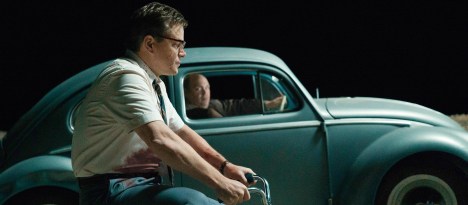
Cycles of violence.

Continue reading

New Podcast! Standard Orbit #196 – “Star Trek Origins: Season 3”

I was thrilled to be invited to join the great Zach Moore on Standard Orbit, a Star Trek: The Original Series podcast hosted over at Trek FM.

Zach very kindly asked me on to talk about an aspect of the original Star Trek that I thought was overlooked, so I suggested the rather unlikely shadow that the third season of Star Trek casts over the rest of the Star Trek franchise. These episodes have developed a reputation as the worst episodes of the original run, coming at a point when the production team was exhausted, the budget had been cut, and the series was in its death throes. With all of that in mind, it is interesting how many core attributes of the Star Trek franchise can be traced back to these twenty-four (relatively) unloved episodes.

Kirk as a lothario, Klingons as honourable, the Federation as a utopia, the Romulans and the Klingons as entities that have lives outside of the Federation.

Zach was, as ever, a very gracious host. You can hear the full discussion below or visit the episode page here.

Continue reading

“My World Doesn’t Exist Anymore.” Man of Steel, Batman vs. Superman, and the Rejection of Nostalgia

Man of Steel and Batman vs. Superman are deeply flawed films. However, they are also breathtakingly ambitious films.

There are very few big budget blockbuster films that look and feel like Man of Steel and Batman vs. Superman. Actor Henry Cavill has diplomatically described Batman vs. Superman as a “niche” film in order to account for the openly hostile fan and critic reaction to the movie. There is a sense that Cavill was trying to offer an apology without an apology, to appease certain vocal segments of fan culture without throwing his work under the bus. However, there is some truth in his words.

It is tempting to wonder how much of the vocal and aggressive online response to Man of Steel and Batman vs. Superman comes down to the fact that these movies challenge popular perceptions of these iconic characters. Comic book writer Mark Waid was very vocal in his dislike of Man of Steel, not on the basis of the direction or the choreography or the framing or the craft, but because the film misunderstood “the essential part of Superman.” These complaints were echoed across the the blogosphere.

An unchallenged and unspoken assumption crept into discussions and debates around Man of Steel and Batman vs. Superman. The primary argument seemed to be that this wasn’t really Superman and this wasn’t really Batman, because these characters were so impossible to reconcile with the popular image of these characters. Many criticisms of Man of Steel and Batman vs. Superman measured them against other iterations of the characters, real and imagined. Man of Steel wasn’t colourful enough. Superman doesn’t kill. Lex Luthor is not Mark Zuckerberg.

The idea was that Man of Steel and Batman vs. Superman violated some unspoken compact with the audience, that it offered a version of these characters and their world that didn’t line up with audience expectations. Indeed, this is perhaps most notable in the inevitable comparisons between Zack Snyder’s work and the output of Marvel Studios. Marvel Studios had spent the better part of a decade building a reputation as a studio that was faithful and respectful of its source material, to the point of slavishness. Marvel Studios offered uncomplicated, straightforward adaptations.

However, there is a sense that Man of Steel and Batman vs. Superman were rather consciously rejecting the culture of nostalgia that has become so dominant and overwhelming in contemporary blockbuster cinema, that the films represented a conscious effort to challenge audience expectations and to push provocative and ambitious interpretations of these characters and their mythos. Indeed, it is hard not to see the audience’s vicious and aggressive response to Man of Steel and Batman vs. Superman as a response to that.

Continue reading

52. Thor: Ragnarok – This Just In (#179)

Hosted by Andrew Quinn and Darren Mooney, This Just In is a subset of The 250 podcast, looking at notable new arrivals on the list of the 250 best movies of all-time, as voted for by Internet Movie Database Users.

This time, Taiki Waititi’s Thor: Ragnarok.

Continue reading

Star Trek: Deep Space Nine – Season 7 (Review)

The seventh season of Star Trek: Deep Space Nine is a remarkable accomplishment.

The seventh season is not perfect by any measure. Taken as a whole, it lacks the consistency that made the fifth season one of the best twenty-odd-episode seasons of television ever produced, particularly in a dire mid-season run of episodes that includes Prodigal Daughter, Field of Fire and The Emperor’s New Cloak. The fifth season (and even the sixth) never hit a run of three consecutive episodes that drag that hard. Similarly, there are moments when the production trips over itself during its epic run of ten closing episodes.

Similarly, it lacks the sheer quantity of all-time great episodes that made the sixth season so exciting and compelling, like that opening six-episode arc or Far Beyond the Stars or In the Pale Moonlight. However, the seventh season does quite well for itself; episodes like Treachery, Faith and the Great River, Once More Unto the Breach, The Siege of AR-558, It’s Only a Paper Moon, Chimera, Inter Arma Enim Silent Leges and Tacking Into the Wind are massively underrated and count among the best episode that the franchise ever produced.

However, the seventh season has a very clear sense of direction and purpose. After all seven years is a long time on television. By the time that the other Star Trek series hit that mark, there was a sense of exhaustion creeping in around the edges. The final season of Star Trek: The Next Generation often felt aimless and meandering, the production team waiting to transition to feature films. The final season of Star Trek: Voyager felt similarly worn out, a faded photocopy of an approach that had worked on the previous three seasons.

In sharp contrast, the seventh season of Deep Space Nine knows roughly where it is going. From the opening scenes of Image in the Sand, the production team are cognisant of the fact that the curtain will be coming down at the end of the season. As a result, the seventh season is written with an ending in mind. The writers might not have known that ending from the outset, and were still working on it even during the sprawling final arc at the end of the year, but they knew that it existed and was waiting twenty-six episodes in the future.

As a result, the seventh season of Deep Space Nine has a very strong sense of identity and compelling sense of urgency. These attributes distinguish the season the final years of The Next Generation and Voyager, but also mark it out as one of Deep Space Nine‘s (and the franchise’s) strongest years.

Continue reading

CinÉireann – Issue 1 (November 2017)

Sin é Cin É!

Announcing CinÉireann, a new monthly magazine focusing on Irish film. It’s full of interesting and exciting news about Irish cinema, including films in development and on release, as well as long-form articles on everything from Irish filmmakers to co-productions to the changing multimedia landscape.

It is largely the work of the wonderful Niall Murphy over at Scannain, and I am thrilled to have provided two articles to the opening issue. (One of them is even the sort-of cover story, a piece focusing on the themes of The Killing of a Sacred Deer.) There’s a host of talent involved. You can read CinÉireann as a digital magazine directly. You can even subscribe and get future issues delivered to you directly.

Or click the picture below.


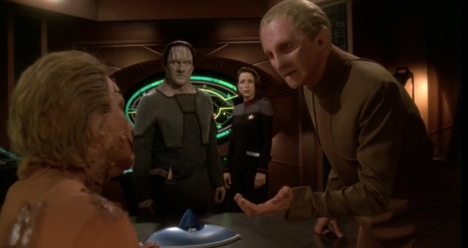
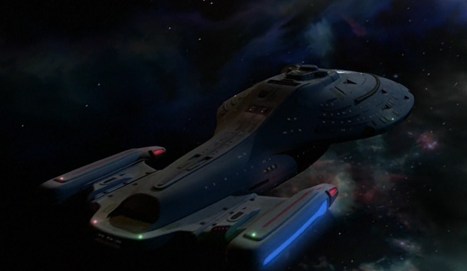
Star Trek: Deep Space Nine – What You Leave Behind (Review)

Ending a television series is always a daunting proposition, even with ten episodes allocated to that purpose.

There are very few “perfect” television finales, very few final episodes that perfectly encapsulate everything that made a television series great. Indeed, many popular television series end with underwhelming finales. Some are even retroactively tarnished by this legacy; The Finale for SeinfeldDaybreak for Battlestar GalacticaThe End for Lost. To its credit, the Star Trek franchise arguably has one perfect finale with All Good Things…, the final episode of Star Trek: The Next Generation.

A touching conclusion…

It might have been greedy to ask for two such perfect finales, especially in such close proximity to one another. What You Leave Behind is not a perfect finale by any measure. It is clumsy in places, it makes bad choices in others. The audience can feel the budgetary constraints on the production team at certain points, and the time constraints on the writing team at others. Star Trek: Deep Space Nine does not end with a “perfect” two-part episode. It ends in a messy fashion.

Still, even if What You Leave Behind is not a perfect television finale, it is a good one. What You Leave Behind doesn’t do everything that it could do, but it does everything that it needs to. While clumsiness and awkwardness hold the episode back from perfection, they exist in such a way as to add to its charm. What You Leave Behind captures the spirit of Deep Space Nine, in its successes and its failures. What You Leave Behind is a finale that speaks to the core essence of its show, to its best and its worst selves in the same breath.

The big goodbye.

The result is a finale that feels satisfying and earned, despite its narrative miscalculations. What You Leave Behind is true to Deep Space Nine, and focuses primarily on trying to pay off seven years of character threads and two years of story. Its gravest mistakes are inherited, the result of decisions made more than a year earlier in episodes like Waltz or The Reckoning that were allowed to fester and grow over the following thirty-odd episodes. Even in its failures, What You Leave Behind is trying to do right by its story.

There is a large gulf in quality between All Good Things… and What You Leave Behind. However, that gap is smaller than the space that separates What You Leave Behind from Turnabout Intruder, Endgame or These Are the Voyages… For all its issues, there is something heartbreaking in What You Leave Behind. There is a sense that this is truly the end of the line, that things have changed and the world keeps right on spinning.

We all need a little space…

Continue reading

51. The 250 Anniversary Special 2017

Hosted by Andrew Quinn and Darren Mooney, The 250 is a (mostly) weekly trip through some of the best (and worst) movies ever made, as voted for by Internet Movie Database Users.

This week, to mark the podcast’s one-year anniversary and passing the fifty-episode threshold, we decided to bring back as many of the guests from the first year as possible. So, joining Andrew and Darren on this podcast are:

We thought we’d take the opportunity to have a talk about the best and worst of this list, both in general and over the past year.

Continue reading

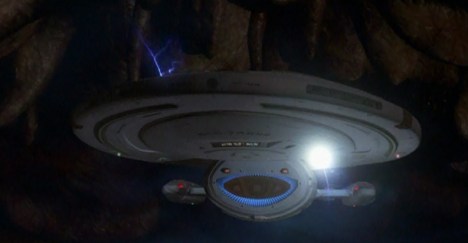
Star Trek: Voyager – Season 5 (Review)

It is hard to discern a central arc or purpose to the fifth season of Star Trek: Voyager.

There are certainly recurring preoccupations and ideas simmering through the twenty-six episodes of the fifth season, reflecting the interests of the creative team. Indeed, many of these themes culminate in Equinox, Part I, the fifth season finale. However, there is never a sense that any of these ideas are being assembled in service of anything, never a sense of what exactly the production team want to say about these themes or where they want to go with these concepts.

The fifth season of Voyager feels rather listless. This may be due to a combination of factors. Most obviously, the fourth season of Voyager was arguably the show’s best season, one marked by a sense of purpose and forward momentum. Thanks to the introduction of Seven of Nine and the miniature arc focusing on the Hirogen, along with the clever bookending of Scorpion, Part II with Hope and Fear, there was a sense that the fourth season of Voyager had ended in a different place than it began.

The big issue with the fifth season of Voyager is that it feels like the series is running in place.

Continue reading

Non-Review Review: Murder on the Orient Express (2017)

Murder on the Orient Express feels like a very conscious effort to disprove the notion that “they don’t make them like this any more.”

Lead actor and director Kenneth Branagh clearly relishes the opportunity to create a decidedly retro murder mystery. Murder on the Orient Express might contain a handful of action scenes and copious amounts of computer-generated imagery, but Branagh is very clearly channelling a more classical style of film making. Released in early November, Murder on the Orient Express has the look and the texture of an old-fashioned Christmas television treat; a fantastic ensemble reenacting a classic murder mystery on lavish sets with heightened melodrama.

Like a train in the night…
Or, you know, the day.

Branagh’s imitation is affectionate, but it is also laboured. Murder on the Orient Express feels like a nostalgic homage to the old ensemble-driven melodramas that were a dime-a-dozen, but there is something uncanny about it. Early in the film, the Belgian detective Hercule Poirot deduces that a fellow passenger is a dealer in forgeries, passing off unconvincing copies as historic artifacts. There is a sense that Branagh is attempting something similar, trying to construct something with the texture of a more classic piece of cinema, but without any of the spirit or the energy.

Murder on the Orient Express is charming and engaging, its enthusiasm for its premise and setting infectious in places. However, it also as lifeless as the corpse at the centre of the mystery.

Cold case.

Continue reading