• Following Us

  • Categories

  • Check out the Archives


  • Awards & Nominations

The X-Files (Topps) – Circle Game (Review)

This November (and a little of December), we’re taking a trip back in time to review the third season of The X-Files and the first (and only) season of Space: Above and Beyond.

There are any number of events that suggest The X-Files was on the cusp of exploding into a phenomenon. The show was spawning conventions and merchandise. It was becoming a hot property in international markets, moving from BBC 2 up to BBC 1 and then across to Sky. It was quickly becoming compelling water-cooler television. The first season had been lucky to avoid cancellation. The second season had rocketed up the ratings. The third was going to be a pretty big deal.

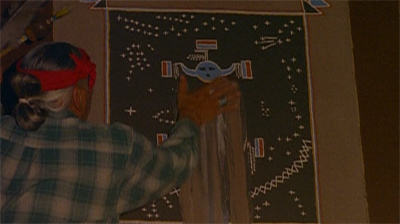
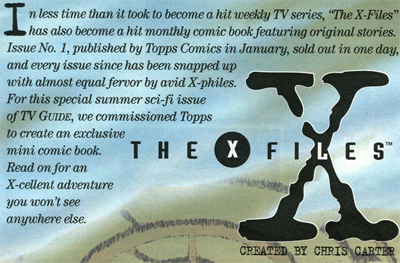
In light of all of this going on around it, a five-page comic doesn’t seem like that big a deal. Written by Stefan Petrucha and illustrated by Charles Adlard, Circle Game would almost seem as business-as-usual for Topps’ popular X-Files tie-in comic. The only significant difference was that Circle Game had been written and illustrated specifically for the July 15th issue of TV Guide. As part of their “stellar summer sci-fi issue!”, the magazine had given over five pages to Petrucha and Adlard to tell an entire X-Files story.
X marks the spot...

X marks the spot…

Even ignoring the narrative challenges posed by such an assignment, that’s a pretty big deal. Even in the age of the internet, time-shifted viewing and multi-channel television, TV Guide still has a circulation of over two million readers. To give a sense of scale, the biggest-selling contemporary comic books would have a readership of less than a tenth of that. To give it a more relevant sense of scale, the July 1995 issue of The X-Files comic book – the version on the stands at this point – sold approximately 72,000 copies.

All of this is just to stress that giving The X-Files comic book five pages of TV Guide was a pretty big deal.
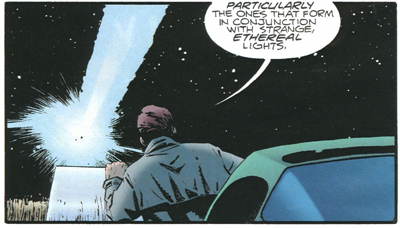
Lights in the sky...

Lights in the sky…

Continue reading

The X-Files – The Blessing Way (Review)

This November (and a little of December), we’re taking a trip back in time to review the third season of The X-Files and the first (and only) season of Space: Above and Beyond.

The Blessing Way is the first mythology episode of The X-Files that doesn’t really work.

And it doesn’t really work for a lot of the same reasons that some of the later mythology episodes don’t really work. Its pacing is terrible. It wallows in new age mysticism, allocating characters thoughtful monologues that awkwardly state themes and render subtext as supratext. It plays into the deification of Mulder, trying to bend Mulder’s story to fit into an archetypal “chosen one” narrative. More than that, it is very clearly a holding pattern, an effort to eat up time without moving forward.

Wiping it all out...

Wiping it all out…

However, despite the fact that The Blessing Way really doesn’t work, it is still a fascinating episode. It’s a wonderful demonstration of how The X-Files has developed a fleshed-out world inhabited by compelling characters. The best moments in The Blessing Way are character-focused, with Skinner caught between his duty to the government and his loyalty to his agents, the Cigarette-Smoking Man revealed to be middle-management at best, and the implication that even vast sinister government conspiracies are hostage to chaos.

The Blessing Way is an oddity, a rather strange piece of television that is almost endearing in its stubborn refusal to deliver what the audience wants and expects. That doesn’t make it good, but it does make it interesting.

The truth is up there...

The truth is up there…

Continue reading

The Flash – Going Rogue (Review)

So, I’m considering reviewing this season of The Flash, because the pilot looks interesting and I’ve always had a soft spot for the Scarlet Speedster. I’m also considering taking a storyline-by-storyline trek through the 1987-2009 Flash on-going series as a companion piece. If you are interested in reading either of these, please let me know in the comments.

One of the more endearing aspects of The Flash is the way that it embraces the stock superhero clichés. It is a television show that seems completely unashamed of its genre trappings, occasionally basking in its cheesiness. The dialogue is occasionally corny, the set-ups occasionally forced, the plot beats a little melodramatic – but that is a large part of the appeal. The Flash feels like something of a live action comic book.

Going Rogue is an episode that basks in its pulpy four-colour roots. Not only does the episode find a bright design for Leonard Snart that hues close to the character’s roots, not only does the show bask in various “cold” puns, not only does it lean heavily on the “save the innocent or catch the guilty” moral dilemma, it even throws in a nice crossover love triangle to keep things interesting. Going Rogue is silly and goofy, but in all the right ways. Endearing and charming, it is a demonstration of how well the show can work.

Chill out.

Chill out.

Continue reading

Doctor Who: Dark Water (Review)

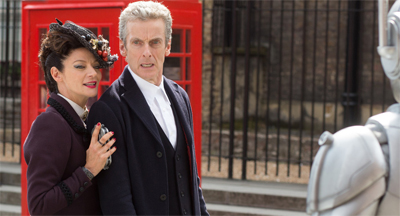
I presume you have stairs?

I’m not a Dalek.

Dark Water is downright provocative in places, and rather ingenious.

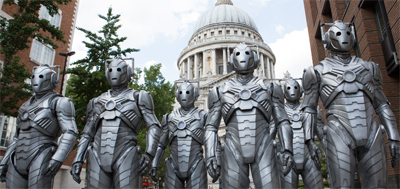
On the surface, Dark Water is the first part of a season-ending two-parter building to the return of two very obvious pieces of Doctor Who continuity. In doing so, it cleverly demonstrates one of the most obvious issues with the two-part structure in contemporary Doctor Who. The episode spends forty-five minutes building to a game-changing cliffhanger that is quite easy to figure out ahead of time. (Not least because the BBC’s publicity department loves Cybermen.) As such, the typical first part of a two-parter ends where the Doctor Who story actually begins.

doctorwho-darkwater9

However, there’s something far shrewder happening beneath the surface. While Dark Water spends most of its runtime affectionately mocking the inevitability of the two revelations at the climax, it is very in keeping with the aesthetic of the Moffat era around it; it is much more interested in the intimate than the epic. The climax beautifully subverts the classic Davies era “global invasion” cliffhanger by dismissing the Doctor as “another mad Scot” while the public look on bemused at the six Cybermen wandering down from St. Paul’s Cathedral.

In contrast, the juicy parts of Dark Water are those defined by the personal relationships at play. For all the iconic visuals and soaring music, the episode doesn’t close on the Cybermen or the Master; it closes on Danny and the reflection of the young child he killed. The episode’s big dramatic beat is that final conversation between Danny and Clara. The reveal that Missy is really the Master is obvious, but it is more interesting for her re-contextualising her relationship with the Doctor as that of a spurned and abandoned lover. It’s all personal.

doctorwho-darkwater13 Continue reading

Star Trek: Voyager – Projections (Review)

This September and October, we’re taking a look at the jam-packed 1994 to 1995 season of Star Trek, including Star Trek: Deep Space Nine and Star Trek: Voyager. Check back daily for the latest review.

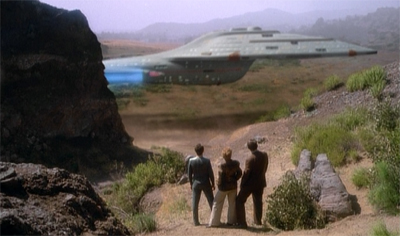
Projections is really the first episode of Star Trek: Voyager that feels like it is the right script coming from the right staff writer. At the start of the show’s first season, it seemed like writing assignments were handed out almost at random, with no real acknowledgement of the relative strength of any of the writers involved.

Brannon Braga is one of the best science-fiction high-concept writers in the history of franchise, but he was assigned the character-driven second episode Parallax and the issue-driven Emanations; Michael Piller’s personal strengths were always more firmly aligned with character development, so it felt strange to see him writing the time travel adventure Time and Again and the anomaly of the week in The Cloud.

All by myself...

All by myself…

Pushing the boundaries of a writing staff is something worth doing – forcing various members of the team to ease themselves out of their comfort zone – but it felt counter-productive to do this during the first season of a new Star Trek show. After all, the first season is about putting the best foot forward, and many of the early scripts for the show feel like they were handed to the wrong writers during the development process.

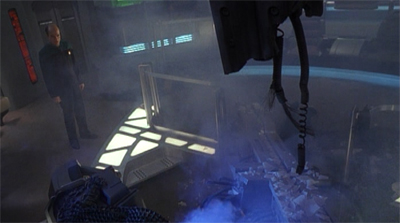
With Projections, it feels like Brannon Braga finally has a Voyager script that plays entirely to his strengths as a writer. It is arguably his most character-driven script on the franchise to date, but it also anchored in a pretty fascinating existential dilemma. In many respects, it is a spiritual companion to Frame of Mind, a sixth season episode of Star Trek: The Next Generationpreoccupied with questions about what reality actually might be.

Everything falls apart...

Everything falls apart…

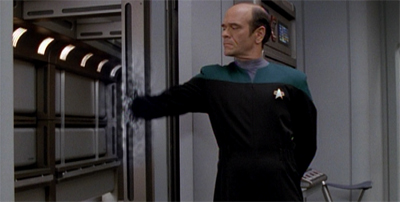
Following on from Heroes and Demons, Projections is only the second episode of Voyager to focus on the character of the Doctor. However, much like Heroes and Demons, it demonstrates the versatility of the character and the range of the actor. Projections is a very clever script that relies on its central character to really carry it across the line. At this point in Voyager‘s run, Robert Picardo seems to be one of the few members of the ensemble who could really pull it off.

The result is one of the (if not the) strongest episode of the show’s first two seasons – somewhat appropriate, given the way the show straddles the gap between the first and second seasons.

He's not all there...

He’s not all there…

Continue reading

Star Trek: Voyager – Initiations (Review)

This September and October, we’re taking a look at the jam-packed 1994 to 1995 season of Star Trek, including Star Trek: Deep Space Nine and Star Trek: Voyager. Check back daily for the latest review.

Broadcast as the second episode of the second season, Initiations was the first episode produced as part of the second season of Star Trek: Voyager. As three of the four shows carried over from the first season – Projections, Elogium and Twisted – were essentially budget-saving bottle shows, the plan was to shuffle some location-heavy episodes into the broadcast order to offer something a bit more exciting and engaging.

Initiations also marked the return of producer Michael Piller to the fold. Piller had left Voyager mid-way through the first season to work on another science-fiction show for UPN. After Legend was cancelled, Piller returned to work on Voyager and found himself presiding over a very troubled second season. The second season of Voyager would be the last time that Piller was actively involved in a season of Star Trek, and so it feels like a pretty momentous occasion for the franchise.

While not spectacular, and suffering from some lingering Kazon-related problems, Initiations is still an effective forty-five minutes of television.

Stargazing...

Stargazing…

Continue reading

Star Trek: Voyager – The 37’s (Review)

This September and October, we’re taking a look at the jam-packed 1994 to 1995 season of Star Trek, including Star Trek: Deep Space Nine and Star Trek: Voyager. Check back daily for the latest review.

The 37’s did not close out the first broadcast season of Star Trek: Voyager, as the producers had intended. The last episode produced in the first season run, it was held back in the schedule into the second season – a decision made by UPN to allow Voyager to get an early start the following autumn. Still, the decision to reposition The 37‘s as the premiere of the broadcast season is quite telling.

Airing ahead of the three episodes produced before it, and ahead of any episodes produced specifically for the second season, there’s a sense that the production team intend The 37’s to be an important episode. After all, the season premiere is just as important as the season finalé in the basic structure of a broadcast season. The finalé serves as a capstone for what has come before, while (hopefully) indicating what might follow. The premiere is a way of setting up what is yet to come.

We have lift-off...

We have lift-off…

So the positioning on The 37’s is interesting, because it indicates just how much the production team had invested in the episode. This is a big episode of Voyager, this is an important episode of Star Trek. As such, it makes for a completely unsatisfying experience. The 37’s isn’t a bad episode by any measure – it has a few interesting ideas and a few memorable elements – but it’s not ambitious. It doesn’t radically change Voyager, but it also doesn’t distil it. It doesn’t offer the sense of purpose lacking for morst of the first season.

The 37’s just sort of is. It’s an episode that would be functional shuffled into the middle of a season – a few episodes earlier or later than broadcast. However, it simply doesn’t work when scheduled into a high-profile slot, particular when it has been moved so consciously and so purposefully.

A second pilot?

A second pilot?

Continue reading

Star Trek: Deep Space Nine – Season 3 (Review)

This September and October, we’re taking a look at the jam-packed 1994 to 1995 season of Star Trek, including Star Trek: Deep Space Nine and Star Trek: Voyager. Check back daily for the latest review.

The third season of Star Trek: Deep Space Nine was a turning point for many reasons. The most obvious was that Star Trek: The Next Generation had gone off the air, meaning the first half of the third season was broadcast during a window where Star Trek: Deep Space Nine was the only Star Trek show on the air. The show was no longer the goofy kid brother to a much beloved mainstream television show. It was out in the syndication market place by itself.

More than that, though, Star Trek: Deep Space Nine was no longer the child of the franchise. With Star Trek: Voyager on the way, launched as the flagship of UPN, Deep Space Nine was left to its own devices for the first time since it was created. Voyager was the high-profile standard-bearer for the franchise, serving as the cornerstone of a new network. In contrast, Deep Space Nine chugged along in syndication, with the powers that be working overtime to bring Voyager to screen.

ds9-thesearchpart1a

In some respects, this was a tough time for Deep Space Nine. It was no longer the newest and freshest Star Trek. It was no longer the bright promising future of the Star Trek franchise. The novelty of having a second Star Trek show on the air had worn off. (Indeed, the decision to treat Voyager as the eighth season of The Next Generation was largely a response to how Deep Space Nine was not filling the niche.)

At the same time, the fact that Michael Piller and Rick Berman were focused on other projects meant that Deep Space Nine really came into its own during the third season. Ira Steven Behr had helped run the writers’ room towards the end of the third season of The Next Generation, and was the logical choice to take the reigns on Deep Space Nine. His influence on the show had been obvious since the beginning, becoming more pronounced after The Maquis.

ds9-defiant19

However, the third season saw Behr becoming the driving creative force on Deep Space Nine, a changing of the creative guard. Ronald D. Moore and Rene Echevarria joined the show from the staff of The Next Generation. Given all this drama behind the scenes, the third season was as chaotic as you might expect. There were all manner of production problems that haunted the third season, with a sense that Deep Space Nine was being produced by the seat of the producers’ pants.

Episodes tended to get shifted around in production order. Various scripts ended up produced under time constraints so tight that there was no opportunity to properly polish them before putting them in front of the camera. There were rumours that Colm Meaney might have been considering leaving;. Episodes had to be extended into two-parters at the last minute. The show had great ideas, but difficulty realising them. The season as a whole was rather oddly paced, plotted haphazardly. And yet, despite all this, the chaos felt necessary.

ds9-explorers28

Continue reading

Star Trek: Deep Space Nine – The Adversary (Review)

This September and October, we’re taking a look at the jam-packed 1994 to 1995 season of Star Trek, including Star Trek: Deep Space Nine and Star Trek: Voyager. Check back daily for the latest review.

The Adversary is a strange little episode. In many respects, barring the last line, it really doesn’t feel like a season finalé. While Star Trek: Deep Space Nine typically eschewed the season-ending cliff-hangers that came to define Star Trek: The Next Generation and Star Trek: Voyager, the last episode of a given year typically ended with a major shake-up to the status quo. They may not have ended with the promise “to be continued…”, but they usually carried a great deal of weight.

In contrast, The Adversary feels like a fairly standard episode of Deep Space Nine. It doesn’t radically alter anything. Although Odo’s last line hints at the shape of things to come, it’s not much more than what Lovok assured us in The Die is Cast. The episode is well-executed, well-constructed and it’s distinct enough from a standard Star Trek episode that it works, but The Adversary feels like it’s not really positioned to close out the year.

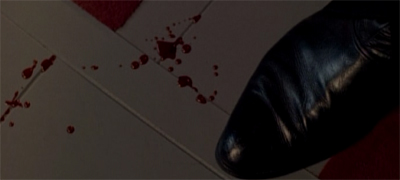
There's blood on the Defiant's floor...

There’s blood on the Defiant’s floor…

This is, of course, because it wasn’t intended to close out the year. The third season of Deep Space Nine was quite troubled. While not anywhere near as troubled as the third season of The Next Generation, it was a year where plans were constantly changing and scripts were frequently written on the fly. It seemed like the writers were constantly struggling against deadlines while trying to keep track of all the moving pieces.

Second Skin was filmed from little more than a first draft; Improbable Cause was extended into a two-parter at short notice. Scripts like The Abandoned looked like they needed a bit more work before being put in front of the camera. Shows like Meridian, Facets and Life Support seemed stitched together out of desperation. Indeed, The Adversary was produced at only a week’s notice. It’s to the credit of the episode – like Second Skin before it – that it holds up remarkably well.

There won't be blood...

There won’t be blood…

Continue reading

Doctor Who: In the Forest of the Night (Review)

There are some things I have not seen. That’s usually because I’ve chosen not to see them. Even my incredibly long life is too short for Les Misérables.

On paper, In the Forest of the Night should be a highlight of the season. Frank Cottrell-Boyce is quite a sizeable “get” for the show, one of the most significant guest writers to work on Doctor Who in quite some time. Cottrell-Boyce is on the same level as Richard Curtis or Neil Gaiman, as far as “special guest writers” go. Coupled with the fact that this is the first time that the Twelfth Doctor has wandered into the “fairy tale” aesthetic that defined his predecessor, In the Forest of the Night should be a classic waiting to happen.

However, In the Forest of the Night never quite comes together as well as it should. At its best, it riffs on concepts already very thoroughly and thoughtfully explored in Kill the Moon. At its worst, it feels ill-judged and an awkward fit for the characters in the show. In the Forest of the Night comes at the end of a highly successful stretch of late-season episodes all credited to writers working on Doctor Who for the first time; it is quite endearing that In the Forest of the Night is the only stumbling block; ironically arriving at the latest possible moment.

Tyger, Tyger...

Tyger, Tyger…

Still, there is some interesting material here. It is also a sly and affectionate homage to the work of William Blake. Blake was famed author, illustrator and poet. In the Forest of the Night takes its title from a line in Blake’s most famous poem Fearful Symmetry. There are points where the episode goes out of its way to reference that work. The Doctor makes a reference to the year of its most popular publication, assuring the assembled audience that “a tiny little bit of 1795 still alive inside of it.” There is a tiger; there is burning bright.

However, these allusions towards Blake ultimately lead In the Forest of the Night into some very questionable ideas. William Blake was haunted throughout his life by visions and hallucinations. He saw things that were not real, but which informed and inspired his work. In the Forest of the Night tries to borrow from this aspect of Blake’s life in its characterisation of Maebh, a young girl with visions. It is a story that falls right back on the rather clichéd narrative about how medicating people suffering with mental illness is in effect destroying what makes them special or unique.

... burning bright.

… burning bright.

Continue reading