• Following Us

  • Categories

  • Check out the Archives


  • Awards & Nominations

The Flash – Some Things You Can’t Outrun (Review)

So, I’m considering reviewing this season of The Flash, because the pilot looks interesting and I’ve always had a soft spot for the Scarlet Speedster. I’m also considering taking a storyline-by-storyline trek through the 1987-2009 Flash on-going series as a companion piece. If you are interested in reading either of these, please let me know in the comments.

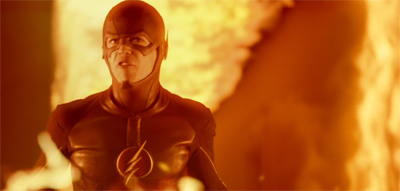
The Flash is a show that can withstand a certain amount of cheese. After all, it is a television series about a character dressed in a red jumpsuit who can run faster than the speed of sound. There is going to be a certain amount of cheesiness baked into the premise by default. City of Heroes and Fastest Man Alive managed to skirt along the edge of the show’s threshold of cheesiness. Some Things You Can’t Outrun just jumps right on over that threshold.

Some Things You Can’t Outrun is the show’s first misfire. It’s the first time that the show has been written by anybody other than Andrew Kreisberg & Geoff Johns, and the first time it has been directed by anybody other than David Nutter. It feels like there’s something of a learning curve here, as Some Things You Can’t Outrun doesn’t work on multiple levels. The show seems to take forever to get going, is hampered by a fairly weak guest star, and weighed down by cringe-inducing dialogue.
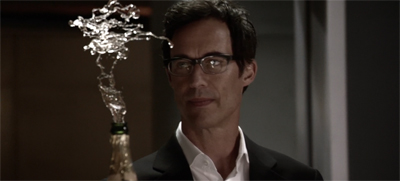
Let's not pop the champagne that fast...

Let’s not pop the champagne that fast…

Balancing cheesiness and earnestness will by one of the biggest challenges to The Flash, as the show has to figure out how to strike the best balance between the inherent goofiness of the character and the demands of a prime-time network drama show. City of Heroes and Fastest Man Alive seemed to suggest that the show had already got a good grip on this delicate equilibrium. Unfortunately, Some Things You Can’t Outrun struggles to be light-hearted without being cheesy, and earnest without being angsty.

There is a sense that the show has hit its first speed bump.
A gas time...

A gas time…

Continue reading

Star Trek: Deep Space Nine – Facets (Review)

This September and October, we’re taking a look at the jam-packed 1994 to 1995 season of Star Trek, including Star Trek: Deep Space Nine and Star Trek: Voyager. Check back daily for the latest review.

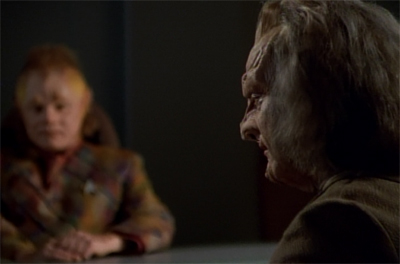
Facets in more than a little muddled. It’s an episode that is all over the place. It’s a script that doesn’t seem to know what it wants to be, leaning in one direction and then another. The episode’s big plot point isn’t dropped until half-way through, and there are any number of points where the script offers a feint towards a plot that never quite develops. As befitting a story called Facets, this is an episode with quite a few different (and often conflicting) sides.

It’s a disjointed little story, and perhaps an effective demonstration of just how much trouble the producers were having with Dax as a character. And yet, despite all this, Facets works surprisingly well. This is likely down to the fact that – like Playing God and arguably Blood Oath before it – it feels like a Dax story that is as interested in the character as it is in the concept.

A little piece of herself...

A little piece of herself…

Continue reading

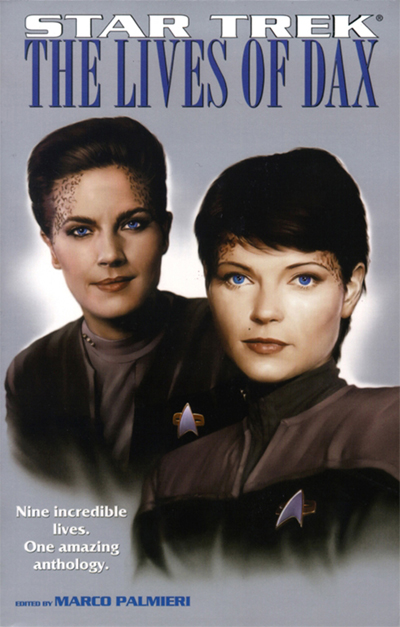
Star Trek: Deep Space Nine – The Lives of Dax: The Music Between the Notes (Curzon) by Steven Barnes

This September and October, we’re taking a look at the jam-packed 1994 to 1995 season of Star Trek, including Star Trek: Deep Space Nine and Star Trek: Voyager. Check back daily for the latest review.

Star Trek: Deep Space Nine struggled with the character of Dax on-and-off for the first three years. Terry Farrell found herself at the centre of interesting character-driven stories with Playing God and Facets, but the show tended to treat the Dax symbiont as a macguffin that just happened to be inside Jadzia. Episodes like Dax, Invasive Procedures and Equilibrium tended to marginalise Jadzia so that the symbiont itself could be pushed to the centre of a story driven by other members of the ensemble.

However, Dax is a character with absolutely phenomenal potential. There is something absolutely fascinating idea of a creature that has lived for centuries, and seen generations of history unfold within its lifetime.The symbiont has witnessed countless changes and pivotal moments. Dax has seen civilisations fall and alliances form; Dax has seen old enemies become true friends, and watched civilisations reach out into the cosmos.

The realities of a seven-season television show mean that Deep Space Nine never really got to explore the fact that Dax was living history. Perhaps Blood Oath and Trials and Tribble-ations come closest, using Dax as a rather logical bridge spanning almost a century of continuity. One of the joys of the Star Trek universe is how expansive and how limitless it is. Infinite diversity and all that. While even Dax cannot have seen everything, Deep Space Nine never felt like it captured the sense of Dax as living history.

At its best, Pocket Books’ The Lives of Dax anthology captures this sense of change and movement. The books spans the width and breadth of the Star Trek franchise, as lived through the life of one single organism. It is beautiful.

ds9-thelivesofdax1 Continue reading

Star Trek: Deep Space Nine – Shakaar (Review)

This September and October, we’re taking a look at the jam-packed 1994 to 1995 season of Star Trek, including Star Trek: Deep Space Nine and Star Trek: Voyager. Check back daily for the latest review.

There are really two versions of Shakaar.

There is the episode that Shakaar very clearly wants to be. It’s intended to offer Kira a bit of closure, following on from the events of Life Support. It’s very clearly meant to explore Kira’s grieving process and to allow her to come to terms with the loss she suffered. After all, the episode opens establishing that Kira still mourns Bareil, while the episode closes with Kira extinguishing the memorial candle she lit for him. (Which does invite the audience to wonder if it was burning the whole time she was on Bajor.)

Carrying a torch...

Carrying a torch…

As such, it makes sense to offer Kira an opportunity to get back to her roots – to suggest that Kira might secretly want to return to the relative simplicity of a rebel fighter resisting an oppressive government; fighting a war is a lot less complex than navigating the peace. Kira’s reunion with the Shakaar Resistance Cell is meant to offer her a way to escape into something comfortable, to avoid moving forward; because moving forward is tough and painful. Shakaar should be about Kira learning that she has to push forward. It should be a companion piece to Progress.

The episode can’t quite manage this. Instead, we end up with an episode about how Kira gets swept off her feet by a dashing hunk of a man – an episode that leaves the viewer with the unfortunate implication that Kira only needed to find another weirdly paternal man to help her get past the death of the man she loved. Shakaar is an episode with a host of interesting ideas, but isn’t quite sure how to best bring those ideas to the screen.

You Winn some, you lose some...

You Winn some, you lose some…

Continue reading

Star Trek: Voyager – Learning Curve (Review)

This September and October, we’re taking a look at the jam-packed 1994 to 1995 season of Star Trek, including Star Trek: Deep Space Nine and Star Trek: Voyager. Check back daily for the latest review.

So, Learning Curve is the last episode broadcast as part of Star Trek: Voyager‘s first season. It’s hard to get too excited about – or be too disappointed by – that.

Learning Curve is a bit of limp finalé to a mediocre season. Like a lot of the season before it, it’s a passable execution of what should have been a fantastic concept. (Boy, that really is Voyager in a nutshell, isn’t it?)

Is the show finally starting to gel?

Is the show finally starting to gel?

Learning Curve‘s position in the broadcast order was apparently a bit of blind luck. It was actually the fifth-last episode produced of the show’s first season. It just found itself broadcast in the “season finalé” slot when UPN decided to hold back the remaining four episodes of the season until the Fall, to broadcast leading into the second season.

However, despite this, Learning Curve seems as good a choice as any to close out the first season – and certainly a better choice than Brannon Braga and Jeri Taylor’s preferred candidate, The 37’s. It returns to the conflict between Starfleet and the Maquis promised in Caretaker, but only fleetingly acknowledged in episodes like Parallax or State of Flux. Although the execution leaves a lot to be desired, it does create a sense that the show has come something of a full circle.

It's Chakotay or the high way...

It’s Chakotay or the high way…

Continue reading

Star Trek: Deep Space Nine – Family Business (Review)

This September and October, we’re taking a look at the jam-packed 1994 to 1995 season of Star Trek, including Star Trek: Deep Space Nine and Star Trek: Voyager. Check back daily for the latest review.

Family Business is surprisingly good, standing as one of the strongest Ferengi-centric episodes produced during the run of Star Trek: Deep Space Nine. This is largely down to how Family Business treats its central characters. While still broadly played as a farce, Family Business is rooted in character. Like House of Quark (and unlike Prophet Motive), the episode takes care to treat its characters with a great deal of respect.

This isn’t an episode constructed around stock comedy tropes and trying to get the audience to laugh at one-note caricatures. Instead, it’s an episode firmly built around exploring Quark as a character in his own right. Family Business makes the decision to treat Quark (and its other Ferengi characters) with respect, and it’s a decision that ultimately pays dividends.

Naked ambition...

Naked ambition…

Continue reading

Star Trek: Voyager – Jetrel (Review)

This September and October, we’re taking a look at the jam-packed 1994 to 1995 season of Star Trek, including Star Trek: Deep Space Nine and Star Trek: Voyager. Check back daily for the latest review.

Jetrel is an interesting episode for a number of reasons. It’s another example of how the first season of Star Trek: Voyager seems anchored in the aftermath of the Second World War. The episode exists primarily as a meditation on guilt over the use of atomic weapon, with the Metreon Cascade attack on Rinax standing in for the dropping of the atomic bomb on Hiroshima and Negaska in 1945. Jetrel aired three months shy of the fiftieth anniversary of the bombing, and amid a national period of reflection about the morality of Harry S. Truman’s actions.

Whatever the context of Jetrel in 1995, it serves as another example of how Voyager seems like a relic from a bygone age, a snapshot of atomic age science-fiction. Cathexis was the show doing Invasion of the Body Snatchers. Faces was an old-fashioned monster movie. Jetrel wasn’t even the first time that the first season had traded in atomic imagery. The aftermath of the polaric detonation in Time and Again was very clearly designed to evoke the aftermath of an atomic blast.

The devil in the pale moonlight...

The devil in the pale moonlight…

Even without all this baggage, Jetrel still feels like a mess of an episode. The heart of the story finds a member of the ensemble confronting a former war criminal while dealing with issues of war guilt and responsibility – a structure that evokes Duet the penultimate episode of the first season of Star Trek: Deep Space Nine. While that episode worked brilliantly, there’s a sense that Jetrel is burdened a little bit trying to offer a two-hander about guilt while tackling the issue of the atomic bomb.

The problem is compounded by a somewhat messy final act that eschews all the episode’s heavy character-based drama in favour of a contrived techno-babble climax that involves a lot of characters spouting nonsense while playing with light-emitting diodes. Jetrel begins as the strongest and boldest episode of the show’s first season, but ends as one of the prime examples of Voyager‘s preference for techno-babble over character work.

Burn with me...

Burn with me…

Continue reading

Doctor Who: Flatline (Review)

Same time, same place… ish.

…ish? Don’t give me an ish.

These readings are very… ish-y.

In many respects, Flatline can be seen as the flipside of Turn Left.

Turn Left was twinned with Midnight towards the end of David Tennant’s final year in the lead role. If Midnight was a story about the Doctor trapped in an adventure without his faithful companion, Turn Left was very much the story of the companion trapped in an adventure without the Doctor. Both of those stories seem to stress the need for both a Doctor and a companion to form a functioning team, building very consciously towards the merging of the two in the season finalé, Journey’s End.

Eyebrows!

Eyebrows!

While Midnight suggests that the Doctor would have great difficulty without a companion to help ground him, Turn Left is even more pessimistic. It seems to set a ceiling for the role of the companion. Without the Doctor, the best that his companions can do is fight to a depressing stalemate and hope to rescue some alternate universe where the Doctor is still alive. As far as Turn Left is concerned, the companion fills a very important function – but that function is very clearly secondary to the Doctor.

In contrast, Flatline seems to suggest that the companion can step up to fill the vacancy left by the Doctor. Flatline builds off the climax of Kill the Moon in positioning Clara as a character who could step in to the role of the Doctor. It is an interesting idea, arguably one that the show has been teasing from as early as Ace’s character during the final season of the classic show. Here, Clara suggests that it might be possible for a companion to elevate themselves to such a position. However, it remains questionable if such a possibility would be desirable.

Drawn together...

Drawn together…

Continue reading

The Flash – Fastest Man Alive (Review)

So, I’m considering reviewing this season of The Flash, because the pilot looks interesting and I’ve always had a soft spot for the Scarlet Speedster. I’m also considering taking a storyline-by-storyline trek through the 1987-2009 Flash on-going series as a companion piece. If you are interested in reading either of these, please let me know in the comments.

In many ways, Fastest Man Alive plays like the second part of a pilot for The Flash. Like City of Heroes before it, Fastest Man Alive is written by Andrew Kreisberg and Geoff Johns, with Greg Berlanti credited on the story. It is also directed by David Nutter, one of television’s most respected pilot directors – even if his famous “hot streak” of pilots going straight to show was interrupted when CBS did not pick up The Doctor in 2011.

Fastest Man Alive is still about building the world around Barry Allen. City of Heroes established the basics, the ground rules of the world in which Barry operates. Fastest Man Alive exists to delineate them a bit further. It defines the ensemble better, clarifying the roles of Joe West and Iris West in the grand scheme of things; it gives Barry the confidence he needs to do what he does; it imposes limits on Barry’s ability; it clarifies that Harrison Wells is not entirely heroic.

CGI flames! My fatal weakness!

CGI flames! My fatal weakness!

Given the amount of attention and effort that Fastest Man Alive devotes to cementing the foundations of The Flash, it’s understandable that there really isn’t too much room for anything else. Fastest Man Alive is about settling the cast and the writers into a sustainable status quo for the next stretch of episodes – maybe even the entire first season. It makes sure that everybody knows where everything lies and that there’s a solid base upon which to build.

So, while Fastest Man Alive might not be an especially brilliant episode of television, it does a very good job of setting up what it needs to set up.

Born to run...

Born to run…

Continue reading

Star Trek: Deep Space Nine – Explorers (Review)

This September and October, we’re taking a look at the jam-packed 1994 to 1995 season of Star Trek, including Star Trek: Deep Space Nine and Star Trek: Voyager. Check back daily for the latest review.

Explorers is a wonderful piece of Star Trek: Deep Space Nine, an episode produced by a show entirely comfortable with itself. Indeed, the entire point of Explorers seems to be stressing just how comfortable Deep Space Nine has become in its own skin. It’s a leisurely and relaxed celebration of what makes the show unique in the Star Trek franchise, wallowing in the things that make Deep Space Nine the show that it is.

With a smart script by René Echevarria adapted from a solid premise by Hilary J. Bader, Explorers is an episode that never feels like it has anything to prove. And that’s the charm of it all.

Open to new cultures...

Open to new cultures…

Continue reading