• Following Us

  • Categories

  • Check out the Archives


  • Awards & Nominations

Star Trek: Voyager – Season 1 (Review)

This September and October, we’re taking a look at the jam-packed 1994 to 1995 season of Star Trek, including Star Trek: Deep Space Nine and Star Trek: Voyager. Check back daily for the latest review.

The best thing that can be said about the first season of Star Trek: Voyager is that it avoids being actively terrible.

This might sound like damning with the faintest of praise, but it’s worth looking at the show in the context of its siblings. None of the Star Trek spin-offs have had illustrious first seasons, often struggling to find their feet. It’s worth noting that Voyager‘s first season doesn’t contain any episodes that are as flat-out bad as something like Code of Honour, Angel One or The Passenger. While the show has more than its fair share of problems, it’s hard to look at the concept behind any episode in Voyager‘s first season and think “this is truly bad idea.”
voy-caretaker2

Of course, the logical counterpoint to that argument is the observation that the show hasn’t produced anything of equivalent quality to Heart of Glory, Conspiracy, Duet or In the Hands of the Prophets. This is perfectly legitimate criticism, and it really explains the problem with the first season of Voyager. While the show has avoided any spectacularly embarrassing decisions, it did this by completely avoiding any real risk.

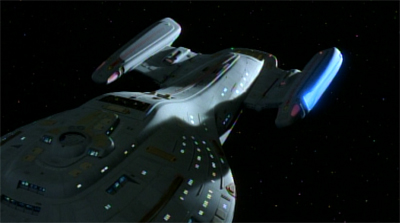
The first season of Star Trek: Voyager is almost perfectly calibrated to land in the Star Trek comfort zone.
voy-learningcurve18

Continue reading

Space: Above and Beyond – The Dark Side of the Sun (Review)

This November (and a little of December), we’re taking a trip back in time to review the third season of The X-Files and the first (and only) season of Space: Above and Beyond.

Space: Above and Beyond is half-way between an epic space opera and a wartime saga.

The Dark Side of the Sun confirms something suggested as early as The Pilot. While creators Glen Morgan and James Wong have a firm grasp of the war story aspect of the show, they are a bit less comfortable with the science-fiction elements. While The Farthest Man From Home was a solid old-fashioned “love in wartime” epic, The Dark Side of the Sun is steeped in stock science-fiction elements and interesting ideas, but seems to falter in the execution.

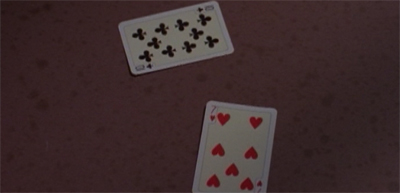
Wild cards...

Wild cards…

It feels very much like Morgan and Wong are trying to push the show’s science-fiction elements to the fore, but aren’t entirely comfortable with those elements. The result is a curious little episode, one that does a decent amount of character and world-building, while also baking some intriguing ideas and concepts into this potential future for mankind. At the same time, there’s an awkwardness to it all, as if The Dark Side of the Sun is trying to establish the show’s sci-fi credentials and can’t quite figure how everything fits together.

The Dark Side of the Sun is a show that feels like it could have used a bit more time and another draft or two, perhaps a reminder that Morgan and Wong are still relatively new at this sort of thing.

Cold dead eyes...

Cold dead eyes…

Continue reading

The X-Files – D.P.O. (Review)

This November (and a little of December), we’re taking a trip back in time to review the third season of The X-Files and the first (and only) season of Space: Above and Beyond.

What is interesting about the third season of The X-Files is the way that everything seemed to click into place. After two years of figuring out how various parts of the show worked, the series was in a place where it worked like a finely-honed machine. The conspiracy episodes hit all the right boxes. The second season had demonstrated the show could do experimental or even humourous episodes. Even the standard “monster of the week” shows were delivered with more confidence and style.

While D.P.O. may not be the strongest episode of the third season, it is an example of how comfortable the show has become. It is an episode that move incredibly well, where the vast majority of the pieces click, and one which is fondly remembered by the fan base. There’s a very serious argument to be made that writer Howard Gordon was the best author of “monster of the week” scripts working on the show at this point, and D.P.O. demonstrates how well he crafts these sorts of stories.

Cooking up a storm...

Cooking up a storm…

D.P.O. also benefits from any number of elements that make it seem memorable, even if it is “business as usual” after a massive three-part conspiracy epic. The opening sequence – featuring Ring the Bells by James – is one of the first times the show has so successfully integrated music into its action, something that would become a memorable part of later shows and even Millennium. The guest cast features Giovanni Ribisi and Jack Black. The episode also perfectly captures teen angst in an insightful manner.

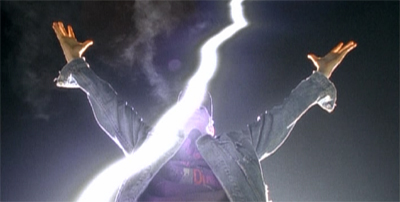
The show was apparently drawn from an index card labelled “lightning boy”, which had been on Chris Carter’s white board since the first season. It’s very hard to imagine the show pulling off something like D.P.O. during its first season. While it might have worked towards the end of the second season, the start of the third season seems the perfect place for it.

Cloudy with a chance of angst...

Cloudy with a chance of angst…

Continue reading

Star Trek: Voyager – Twisted (Review)

This September and October, we’re taking a look at the jam-packed 1994 to 1995 season of Star Trek, including Star Trek: Deep Space Nine and Star Trek: Voyager. Check back daily for the latest review.

It’s easy to see why the decision was made to bury Twisted as deep into the second season of Star Trek: Voyager as possible. The third of four episodes carried over from the end of the show’s first production year, it was the sixth episode of the show’s second broadcast season. Not only did it air behind the last episode produced as part of that first year, it also aired behind the first two episodes produced during the second season.

To be fair, Twisted isn’t a bad episode. It has a whole host of problems, but the most fundamental issue with Twisted is that it is incredibly dull. It’s the most pointless sort of story imaginable, where a bunch of weird stuff happens to our characters and there’s no way to save the day so they just sit around and wait patiently until it stops. While the script to Twisted is comprised of irritating moments, they don’t add up to anything substantial.

Twisted is very much the equivalent of forty-five minutes of Star Trek themed dead air.

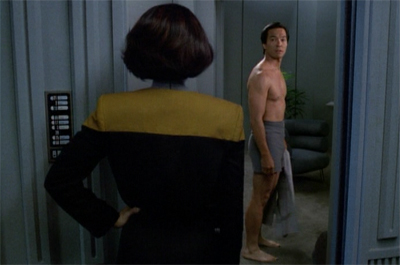
"Why, hello there..."

“Why, hello there…”

Continue reading

Space: Above and Beyond – The Farthest Man From Home (Review)

This November (and a little of December), we’re taking a trip back in time to review the third season of The X-Files and the first (and only) season of Space: Above and Beyond.

Due to network anxiety about the investment in Space: Above and Beyond, The Pilot had a very clear three-act structure building to a very explicit resolution. Not only did The Pilot figure the beginning of the war with the aliens, it also featured a crucial moral-boosting victory. It ended with the squad fully-formed and ready for action. It packed a lot of stuff in, and worked quite well as its own self-contained story; even if it left a host of broad narrative threads for the rest of the series to follow.

The Farthest Man From Home is pretty solid as far as first standalone episodes go. Free from the constraints of having to work as a potential movie-of-the-week, The Farthest Man From Home is free to do a little development and foreshadowing, but doesn’t have to wrap up everything in a neat bow by the time that the closing credits role. It’s also spared a lot of the exposition that made The Pilot feel so heavy – Hawkes’ status as an InVitro is fleetingly mentioned, and the Silicates don’t come up.

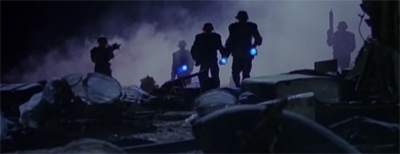
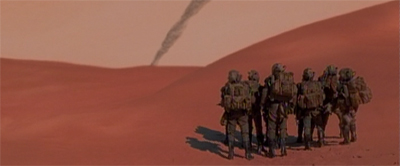
It's a wasteland out there...

It’s a wasteland out there…

Instead, The Farthest Man From Home is free to focus on the story that it wants to tell, and in marking out narrative space  for the development of both the larger war arc and West’s own personal journey. The Farthest Man From Home is a rather loose episode, but it’s loose in a way that makes sense for a second episode. It eases the audience into the world of Space: Above and Beyond a lot more fluidly than The Pilot did.

That said, there’s still an awkwardness here as Morgan and Wong struggle to figure out what the show is about and the form that it will eventually take. Examined in hindsight, while The Farthest Man From Home establishes a lot of important stuff for the show, it is also clearly a work in progress for the series – an early iteration of a show that would grow and change over the course of its first season. This is perhaps the second draft of Space: Above and Beyond, a solid base to build on for what lies ahead.

Tag it and move on...

Tag it and move on…

Continue reading

The X-Files – Paper Clip (Review)

This November (and a little of December), we’re taking a trip back in time to review the third season of The X-Files and the first (and only) season of Space: Above and Beyond.

And now we return to your scheduled viewing.

In many respects, Paper Clip feels like the real third season premiere. It establishes a lot of the recurring themes and ideas for the mythology of the season, from Krycek-on-the-run through to collaboration in the wake of the Second World War. It builds on the successful multi-part formula established by episodes like Ascension or End Game during the show’s second season. It moves things along in a way that The Blessing Way simply refused to. (It even resolves the cliffhanger from the last episode on screen.)

The light at the end of the tunnel...

The light at the end of the tunnel…

Paper Clip demonstrates the strengths of the third season of The X-Files. The third season was the point at which the show really pushed the mythology out, building on earlier implications that there was form to be found in the shadows. The third season also looked to the second season to determine what had worked and what had not worked. Paper Clip is very clearly modelled on the successful aspects of second parts like Ascension or End Game.

It moves. The power of Paper Clip comes from an incredible forward momentum that allows the show to maintain tension and excitement while refusing to allow the audience to catch their breath. Instead of resolving the bigger plot threads from the first episode, questions and hints are thrown out with reckless abandon as the script just drives through set pieces and emotional beats and suspenseful sequences. It is a very meticulously, very cleverly constructed piece of television.

Watching the skies...

Watching the skies…

Continue reading

Star Trek: Voyager – Non Sequitur (Review)

This September and October, we’re taking a look at the jam-packed 1994 to 1995 season of Star Trek, including Star Trek: Deep Space Nine and Star Trek: Voyager. Check back daily for the latest review.

Non Sequitur is a Brannon Braga script touching on familiar Brannon Braga concepts – big ideas like time and space and reality and existence. Harry Kim wakes up to find himself in bed with his girlfriend, Libby. The two are living in San Francisco on Earth. Ensign Harry Kim never served on Voyager, instead working in Starfleet Engineering on Earth. Unable to explain what has happened, Kim finds himself struggling to cope with the situation.

Luckily, in true Star Trek: Voyager fashion, everything is conveniently reset at the end of the episode.

Feels like going home...

Feels like going home…

Continue reading

The X-Files (Topps) #8-9 – Silent Cities of the Mind (Review)

This November (and a little of December), we’re taking a trip back in time to review the third season of The X-Files and the first (and only) season of Space: Above and Beyond.

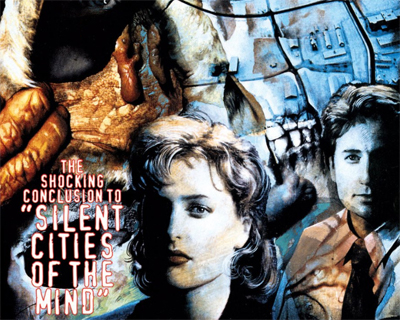
Silent Cities of the Mind is a very “comic book” story – it’s a story that might easily seem outlandish or ridiculous if committed to film, but which works very well within its medium. After all, the plot centres around a bunch of ancient Aztec priests who built an elaborate underground city that could project itself above ground as a mirage. Indeed, the story seems to accept this as a given, with Scully instead spending most of the adventure questioning whether memories can be transmitted via cannibalism.

It’s a concept that could easily seem ridiculous, and it’s a testament to writer Stefan Petrucha and artist Charles Adlard that it works as well as it does. Silent Cities of the Mind is a decidedly pulpy adventure, but that lends the story an undeniable charm. It’s a story packed to the brim with clever and fascinating ideas – from ancient aliens to ritual cannibalism to hidden cities to crystal skulls. All this is crammed tightly into two issues, meaning that everything moves so fast there’s no real time to stop and nitpick it all.

It's all in the mind...

It’s all in the mind…

Mulder is negotiating with survivalists! There are memories transferred through the act of ritual cannibalism! Mulder and Scully are shot down over Alaska! Mulder is trapped with a cannibal! There’s a hidden Aztec city buried underground! Mulder has discovered ancient Aztec mythology! There’s an army rescue team that isn’t a rescue team! There’s a macguffin that allows its wearer to commune with the gods! There’s a stand-off!

It’s all rather exhausting, but in a fun and exciting sort of way. Silent Cities of the Mind is perhaps the best example of how Petrucha and Adlard were writing The X-Files as a comic book, positioning the show’s tropes and iconography within the framework of comic book conventions.

Bonfire of the vanities...

Bonfire of the vanities…

Continue reading

Space: Above & Beyond – Pilot (Review)

This November (and a little of December), we’re taking a trip back in time to review the third season of The X-Files and the first (and only) season of Space: Above and Beyond.

Space: Above and Beyond made a great deal of sense in the context of the mid-nineties. Fox had begun its life as a scrappy little network that had trouble producing seven nights of broadcasting, but had rapidly solidified itself into a credible alternative to the big three networks. There were lots of reasons for this. The X-Files was one reason, but the network had also solidified itself with a slate of popular young dramas like Beverly Hills 90210, Melrose Place and Party of Five. Securing the NFL rights in 1993 didn’t hurt.

By late 1995, Fox was largely past the growing pains stage of its evolution. The network had been announced in late 1985, and first hit the airwaves in late 1986. It was approach the end of its first decade by the time Space: Above and Beyond was broadcast. Fox was no longer a small network fighting for scraps, but a viable challenger to the so-called “big three.” This change in outlook would lead to great success in the twenty-first century, but would also lead to change in how Fox did business.

Everything burns...

Everything burns…

The X-Files had been the right show at the right time in a number of ways. It landed at the perfect point to speak to a generation that grew up in the shadow of Watergate, but also to tap into millennial anxieties and insecurities. From a commercial perspective, The X-Files launched towards the end of the period where Fox could take chances on young shows struggling to find an audience. The first season of The X-Files was a cult hit, but not a breakout success story. The network had faith in the show, and that faith paid off.

It is interesting to wonder whether The X-Files would have received a second season if it débuted even two years later. After all, Fox would develop a reputation as a network with a ruthless tendency towards cancellation and plug-pulling. If The X-Files had first appeared in September 1995, would it have enjoyed the same fate as Space: Above and Beyond?

Distant sands...

Distant sands…

Continue reading

Star Trek: Voyager – Elogium (Review)

This September and October, we’re taking a look at the jam-packed 1994 to 1995 season of Star Trek, including Star Trek: Deep Space Nine and Star Trek: Voyager. Check back daily for the latest review.

Elogium is the first script from writer Kenneth Biller, even if it was his second script produced and his third script to air. Adapted from a script by Jeri Taylor from a freelance pitch from Jimmy Diggs, Elogium has gone through quite a few sets of hands before reaching the screen. In many respects, Biller’s script went through the opposite approach of many writers working on Star Trek for the first time.

Ronald D. Moore’s script for The Bonding and René Echevarria’s teleplay for The Offspring both went through story editor Melinda Snodgrass and executive producer Michael Piller for varying amounts of re-writes before their ideas reached the screen. In contrast, Biller’s début assignment is re-writing a script written by an executive producer from a freelance pitch. It’s no wonder that Elogium turned into such a mess.

Love in a turbolift...

Love in a turbolift…

The episode was produced towards the tail end of the first season of Star Trek: Voyager, and it’s almost a shame that it was held back into the second season. While hardly an episode deserving of repeat airing over the summer, it was also a pretty poor way of welcoming viewers into the show’s second season. It’s a problem with all of the hold-overs, except for Projections. The other three episodes carried over are among the weakest episodes of a troubled season. Elogium might not be quite as dull as Twisted or as unfocused as The 37’s, but it is a deeply creepy episode of television.

The two episodes produced during the second season to air in the first six weeks – Initiations and Non Sequitor – might not represent franchise high-points, but they are well-produced hours of television that suggest Voyager might be finding its feet. The hold-overs from the first season undermine that sense of progress.

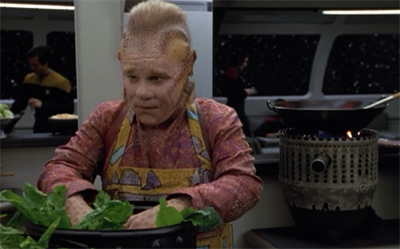
Neelix was shocked to discover that Ocampan children were not found under cabbage patches...

Neelix was shocked to discover that Ocampan children were not found under cabbage patches…

Continue reading