• Following Us

  • Categories

  • Check out the Archives


  • Awards & Nominations

Non-Review Review: The Nun

Nobody really talks about how strange The Conjuring is.

James Wan has effectively managed to fashion Hollywood’s second most successful shared universe from a variety of old-fashioned horror tropes stitched together with a more modern blockbuster aesthetic. The films in franchise – which include The Conjuring 2, Annabelle and Annabelle: Creation – are remarkable because they seem like such a strange basis for a twenty-first century blockbuster franchise. They are all period piece jump-scare driven retro jorror movies that are produced with a very slick and modern sensibility.

Bad habits.

The Nun is another worthy (and interesting) addition to that canon. As with the other films in the series, its basic structure wields more modern storytelling and filmmaking techniques to a more classic horror tone. As with the other films, the production team also understand the appeal of a certain level of variety within that familiar template. The Conjuring was a throwback to beloved seventies haunted house films, Annabelle set its horror against the backdrop of the sixties, The Conjuring 2 moved to England and Annabelle: Creation unfolded against the backdrop of rural America.

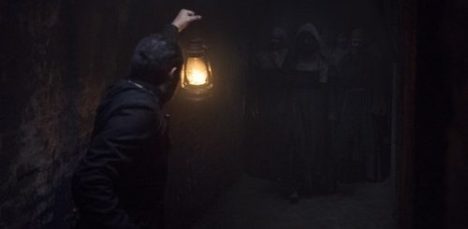
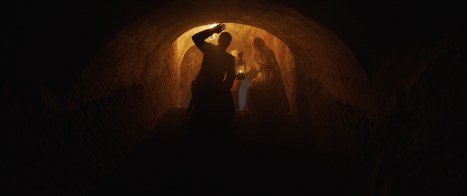
The Nun evokes gothic horror. Set in a creepy abbey in Romania during the fifties, following an investigator dispatched from the Vatican to investigate the suicide of a young nun, The Nun thrives in this environment with this iconography. The Nun falters a little bit in its storytelling, especially its exposition, and it stumbles a little bit when it comes to building a climax that works as both an action film and as a horror. However, the film is canny enough in its choice of setting and imagery that it never completely comes apart.

Who goes stair?

Continue reading

Non-Review Review: Mile 22

Mile 22 is an intriguing and muddled piece of work.

Judged by the standards of contemporary filmmaking, Mile 22 is a deeply frustrating and disjointed piece of cinema. In some ways, it seems strange to describe it as a movie. It is a film with one of the most blatant and transparent sequel hooks in recent memory, cutting to the credits at what feels like the end of the second act. This sense of confusion and bewilderment is only increased by Berg’s direction of action sequences, which are disorienting to the point where they come close to incomprehensibility.

Wahl-to-Wahl action.

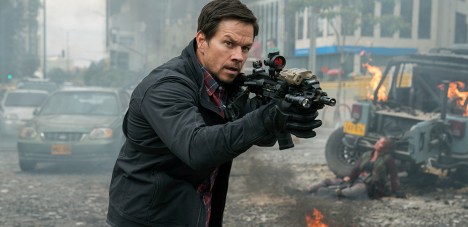
However, while these elements add up to an underwhelming cinematic experience, there is something strangely compelling in the way that Berg stitches together this relatively straightforward narrative. The chaos at the heart of the movie makes it hard to enjoy the action sequences, but offers an endearing frenetic energy that sustains the film. There are moments when Mile 22 borders on the self-aware, particularly as at careens towards a climax that seems to have been reverse-engineered from two separate Mark Wahlberg memes.

The results are baffling, but fun to pick at.

Picking up the pace.

Continue reading

Bottom’s Up: The IMDb Bottom 100 and the Art of Identifying “Worst” Movies…

Readers of the site might be aware that I co-host a weekly podcast called The 250 with my good friend Andrew Quinn, in which we pick a movie ranked on the Internet Movie Database as one of the best movies of all-time. It’s a dynamic and public list, which means that it covers a wide variety of films and tastes. In the part couple of months alone, we’ve covered everything from Mission: Impossible – Fallout to Battle of Algiers to Paper Moon to The Secret in Their Eyes to The Prestige. I’m very proud of the podcast, and a lot of the discussions that we’ve had on it.

Part of this podcast has also involved looking at the list that the Internet Movie Database maintains of the worst movies ever made. We originally planned to rotate through both lists in an even-handed manner; five episodes of the top two-hundred-and-fifty for two episodes of the bottom one hundred. Indeed, we cover a number of the bottom one hundred as part of the show; episodes like Crimea and United Passions. However, we moved away from covering the bottom one hundred because we found that the movies populating the list weren’t so much awful as just mind-numbingly dull; Lawnmower Man 2, Crossover.

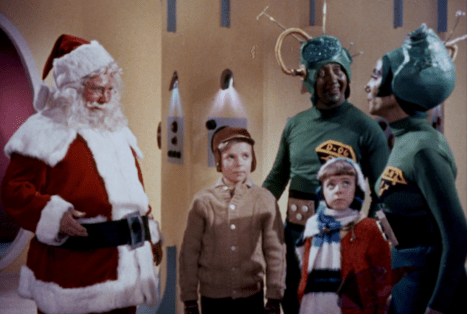
However, something vaguely interesting happened in the middle of July. The Internet Movie Database made a change to their list of the one hundred worst movies of all time that radically revised the nature and composition of the list. Suddenly, a lot of the smaller and stranger titles disappeared. Fringe films like Space Mutiny, Die Hard Dracula, Invasion of the Neptune Men and Santa With Muscles were all wiped out in an instant, replaced by more familiar and recognisable films like Jaws 3D, S. Darko, Blair Witch II: Book of Shadows, The Wicker ManBatman and Robin and Fifty Shades of Grey.

The result was a list that was suddenly a lot more fun to talk about, composed of films that people had actually seen instead of disastrously bad cult curiosities. Indeed, one very small consequence of this change is that we’re actually going to try to get back into talking about these terrible movies on a semi-regular basis on the podcast, because the list is now populated with films that will engender more interesting discussions both about the films themselves and their larger cultural context.

At the same time, it raises larger questions about what we consider to be the “worst” films, how we rank and access bad cinema and what that actually means in the grander scheme of popular culture. The change implemented to the IMDb’s bottom one hundred list is a conscious attempt on the part of the organisation to answer these questions, to create a broad consensus about what it means to be the “worst” films ever made. It’s an intriguing effort, and arguably something very different from trying to pick the “best” films ever made.

After all, it’s broadly possible to forge something resembling a consensus on the best movies. Trying to identify the worst is a much more difficult proposition.

Continue reading

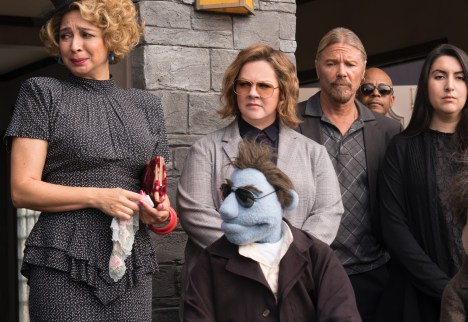
Non-Review Review: The Happytime Murders

The Happytime Murders may be the worst film of the year.

There are any number of issues with The Happytime Murders. The film is only ninety one minutes long, but feels interminable. The film has no idea what it is about in any meaningful sense, beyond assembling a number of familiar tropes in a very familiar way. Beyond that, the film seems to believe that rehashing familiar clichés is amusing of itself, some sort of self-aware postmodern ironic anti-comedy where the reference to the thing is enough of itself to become a joke.

It really blows.

A larger problem is that the film assumes that seeing puppets do “adult” things has greater novelty than it does. The Happytime Murders is a film that is consciously powered by the juvenile thrill of watching beloved children’s characters caught in inappropriate situations – swearing at one another, smoking cigarettes, engaging in vigorous sexual activity. This glosses over the fact that there are plenty of other media that has already covered this ground. The Happytime Murders runs on a joke that has already been repeated and rehashed several times.

However, all of these concerns distract from the biggest issue with The Happytime Murders. It is just not funny.

The boy in blue.

Continue reading

“It’s not over, it’s just not yours any more”: Thoughts on Fandom and Growing Old Gracefully…

It is not a new observation to suggest that modern audiences live in a world dominated by existing intellectual property.

It has been argued frequently and convincingly that the era of the movie star has surrendered itself to the era of the brand, where the biggest draw for audiences it not which actor is on screen but which universe is being developed. Cinemas are flooded with long-delayed sequels and spin-offs to beloved favourites, films often separated from their predecessors by decades; consider the gap between The Incredibles and Incredibles II or between Blade Runner and Blade Runner 2049, even between xXx 2 and xXx 3 or between Trainspotting and Trainspotting 2.

It is easy to exaggerate the scope of these issues. After all, there have always been films based around established intellectual property, whether early films or television series or even novels. Gone with the Wind was a book before it was a film. The Magnificent Seven was a remake of The Seven Samurai. Philip Marlowe was continuously reimagined on film from Time to Kill in 1942 to The Big Sleep in 1978. Star Trek: The Motion Picture transitioned a failed television series into a big budget science-fiction film franchise. This is to say nothing of perennial favourites like the story of Robin Hood or Jesus Christ.

At the same time, the indie market is thriving. Although making any movie is a tremendous accomplishment, there has arguably never been a better time for people making movies. Companies like Netflix and Amazon are buying up as much “content” from film festivals as they can, and in doing so are making filmmakers and production companies whole. Companies like Annapurna are adopting a model that consciously puts creativity ahead of commercial concerns. Even technology has advanced to the point where it is possible to make films on a phone. Cinema is not endangered or under threat. It is vibrant.

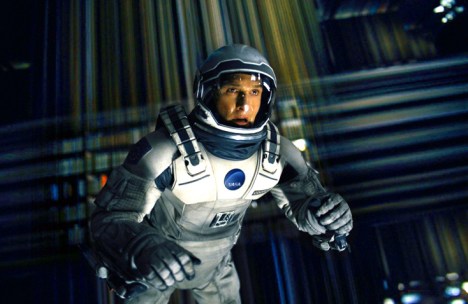
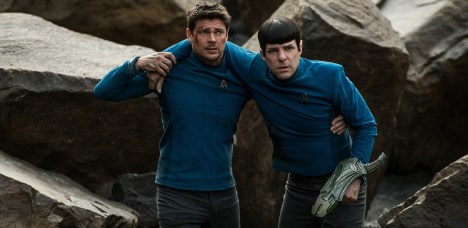
Still, it feels like things are different in the modern era of blockbuster entertainment. For one thing, there are fewer big budget blockbusters based around wholly original ideas. In the past decade, only the work of Christopher Nolan stands out; Inception, Interstellar, Dunkirk. There have obviously been other success stories, like J.J. Abrams’ Cloverfield and Super 8 or like Jordan Peele’s Get Out, but these are notable for being the exception rather than the rule. There is a sense that the mainstream is dominated by revivals of beloved properties, and not just in film. Hannibal, Star Trek: Discovery, Fargo, Watchmen.

One of the interesting tensions of this era has been in watching the way that fandoms react to these revivals, the manner in which they approach these new takes on established mythologies. By and large, it has not been especially flattering or engaging. There have been death threats, misogyny, cultural wars, heated arguments, simmering disagreements. Recent years have seen the growth of a strange cult of fannish entitlement within the cultural mainstream, perhaps reflecting the manner in which the mainstream has embraced fannish desire. There is something deeply frustrating and disheartening about this.

Continue reading

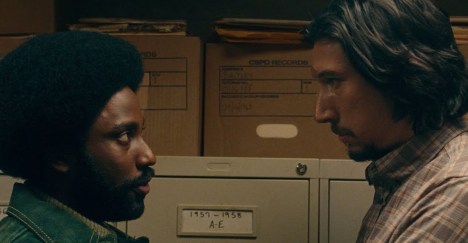
Non-Review Review: BlacKkKlansman

BlacKkKlansman is an American tragicomedy.

The past few years have seen a heightening of reality, a blurring of the boundaries between fact and fiction, an intrusion of the unreal into the real world. The President of the United States is effectively a reality television star, and is running the country as some sort of grotesque reality television show. “Truth is not truth”, to quote one administration figure, while another has peddled in the idea of “alternative facts” while alluding to a horrific terrorist attack that simply never happened while other supporters of the administration insist that other horrific events did not happen.

The two Ronnies.

With all of that going on in the background, soaking into the zeitgeist, BlacKkKlansman feels very much like a movie for the moment. It is – to quote the introductory text – “based on some fo’ real, fo’ real sh*t”, taking its inspiration from a memoir written by undercover police officer Ron Stallworth. However, it is also filtered through the hyperstylised cartoonish lens of a blackploitation buddy comedy, with Lee taking every opportunity to remind his audience that they are watching a piece of pop culture.

The premise of the film is so absurd that it’s almost impossible to play it as anything but comedy. The first black police officer in Colorado Springs launches an undercover sting on the KKK, using his own name to infiltrate the organisation through the telephone. Working with a fellow white police officer, this ambitious young go-getter manages to manoeuvre his way to the top of the organisation, fooling even the Grand Wizard himself. It’s a ridiculous story, one that seems inherently unreal. Even the name – “Stallworth” – sounds like something from a dimestore paperback.

Hitting all its marks.

Of course, in this era of unreality, it is entirely real. Indeed, the power of BlacKkKlansman comes crashing down on the audience in the final moments, when Lee brushes aside the heavy-handed references to contemporary politics that play through the narrative for something that is much more tangible and real, serving to throw the entire grim joke of the film into stark relief, suggesting that so much of the awkward squirming and ridiculous twists are all the foundation of the horror show through the audience are living.

BlacKkKlansman laughs in the face of horror and brutality. But only because the alternative is to cry.

The historical record.

Continue reading

Non-Review Review: The Children Act

Perhaps the most striking thing about The Children Act is how it manages to combine so many stock prestige drama beats into such a chaotic cacophony.

The Children Act is a mess from beginning to end, all the more jarring for how familiar and how recognisable the constituent elements might be. The Children Act often feels like a fairly standard IKEA table where all of the pieces have been assembled to create something monstrous. Often during the runtime, the audience might spot a familiar beat or plot point, but often one deployed with little consideration for how these elements normally work or how they might better service this particular story.

Come what May.

The Children Act is a film that very clearly aspires towards a certain style of prestige cinema. It is directed by Richard Eyre, responsible for awards fare like Iris or Notes on a Scandal and even the recent highly successful BBC adaptation of King Lear. It is written by Ian McEwan, adapting his own novel, the writer perhaps still best know to movie-going audiences as the novelist who provided the source material for Atonement. It stars Emma Thompson and Stanley Tucci, two actors who are always highly engaging, and who should bounce off one another.

Unfortunately, almost nothing within the film actually works, with strange decisions contorting the narrative into strange shapes. The Children Act is a curiousity that is more intriguing than it is engaging, more compelling for how completely it refuses to work than for anything that it is actually trying to say.

Just this.

Continue reading

Non-Review Review: Upgrade

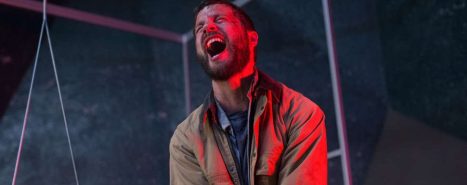
On a very fundamental level, Upgrade understands the anxieties that drive body horror.

Body horror is largely rooted in the grotesque realisation that human bodies are little more than machines made of meat. After all, every student who has studied biology understands the mechanics of the human body; the processes that drive it, the structures that hold it together, the logic by which it operates. The nerve endings that relay signals from the furthest region of the body back to the brain, the synapses that fire within the brain. Described in such cold and rational terms, human consciousness becomes a mystery, a piece of the puzzle that doesn’t fit. Software we don’t understand running on wet hardware.

What the neck is going on?

More than that, human bodies are inefficient machines. They are soft and squidgy, held together by tendons and muscles stretched over bones built of calcium and hinges filled with synovial fluid. The human body impressive feats of engineering from an evolutionary perspective, through the mere fact that it exists, albeit more vulnerable than the architecture or the mechanics of the world designed by human beings. Bodies can easily be bent and broken, warped and distorted. They can be attacked in so many ways, and fall into disrepair with such ease. They are unreliable, and very difficult to fix.

Upgrade understands that body horror thrives at the intersection of these twin anxieties; the nightmarish uncertainty of how human consciousness fits within the mechanics of basic biology, and the realisation that the human body would never pass basic health and safety standards for any complex piece of machinery. Upgrade wonders what happens when that machine made of meat receives an update to its operating system.

An impressive body of work.

Continue reading

“A Bunch of Grown Men in Rubber Masks Playing Trick or Treat.” Mission: Impossible – Fallout and Good Old-Fashioned Espionage Fun…

One of the most striking aspects of Mission: Impossible – Fallout is how thoroughly and how completely it rejects the idea of morally compromised blockbuster protagonists.

The Mission: Impossible series has always had a bit of an auteur quality to it, with individual writers and directors bringing their own styles to bear on a given installment. The original is very much a Brian dePalma film, leaning heavily into themes of identity and Hitchcockian tension. The second is very much a John Woo film, complete with slow motion black leather and white doves. The third is a J.J. Abrams film that comes in and very consciously tweaks the formula while drawing attention to its own plot mechanics. The fourth is a string of incredibly impressive and kinetic action sequences strung together with Brad Bird’s patented sense of pacing and spectacle.

However, there was some tension when Christopher McQuarrie was recruited to direct the fifth film in the franchise and returned to direct the sixth. McQuarrie is primarily known as a writer rather than a director, with only a handful of director credits to his name. McQuarrie doesn’t necessarily have a distinctive style, although he has a long-standing relationship with Cruise from his work as director on Jack Reacher and as writer on Valkyrie and The Mummy. However, in a high-stakes action series, there was always a question of what McQuarrie could bring to the series to put his own distinct slant on the series. Whether he has or not is still a matter of heated debate; some would argue that Mission: Impossible is an ode to Tom Cruise as auteur or to the stuntman as auteur.

That said, there is a sense that McQuarrie is approaching the material in his own unique way. Perhaps reflecting his own background as a writer, his two Mission: Impossible films tend to play rather heavily with the idea of what a Mission: Impossible film actually is, even if they aren’t quite as ponderous or self-conscious as the recent James Bond films. McQuarrie’s scripts for his Mission: Impossible films are decidedly writerly in a way that Mission: Impossible II and Mission: Impossible – Ghost Protocol are not, and in a markedly different manner than Mission: Impossible III. In fact, arguably the biggest issue with Mission: Impossible – Rogue Nation was that McQuarrie was too writerly, working too hard to sell the idea of Ethan Hunt as a compulsive workaholic.

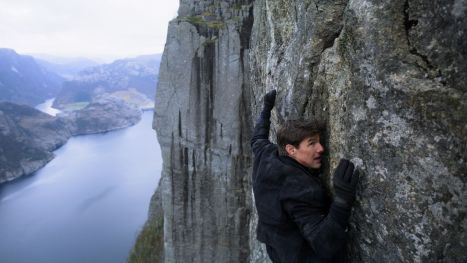
Fallout perhaps gets the balance right. A large part of this is down to the careful structuring of its action sequences to build a sense of propulsive momentum. Most Mission: Impossible films tend to peak in the middle; the dangling sequence from Mission: Impossible, the Vatican sequence and bridge raid in Mission: Impossible III, the skyscraper climb from Ghost Protocol, the opera sequence and underwater dive from Rogue Nation. Instead, barring the spectacle of the HALO jump, the set pieces in Fallout constant escalate. They ramp up; the bathroom brawl, the Paris motorbike chase, the two-level urban pursuit, all building to the three-thread helicopter climax.

However, part of that is undoubtedly down to the fact that McQuarrie seems to fundamentally understand how a Mission: Impossible film works, and so weaves it carefully into the plot. Fallout superficially resembles a modern franchise blockbuster in a number of ways; the pulsing Lorne Balfe score, the darker and edgier teases, the heightened sense of continuity, the ridiculous escalated stakes, the crosscutting climax. However, all of these elements serve to emphasise the relative simplicity of Mission: Impossible as a series, and to celebrate what distinguishes it from contemporary blockbusters rather than attempting to close the gap.

The Mission: Impossible films seem relatively old-fashioned as far as blockbuster franchises go. They are released at a fairly steady pace, but with significant gaps between films. There is always relatively little gossip or hype around them until they actually arrive. There are seldom any casting rumours. There are no hardcore fans wondering how this instalment will fit within an established continuity. There is no post-credits teaser to set-up the next installment. Each film has a markedly different tone instead of enforcing a consistent house style across the films. It is possible for audiences to dip their tow into a particular film in the franchise without having to do any real homework.

More than that, they are a rare modern franchise that seems to be driven as much by star power as by the intellectual property. This may be largely down to how Brian dePalma adapted Mission: Impossible for the big screen in 1996, in the era before X-Men and Spider-Man effectively changed the blockbuster landscape. dePalma approached Mission: Impossible not as a sacred “mythos” to be adapted to screen with fidelity and delicacy. Instead, dePalma treated Mission: Impossible as a springboard to crafting his own decidedly esoteric psychological espionage thriller. There are elements of the original Mission: Impossible that can be traced back to the original show, but it is about as faithful to the source material as Tim Burton’s Batman and Batman: Returns.
Continue reading

“The Things You Gotta Remember Are the Details”: Reservoir Dogs and the Fragility of Memory and Meaning in the Nineties…

It’s always interesting to understand how much of being one of the defining artists of a cultural moment is down to understanding the zeitgeist, and how much of it is down to simply being in the right place at the right time.

This is not to denigrate the incredible skill and talent required to be perfectly positioned “in the right place at the right time”, as any amount of sustained success requires both a great deal of determination and an incredible amount of talent. Quentin Tarantino is undeniably determined and impressively talented. Tarantino has a unique knack with dialogue, a keen understanding of genre, and a fine appreciation of the history the medium. It is hard to imagine a world in which Tarantino would ever have been unable to parlay those skills into some form of success in filmmaking.

Still, there are very few directors who were so perfectly in step with the nineties as Quentin Tarantino. Tarantino is a writer and director who emerged almost fully formed, to the point that many critics and pundits would argue that his first two films are the best films in his filmography; Reservoir Dogs and Pulp Fiction. (As an aside, there are a not-insignificant number of pundits who would argue that Tarantino’s best film was his third, the underrated Jackie Brown.) It seems fair to describe Tarantino, however controversial his legacy and however divisive his modern films might be, as a defining nineties filmmaker.

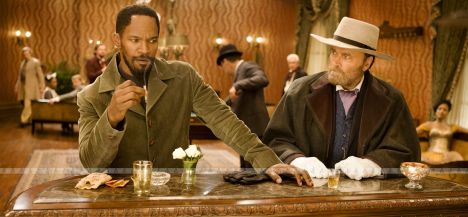
(As an aside, it should be acknowledged that Tarantino arguably had something of a similar moment towards the end of the first decade and into the second decade of the twenty-first century. Inglourious Basterds, Django Unchained and The Hateful Eight are films that have generated a lot of polarised debate, but they also seemed very much on-the-pulse in terms of the tensions and anxieties that bubbled to the surface of American popular consciousness at towards the end of the twenty-tens. However, that is perhaps a debate for another time.)

Reservoir Dogs and Pulp Fiction speaks specifically to a collection of nineties anxieties and uncertainties that seem only to have crystalised in retrospect, as if working through an existential crisis that the decade didn’t realise it was having in real time. Reservoir Dogs and Pulp Fictions are stories about memory and meaning, and how fleeting the human understanding of a chaotic world can be. They are stories about the breakdown of social order, and of trying to find some way to navigate increasingly turbulent and unstable times.

They are films that embody the tensions of nineties as effectively as Forrest Gump or the films of Oliver Stone or Chris Carter’s work on The X-Files and Millennium.

Continue reading