• Following Us

  • Categories

  • Check out the Archives


  • Awards & Nominations

Non-Review Review: Avengers – Endgame

It says a lot about the state of contemporary pop culture that the biggest movie of the year is essentially a clip episode.

Pop culture has always been vaguely nostalgic, evoking an idealised past and reminding audiences of times when the future seemed brighter. After all, much of the New Hollywood canon is explicitly nostalgic, sixties and seventies films that pay loving homage to the thirties and the forties, often explicitly; The Sting, The Godfather, Paper Moon, Chinatown, Bonnie and Clyde. The past has always had a certain allure for cinema, perhaps because that’s what pictures have always been; individual moments captured on film and frozen in time, removed from their original context. Film is simply those frozen images run together to create the illusion of movement and life. Every film is a time machine, some are just more explicit than others.
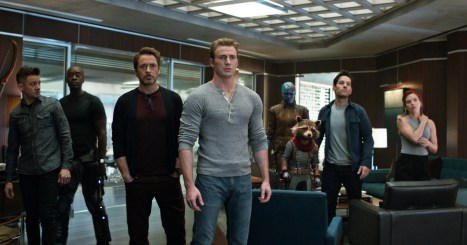
Assembly line.

However, there is something fascinating about the modern wave of nostalgia, the speed at which pop culture is consuming itself. Recent waves of seventies, eighties and nineties nostalgia are still cresting. Earlier this summer, Captain Marvel channeled some of this nineties nostalgia into blockbuster (and Blockbuster) form. However, it also feels like nostalgia is getting closer and closer to the present, brushing up against the current moment. In some respects, the success of Lady Bird is indicative here. After all, Lady Bird is a film that is explicitly nostalgic about the post-9/11 era, evoked through footage of the Iraq War and the sounds of Justin Timberlake playing at a teen house party.

Avengers: Endgame is a strangely nostalgic beast. It is not strange that the film is nostalgic; after all, this is something of a coda to a decade of superhero films. However, it is strange how that nostalgia brushes up against the present, the climax of the film feeling very much like a loving homage to Avengers: Infinity War, a film that only premiered one year ago.
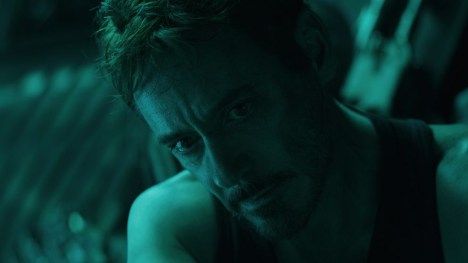
Stark raving mad…

Continue reading

Non-Review Review: Little Woods

Little Woods is a slow and somber film that never rushes, perhaps because it understands that its characters have no place to go.

There’s a strong central irony built into Little Woods, a story that unfolds against the north-western frontier of Washington State. Ollie lives on what is effectively the edge of the frontier, that great American wilderness. However, manifest destiny has not delivered. The frontier is not as vast as it might seem. Instead, Ollie finds herself trapped on the edges, pressed against the limits of the United States. Little Woods is a story about the boundaries on the extremes of the American Dream. It is no coincidence that Nia DaCosta’s theatrical debut opens and closes at the Canadian border; it is a story of character who are pressed and squeezed against the margins, at the end of everything that they know.

The circumstances Tessa-t her.

There is a compelling stillness to Little Woods, anchored in a fantastic central performance from Tessa Thompson. Little Woods works well in several different modes: as a character study, as a crime drama, as a frontier story. The film is suspenseful when it needs to be, capable of making the audience squirm when it wants them to. However, it is most effective in its relative stillness. Little Woods never feels sensationalist or absurd. It never feels exploitative or stylised. Instead, there is something very effectively grounded and mundane in the portrait that the film traces of those people trapped on the margins. There is something very matter-of-fact about the way in which Little Woods portrays the choices (or, more importantly, the lack of choices) afforded its characters.

Little Woods is an evocative, effective and atmospheric about characters living in a liminal space.

Sister act.

Continue reading

Non-Review Review: Little

Little overcomes some big problems.

There are a number of very obvious flaws with Little. On a very superficial level, the film suffers from the problem that affects a lot of comedies. Little is simply not as funny as it thinks that it is. The jokes are not bad, and don’t fall flat, but also don’t land as efficiently as they might. Even beyond that, Little suffers from some very serious structural issues. The film has a short attention span, often allowing its focus to wander without a clear sense of purpose or motivation. More than that, Little often struggles to decide which of its two primary plots (and leads) to focus upon.

A Little goes a long way.

These are serious issues, and they prevent Little from working as well as it might otherwise. However, the film works much better than these issues would suggest. There is something surprisingly endearing about Little, a genial quality that prevents the film from ever crashing too hard. It isn’t just the relatively simple (bordering on simplistic) central thesis about childhood and playfulness, it is also the empathy that the film feels for most of its cast, especially those introduced as comedic fodder. Little is a very pleasant film, particularly by the standards of studio comedy.

However, the film’s ace in the hole is its fifteen-year-old star Marsai Martin, perhaps best known for her work on Blackish. Martin produced Little as a vehicle for her talent, and it is an effective showcase. Martin carries a surprising amount of the film with a surprisingly nuanced performance for what is a deliberately broad comedy. Martin is not only game for the film’s jokes, but also capable of handling the broad emotional range (and swift emotional transitions) that the script demands of her. Little might just be Martin’s big break.

Somebody’s assistant could use a pay bump.

Continue reading

Non-Review Review: Unicorn Store

Unicorn Store is, appropriately enough, a strange beast.

Brie Larson’s feature-length directorial debut, adapted from a screenplay by Samantha McIntyre, struggles to manage its tone. What is Unicorn Store? Who is the target audience for Unicorn Store? The stylistic sensibilities of Unicorn Store evoke the modern American mid-budget indie film; the listless title character stuck in arrested development, the cast populated by distinguished character actors like Joan Cusack and Bradley Whitford, the use of shaky handheld camerawork to create a sense of grounded intimacy and authenticity. However, the narrative itself aspires towards something more surreal and strange, the sort of abstract stylised magical realism associated with directors like Michel Gondry or Tim Burton.

Painting a perfect picture.

Similarly, the story itself never seems to figure out at what level it wants to pitch itself. Is Unicorn Store meant for children, with its empowering story about the importance of pursuing one’s dreams in a world that expects too much adult responsibility too quickly? If so, the narrative is too rooted in adult fears and anxieties to really land, the whimsical wonder often eroded by more mundane realities that are of little interest to a young audience. Is Unicorn Store aimed at an older audience then, people like the lead character Kit, who never grew up despite society constantly telling them that they needed to? If so, the story is too light and fluffy, too superficial and too simplistic in its outlook.

Perhaps, like the mysterious “Store” featured in the film, Unicorn Store is trying too hard to be all things to all people. Indeed, the climax of the film hinges on the idea that the eponymous “Store” cannot satisfy all of its customers. While the Unicorn Store attempts to put an optimistic spin on this, there is a sense in which this is true of the film itself. Unicorn Store seems so eager to be everything that anybody could want it to be that it never figures out what it actually is.

Making her mark.

Continue reading

Non-Review Review: Missing Link

Missing Link is yeti ‘nother triumph for stop motion animation studio Laika.

To be fair, Missing Link is a different beast than Kubo and the Two Strings, the last major release from the studio and one of the most striking (and under-appreciated) animated films of the last decade. Kubo and the Two Strings was a lyrical and powerful fairy tale, a surprisingly weighty meditation on big ideas like the stories that people tell and the losses that they carry around with them. Missing Link is a much lighter film than that, a piece of film that is much less consciously mature in the story that it is telling. This is not to suggest that Missing Link is shallow or superficial, or that it ignores big ideas in favour of small delights. However, Missing Link is a film that foregrounds its visceral thrills over its central themes, and there isn’t anything inherently wrong with that.

Armed and dangerous.

Although Missing Link director Chris Butler co-wrote the script for Kubo and the Two Strings, it is probably more accurate to treat Missing Link as a more mature extension of Butler’s last work for the studio. Missing Link might be seen as a more reflective and introspective take on some of the core ideas of ParaNorman, a similar high-energy romp that meditated upon the relationship that exists between mankind and those things which exist beyond mortal comprehension. Missing Link is sturdily constructed from a narrative perspective, with well-defined characters who are given strong arc and a script that understands both what it is trying to say and how best to say it without tripping over itself. However, the script also understands that it is not the primary draw to Missing Link.

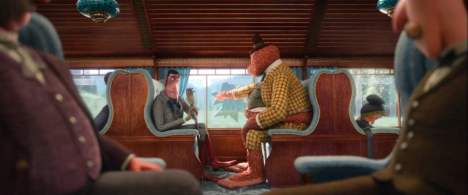
Whereas Kubo and the Two Strings felt like an intricate portrait drawn from the deepest pools of the animators’ imagination, Missing Link is a much more kinetic and dynamic piece. Missing Link is a globe-trotting adventure that spans from the deep blue-green forests of Washington State to the snowy plains of the Hindu Kush. It is the sort of rollicking old-fashioned adventure populated by heroes who spend a lot of time charting train lines and ferry lanes on maps, where obligatory back story is delivered against mesmerising backdrops, and where a variety of energised and imaginative action scenes arrive to a tightly-calculated schedule. Missing Link might lack the complexity of Kubo and the Two Strings, but there’s an infectious dynamism to Missing Link that neatly compensates.

Following their train of thought.

Continue reading

Non-Review Review: Pet Sematary

The horror in Pet Sematary is primal and ancient, both literally and figuratively.

The tropes that power Pet Sematary were already familiar and old-fashioned by the time that Stephen King published the book more than a quarter of a century ago. Indeed, there are extended stretches of the novel when Pet Sematary feels like a game of Stephen-King-related mad-libs: a dash of paternal anxiety here, a sense of existential dread about the American wilderness there, a familiar older character to provide exposition thrown in, and a climax where everything gets very brutal very quickly.

“You just take a left at the Pet Seminary.”

Even beyond the sense of Pet Sematary as a collection of familiar Stephen King elements blended together, the novel riffed on familiar genre elements. There was more than a faint whiff of The Monkey’s Paw to the basic plot, the story of a seemingly wondrous device that could resurrect the dead only for the person responsible to realise that their beloved had come back “wrong” – or, as Jud helpfully summarises, that “sometimes dead is better.” (The novel alluded to this more directly with the story of Timmy Baterman, which is consigned to a newspaper clipping in this adaptation.)

Writer Jeff Buhler, along with directors Kevin Kölsch and Dennis Widmyer, clearly understand that appeal. The script for Pet Sematary makes a number of major alterations to the book’s plot, but most are logical and organic, rooted in the realities and necessities of cinematic storytelling more than the desire to change things for the sake of changing them. For the most part, Pet Sematary revels in the old-fashioned blend of Americana and horror that defines so much of King’s work, the mounting sense of dread and the decidedly pulpy sensibility.

The purr-fect villain.

Pet Sematary only really runs into trouble in its third act, and this is arguably a problem that is carried over from the source material despite the major branching choices that the script makes leading up to that point. The issues with the third act are not those of character or plot, but instead of tempo and genre. In a weird way, these third act issues make Pet Sematary feel like a spiritually faithful adaptation, carrying over something of the essence of the book, for better and for worse.

Pet Sematary is at is strongest when building mood and mounting dread, when offering its own shading on the familiar iconography of a haunted and untamed wilderness. Pet Sematary is at its weakest when it is forced to shape that dread into a more conventional horror movie climax.

Shades of grey.

Continue reading

Non-Review Review: Shazam!

There’s a lot to like about Shazam!

Most obviously, there’s the sheer joy that the film takes in live-action superheroics. It is, of course, something of a cliché to suggest that a certain film or television show “makes superheroes fun again.” Even just among the recent crop of superhero cinema, Spider-Man: Into the Spider-VerseIncredibles 2, Ant Man and the Wasp, Thor: Ragnarok and Spider-Man: Homecoming can all claim to have injected fun back into the genre. (Indeed, for their myriad flaws, the problem with Justice League and Aquaman was not that they weren’t trying to have fun. Quite the opposite in fact.) So it is disingenuous to state that Shazam! reintroduces the concept of fun into the genre.

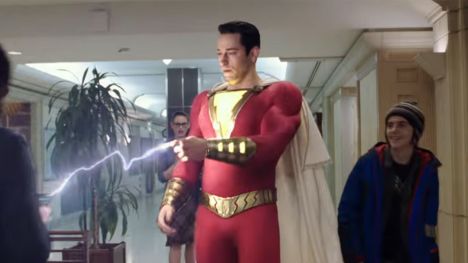
Dab-bling in superheroics.

However, Shazam! still takes an incredible amount of joy in playing with the tropes and conventions of the genre. Part of this comes built into the premise. While the character of Captain Marvel could be seen as an example of the “flying brick” archetype most effectively embodied by Superman, the most appealing part of the concept has always been his secret identity. Unlike other superheroes who simply change costume to fight crime, the character physically transforms into a superhero through the use of the magic word. Captain Marvel’s secret identity is Billy Batson, usually portrayed as a child or a teenager. There’s something endearing about the wish fulfillment that anchors that concept. Shazam! invites its audience to look at superheroics through the eyes of a child.

The first two acts of Shazam! are (mostly) a joy, an engaging riff on a playful concept that understands a large part of the appeal of superheroes to their target audience. Unfortunately, the film fumbles the ball in its third act. While the relative innocence and simplicity of Shazam! are a large part of its appeal, the climax of the film gets a little bit too boggled down in cynical worldbuilding, indulging in a bloated and over-extended computer-generated fight sequence that feels lifted from a much less playful and exciting film. To borrow an old cliché, Shazam! almost convinces its audience that a man can fly, but it just can’t stick the landing.

Zap to it.

Continue reading

Non-Review Review: Us

Us is fascinating, if undercut by comparisons to Get Out.

Get Out was a phenomenal feature debut from writer and director Jordan Peele, an unexpected left-turn from a comedian who was (at that time) best know for his work on one of the decade’s best sketch comedy shows, Key & Peele. It was an unexpectedly sharp piece of social satire, an incredibly pointed commentary on race and identity in contemporary America, one held together by an incredibly strong central metaphor. Get Out was driven by an almost single-minded commitment to its core ideas, which were skillfully wed to a genre vehicle. It was always clear exactly what Get Out was saying, and why it was saying that in the way that it was.

Taking a second swing.

Us is a fundamentally messier film, at once more conventional in terms of its structure and rhythms while being more abstract and confused in its central metaphors. One of the central throughlines of Us is the concept of “the untethering”, and it often feels like a metaphor for the film’s own internal creative process. Us is a lot less focused than Get Out, a lot less together. It often seems like the film is caught in a tug-of-war between its two core elements: on one hand, the desire to present an old-fashioned home-invasion-turned-national-crisis narrative in the style of everything from The Strangers to Dawn of the Dead; on the other, a central metaphor touching on everything from Jungian anxiety to class warfare to the modern division of the United States.

So, to answer the important questions about Us: no, the film is not as good as Get Out; and yes, the film is really good.

Face yourself.

Continue reading

Non-Review Review: Under the Silver Lake

There is far too much masturbation in Under the Silver Lake, of both the literal and figurative variety.

To be entirely fair to writer and director David Robert Mitchell, this is entirely the point. Under the Silver Lake is many things, but a large part of it is a genre hybrid between existential slacker drama, anthropological journey through the eccentric and self-absorbed spaces of Los Angeles, and absurdist investigative thriller. Those sorts of genres lend themselves to excessive self-indulgence and self-importance, the sorts of grand-sounding-yet-completely-empty philosophical treatises on the human condition that seem to have been written by those high on their drug of choice or simply themselves. With that in mind, the amount of literal masturbation in Under the Silver Lake seems pointedly self aware, a tacit acknowledgement of the figurative masturbation.

Lost Angeles.

Under the Silver Lake does have a few good ideas. More than that, it has a couple of legitimately great scenes, moments that demonstrate the same skill with the uncanny that made Mitchell’s It Follows so effective. There are moments when Under the Silver Lake walks that fine line between being darkly, bleakly funny and also being uncomfortably, hauntingly unsettling. However, the issue is that these moments are far too fleeting and far too ephemeral, frequently lost amid long and listless passages in which Under the Silver Lake indulges in well-worn cliché and obvious ideas. Under the Silver Lake is shrewd enough to acknowledge and even try to deflate some of its sense of self-importance, but there’s an awkward seam of self-assuredness that runs through the film.

As much as Under the Silver Lake might brutally and incessantly mock its lead character for his assumption that he can figure out the secret code of the universe, it often feels like Under the Silver Lake is convinced that it has a much more insightful perspective, even as it packages well-worn ideas as profound revelations.

This is all going swimmingly.

Continue reading

Non-Review Review: What Men Want

What Men Want is probably as solid an execution as the title premise could expect.

To be clear, What Men Want is very trite and straightforward. It is a movie that is largely defined by cliché. As the title implies, it’s essentially an exercise in broad gender stereotypes. There is very little novel and exciting in What Men Want. In fact, the most frustrating aspect of the whole film is the consistent refusal to work for a joke when the opportunity for a cheap lay-up presents itself. What Men Want is in no way an exceptional piece of work.

“Are you psychic?”
“No, I’ve just seen a rom-com before.”

At the same time, there is a certain charm to all of this. What Men Want is effectively an exercise in familiar formulas. Audience members will recognise all the stock romantic clichés employed here: the absurd lie that spirals into a brutal personal betrayal, the gay supporting character and sounding board, the third act separation and reunion, the protagonist’s journey towards realising that they need other people. However, there is something to be said for hitting those marks in a manner more effective than many modern films in the same subgenre.

It also helps that What Men Want is driven by a powerhouse central performance from Taraji P. Henson, who demonstrates a commitment and energy that the film can seldom match.

Catching up.

Continue reading