• Following Us

  • Categories

  • Check out the Archives


  • Awards & Nominations

Space: Above and Beyond – The River of Stars (Review)

This November (and a little of December), we’re taking a trip back in time to review the third season of The X-Files and the first (and only) season of Space: Above and Beyond.

And so this is Christmas.

On the face of it, doing a Christmas episode of Space: Above and Beyond seems absurd. Space: Above and Beyond is a show about a grim and relentless future war, where human lives are sacrificed in a long and brutal slog. It is very hard to reconcile that with the traditional structure of a Christmas story, which typically draws together a family so that they might celebrate the possibility of “peace on Earth” and “goodwill to all men.”
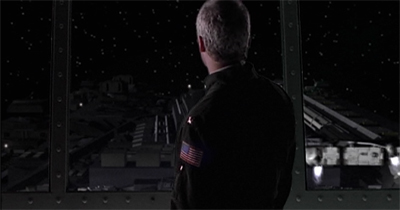
Homecoming...

Homecoming…

And yet, the episode works in spite of this contrast – or, perhaps, because of it. The River of Stars opens with a monologue narrated by Wang that helps to set the mood for the next forty-five minutes, documenting the well-known Christmas truces that took place during the First World War. Although these spontaneous demonstrations of good will and trust were by no means unique, those temporary reprieves served as a reminder of the humanity that often seemed lost amid the pain and the bloodshed.

If any show could use a charming feel-good story about the possibility of peace on Earth and goodwill towards other people, Space: Above and Beyond might be it.
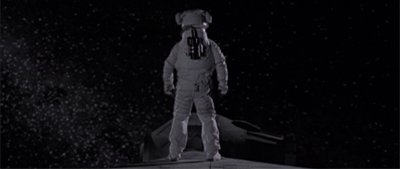
Staring at the stars...

Staring at the stars…

Continue reading

The X-Files (Topps) – The Pit (Review)

This November (and a little of December), we’re taking a trip back in time to review the third season of The X-Files and the first (and only) season of Space: Above and Beyond.

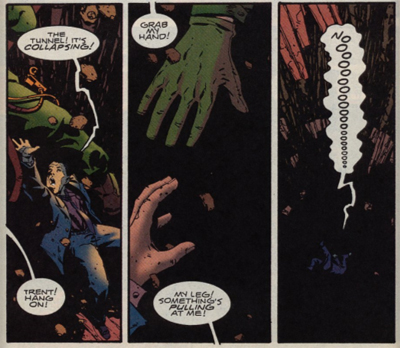
Tucked away in the Winter 1996 issue of The X-Files Magazine and republished with The Silent Sword in September 1996, The Pit is an atmospheric short story from Petrucha and Adlard, demonstrating the two work quite well together across a variety of formats. The Pit is only nine pages long, including two splash pages – and another half-page splash. There isn’t a lot of room for plot or detail. Instead, Petrucha and Adlard opt for mood and atmosphere, crafting a weird and spooky little diversion.

All fall down...

All fall down…

Continue reading

The X-Files – Revelations (Review)

This November (and a little of December), we’re taking a trip back in time to review the third season of The X-Files and the first (and only) season of Space: Above and Beyond.

Religion, eh?

In the mid-nineties, religion was a very difficult subject to navigate on network television. The so-called “culture wars” were in full swing at the middle of the decade, with religious values serving as a particularly brutal battleground. Religion is a very thorny and contentious subject. As recently as 2012, more than 40% of polled Americans stated they would not vote for an atheist candidate in a presidential election. Pete Stark would admit to being an atheist in 2007, becoming the first self-identified atheist in the United States Congress.

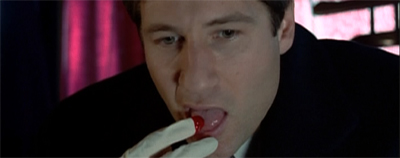
Mulder's got a taste for adventure...

Mulder’s got a taste for adventure…

As a result, it is very difficult to have a meaningful and thoughtful conversation about it. “There’s a man that I work with – a friend – and usually I’m able to discuss these things with him… but not this,” Scully confesses at the end of the episode. While undoubtedly a comment on Mulder’s stubborn refusal to engage with Scully on the topic, it also feels like a commentary on the awkwardness of any public discussion about religious beliefs or values, which was prone to become highly charged and contentious.

The conventional wisdom was that you didn’t talk about religion at the dinner table. It wasn’t much easier on television. This puts Revelations in a very awkward position.

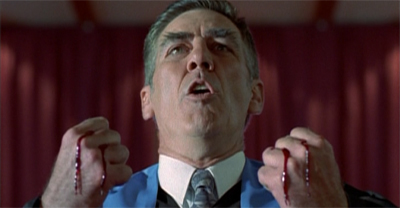
A bloody business...

A bloody business…

Continue reading

Non-Review Review: Whiplash

The joy of Whiplash is in how the film subverts so many of the conventions of the “unconventional teacher pushes promising young student” subgenre. A one-sentence plot summary for the film suggest an inspirational and life-affirming tale. Andrew heads to a prestigious music school to hone his skills on the drums, and encounters an obnoxious and confrontational teacher who pushed him to his limits. One can already hear the applause, see the inevitable hug, feel the radiating mutual respect.

Whiplash carefully and meticulously subverts these expectations, avoiding many of the familiar plot beats that one might expect from a story like this. There’s a raw, gruelling honesty to the story – Whiplash is not a story calibrated or tailored to make the audience feel particularly comfortable or happy. Indeed, it addresses its central themes with a refreshing candidness. It asks some very tough questions about honing talent and the responsibilities of a teacher. It doesn’t offer any easy answers.

Anchored in two compelling central performances and a beautiful soundtrack, Whiplash builds to a beautifully cathartic climax, one that refuses to wrap too tight a bow around an intriguing little film.

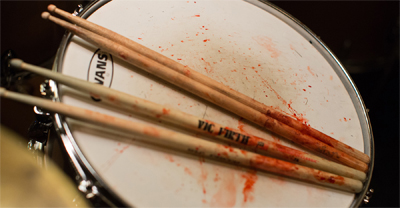
Stick around...

Stick around…

Continue reading

Space: Above and Beyond – Stay With The Dead (Review)

This November (and a little of December), we’re taking a trip back in time to review the third season of The X-Files and the first (and only) season of Space: Above and Beyond.

There is a nice story buried somewhere in Stay With the Dead. Space: Above and Beyond has generally worked better as a story about warfare than an action-adventure science-fiction show. As such, it’s telling that the best parts of Stay With the Dead have less to do with the plot-driven flashback-ridden mystery at the heart of the episode, and more to do with the aspects of the script that confront the uncomfortable realities of war.

Post-traumatic stress disorder is an absolutely terrifying aspect of armed conflict. War claims lives; countless soldiers and civilians are sacrificed in the name of the greater good. However, even those who survive are left scarred by the experience. The trauma need not be physical. Exposure to combat and warfare can leave a lasting psychological scar. It has widely been suggested that shell-shock and other post-traumatic stress disorders have been under-reported among veterans of previous conflicts.

The wages of warfare...

The wages of warfare…

Stay With the Dead broaches the topic when West is recovered from the field of battle suffering from anxiety attacks and struggling to recall the details of his experience. He is unable to sleep, with even the smallest noise reminding him of his experiences. Army doctors are unable to help him, and make suggestions that seem more interested in what is most convenient for the war effort rather than addressing his own needs. There’s a lot of potentially compelling commentary about how warfare works, and the conflicts of interest that arise.

However, instead of exploring these issues, Stay With the Dead instead becomes a flashback race-against-time mystery. It is not a very good one.

Purple haze...

Purple haze…

Continue reading

The X-Files (Topps) Digest #1 – Big Foot, Warm Heart (Review)

This November (and a little of December), we’re taking a trip back in time to review the third season of The X-Files and the first (and only) season of Space: Above and Beyond.

It is very odd to think that The X-Files has never done an episode about Bigfoot, perhaps America’s most recognisable and iconic mythological figure.

Perhaps there’s a reason for this. The show did a Bigfoot-type creature early in its first season, with The Jersey Devil. The fifth episode of the first season, The Jersey Devil helped to solidify the impression that The X-Files was better at abstract horrors than familiar monsters. It is not too difficult to imagine that the production team looked at The Jersey Devil and decided that Bigfoot was unlikely to be a runner.

Here there be monsters...

Here there be monsters…

Still, the show has waded into cryptozoology on occasion – with somewhat mixed results. Quagmire featured the agents hunting a mysterious reptile in a rural lake. When the show had to relaunch itself during the eighth season, Scully and Doggett bonded over their pursuit of a giant bat-like creature in Patience, the first standalone episode within that new status quo. Even Bigfoot was frequently referenced and cited. Most obviously, the final montage of Jose Chung’s “From Outer Space” suggests that Mulder treats the Roger Patterson footage as an almost holy text.

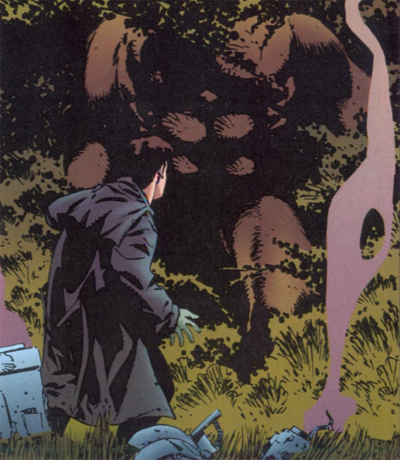
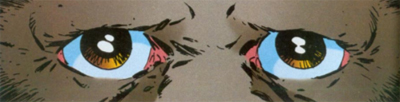
Perhaps it’s appropriate, then, that Mulder and Scully would come face to face with Bigfoot in the pages of the licensed tie-in, as part of the “digest” that Topps released at the end of their first year publishing the comic.

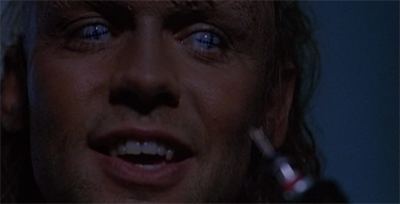
Eye see...

Eye see…

Continue reading

The X-Files – 731 (Review)

This November (and a little of December), we’re taking a trip back in time to review the third season of The X-Files and the first (and only) season of Space: Above and Beyond.

731 is a lot more substantial than Nisei.

This is most likely due to the episode’s production history. Frank Spotnitz had pitched the episode that would become 731 as a single standalone episode, but the production team discovered that the show was too large to fill a single forty-five minute block. So the show was extended into a two-parter. Given that Spotnitz was the credited writer on 731, it would seem that the second part retained most of the substance.

It's in the eye of the beholder...

It’s in the eye of the beholder…

This makes a great deal of sense, given that the two-parter eschews the stand format of a two-part X-Files episodes, featuring a frantic run-around in the first forty-five minutes and a tighter more intimate story in the second. Coupled with the fact that the episode is more about working through what we already know instead of heaping more information on top, and the two-parter seems a lot more substantial than most of the series’ big mythology shows.

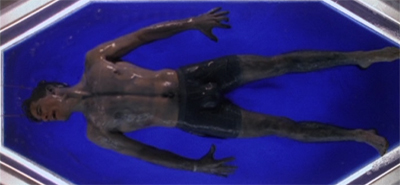
Thoughtful, introspective, and unnerving, 731 is perhaps the highpoint of the show’s entire nine-season conspiracy arc.

Where the bodies are buried...

Where the bodies are buried…

Continue reading

Space: Above and Beyond – Choice or Chance (Review)

This November (and a little of December), we’re taking a trip back in time to review the third season of The X-Files and the first (and only) season of Space: Above and Beyond.

Hostile Visit and Choice or Chance follow the two-part template established by The X-Files, keeping things fresh by offering a pretty dramatic shift between the two episodes in question.

Hostile Visit featured a covert trojan house mission to infiltrate enemy space and stage a devastating attack behind enemy lines. The episode ended with the mission a failure and our heroes drifting through space. Choice or Chance features our heroes landing on a prison planet maintained by the Silicates, the evil artificial organisms that have skirted around the edge of the show’s mythology to this point.

Here's Douggie!

Here’s Douggie!

Choice or Chance comes very close to working. It is a lot more dynamic than Hostile Visit was, which is a good thing for the second half of a two-parter airing during November Sweeps. However, while Hostile Visit felt a little padded and extended, never quite building the momentum necessary for the story to work, Choice or Chance feels a little over-stuffed. There’s a lot of nice stuff here, but no room to properly digest it. It’s an episode that comes up with something for every member of the cast to do, but this inevitably means that the character arcs feel abbreviated and shortened.

There is a  pretty solid two-part episode to be constructed out of the ingredients of Hostile Visit and Choice or Chance. Sadly, the resulting two-parter is not it.

Crash and burn...

Crash and burn…

Continue reading

The Flash – Plastique (Review)

So, I’m considering reviewing this season of The Flash, because the pilot looks interesting and I’ve always had a soft spot for the Scarlet Speedster. I’m also considering taking a storyline-by-storyline trek through the 1987-2009 Flash on-going series as a companion piece. If you are interested in reading either of these, please let me know in the comments.

Plastique demonstrates that we are still in the early days of The Flash as a television show. We are still working through all the stock elements and trying to figure out what works, while also using fairly stock plot lines to help the show find its feet. Going Rogue was a massive step forwards for the show, but Plastique can’t quite maintain the forward momentum. It feels more like The Fastest Man Alive or Some Things You Can’t Outrun, episodes using a fairly episodic format with generic guest stars and familiar plots to help get things moving.

Plastique is a nice demonstration of what works and what doesn’t work about The Flash at this stage in its life-cycle. It is light and bubbly, and more than a little silly. It is very consciously a CW show, to the point where it seems to wryly winking at the audience. It is also endearingly earnest, embracing a lot of its core superhero tropes even as the characters within the narrative remain reluctant to latch on to “the Flash” as a superhero code name. The Flash is a show that is unashamed about its comic book roots; Plastique even teases the appearance of a psychic gorilla.

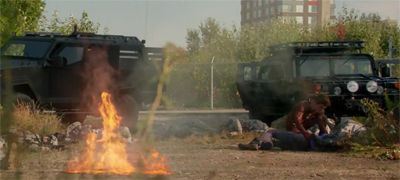
Boom!

Boom!

However, there are problems. The ensemble is uneven at best. The stand-out performers – whether part of the main cast or simply guest stars – skew older. The younger actors tend to be a bit more hit-and-miss. It is more exciting to watch actors like Jesse Martin, Clancy Brown and Tom Cavanagh interact than to spend any time with Kelly Frye or Carlos Valdes. While a lot of that is down to the quality of the casting, the writing is also to blame. The Flash is at its best when it seems to treat characters as adults, rather than young people doing young people stuff.

Plastique is a solid enough episode, but it is one that demonstrates where the strengths and weakness of the show lie. The Flash needs to start compensating and adjusting for that.

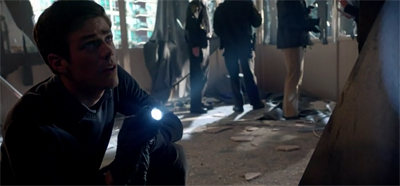
A flash of inspiration...

A flash of inspiration…

Continue reading

The Flash (1987-2009) #9-11 – The Chunk/Chunk in the Void/Chunk Barges In (Review)

So, I’m considering reviewing this season of The Flash, because the pilot looks interesting and I’ve always had a soft spot for the Scarlet Speedster. I’m also considering taking a storyline-by-storyline trek through the 1987-2009 Flash on-going series as a companion piece. If you are interested in reading either of these, please let me know in the comments.

While writing The Flash, Mike Baron tended to avoid established villains.

While appearances from Vandal Savage bookend the run, most of the character’s iconic rogues are completely missing from the first year of the title. There is no Reverse-Flash, no Captain Cold, no Weather Wizard, no Heatwave, no Captain Boomerang, no Trickster. Instead, Baron tended to create his own antagonists for Wally West. To be fair, his creatures tended to pop up here and there over the years, but none of them really broke through into the character’s regular supporting cast.

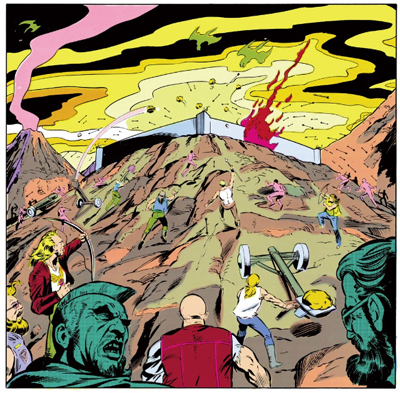
It's the end of the world as we know it...

It’s the end of the world as we know it…

Perhaps Chunk came closest. Chester Runk is the most memorable and well-defined new character to appear during Baron’s run on the title. The character would never become a regular fixture of The Flash, but he would pop up time and again over the years. It is easy to see that might be the case. He is rather distinct from most of the other baddies to debut under Baron’s pen. He looks visually distinctive, has a nice character hook, and fits quite comfortably in the world of The Flash. He’s a nice adversary.

Sadly, his debut story is not a good story.

The big man...

The big man…

Continue reading