• Following Us

  • Categories

  • Check out the Archives


  • Awards & Nominations

The X-Files – The Unnatural (Review)

This July, we’re taking a trip back in time to review the sixth season of The X-Files and the third (and final) season of Millennium.

Let me get this straight: a free-spirited alien fell in love with baseball and ran away from the other non-fun-having aliens and made himself black, because that would prevent him from getting to the majors where his unspeakable secret might be discovered by an intrusive press and public and you’re also implying that…

You certainly have a knack for turning chicken salad into chicken spit.

– Fox Mulder and Arthur Dales discuss the merits of The Unnatural

Swing and a hit...

Swing and a hit…

Continue reading

Non-Review Review: Pixels

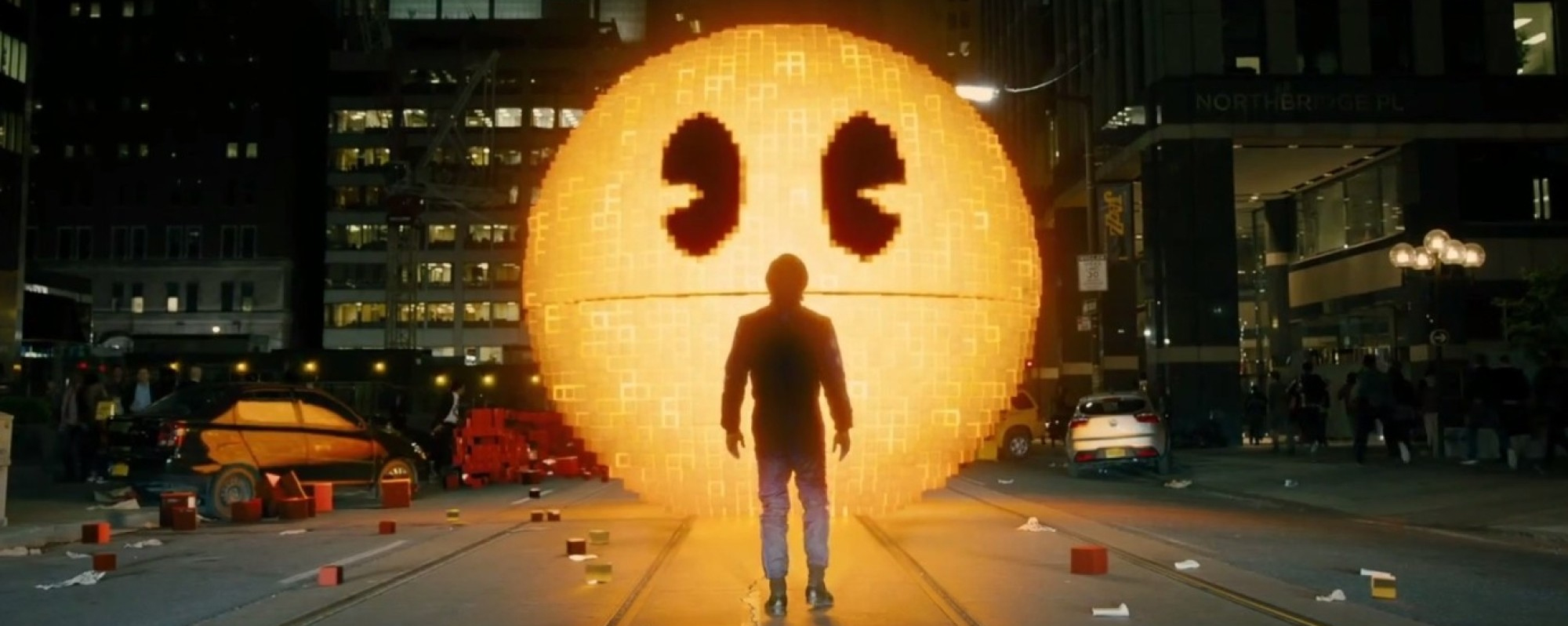
Pixels has a fun concept.

The idea of video game characters invading the world is a delightfully gonzo piece of pop culture nostalgia. It is easy to see why Sony picked up the option for Patrick Jean’s 2010 short film, even if the concept was not new. Neither version of Pixels can quite measure up to Raiders of the Lost Arcade, the short that aired as part of Anthology of Interest II during the third season of Futurama. That ten minute short story captured the sheer unadulterated joy of a world under siege from its juvenile obsessions.

You are my sunshine...

You are my sunshine…

There are a lot of problems with Pixels. The most obvious is that it seems completely disinterested in its core concept as anything other than a vehicle for Adam Sandler. There is a lot of CGI and a number of recognisable pop culture references, but Pixels plays just like any other Happy Madison vehicle. It is an excuse to pair Adam Sandler up with a beautiful actress and pay for trips for friends and acquaintances around the world while making jokes that were tired when most of the audience was making them in the playground.

Pixels never embraces the goofy joy of an invasion of eighties video games, instead wallowing in the presence of washed up nineties hackery.

All the President's... People.

All the President’s… People.

Continue reading

Millennium – Bardo Thodol (Review)

This July, we’re taking a trip back in time to review the sixth season of The X-Files and the third (and final) season of Millennium.

As with Saturn Dreaming of Mercury and (to a lesser extent) Darwin’s Eye, Bardo Thodol continues to boldly push Millennium towards abstraction.

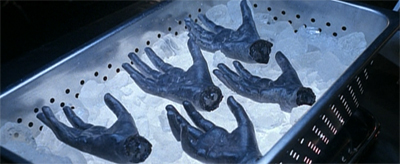
The plot of Bardo Thodol is actually fairly basic, in the same way that the plot to Darwin’s Eye is fairly basic. Mister Takahashi has done terrible things. Fleeing the Millennium Group assassin known only as Mabius, the mysterious scientist seeks refuge in a Buddhist Temple. As his body turns against him, Takahashi seeks to atone for his crimes. At the same time, an FBI raid on a cargo ship turns up an ice box packed with severed hands. Inevitably the two threads turn out to be intertwined.

Give the man a hand...

Give the man a hand…

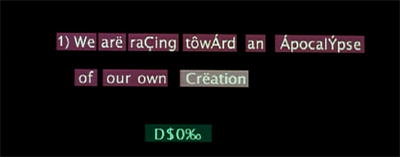
However, as with a lot of Millennium scripts, the details of this fairly simple plot are delightfully askew. Bardo Thodol feels almost like a game of Millennium word association. There are cloning experiments, assassination attempts, meditations on reincarnation, actual meditation, discussions of forgiveness, ominous messages delivered by computer virus, lots of atmosphere, an oppressive sense of paranoia. Adjectives like “cluttered” and “stuffed” come to mind, to the point that it feels like a lot of Bardo Thodol ended up on the cutting room floor.

As with Darwin’s Eye, it feels like Bardo Thodol works better as a mood piece than as an example of storytelling television. It is not a hugely satisfying forty-five minutes, but it is always interesting.

Yes. Yes the show is.

Yes. Yes the show is.

Continue reading

The X-Files – Milagro (Review)

This July, we’re taking a trip back in time to review the sixth season of The X-Files and the third (and final) season of Millennium.

The teaser establishes the mood quite quickly. It is a rather striking opening sequence for an episode of The X-Files, focusing on a writer staring at a blank page. The sequence cuts through time as the writer searches for inspiration, trying to take his cue from the index cards helpfully arranged on the wall. Eventually, the writer makes a grand gesture. He reaches into his chest, and pulls out his heart. It is a very effective opening sequence, one that makes it clear that Milagro will not be a normal episode of The X-Files.

The sequence also makes it clear that Milagro will not will it be a subtle piece of television. The teaser is not a particularly elegant metaphor, but it is an effective one. What is writing but tearing out a piece of yourself? Sometimes you have to wear your heart on your sleeve; sometimes you have to put it on the page. The teaser to Milagro is a very earnest piece of work from Chris Carter, a clear acknowledgement that what follows is a deeply personal piece of work.

Burning heart...

Burning heart…

Continue reading

Millennium – Darwin’s Eye (Review)

This July, we’re taking a trip back in time to review the sixth season of The X-Files and the third (and final) season of Millennium.

There is a reckless abandon to the the late third season of Millennium that is oddly endearing.

The first half of the year seemed almost cautious and conservative, as if trying to smooth the rough edges off the show in the hopes of turning it into a more generic piece of television. That approach failed spectacularly, and hobbled the rest of the season. Towards the end of the third season, Millennium allowed itself to become a bit bolder and more abstract, proudly flying its freak flag high. The show found an energy and verve, throwing crazy concepts into scripts with reckless abandon and little regard for how they fit together.
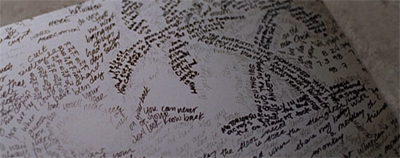
Shady theories...

Shady theories…

It doesn’t entirely work. If anything, it underscores just how skilfully the second season had integrated these crazy ideas with a clear creative direction and a solid thematic foundation. The second season know roughly where it wanted to go, and so embarked on an epic journey towards that point. While the third season has its own thematic underpinnings, these feel more like recurring visual motifs and ideas than a clear purpose. As a result, the weirdness can seem detached and purposeless, abstract and surreal.

However, even when the late third season episodes don’t quite work, they remain interesting. There is a breathless energy to these stories that was sadly missing in the first stretch of the year. Darwin’s Eye is a prime example. It is not an episode that could be described as a success by any measure, but it is still ambitious and dynamic in a way that mitigates its failings. Somewhat.

That's one way to get a head in love...

That’s one way to get a head in love…

Continue reading

The X-Files – Trevor (Review)

This July, we’re taking a trip back in time to review the sixth season of The X-Files and the third (and final) season of Millennium.

Trevor is a perfectly solid monster of the week episode of The X-Files.

In many respects, it feels like the episode that Alpha desperately wanted to be. It is very much a traditional story in a season that has been relatively untraditional in its structure and format. Mulder and Scully are assigned to a case that is explicitly paranormal and set about investigating it to the best of their ability. Along the way, Mulder and Scully become passengers in a story that involves the guest cast. Trevor is not as sly or self-aware as something like Monday, Arcadia or Milagro. It is a straightforward case of the week.

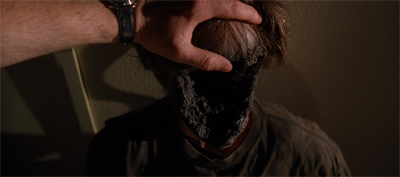
"I wanna take his face... off..."

“I wanna take his face… off…”

There are other similarities between Trevor and Alpha. Alpha was an episode that really wanted to tackle a very traditional monster in a very traditional way – it was a very disappointing attempt at a werewolf episode, following on from Shapes in the first season. In a way, Trevor alludes to a more classical monster story than most X-files. Wilson “Pinker” Rawls is effectively a wraith avenging himself upon those who did him wrong, the embodiment of past mistakes returned to haunt the living. He is a ghost, even beyond his ability to walk through walls.

Of course, Trevor provides a suitably pseudo-scientific explanation for what Rawls does, and the climax builds to an intimate family tragedy. However, Trevor feels very much like a classic ghost story about a man returned from the dead to visit retribution upon the living.

Diehl it back...

Diehl it back…

Continue reading

Millennium – Saturn Dreaming of Mercury (Review)

This July, we’re taking a trip back in time to review the sixth season of The X-Files and the third (and final) season of Millennium.

That’s an intense little girl you’ve got there.

Intensity’s fine.

– Emma and Frank discuss how Jordan takes after her father

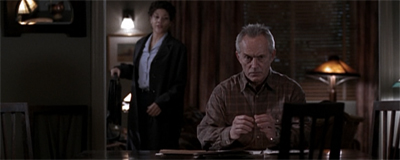
"Quiet. I'm trying to figure out the title."

“Quiet. I’m trying to figure out the title.”

Continue reading

The X-Files – Alpha (Review)

This July, we’re taking a trip back in time to review the sixth season of The X-Files and the third (and final) season of Millennium.

After a couple of misfires in the first few seasons, The X-Files had most steered clear of “classic” monsters. The first season had struggled with werewolves and ghosts and cryptozoology in Shapes and Shadows and The Jersey Devil respectively. 3 had been the show’s first “true” vampire episode, and had ended up as a bit of a mess. Perhaps it indicated that The X-Files was not a show that did “traditional” monsters particularly well; or maybe it was just a sign that the creative team were still figuring out how to make the show.

There was some evidence that the show might have been getting better at this sort of thing. In the fourth season, Elegy had been a (mostly) effective traditional ghost story. In the fifth season, Bad Blood had demonstrated that it was possible to make a good episode of The X-Files about vampires. Perhaps it was time to try another werewolf story. After all, the budget on The X-Files was bigger than it had ever been. There would likely be no better time to tell a classic werewolf story. Sadly, Alpha is anything but a classic werewolf story.

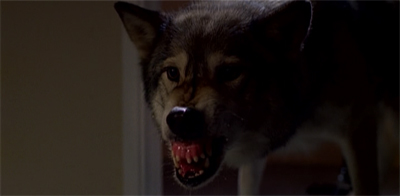
Hungry like the wolf...

Hungry like the wolf…

Continue reading

Non-Review Review: Mission: Impossible – Rogue Nation

Mission: Impossible: Rogue Nation moves like the clappers.

The movie speeds along through a selection of impressive stunt work and setpieces, constantly ramping up the tension and raising the stakes. The threat is constantly larger, the game ever more deadly. The film escalates and escalates, to the point where foreign heads of state are nothing more than pieces on a chessboard, fodder for impressive action sequences and swift double-crosses. In a way, this is the approach that made Mission: Impossible III and Mission: Impossible: Ghost Protocol taken to its logical conclusion. Momentum is key.

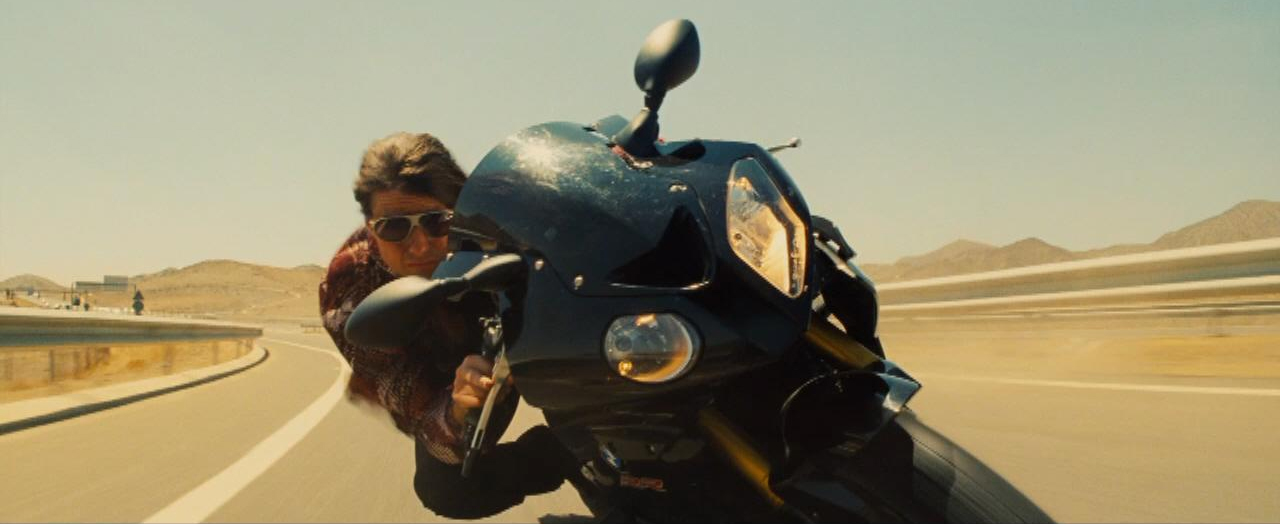
Cruising...

Cruising…

However, there are points where it feels like Mission: Impossible: Rogue Nation hits the limit of this approach – that it serves as a control case to demonstrate just how far you can push this sort of suped up storytelling without breaking the emotional tethers that hold all this together. There are several major emotional beats in Mission: Impossible: Rogue Nation that simply don’t land because the film has never eased its foot off the gas long enough to develop any of its characters beyond familiar archetypes.

This is perhaps the biggest problem with the film, but writer and director Christopher McQuarrie is shrewd enough that he never lets it get entirely out of hand. If the movie’s biggest emotional moments never have the necessary punch, that is not enough to sink the film; there is always another big action setpiece or another reversal or another tense thrill ride waiting after this underwhelming character beat. Mission: Impossible: Rogue Nation might move so fast that it seldom has room for its characters, but it also moves so fast that this is seldom a fatal flaw.

Winging it...

Winging it…

Continue reading

Millennium – Forcing the End (Review)

This July, we’re taking a trip back in time to review the sixth season of The X-Files and the third (and final) season of Millennium.

In its own odd way, Forcing the End is reassuring.

Not in any way that makes Forcing the End a good piece of television. In fact, Forcing the End is a terrible piece of television. It is poorly written, awkwardly staged, horribly muddled and needlessly convoluted. It wastes two potentially interesting guest stars in Julie Landau and Andreas Katsulas, and doesn’t give our characters anything interesting to do. The best that can be said bout Forcing the End is that it has some interesting ideas and striking imagery, but never seems to be able to fashion them into a functioning story.

"Wait. What."

“Wait. What.”

However, Forcing the End is reassuring because it stands as a monument to the second season of Millennium. The second season of Millennium was a gloriously odd and ambitious piece of television, one that floated ideas and concepts that often seemed insane or ridiculous. It was unlike anything else on television, and holds up rather well. However, the second season of Millennium is interesting because it invites the viewer to wonder whether to is fueled and sustained by its high concepts and big ideas, rather than its scripting and plotting.

Forcing the End answers that question rather clearly. It confirms that the second season works as well as it did because it was well written and beautifully constructed; carefully put together and meticulously crafted. It is not enough to just throw crazy apocalyptic concepts and imagery at the screen and see what sticks. The fact that Forcing the End is so packed with weird eschatological imagery and themes, and yet so stubbornly refuses to work, demonstrates that it is not enough for television to be odd. It has to be good.

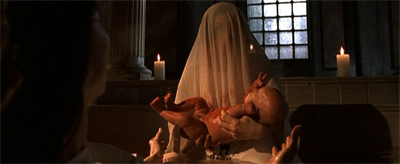
Veiled threats...

Veiled threats…

Continue reading