• Following Us

  • Categories

  • Check out the Archives


  • Awards & Nominations

The X-Files – Arcadia (Review)

This July, we’re taking a trip back in time to review the sixth season of The X-Files and the third (and final) season of Millennium.

Arcadia was originally produced directly after Two Fathers and One Son. It was moved later in the broadcast cycle because it needed more post-production work than Agua Mala or Monday. Looking at the finished product, one suspects that the garbage monster posed no shortage of problems for the production team. Whatever the reason, Arcadia was shifted down two slots in the broadcast order. This is a shame on multiple levels. Most obviously, “Mulder and Scully go undercover as a suburban couple” would have been a great sweeps episode.

More than that, though, there is something delightfully subversive in the idea that Arcadia is the first case that Mulder and Scully are assigned after reclaiming their iconic basement office at the end of One Son. The decision to reassign Mulder and Scully to the X-files would seem to promised a return to the status quo after a weird stretch earlier in the season (from Triangle to The Rain King) where The X-Files turned into a weird paranormal romantic comedy. Fan reaction to this stretch of the show was (and still is) polarised.
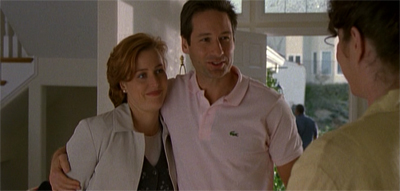
So happy together...

So happy together…

However, instead of reassuring those fans wanting a return to more traditional X-Files aesthetic, Arcadia reasserts the “quirky domestic comedy” tone of shows like Dreamland I, Dreamland II or How the Ghosts Stole Christmas. In fact, it’s telling how completely disinterested Arcadia is in the fact that Mulder and Scully are back on the X-files for the first time since the end of the fifth season. There’s a quick exchange referencing their reassignment, but no examination of the fallout of One Son. There is not even a single scene set in the familiar basement set.

As such, Arcadia seems quite cheeky. It celebrates the return to the show’s classic status quo by ignoring it almost completely. Arcadia is a silly little relationship comedy that could easily have aired in the first stretch of the season, its positioning here feeling like a playful tease of those fans clamouring for the return of a classical approach to the series. Unfortunately, a lot of that gets lost in the shuffling of the episode around in the broadcast schedule. Using Agua Mala and Monday to insulate Arcadia from Two Fathers and One Son undercuts its cheeky charm.
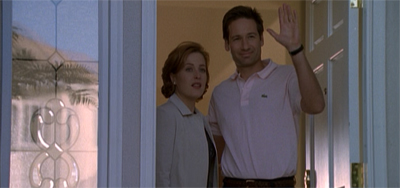
There goes the neighbourhood...

There goes the neighbourhood…

The post-production delay on Arcadia hurts the episode. Instead of a cheeky tweaking of fandom’s nose, Arcadia becomes a fairly middling mid to late season instalment. It is not as limp and lifeless as Agua Mala or Alpha, but not as insightful and fun as Monday. In fact, while Arcadia contains a few chuckles, the episode lacks the charm of something like Triangle or How the Ghosts Stole Christmas (or even The Rain King). Arcadia feels like it takes the cheesy teasing of a Mulder/Scully relationship just a little too far.

In many ways, The Rain King represented the point at which the show should have pressed forward with a romantic relationship between Mulder and Scully; regardless of whether the viewer is a shipper or a noromo, the teasing had reached critical mass, and it was time to commit one way or another. Arcadia instead insists that the show remains decidedly noncommittal, trying to have the best of all possible worlds. There comes a point where the show feels like it is just “trolling.”
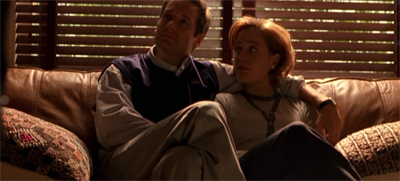
"Well, this is easy enough..."

“Well, this is easy enough…”

Continue reading

Millennium – Matryoshka (Review)

This July, we’re taking a trip back in time to review the sixth season of The X-Files and the third (and final) season of Millennium.

It seems like every time that the third season of Millennium takes a step forward, it is simply preparing to take a tumble backwards.

After spending over a third of the season trying to rewrite the events of the second season, it seemed like the show was finally accepting the changes that had been made by Glen Morgan and James Wong over the course of the sophomore year. Omertà, Borrowed Time, Collateral Damage and The Sound of Snow had all seen the show trying to make its peace with the loss of Catherine Black and the changes to the Millennium Group stemming from the second season finalé. It looked like the show was working through its conflicted feelings, and was ready to move on.

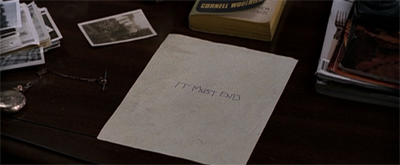
Perhaps it must...

Perhaps it must…

However, both Antipas and Matryoshka represent a very clear step backwards. Antipas feels like an attempt to return to the mood and aesthetic of the late first season (and first season characterisation of Lucy Butler) with no regard for what came afterwards. Matryoshka attempts to reintroduce the sort of clumsy revisionist rewriting of Millennium‘s internal continuity in a manner that evokes The Innocents or Exegesis or Skull and Bones. It presents a secret history of the Millennium Group that heavily contradicts The Hand of St. Sebastian.

There is a host of potentially interesting stuff buried under all of this, but – as with a lot of the third season – it is very hard to care about a show more invested in playing ping-pong with its own history than in trying to tell a new and compelling story. It seems like the most striking thing about most third season episodes is how they engage with what came before, more than what they are actually trying to do. Watching the third season, it seems like the Millennium writing staff is just as divided as the Millennium Group was in Owls and Roosters.

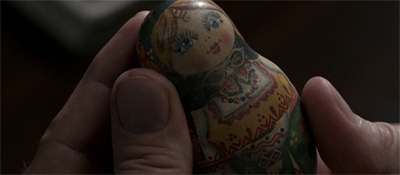
Nesting dolls...

Nesting dolls…

This approach is self-defeating on a number of levels. The second season was admittedly divisive among fans, but it seems like the third season simply cannot get past The Fourth Horseman and The Time is Now in any meaningful fashion. Fans who enjoyed the second season will inevitably feel frustrated by the repeated efforts to minimise or over-write it. Fans who disliked the second season will grow increasingly annoyed that the show is still fixated upon it. Any viewers without a working knowledge of the history of the show are likely to just be confused and befuddled.

Matryoshka is not the worst offender for this sort of confused self-contradiction and self-fixation, but there is a sense that Millennium‘s fascination with the continuity (or lack thereof) of the second season has already passed to point of diminishing returns. Much like the script for Matryoshka, it seems like the third season of Millennium is trapped in the past.

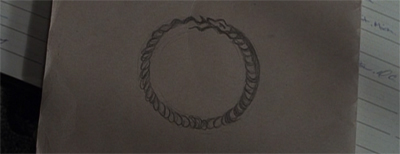
Eating its own tale...

Eating its own tale…

Continue reading

The X-Files – Monday (Review)

This July, we’re taking a trip back in time to review the sixth season of The X-Files and the third (and final) season of Millennium.

It always ends the same way. As is appropriate for a story about a time loop, Monday begins with an ending. The teaser catches the last few minutes of one of the episode’s repeating time loops. It is a striking image. Everybody dies – including Mulder and Scully. How could the episode possibly continue past that point? It is simple. Time resets. The universe snaps back into shape around Mulder and Scully, much like it did at the climax of Dreamland II. Everybody gets another chance to set things right. The show bounces back to its status quo, as it did with One Son.

Time for a do-over. Revise it until it’s right.

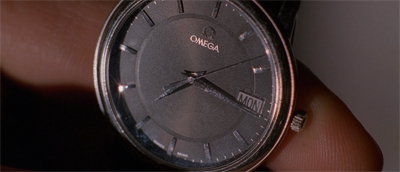
A ticking clock...

A ticking clock…

Continue reading

The X-Files – Agua Mala (Review)

This July, we’re taking a trip back in time to review the sixth season of The X-Files and the third (and final) season of Millennium.

Agua Mala means “bad water.” It also makes for a bad episode.

Agua Mala is perhaps the most infamous turkey of the sixth season, beating out Alpha (and – depending on who you ask – Milagro) for that honour. This is the sixth season equivalent of Space or Excelsis Dei or El Mundo Gira or Schizogeny. Conveniently enough, it arrives at around the same point in the season. It is just around the half-way through the year, near the Christmas break. There is a sense of desperation and fatigue to proceedings; it is as if the entire production team just want to get something in front of the cameras to meet the season order.

Choking the life out of him...

Choking the life out of him…

Agua Mala doesn’t really work on any level. The structure is a mess, the plotting is generic. The bulk of the cast are not introduced until half-way through the episode, and climax of the episode takes place off-screen. The monster is ridiculous, and the script decides to compensate by aiming for broad comedy. However, Agua Mala might be the least funny “comedy” episode that the show has produced up to this point in its run. It is an episode that is fundamentally and undeniably flawed.

It feels almost a waste that Agua Mala was broadcast directly after Two Fathers and One Son, representing something of a return to “business as usual” for the show. If this is the new “business as usual”, it is quite unsettling.

Somebody got slimed...

Somebody got slimed…

Continue reading

The X-Files – One Son (Review)

This July, we’re taking a trip back in time to review the sixth season of The X-Files and the third (and final) season of Millennium.

Two Fathers and One Son are a mixed bag.

They are very messy and convoluted episodes of television, attempting to resolve a long-running plot without committing to a resolution. They swing wildly between clichéd ambiguity and b-movie exposition. They strain to stitch together half-a-decade of storytelling into a ninety-minute finalé, while trying to avoid drawing attention to any of the countless elements that might contradict or undermine the story that they are telling. They are both ambitious and efficient, energised and noncommittal.

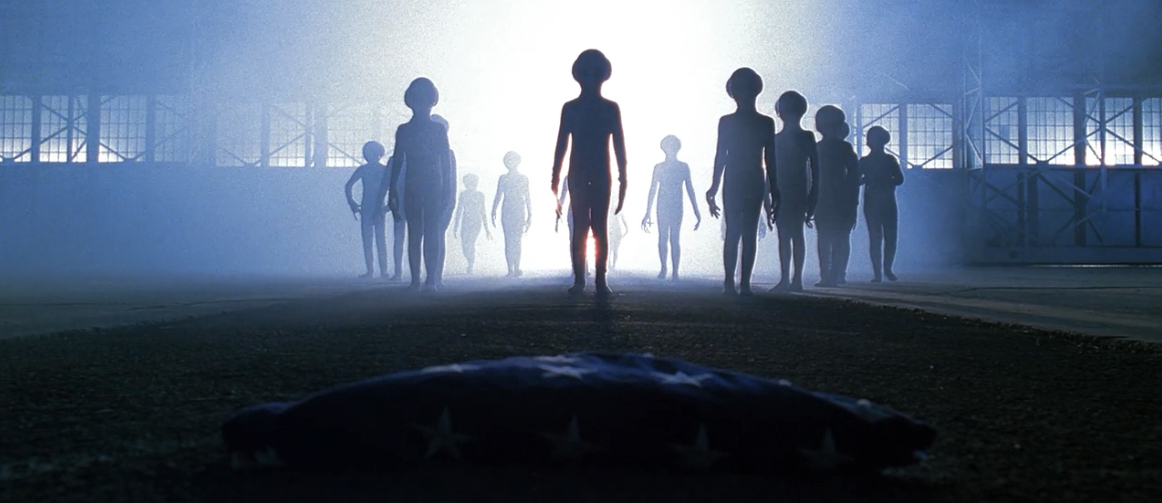
They're here.

They’re here.

At the same time, Two Fathers and One Son make a valiant effort to bring the vast sprawling global conspiracy down to a more manageable level. Over the years, the conspiracy has evolved from a few alien abductions to a vast plot against the majority of mankind. Although they doesn’t always succeed, Two Fathers and One Son try to ground this crazy story about faceless rebels and looming colonisation in the trauma of a single family unit. The fate of mankind plays out against the backdrop of a family collapsing under its own weight.

While it doesn’t work as well as it might, it does help to draw attention to the larger themes that have played out across The X-Files as they relate to power and control, legacy and guilty, abuse and exploitation. It seems appropriate that Two Fathers and One Son should push these ideas to the fore as it attempts to close off the show’s long-running conspiracy thread, reminding viewers of what it was actually talking about.

Baby steps...

Baby steps…

Continue reading

Millennium – Antipas (Review)

This July, we’re taking a trip back in time to review the sixth season of The X-Files and the third (and final) season of Millennium.

Antipas is the second of three scripts written by Chris Carter and Frank Spotnitz over the third season of Millennium. It is also the first of Lucy Butler’s two appearances during the third season, although she has little more than a cameo in Saturn Dreaming of Mercury. This is actually the second time that Chris Carter has written for the character of Lucy Butler, having scripted her début back in Lamentation towards the end of the first season. Antipas feels like a conscious effort to connect back to that first appearance.

To be fair, Lucy Butler has been radically different in each appearance. It is difficult to get a read on the character or to suggest a “definitive” take. Finding the “real” Lucy Butler is as difficult as identifying the “real” Millennium Group or as arbitrary as naming the “real” version of Millennium. That said, there are thematic throughlines. Four of her five appearances are tied into children, for example; the show fairly consistently portrays Lucy as a demonic mother figure in contrast to Frank as a loving father.

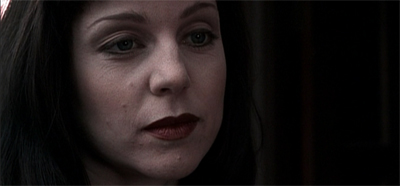
Here's Lucy!

Here’s Lucy!

While the idea of Lucy as a creepy mother ties Antipas into A Room With No View just as much as Lamentation, the script seems to hark more firmly back to Lucy’s character motivation in Lamentation than to her scheming in A Room With No View. In Antipas, Lucy is once again obsessed with biological motherhood, trying desperately to conceive – and even to claim another child as her own. In Lamentation, she sought to mother a child with Doctor Ephraim Fabricant; in Antipas, she seems to aspire towards Frank Black.

Along the way, Antipas is packed with fevered dream imagery and uncanny visuals. As with a lot of the episodes around it, Antipas feels like a very odd piece of television. When Carter wrote Lamentation, this oddness was enough of a break from the norm to power an entire episode. Antipas lacks the sort of strong centre that a piece of television like this needs to ground it. The result is an intriguing and unsettling, if not quite compelling and engrossing, episode of television.

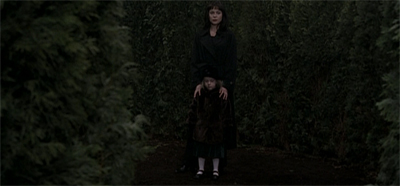
A-mazing nanny...

A-mazing nanny…

Continue reading

Torchwood: Miracle Day – The New World (Review)

In a way, Torchwood: Miracle Day is a miracle itself. It’s a sign of just how far Russell T. Davies has brought Doctor Who, to the point where one of the franchise’s spin-offs could be an international co-production between America and the United Kingdom. Sure, Starz is hardly the best and brightest of American networks, but it’s no small accomplishment on the part of Davies.

America has been something of a promised land for the franchise since the eighties, when John Nathan Turner would spend considerable time and money visiting American fan conventions or casting multinational companions or even arranging international co-financing or to air The Five Doctors first in international territories. None of those examples really took, and most of America only really knew the franchise through PBS airings of the Tom Baker era.

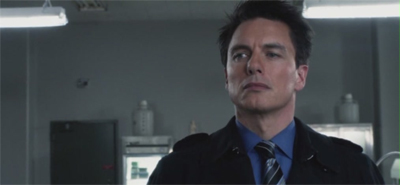
Jack's back...

Jack’s back…

Davies did a lot of work to bring Doctor Who to America. That work really came to fruition during the Steven Moffat era, with a massive opening two-parter set in 1970’s America and the use of Utah as a crucial location. Massive visits to Comic Con became an annual ritual for the show, its producers and performers. The Day of the Doctor will be broadcast live around the world at the same time, no small accomplishment.

While it’s undoubtedly on a much smaller scale, it is nice that Miracle Day affords Davies a chance to be part of this expansion – spearheading his own project that directly intersects with American television. Starz is hardly Fox, the network that Davies originally pitched to, but it is a significant achievement, and a lot of Miracle Day is best understood as an opportunity for the franchise “to go American.”

Defying classification...

Defying classification…

Continue reading

The X-Files – Two Fathers (Review)

This July, we’re taking a trip back in time to review the sixth season of The X-Files and the third (and final) season of Millennium.

This is the end. I never thought I’d hear myself say those words after all these years. You put your life into something… build it, protect it… The end is as unimaginable as your own death or the death of your children. I could never have scripted the events that led us to this. None of us could. All the brilliant men… the secret that we kept so well. It happened simply, like this.

– the Cigarette-Smoking Man channels his inner Chris Carter

In case you were wondering about the title...

In case you were wondering about the title…

Continue reading

Millennium – The Sound of Snow (Review)

This July, we’re taking a trip back in time to review the sixth season of The X-Files and the third (and final) season of Millennium.

“Our pasts are what we are,” Alice Severin explains to Emma Hollis and Bob Giebelhouse towards the climax of The Sound of Snow. It seems as if she might be talking for Millennium itself.

The Sound of Snow is a literal homecoming for Frank Black and Millennium as a television show. It is the last time that a number of crucial elements of Millennium appear in the show. It is the last appearance of Detective Bob Giebelhouse, the Seattle police officer who has been around since The Pilot. It is the last appearance of the yellow house, although it has since been painted a less striking white. It is also the last appearance of Catherine Black, who was a regular character for the show’s first two seasons.

...............

……………

The Sound of Snow features Frank Black returning to Seattle. This is not a big deal of itself. After all, Frank visited Seattle during TEOTWAWKI. However, The Sound of Snow sees Frank wading through memories. He flashes back to the events of The Fourth Horseman and The Time is Now, and visits the yellow house. He even takes a trip out to visit the cabin where he tried to wait out the end of the world with his wife and daughter. The Sound of Snow is about reconciliation, allowing Frank one last conversation with his beloved.

The Sound of Snow is also about reconciliation for the show itself. Since Omertà, the show has been trying to deal with the legacy of a second season that the first eight episodes of the year had tried minimise or ignore. The Sound of Snow is the culmination of that approach, with the third season finally picking up from where the second season let off.

...............

……………

Continue reading

The X-Files – Tithonus (Review)

This July, we’re taking a trip back in time to review the sixth season of The X-Files and the third (and final) season of Millennium.

Alas! for this gray shadow, once a man—
So glorious in his beauty and thy choice,
Who madest him thy chosen, that he seem’d
To his great heart none other than a God!
I ask’d thee, ‘Give me immortality.’
Then didst thou grant mine asking with a smile,
Like wealthy men, who care not how they give.
But thy strong Hours indignant work’d their wills,
And beat me down and marr’d and wasted me,
And tho’ they could not end me, left me maim’d
To dwell in presence of immortal youth,
Immortal age beside immortal youth,
And all I was, in ashes. Can thy love,
Thy beauty, make amends, tho’ even now,
Close over us, the silver star, thy guide,
Shines in those tremulous eyes that fill with tears
To hear me? Let me go: take back thy gift:
Why should a man desire in any way
To vary from the kindly race of men
Or pass beyond the goal of ordinance
Where all should pause, as is most meet for all?

– Alfred, Lord Tennyson, Tithonus

Shades of grey...

Shades of grey…

Continue reading