• Following Us

  • Categories

  • Check out the Archives


  • Awards & Nominations

Star Trek: Voyager – Good Shepherd (Review)

Good Shepherd is a terrible execution of a potentially interesting premise.

There is something interesting in speculating what the Star Trek universe must look like for those characters who exist outside the senior staff of a given series. This premise has been explored and touched upon in a number of episodes; most notably in the basic premise of Star Trek: Discovery, the primary plots of Lower Decks and Learning Curve, even the sections of Strange New World focusing on Novakovich and Cutler. Still, these are only a handful of episodes in a franchise that spans half a century and over seven hundred installments.

Looking out for her crew…

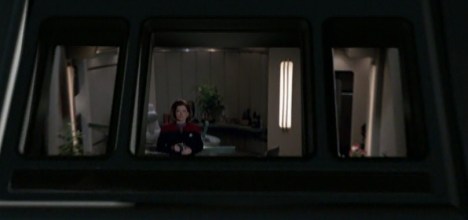
As such, the basic plot of Good Shepherd is compelling. The teaser visuals the appeal of such a story in a playful and innovative way, with the camera following a command all the way from the top of the ship to the bottom; from Janeway’s ready room to Astrometrics to Engineering to the lowest viewing port on the ship. It is an interesting way of demonstrating how anonymous and disconnected individuals can feel, even on board a ship with a crew numbering around one hundred and fifty. What does it feel like to be anonymous, on a ship as isolated as Voyager?

Unfortunately, Good Shepherd awkwardly bungles the question. In doing so, it fails to provide any satisfying answers.

Running rings…

Continue reading

Non-Review Review: Jurassic World – Fallen Kingdom

Jurassic Park: Fallen Kingdom is an intriguing and compelling mess of a film. It is shrewd and clever, if never entirely human.

Director J.A. Bayona might be the first director since Spielberg to put his own unique slant on the Jurassic Park franchise, to move with just enough confidence and faith in his own stylistic sensibilities to escape the shadow of the legendary director who turned a pulpy novel into a beloved family classic. Bayona does that by allowing his own stylistic sensibilities to shine through, to embrace his own interest and to engage with the material on his own terms.

Dino escape.

Fallen Kindom walks a fine line. It is very much a creature grown in a laboratory to satisfy the demands of the larger franchise. There are elements here that exist purely because they are expected, because they are signifiers of what a “Jurassic Park movie” should look like, including both returning characters and new characters fashioned after familiar archetypes. At the same time, there is a coy and wry self-awareness to Fallen Kingdom that was sorely lacking from Jurassic World, a cynicism about its own nature that integrates rather neatly into its larger worldview.

Although it may be damning with faint praise, Jurassic World: Fallen Kingdom is easily the best Jurassic Park movie since Jurassic Park: The Lost World, the film in the franchise with which it shares most of its DNA.

Things are heating up.

Continue reading

81. Django Unchained (#61)

Hosted by Andrew Quinn and Darren Mooney, The 250 is a (mostly) weekly trip through some of the best (and worst) movies ever made, as voted for by Internet Movie Database Users. New episodes are released every Saturday at 6pm GMT, with the occasional bonus episode thrown in.

This time, Quentin Tarantino’s Django Unchained.

A “Southern” set against the backdrop of the southern states in the lead-up to the Civil War. Freed by the German bounty hunter King Schultz, Django embarks upon a mission to free his wife Broomhilda from the clutches of slave-owner Calvin Candie. Together, Schultz and Django find themselves entering the heart of darkness.

At time of recording, it was ranked the 61st best movie of all time on the Internet Movie Database.

Continue reading

New Podcast! The X-Cast – Season 3, Episode 1 (“The Blessing Way”)

I was thrilled to join Tony Black to launch the third season of The X-Cast, a podcast taking a tour through Chris Carter’s The X-Files.

I’ve been lucky enough to guest on a number of episodes, including the one covering the second season finale, Anasazi. After finishing up the second season, Tony took a bit of a break to rush through a podwatch of the entire series; I was thrilled to be invited to take part in that, commenting on episodes from Aubrey to Musings of a Cigarette-Smoking Man to Never Again to The Post-Modern Prometheus to The Unnatural and beyond. It was a real pleasure to be a part of that. And to contribute to Tony’s coverage of the eleventh season, including the final two episodes, maybe forever, Nothing Lasts Forever and My Struggle IV.

However, with Tony having covered all of that, we jumped right back into the regularly scheduled coverage. It was an absolute pleasure to talk about The Blessing Way, which is the third season premiere. I’ve gone on record in the past as both being a tremendous fan of the third season as a whole, which I think is one of the best twenty-odd episode seasons of television ever produced. I’ve also been a bit skeptical of The Blessing Way at the same time. I hope I’m fair to it here, where I confess why it’s both one of my least favourite episodes of the season and something that I’m very glad exists in this form.

As even, Tony was a fantastic host, and we had a fun and wide-ranging discussion about everything from abstract concepts of “truth” to why we love the Well-Manicured Man so much to the recurring theme of mirroring and doubling that plays through this three-parter in particular and the X-Files in general. Check it out the episode here, or click the link below.

Continue reading

Star Trek: Voyager – Child’s Play (Review)

Interesting, isn’t it?

What?

With all their technology, their opportunity to explore the galaxy, the thing they want most is to get home.

A Trek away from the Stars.

Child’s Play is a fascinating episode of Star Trek: Voyager, in that it might be seen as a firm rejection of some of the show’s core conservatism.

Voyager has always been the most conservative of the Star Trek franchise, the series most likely to panic about gang violence for two whole seasons starting in Caretaker or to rail against immigration in Displaced or to voice its anxieties about refugees in Day of Honour. More than that, what are episodes like Remember or Distant Origin or Living Witness or Memorial but expressions of literal anxieties about the erosion of the certainty of history to postmodernism and moral relativism? At its core, Voyager is a series about nostalgia, about the yearning to recapture what once was, how the only journey is the journey home.

“Everything the light touches is your kingdom…”

Child’s Play is interesting as a firm rejection of the idea of the traditional family unit in favour of a more modern (and less rigidly defined) idea of a “found family.” It is a story about how a child’s best interests do not always lie with their biological parents, and about how some of the strongest and most loving bonds in a young person’s life can be forged by chance rather than biology. Child’s Play is essentially an ode to the kind of complicated family dynamics that were entering the mainstream at the turn of the millennium, a staunch defense of a liberal and inclusive definition of family.

More than that, the episode also seems to be making several very pointed jabs at Voyager‘s traditionally conservative outlook.

“I want to be out there…”

Continue reading

Non-Review Review: Fahrenheit 451

Fahrenheit 451 certainly makes a strong case for being “the movie of the moment.”

Adapted loosely from Ray Bradbury’s iconic and beloved science-fiction novel, a piece of source material that famously bewildered François Truffaut during his first and only interaction with Hollywood movie-making, writer and director Ramin Bahrani perfectly positions Fahrenheit 451 as a piece of pop culture for the Trump era. Bahrani smartly retains almost as much of the aesthetic of the source material as he updates, making a strong case that Fahrenheit 451 is more than just an opportunistic broadside at the current political moment.

“I’m going to burn it all.”

Nevertheless, Bahrani makes a number of changes to the story, and turns up the volume on particular story elements, to align his televisual adaptation for the current cultural moment. Ray Bradbury famously claimed that he wrote Fahrenheit 451 as a criticism of television, creating an engaging irony within this adaptation. Bahrani shifts the emphasis slightly to position his adaptation as a criticism of the internet, in particular modern internet subcultures and the way it decreases the audience’s attention span. There are live streams, in-home assistants that are always listening, emojis, and online “fans.”

This is certainly a valid approach to the material, and it’s to the credit of Bahrani as a writer and a director that he manages to build a world that is obviously of a piece with that created in the source material written sixty-five years ago and which works as a pointed commentary on modern cultural discourse. With its brutalist architecture, its cold digital cinematography, its compelling central performances, its suggested alternative history, and its ominous ambient lighting providing the occasional splash of vivid colour, Fahrenheit 451 creates a fictional world that is compelling and engaging.

Lighting a spark…

Unfortunately, the film’s narrative is nowhere near as engaging as its setting. Bahrani cannily borrows characters, premises and sequences from the source novel, but he largely reworks the story. Fahrenheit 451 is restructured as a more conventional science-fiction narrative than the original book, complete with apocalyptic stakes and a macguffin to drive the plot. The plot of Fahrenheit 451 is generic science-fiction fluff, a pale imitation of the familiar rhythms of movies like The Matrix or Equilibrium or Aeon Flux. It is almost as though Bahrani has internalised Bradbury’s critique of television as dumb and simple and broad.

As a result, Fahrenheit 451 doesn’t work nearly as well as it should. It is a beautiful piece of work from an aesthetic perspective, but one employed in a very crude and unsatisfying manner.

Television film.

Continue reading

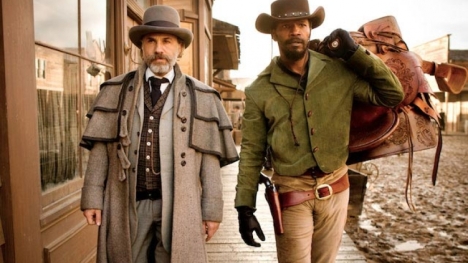
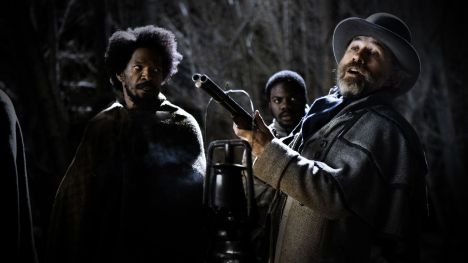
Django Unchained and Tarantino Off the Chain….

Django Unchained is one of the most quietly influential movies of the twenty-first century.

It feels strange to acknowledge that fact, to say it out loud. On paper, it sounds absurd. Django Unchained is an R-rated western that deals with slavery in the manner of an exploitation film, released at Christmas. It is a movie that is downright abrasive, in terms of both tone and content. On the one hand, it is cheeky and provocative, playful and flippant; it is hyperstylised, from the Ennio Morricone score to the camera zooms to the bright flourishes of colour. It is also so violent and brutal that it is difficult to watch, even having seen the film before and knowing when the horrors are coming.

However, the film was a box office success. It earned over one hundred and sixty million dollars at the domestic box office, and more than two hundred and sixty million dollars at the foreign box office. More than that, it became a cultural touchstone. Jamie Foxx would reprise the role of Django in A Million Ways to Die in the West. The character would appear in a number of licensed comic book adaptations, including a crossover with Zorro published by Dynamite and Vertigo publishing.

The influence of Django Unchained is subtler than that. It is a film that shifted the conversation on the popular history of the United States. It did not do this alone, and it is hard to argue whether it was part of a broader cultural shift or simply a reaction to it. Nevertheless, Django Unchained coincided with a massive shift in how popular culture engaged with American history. Its impact is felt in the strangest of places, from the blending of horror movie conventions with a western aesthetic in films like The Revenant or Bone Tomahawk to the sounds of Kanye West playing over the opening scenes of Underground.

There had been movies about slavery before; indeed, Django Unchained was released roughly contemporaneously with both Lincoln and 12 Years a Slave. However, there had never been a movie about slavery like this. The western genre had been greatly diminished before Django Unchained was released, but it was profoundly changed in its wake. After Django Unchained, it seemed to become impossible to construct a western without reference to the atrocities upon which the west had been won.

Django Unchained argued that these horrors weren’t just one version of the story, but instead an essential part of the overall story of the frontier and the nation. Sofia Coppola’s refusal to confront slavery in The Beguiled became a minor controversy. Even Hostiles confronted the genocide of the Native Americans. There were westerns that avoided these controversies in the intervening years, but they became fewer and further between. Indeed, The Ballad of Lefty Brown is perhaps most notable for the ill-judged scene in which its only major African American character attempts to lynch the white lead.

Still, even approaching Django Unchained more than half a decade removed from its release, it remains a fascinating and compelling piece of cinema. It is a genuinely provocative piece of cinema, one designed to challenge and upset the audience. However, the true beauty of the film lies as much in its contours and finer details as it does in the broad strokes, in the little touches that enrich and enlighten the finished product. In particular, the sense that Tarantino understands the precarious nature of what he is attempting, despite the somewhat flippant attitude towards violence and bloodshed.

This sense of consideration and reflection is perhaps best explored in the character of King Schultz, who is positioned quite cannily as a deconstruction of the familiar white saviour trope.

Continue reading

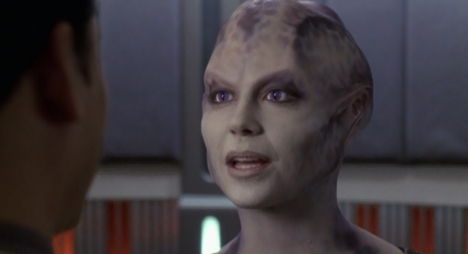
Star Trek: Voyager – Ashes to Ashes (Review)

Death is inevitable and inescapable. It comes to all in time.

Death provides a sense of closure. It marks an end of a journey. It establishes a boundary that might serve as an outline of a life. Death is the high price of living, the unavoidable reckoning that waits beyond the mortal veil. Death is the final frontier, one which all cross in time. Death is the undiscovered country, from which none have returned and about which all must wonder. Sometimes death comes quickly, sometimes it lurks and stalks its prey, sometimes it is even embrace. Nevertheless, death always comes.

The sad ballad of Lyndsay Ballard.

By the sixth season of Star Trek: Voyager, the Star Trek franchise was acutely aware of its own mortality and the unavoidable nature of its own death. Ratings were in decline, and there was no reprieve in sight. The fans were growing increasingly angry with the franchise’s output, and the press was eager to turn on the grand old man of television science fiction. Ronald D. Moore had been forced to quit the franchise, and Brannon Braga would later confess that this was the point at which all of his creative energy had been exhausted.

This mortality hangs over the sixth season of Voyager. The fifth season had repeatedly fixated on the idea of Voyager as a series trapped in time, an inevitability: the thwarted suicide attempts of Janeway in Night and of Torres in Extreme Risk; the frozen ship and crew in Timeless; the multiple copies of Seven of Nine and Janeway in Relativity; the decaying and collapsing imitations in Course: Oblivion, barely registering as a blip on the “real” crew’s radar; the rejection of millennial anxiety in 11:59; even the crew’s broken counterparts in Equinox, Part I.

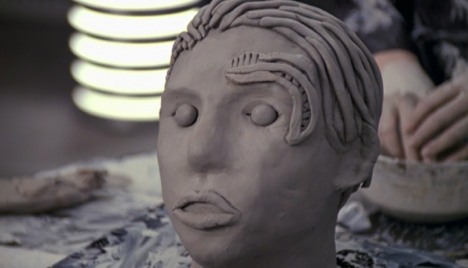
Mortal clay.

In contrast, the sixth season returns time and again to the idea of death and decay: the ruined empire in Dragon’s Teeth; the underworld in Barge of the Dead; the ghost story in The Haunting of Deck Twelve; the floating tomb in One Small Step; the memories of a massacre in Memorial; the dead Borg Cube in Collective; the vengeful death throes of the returning Kes in Fury; the EMH’s visit to an aging and frail relative in Life Line; the Borg heads on spikes in Unimatrix Zero, Part I. This is to say nothing of the funereal tone of Blink of an Eye.

Ashes to Ashes is perhaps the most literal articulation of this recurring theme and preoccupation, the episode that most strongly and overtly explores the sixth season’s fascination with death and decay. The episode centres on a one-time guest star, a deceased member of the crew who has been resurrected by an alien species and seeks to return to the land of the living. Inevitably, she discovers that this is not possible. Death cannot be outwitted or evaded. It always catches up.

Whose episode is it anyway?

Continue reading

80. Deadpool 2 – This Just In (#183)

Hosted by Andrew Quinn and Darren Mooney and with special guest Graham Day, This Just In is a subset of The 250 podcast, looking at notable new arrivals on the list of the 250 best movies of all-time, as voted for by Internet Movie Database Users.

This time, David Leitch’s Deadpool 2.

At time of recording, it was ranked the 183rd best movie of all time on the Internet Movie Database.

Continue reading

Star Trek: Voyager – Spirit Folk (Review)

The holodeck is horrifying.

This is nothing new. It has been this way since Star Trek: The Next Generation. The holodeck has been an unsettling concept from almost the very beginning, not least because of the kinds of stories that the holodeck suggests. From the moment that the Enterprise updated the holodeck in The Big Goodbye, there has been a creeping sense that the holographic creations are capable of comprehending the nature of their existence; in fact, that episode ends with the horrifying notion of McNary wondering what would happen to him when Picard turned off the program.
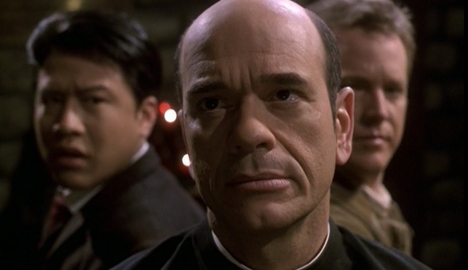
It’s the poster for the least exciting action movie of the late nineties.

This anxiety simmered in the background of the next few holodeck-centric episode, albeit less directly. Both Minuet in 11001001 and the Comic in The Outrageous Okona seemed to grasp their nature as computer constructs designed to serve specific purposes. They lacked the existential angst that McNary expressed in his final moments, but there was still something lurking just beneath the surface. If these entities were self-aware, could their creation and destruction be ethical? In Elementary, Dear Data, Moriarty brought the question to the fore; a hologram who wished to escape his captivity.

Star Trek: Deep Space Nine largely stayed away from the holodeck (or the holosuite) for most of its run, barring small recurring gags about the crew’s recreational use of the facilities. Our Man Bashir cleverly side-stepped the issue of holographic self-awareness by casting the lead actors in the role of holographic supporting players. Nevertheless, the introduction of Vic Fontaine in His Way introduced yet another self-aware holographic character, his self-awareness taken for granted and only really articulated in episodes like It’s Only a Paper Moon.
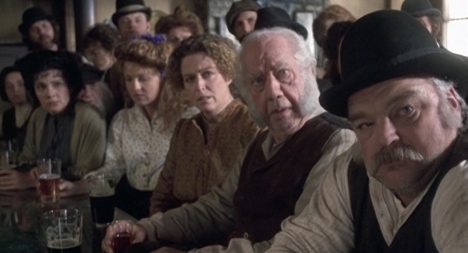
A public (house) meeting.

In contrast, Star Trek: Voyager has only doubled-down on this idea that holographic characters are self-aware. This is most obvious with the EMH, the holographic doctor who struggled for recognition as a person in early episodes like Eye of the Needle and who made a long and gradual journey towards self-actualisation in episodes like Lifesigns and Real Life. However the show engaged with the idea of holographic self-awareness even outside of the EMH, with characters like Dejaran in Revulsion, Leonardo DaVinci in Concerning Flight, the aliens in Bride of Chaotica! and the town in Fair Haven.

To be fair, some of the arguments made by Voyager have been treated with the weight which they deserve. The EMH consciously asserts his personhood in Author, Author, a clumsy but well-intentioned final-season homage to The Measure of a Man. There is a sense that Voyager is capable of treating holograms with the same dignity that The Next Generation afforded Data on his own journey towards self-actualisation. There is something genuinely moving, for example, in the way that the degradation of his program in The Swarm is treated with the same gravity as the neurological decline of a flesh-and-blood character.
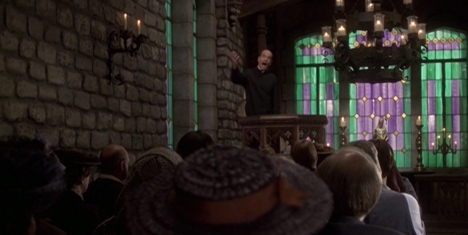
Mass appeal.

However, this also creates a strange dissonance in the episodes that don’t use the holodeck for high drama, and instead treat it as the setting for a romp or an adventure. Voyager seems to argue that every hologram is capable of reaching self-awareness, which means that every use of the holodeck to create new characters should be a momentous occasion. In the world of Voyager, every holodeck program, with the right combination of time and experience, can become a sentient being. This means that use of the holodeck should be something treated with weight and respect.

Fair Haven and Spirit Folk are nowhere near as charming as the production team seem to think that they are, but in the broader context of how Voyager approaches holographic characters, they are downright horrifying.
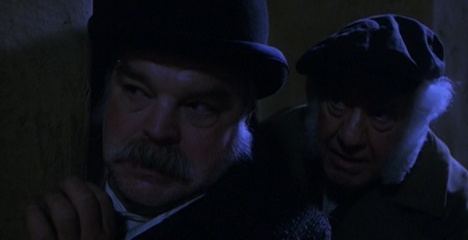
High spirits.

Continue reading