• Following Us

  • Categories

  • Check out the Archives


  • Awards & Nominations

86. Mister Smith Goes to Washington – Independence Day 2018 (#147)

Hosted by Andrew Quinn and Darren Mooney, The 250 is a fortnightly trip through some of the best (and worst) movies ever made, as voted for by Internet Movie Database Users.

This time, an Independence Day treat. Frank Capra’s Mister Smith Goes to Washington.

Local activist and unlikely politician Jefferson Smith finds himself appointed to represent his great state in the United States Senate. However, while trying to ensure a fair deal for his constituents, Smith soon finds his faith in democracy threatened as he figures out how the institutions actually work.

At time of recording, it was ranked the 147th best movie of all time on the Internet Movie Database.

Continue reading

New Podcast! Scannain Podcast (2018) #23!

We’re now completely caught up on the Scannain podcast. And with new and improved sound design, thanks to the wonderful Donnacha Coffey.

This week, I join a fantastic panel including Grace Duffy, Jason Coyle, Ronan Doyle, and Donnacha Coffey from Filmgrabber. As ever a wide-ranging discussion took place, including talk about Set It Up and Netflix’s niche, the incredibly vibrant world of Streets of Fire, the continuing disaster that is Star Wars fandom after the release of Solo: A Star Wars Story and whether Lady Bird is the best film of the year so far. New releases include The Happy Prince, Kissing Candice and Ocean’s 8.

Give it a listen at the link, or check it out below.

New Podcast! Scannain Podcast (2018) #22!

Almost caught up on the backlog of the Scannain podcast.

This week, I join Donnacha Coffey of Filmgrabber, Jay Coyle and Ronan Doyle to discuss the week in Irish film news. An eclectic discussion as ever, topics include the tragic loss of mid-budget nineties thrillers like The Peacemaker, the sad and angry later work of Orson Welles, the perfect age at which to watch Steven Spielberg, a lightning round on the Galway Film Fleadh, the Inaugural International Week of the Trailer. New releases include Hereditary.

Give it a listen at the link, or check it out below.


New Podcast! Scannain Podcast (2018) #21!

We’re continuing to work through a bit of a backlog on the Scannain podcast, although we’re now making our way through June.

This week, I’m joining Jason Coyle, Luke Dunne from Film in Dublin and Ronan Doyle to discuss the week in film news, Irish and international. Ronan is fresh from the Transylvanian International Film Festival in Romania, and offers his insights and recommendations. New releases include Jurassic World: Fallen Kingdom, although we also discuss some of the movies premiering through streaming services and direct-to-video, including China Salesman and The Tale.

Give it a listen at the link, or check it out below.


New Podcast! Scannain Podcast (2018) #19!

We’re continuing to work through a bit of a backlog on the Scannain podcast, this time jumping back in to cover the last week in May.

This week, I’m joining Luke Dunne from Film in Dublin, Ronan Doyle, Jay Coyle and Grace Duffy. It’s a free-form and rambling conversation, with topics including the secret screening of Citizen Jane at the IFI to mark the upcoming Irish abortion referendum, the receipt of career Oscars in competitive categories, the Netflix release of Cargo, the absurdity of building horror shared universes, and the act of fridging in Deadpool 2.

The podcast also contains what might be the best segue in the history of podcasting, and new releases include The Breadwinner, Solo: A Star Wars Story and the surprisingly controversial Show Dogs.

Give it a listen at the link, or check it out below.

New Podcast! Scannain Podcast (2018) #20!

We’re continuing to work through a bit of a backlog on the Scannain podcast.

This episode from early June finds myself, Grace Duffy and Jason Coyle discussing the week in film news, Irish and international. Along the way, there’s time to discuss the joys of Mamma Mia, the complicated relationship that we have with Ridley Scott and which Ridley Scott appears to have with Alien: Covenant, along with the massive controversy over Roseanne. Oh, and the box office returns on Solo: A Star Wars Story. It’s a relatively quiet week for new releases including Book Club, Lamont Double and My Friend Dahmer.

Give it a listen at the link, or check it out below.

Luke Cage – On and On (Review)

Bushmaster is a fascinating addition to the Luke Cage canon.

In some ways, the character is an interesting choice to add as the new antagonist of the second season, particularly the driving force for so much of the first two-thirds of the year. The comic book character was actually introduced in the pages of Iron Fist #15, as part of the run by writer Chris Claremont and John Byrne. A product of the same experiments that produced Luke Cage. He would later die in the pages of Power Man #67, before his son assumed the mantle. His back story was rather hazy and undefined, and he was certainly far removed from an a-list villain, even as far as Luke Cage villains go.
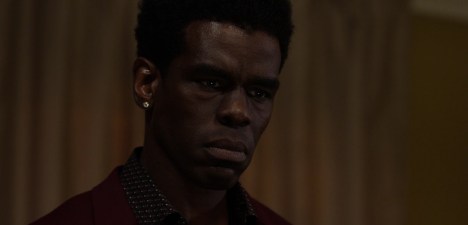
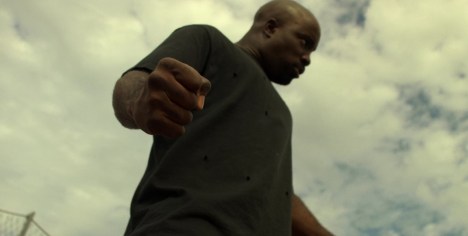
However, the second season of Luke Cage completely reinvents the character, while retaining the roughest of outlines from the four-colour source material. Jon McIver is still a bulletproof black man, making him an effective foil to Luke Cage. However, he no longer gained his power from the same experiments and his power does not work in exactly the same way. Similarly, while the comic books left his back story hazy, the television series devotes a considerable amount of time to fleshing it out. He gets a big monologue towards the end of On and On and a series of flashbacks in The Creator.

Indeed, the second season of Luke Cage radically reinvents Jon McIver in the style of the series, as another extended homage to blaxploitation cinema. This is a risky gambit, particularly given the challenges that the series faced with the consciously campy Willis Stryker in the second half of the first season. Indeed, much of the work with Bushmaster can be seen as a do-over on Willis Stryker. As with Stryker, the character is admittedly heightened, even in the context of a superhero crime show. McIver often seems like he might have wandered out of some forgotten seventies blaxploitation film.

However, there is more to it than that. The first season of Luke Cage failed to properly capture the familial melodrama that tethered Luke Cage and Willis Stryker, the two sons of one father by two different mothers. This absurd superpowered soap opera should have made for compelling television, with the characters wrestling with their histories as much as with each other. Instead, the execution was clumsy and lackluster. With Bushmaster, the second season makes a number of subtle corrections, but retains the basic idea. Luke and McIver are two sides of the same warped coin.

Although arguably more of a catalyst for the season than a central narrative agent, Bushmaster is an important part of why the second season of Luke Cage works as well as it does.

Continue reading

New Podcast! Scannain Podcast (2018) #18!

We’re working through a bit of a backlog on the Scannain podcast, so expect a number of entries publishing today.

This week, I join Alex Towers and Graham Day to discuss a week of film news and new releases that include Deadpool 2, Filmworker and On Chesil Beach. Give it a listen at the link, or check it out below.

Luke Cage – The Basement (Review)

The second season of Luke Cage inevitably battles with the infamous Netflix bloat.

This is a structural problem with a lot of Netflix series, but particularly with the Marvel Netflix fare. It is a result of a combination of factors, from the production team’s commitment to telling a single serialised story in a give season to the need to pad all of these seasons out to fill thirteen episodes. To be fair, certain seasons are more affected by this bloat than others; the first seasons of Iron Fist and The Punisher tell simple stories in extreme slow motion, while the second season of Jessica Jones spends almost half a season building towards the starting point of its own story.

The first season of Luke Cage had its own particular twist on this issue of pacing and padding. The first half of the season flowed relatively smoothly, as reflected in the extremely positive pre-release reviews that praised it as a series that “should rightfully elevate [Cheo Hodari] Coker into the league of television auteurs.” When the entire series was released, reaction was a bit more muted, with a second half of the season that effectively extended a ninety-minute blaxploitation homage into six hour-long episodes filled with stalling tactics and wheel-spinning.

At the end of Manifest, Luke Cage was shot by Willis Stryker, which effectively (and literally) took the lead out of his own show for a three-episode trip to Georgia that lasted through Blowin’ Up the Spot, DWYCK and Take It Personal. To prolong the plot, Cage and Stryker fell into a pattern of attack-and-repeat; Stryker shot Cage with a Judas bullet in both Manifest and Blowing Up the Spot, while Luke forces a confrontation with Stryker in Now You’re Mine, only for the season to stall with an episode about the police chasing Luke in Soliloquy of Chaos before allowing a final fight in You Know My Steez.

That second half of the first season was disastrous, with characters dancing around one another in order to hit a mandated running time, the desperation obvious in the variety of contrivances that prolonged the drama. In contrast, the second season has much great balance and control, never descending to that level of clumsy plotting in order to justify the thirteen-episode season order. At the same time, there are points where the series is obviously stretching itself out in order to make this story last thirteen hours instead of eight.

While still imperfect, the second season of Luke Cage represents a significant improvement.

Continue reading

Non-Review Review: Tag

Tag is a charming comedy that largely coasts off star charisma and a surprisingly heartwarming premise.

The plot is a compelling hook of itself. Inspired by a true story, Tag is the tale of a bunch of male friends who take one month out of every year in order to participate in a game of tag. This game has been going, on and off, for the better part of three decades. As the players get older, the pranks get more elaborate – the ruses, the feints, the misdirections, the ambushes. However, throughout the movie, the characters repeatedly stress that the game has also kept them together and in one another’s lives.

Touching.

This is a familiar set-up. It is the stuff of “overgrown manchildren” comedy, the tale of adult (and often even middle-aged) men who have the emotional maturity of children. Stepbrothers is perhaps the gold standard of the increasingly common comedy subgenre, which arguably includes films as diverse as Old School, Bad Neighbours and Knocked Up. Even indie comedies have gotten in on the act with movies like The Skeleton Twins, Cyrus or Adult Beginners.

While not strong enough or smart enough to rank with the best examples of the genre, Tag flirts with something resembling self-awareness. The movie is just cognisant enough of its underlying immaturity to keep the audience onside. Tag also benefits from a strange bittersweet quality, its joyous celebration of hypermasculine friendship gently flavoured with something resembling melancholy. It’s never entirely clear how much of that melancholy is intentional, but it permeates and enriches the film.

Renner, Renner.

Continue reading