• Following Us

  • Categories

  • Check out the Archives


  • Awards & Nominations

Non-Review Review: Escape Plan 2

Escape Plan was a rather disappointing exercise.

The first Escape Plan had a hell of a hook entirely separate to its central plot. Escape Plan brought together eighties action movie icons Sylvester Stallone and Arnold Schwarzenegger for the first time as equals; not one cameoing in the other’s movie, not a sly wink or a nod, but as leads in an action movie together. This was the b-movie equivalent to Heat, an opportunity to watch two titans square off against one another inside the framework of a vaguely defined science-fiction b-movie. The results were underwhelming, the film feeling too late and self-indulgent.

Escapes and scowls.

Escape Plan 2 is just a bad movie.

Escape Plan 2 seems to assume that the appeal of the original Escape Plan was not in its combination of two iconic action stars collaborating as equals, instead suggesting that the audience for the original Escape Plan was really there for the reheated prison movie clichés that had been handled much better in other movies. And so Escape Plan 2 drops Schwarzenegger for an even more complicated escape from an even more complicated prison. This feels like a fundamental misunderstanding of what the audience wanted. An unsatisfying prison movie without the Stallone/Schwarzenegger team is just an unsatisfying prison movie.

It’s all going according to plan.

Continue reading

Luke Cage – All Souled Out (Review)

It is interesting watching Luke Cage in the age of Donald Trump.

The first season did not have to worry about such things. Luke Cage premiered in late September 2016, more than a month before Donald Trump’s surprise victory in the United States Presidential Election. The first season had entered production a year earlier, in September 2015, only fourth months after Donald Trump had announced his presidential bid. Production on the first season wrapped in March 2016, a couple of months before Ted Cruz would formally throw in the towel and affirm Donald Trump as the Republican nominee for President of the United States.

However, the second season emerges in a highly-charged political environment where it seems like every piece of popular culture exists in the shadow of Donald Trump. Trump exerts a strange gravity over popular culture, making every piece of pop culture a strange referendum on his premiereship. Is Jurassic World: Fallen Kingdom about Donald J. Trump? How about Darkest Hour? Could the analogy stretch to Avengers: Infinity War? There is so much pop culture and so little time.

At the same time, it seems inevitable that the second season of Luke Cage would have to confront the legacy of Donald Trump and what he represents in American popular culture. However, the series does this in a rather interesting way.

Continue reading

Non-Review Review: Dublin Oldschool

Dublin Oldschool is a pillpopping, soulsearching, trainspotting Ulysses.

Following its central character on what effectively amounts to a bank-holiday-weekend-long bender, Dublin Oldschool is an ode to the idea of Dublin as a village. It is a celebration of the nation’s capital as a place where you are always where you needs to be, even if you don’t know exactly where you’re going. It’s a moving meditation on that intangible spirit of the city, on the metaphorical rivers that move through it, guiding its residents along journeys that they don’t always comprehend.

To beach’s own.

Befitting its protagonist, who spends most of the movie lost in a hazy of exotic substances and bouncing from one crisis to another, Dublin Oldschool is loose, rambling, a little indulgent. The movie isn’t afraid to wander, to take its time getting to where it’s going, to soak in the characters and the dynamics. However, that’s kinda the point. There is an endearing mellowness to Dublin Oldschool, even in its most sombre and serious moments, a sense of a film that is drifting to where it is supposed to be.

There’s something endearing in that idea.

Urban wild life.

Continue reading

Luke Cage – I Get Physical (Review)

Luke Cage is engaged with the idea of celebrity.

To be fair, it is perhaps the only Marvel Netflix series that could explore this particular theme. After all, Daredevil is about a vigilante who trades in fear and operates primarily at night. Jessica Jones is about a self-hating alcoholic who is constantly on the verge of imploding. Iron Fist is so mired in cultural appropriation that it is impossible to imagine the series pulling off the theme in a manner that wouldn’t make the show worse. The Punisher is afraid to acknowledge what its hero actually is.

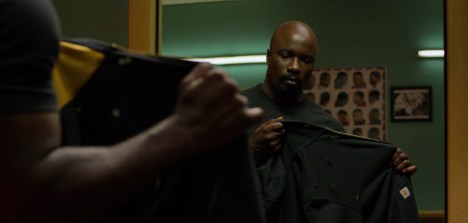
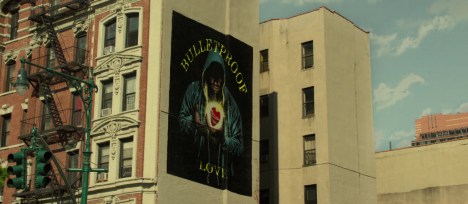
In contrast, Luke Cage is anchored in a central character who is essentially a neighbourhood celebrity. Soul Brother #1 demonstrates how Luke has imposed himself on Harlem, his actions tracked through an application, his merchandise sold in the barbershop, his image graffitied on walls. In Straighten It Out, he hands out his contact details, with instructions to call him if there is an emergency. In Can’t Front On Me, it is made clear that the local community know that they can reach out to him in person at the barbershop in case of emergency.

However, what is most striking about the handling of celebrity within Luke Cage is not just that it deals with the idea of Luke as a celebrity, but that it then uses Luke in order to interrogate how society treats its celebrities and how popular culture hungers for the fall just as excitedly as they cheered for the rise.

Continue reading

New Podcast! The Pensky File – Star Trek: Deep Space Nine, Season 3, Episode 9 (“Defiant”)

This weekend, I had the pleasure of dropping by The Pensky Files to discuss one of the more interesting episodes of the third season of Star Trek: Deep Space Nine.

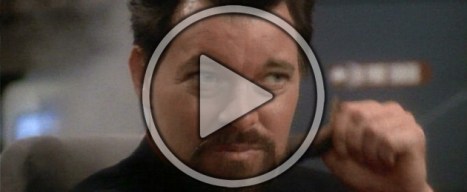
Defiant is a gleefully insane episode of Star Trek, in which William Riker’s evil transporter duplicate hijacks the Defiant to lead a mission into the heart of Cardassian territory to expose a government conspiracy that might threaten the security of the entire Alpha Quadrant. Along the way, there’s discussions of terrorism and heroism, of missed family birthdays, and of just how absurd Picard’s log entries must sound when they are read aloud.

It was a pleasure to record with Wes and Clay, diving deep on everything from Riker’s “woman in need of relaxation”-dar to the franchise’s complicated attitude towards the Maquis. You can find more from The Pensky Podcast here, and listen to the podcast by clicking the link or just listening below.

Continue reading

Luke Cage – Wig Out (Review)

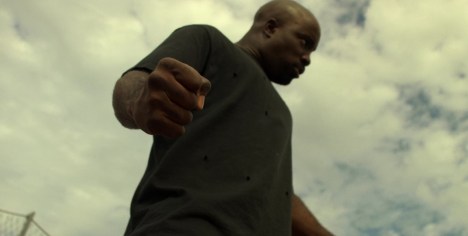
The second season of Luke Cage engages with the idea of masculinity in a number of interesting ways.

This is an interesting choice on a number of levels. Most obviously, the idea of exploring masculinity within the framework of a Marvel Netflix show should (in theory) belong to Jessica Jones. With the character of Kilgrave, it was the streaming service’s first female-led superhero series that marked out the idea of masculinity as a concept worth exploring within the framework of a superhero narrative. However, the second season of Jessica Jones is very engaged with the idea of female relationships, whether friendly or familial.

In doing so, Jessica Jones may have passed the theme on to the second season of Luke Cage. This makes sense on a number of levels. Most superficially, Luke Cage was actually introduced as a recurring guest star on the first season of Jessica Jones, and so ideas about masculinity are clearly woven into the character’s core identity. Beyond that, there is some value in Luke Cage in exploring the idea from a different perspective. After all, Luke Cage is a series with a male heroic lead. Its approach to the theme of masculine identity would be radically different.

As such, the second season of Luke Cage is perfectly positioned to explore notions of masculine identity.

Continue reading

Luke Cage – Straighten It Out (Review)

The black experience is not monolithic.

This should be obvious. Dark-skinned Americans are not a single political or cultural entity with one easily defined ethnic identity, much like light-skinned Americans have their own diverse heritages and experiences. The Irish American experience is different from the Dutch American experience or the Italian American experience or the German American experience. As such, it makes sense that the ethnic group that might be casually classed as “African American” is itself a composite of a wide array of backgrounds and histories.

One of the most remarkable aspects of the second season of Luke Cage is the ease and willingness with which the series looks outside of the culture and history of Harlem to broaden and deepen its exploration of a variety of black perspectives and experiences. The second season of Luke Cage builds on the first season in establishing a world populated by black characters and black voices, but has the luxury of extending its focus into exploring how those experiences and individuals differ from one another.

For a broad comic book television series about a superhero with bulletproof skin, that is quite the accomplishment.

Continue reading

85. Forrest Gump (#12)

Hosted by Andrew Quinn and Darren Mooney, The 250 is a (mostly) weekly trip through some of the best (and worst) movies ever made, as voted for by Internet Movie Database Users. New episodes are released every Saturday at 6pm GMT, with the occasional bonus episode thrown in.

This time, Robert Zemeckis’ Forrest Gump.

Forrest Gump is an unremarkable man who has lived the most remarkable of lives, a feather caught in the breeze of history. From his childhood in Mississippi through the turbulence of the sixties and seventies, Forrest Gump lives a life that intersects repeatedly with the biggest moments of the twentieth century, having a profound and unspoken effect upon the course of history.

At time of recording, it was ranked the 12th best movie of all time on the Internet Movie Database.

Continue reading

Luke Cage – Soul Brother #1 (Review)

The Netflix Marvel shows benefit greatly from a sense of place, a firm geography.

Part of this is down to the simple logistics of their production. DaredevilJessica JonesLuke CageIron FistThe Defenders and The Punisher actually shoot on location in New York City, especially in Manhattan. Film and television often use other locations for filming purposes, often to capitalise on tax incentives. For its first fives seasons, The X-Files used Vancouver to double for all of the New United States. Spider-Man might be an iconic New York fixture, but Spider-Man: Homecoming was shot primarily in Atlanta to capitalise on filming incentives.

This lends the portrayal of New York an authenticity that is often lacking in other productions, a real sense of existing in a real space. After all, The Incredible Hulk filmed its climactic Harlem battle in Toronto of all places. At least You Know My Steez was able to shoot Harlem for Harlem. Of course, there have been points where this location shooting has been an issue, such as attempts to use New York to double for China in The Blessing of Many Fractures, but it mostly works. (The Jamaican scenes in The Creator work much better. In part because they were filmed there.)

More than that, each of the Marvel Netflix series unfolds in a particular version of New York City, distinct in time and space. Jessica Jones unfolds in an archetypal disconnected beautiful city version of New York, with Jessica standing atop the Brooklyn Bridge to bid farewell to the city in AKA Top Shelf Perverts. In contrast, Daredevil and The Punisher unfold in a version of the city that is perpetually stuck in the late seventies and early eighties, perhaps typified by the mood and tone of Bang. In contrast, Luke Cage is firmly anchored in the mood and the tone of Harlem.

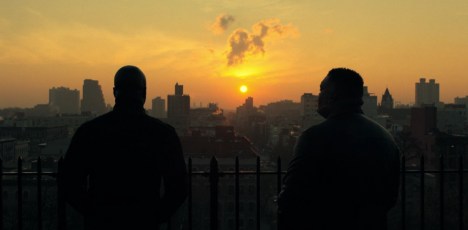
However, the second season of Luke Cage does something very interesting with its Harlem setting. The second season develops a parallel version of Harlem that seems to branch off its real-life counterpart. In keeping with the pulpy comic book aesthetic of Luke Cage, there is a consciously heightened quality to the Harlem inhabited by its central characters, defined by its own geography and its own spaces. The second season of Luke Cage suggests a version of Harlem with its own archetypal environments and settings, its own iconography and geography.

The production team infuse Luke Cage with an authentic Harlem aesthetic, but they also understand that the power of superhero stories is rooted in iconography and symbolism. The version of Harlem created in the first season of Luke Cage and developed in the second season is very much a point of intersection between the real world and the more stylised realm of comic book superheroics.

Continue reading

Netflix and Marvel’s Luke Cage – Season 2 (Review)

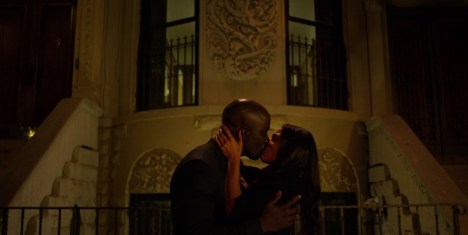
The second season of Luke Cage is a fascinating piece of work.

It is far more cohesive than the first season when taken as a whole, and harks back to the sturdy consistency of earlier seasons like the first seasons of Daredevil and Jessica Jones. It is a show with a very clear idea of what it is trying to do and say, and with a much stronger sense of structure than its stablemates like Iron Fist, The Defenders and The Punisher. It also avoids the surplus of ambitions and lack of structure that undercut the second seasons of Daredevil and Jessica Jones.

It is fair to describe Luke Cage as the first Marvel Netflix series to tangibly improve in the transition from its first season to its second season, to learn from some of the mistakes that the production made in their initial thirteen episodes and to render a more satisfying and cohesive whole. Indeed, there’s a reasonable argument to be made that the second season of Luke Cage does what a lot of really great sequels should do, in that it deepens the themes of the original while also refining what works and expelling what doesn’t.

This is not to say that the second season of Luke Cage is perfect. The season suffers from the now-familiar “Netflix bloat”, the sense that the writers are effectively padding the series to reach a preordained episode count that is tied to outdated notions of what television is or should be. There is no reason for the second season of Luke Cage to be a loose thirteen episodes, when it could easily work as a tighter eight. There are points in the season where the show enters a conscious holding pattern, like a song that keeps looping its bridge to stall before the crescendo.

However, even allowing for these problems, there is a sense that the production team are trying to find a way to make these thirteen episodes work. There are several points in the season in which the show allows its characters room to breath in sequences that could have been shortened or rendered more efficient, allowing the audience to spend extended amount of time with these individuals between the big dramatic beats to capture a sense of humanity that might be lost in a tighter or more efficient version of the series.

The second season of Luke Cage is a fascinating and engaging piece of work, even if it suffers a bit in terms of padding and pacing. Nevertheless, it represents a significant improvement on most of the recent collaborations between Netflix and Marvel Studios, having a strong sense of identity that was sorely lacking from most of the material produced since the end of its first season.

Continue reading