• Following Us

  • Categories

  • Check out the Archives


  • Awards & Nominations

Star Trek: Voyager – Fury (Review)

Normally, the return of an old cast member to an established show is a cause for celebration, akin to a belated family reunion.

The obvious examples involve the appearances of cast members from other shows on later spin-offs. Think of the reverence and sincerity with which Star Trek: The Next Generation treated Spock and Scotty in episodes like Unification, Part I, Unification, Part II and Relics. Think about the delight with which Star Trek: Voyager greeted Geordi LaForge in Timeless or Deanna Troi in Pathfinder. Even when Star Trek: Deep Space Nine subverted expectations with Jonathan Frakes’ appearance in Defiant, it was still joyful. If anything, Star Trek: Enterprise went too far in accommodating Troi and Riker in These Are the Voyages…

Self-control.

Even within individual shows, the return of long-absent cast members is often treated as an opportunity to celebrate that character, and perhaps even to acknowledge past missteps involving them. Yesterday’s Enterprise brought back the character of Tasha Yar, and used the opportunity to rewrite her mean-spirited and pointless death in Skin of Evil. When mirror!Bareil visited in Resurrection, the episode became a meditation upon how the character’s intrinsic decency was strong enough to transcend dimensions and to define even the worst version of himself.

This approach to the return of established characters makes a great deal of sense for a wide variety of reasons. Most obviously, the production team have gone out of their way to recruit these actors for this specific purpose; it makes sense that these episodes should serve as a celebration of their contributions to the franchise. Even beyond that, it is safe to say that almost any lead character on a Star Trek series has something resembling a fan base; think about the ominously-named “Friends of Vedek Bareil.” Why bring back a character, and attract in those fans, just to do something horrific?

That healthy blue glow.

All of this serves to make Fury all the more perplexing. Fury is an episode of Voyager that effectively resurrects the character of Kes, a regular on the first three seasons of Voyager who departed the series in The Gift at the start of the fourth season. The return of Kes is a strange choice, in large part because the production team often struggled with what to do with the character while she was part of the core cast. Still, there are any number of interesting possibilities. And there is the possibility that, like Yesterday’s Enterprise or Resurrection, the production team might use the occasion to say something interesting about Kes.

Unfortunately, Fury is a spectacular mess of an episode with half-developed character motivations and a highly surreal premise that undercuts a lot of the appeal of bringing Kes back in the first place.

Having its cake and eating it too.

Continue reading

Non-Review Review: Set It Up

Set It Up is a loving ode to the classic romantic comedies of the nineties, harking back even further to their antecedents, the screwball comedies of the forties.

The basic premise of Set It Up is straightforward. Zoey Deutch is Harper, the personal assistant to Lucy Liu’s Kirsten. Kirsten is a cutting-edge sports journalist, and Harper is an aspiring writer who found herself working as a personal assistant and has been unable to extricate herself from that situation. Glen Powell is Charlie, the personal assistant to Taye Diggs’ Rick. Charlie hopes to leverage his experience with Rick into a successful and prosperous career, if he can survive Rick’s temper tantrums.

Their chemistry is through the roof.

Following a chance encounter while picking up a delivery late one night, Charlie and Harper hit upon a cunning plan to escape the ridiculous demands of their bosses. Charlie and Harper will use the positions of trust afforded to them as personal assistants in order to trick their bosses into a relationship. Their logic is that a potential romance would eat into Kirsten and Rick’s free time, and thus afford Charlie and Harper more personal time. Charlie can reconnect with his increasingly estranged girlfriend, while Harper can try to become the writer that she always wanted to be.

It is perhaps churlish to describe Set It Up as formulaic, as the primary appeal of the movie is in watching a charming cast navigate a modern spin on a variety of classic romantic comedy tropes. There are perhaps moments when Set It Up leans a little too heavily into its genre trappings, and there are moments when its attempts to update genre conventions for the twenty-first century don’t exactly land. Nevertheless, the film is elevated by charming central performances and breezy yet witty script that understands the mechanics of the genre enough to know when to play with them and when to play them straight.

Will we see some PDAs from the PAs?

Continue reading

Irony, Thy Name Is Gump: “Forrest Gump” and the Art of Earnest Irony…

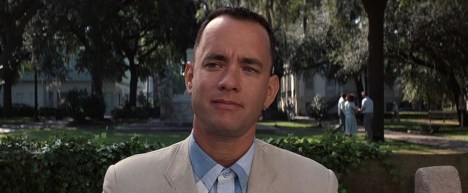
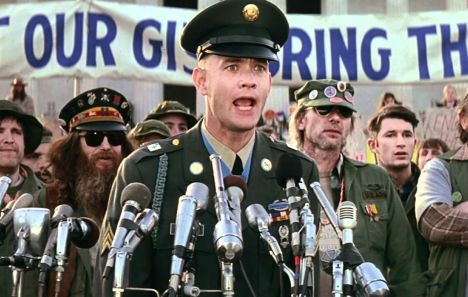
Forrest Gump is a movie that I’ve never quite been able to wrap my head around.

On one level, it’s an incredibly sacchrine and simplistic exploration of the first fifty years of the so-called “American Century”, the turbulent second half of the twentieth century as navigated by a dim-wit with nothing but good intentions to guide his way. The eponymous character floats on the winds of history like a feather, a metaphor that bookends the film in a manner that is incredibly cloying. There is something undeniably condescending and overly simplistic in the notion of history in Forrest Gump, as a force that sweeps up men and nations without any rhyme or reason.

As such, it’s easy to be wary of Forrest Gump and its approach to history. Forrest Gump presents a very clean and sanitised accounting of the second half of the twentieth century, one in which there is absolutely nothing happening beneath the surface of American life, and in which there is no point even attempting to comprehend the myriad of forces at work on the country and its inhabitants. In this way, Forrest Gump plays as a trite moral fable. There is no point in even trying to understand the chaos that is the modern world. It is enough to be decent and oblivious, and things will work out fine.

At the same time, there has always been something lurking at the edge of the frame in Forrest Gump, beneath all the folksy trappings and the simplistic history lessons. It is too much to suggest that Forrest Gump has an edge, but it certainly has a point. Forrest Gump in many ways presents an avatar of the final fifty years of the twentieth century in its central character. The eponymous character is an embodiment of a certain American ideal, a personification of the American public that has been bewildered and confused by the speed and pace with which history seemed to move in that turbulent half-century.

With that in mind, there is something vaguely self-aware in Forrest Gump, something that perhaps simmers beneath the surface of the film. Gump is a likable and charming protagnonist, brilliantly brought to life by Tom Hanks in a performance that (deservedly) won him his second Best Actor Oscar. However, there has always been something uncanny in the film’s presentation of Gump as the character most ideally suited to the twentieth century, in contrast to supporting characters like Lieutenant Dan or Jennie. Forrest Gump is a movie that argues the only way to survive the twentieth century is as a fool and an idiot.

There’s always seemed something very wry and very cynical in that idea, buried beneath the film’s cotton-candy exterior.

Continue reading

Non-Review Review: Adrift

Adrift is a visceral and powerful survival thriller, based on the remarkable true story of Tami Oldham.

In the mid-eighties, Oldham became a figure of note following a disastrous journey into the Pacific with her fiancé Richard Sharp. Sailing from Tahiti to San Diego, their luxury yacht is caught in the middle of Hurricane Raymond. The ship is damaged, the pair separated. Waking up in the flooding living compartment, Oldham is forced to improvise in order to survive. It is a harrowing scenario, a story of a woman essentially wrestling against the elements in a desperate attempt to stay alive in a seemingly impossible situation.

Sail away with me…

The basic premise of Adrift is familiar. It recalls any number of powerful lost-at-sea narratives, from All is Lost to Cast Away to The Mercy. Director Baltasar Kormákur wrings as much tension as possible from the premise, perhaps drawing on his experience working on similar ocean-themed movies like The Sea or The Deep. At certain points in Adrift, the audience is liable to feel claustrophobic, to gasp for breath as the camera whirls and struggles against the oppressive force of nature.

Adrift suffers slightly from a sense of over-familiarity, and from a clumsy plot development that it chooses to play as a big twist rather than an organic narrative element. Nevertheless, Adrift is a tense story of survival in impossible circumstances.

Mast-er and commander.

Continue reading

Non-Review Review: Hereditary

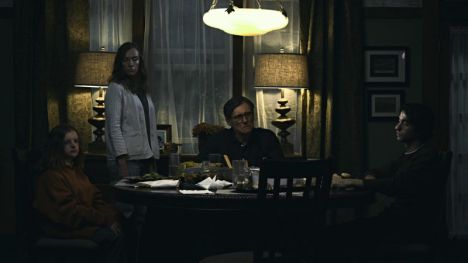
Perhaps what is most striking about Hereditary is how all the comparisons to The Exorcist seem off base.

To be fair, every movie deserves to be judged on its own terms unless it expressly demands otherwise, whether through a preexisting relationship or an inviting homage. Nevertheless, The Exorcist has been a touchstone for Hereditary in the run-up to the film’s release, a critical cliché employed to underscore just how effective Hereditary is. Rolling Stone has pitched the film as “this generation’s The Exorcist.” TimeOut described it as “a new generation’s The Exorcist.” Titlemag acknowledged the use of such critical shorthand.

Something to chew over.

It’s easy to see why this comparison has been made. The Exorcist is public short-hand for scary, a famously controversial film that shocked audiences upon release and which many members of the current generation first heard discussed in hushed tones. More than that, there’s significant thematic overlaps between Hereditary and The Exorcist, with both films serving as unsettling explorations of a tightly-knit family dynamic that use supernatural horror as prism through which these dynamics might be interrogated.

However, there is a major tonal difference between Hereditary and The Exorcist. In many ways, The Exorcist represents a very broad and populist strand of seventies horror, with an accessible central narrative that plays off easily understood fears in a very direct manner. The Exorcist was a cultural phenomenon, earning almost two hundred million dollars at the United States box office on initial release, and becoming a touchstone for an entire generation of horror fans. It is a movie that has inspired parodies and references, which can be used casually as shorthand with non-cinephile audiences.

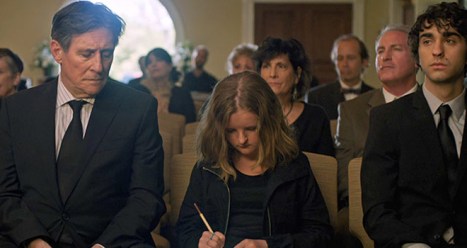
Putting the ‘fun’ in ‘funeral.’

Hereditary is a very different sort of beast. Hereditary is not a descendant of that sort of broad crowd-pleasing horror spectacle. The narrative is dense and layer, its symbolism abstract and its storytelling often allegorical. Hereditary is full of ambiguities and lacunas, with tension simmering beneath the surface before exploding dramatically towards the climax. If Hereditary is a descendant of sixties and seventies horrors, it is a closer relation of more abstract nightmares like Nicolas Roeg’s Don’t Look Now or Roman Polanski’s Rosemary’s Baby.

This is perhaps the most interesting thing about the film, and one which perhaps goes a long way towards explaining some of the more contradictory aspects of its theatrical release.

Do look now.

Continue reading

83. United Passions (-#55) – World Cup 2018

Hosted by Andrew Quinn and Darren Mooney, and this week with special guests Chris Lavery and Babu Patel, The Bottom 100 is a subset of the fortnightly The 250 podcast, a trip through some of the worst movies ever made, as voted for by Internet Movie Database Users.

This time, to mark the launch of the World Cup 2018, Frédéric Auburtin’s United Passions.

Continue reading

Non-Review Review: Ocean’s 8

Ocean’s 8 is mostly a charming and inoffensive heist movie that coasts off the charisma of its central cast.

This isn’t necessarily a criticism of itself. There’s nothing wrong in watching an ensemble including Cate Blanchett and Sandra Bullock bounce off one another, performers who are both talented screen and genuine old-fashioned movie stars. As with the series of films that obviously inspired (and named) Ocean’s 8, the cast have an easy chemistry with one another. Star power goes a long way, and there’s something almost refreshing in seeing a movie that runs almost exclusively on it in this age where these sorts of high-profile movies are largely driven franchising, high concepts and intellectual property.

Properly trained for this.

Of course, there’s some small complication in that in that Ocean’s 8 feels at times like an effort to split the difference between being a star-driven caper movie and also the latest installment in a larger recognisable franchise. Indeed, some of the movie’s weakest moment lean most heavily on nods and winks to the trilogy of Steven Soderbergh movies that provided a launching pad for this female-star-driven caper. The title character is Debbie Ocean, revealed to be the sister of Danny Ocean; that is the least of it. (Even the choice of “8” in the title seems designed to leave room for two more installments making a trilogy.)

Still movie stars are a dying breed, so it’s a novelty to see so many of them congregating in the same place and to see a movie that understands the appeal of watching confident performers playing competent characters who are constantly in motion. Ocean’s 8 lacks some of the more undervalued elements of the earlier films, the problems created by their absence here underscoring their importance, but it mostly succeeds as a light and breeze caper movie without a clear antagonist, without a strong directorial vision and with an over-extended third act.

Getting the gang together.

Continue reading

Star Trek: Voyager – Muse (Review)

In its own way, Muse marks the end of an era for Star Trek: Voyager, as Joe Menosky’s last solo script for the series.

To be fair, this is not Menosky’s last script credit on the series. Menosky would collaborate with Brannon Braga on the season-bridging two-parter Unimatrix Zero, Part I and Unimatrix Zero, Part II. In fact, those episodes have themes that play directly into Menosky’s interests; the two-parter is a story about dreams and narratives, about worlds that exist beyond the literal and the concrete. More than that, Menosky would work on the writing staff of Star Trek: Discovery, contributing the script to Lethe, one of the season’s stand-out episodes that was also about narratives – albeit internalised ones.

Dropping the mask.

However, Muse still feels like it marks the end of an era. Menosky had been a fixture of the Berman era of Star Trek dating back to the fourth season of Star Trek: The Next Generation, making his debut with Legacy and arguably making his biggest impression with Darmok early the following season. Menosky’s involvement with the franchise ebbed and flowed in the intervening years, but his influence was often felt. Indeed, Menosky even contributed a handful of scripts and stories to Star Trek: Deep Space Nine, including the teleplay for the underrated Dramatis Personae.

With Menosky’s departure from Voyager at the end of the sixth season, Brannon Braga would become the longest-serving writer working on the Star Trek franchise. His tenure on the television franchise would surpass that of Ronald D. Moore, and of any writer who hadn’t spanned the gap from the end of the original Star Trek to the early seasons of The Next Generation, with the arguable exception of producer Rick Berman. As such, Muse feels very much like the end of an era. It marks the departure of one of the guiding light of the Star Trek franchise, albeit one often overlooked or ignored.

Storyteller.

Muse is an episode that speaks to Menosky’s key interests within the Star Trek franchise, the idea of Star Trek as something akin to a modern mythology. More than any other writer on Star Trek, Menosky is invested in stories that are fundamentally about stories. His influence on Voyager is more subtle than that of Michael Piller, Jeri Taylor or Brannon Braga, but can felt in the recurring idea that Voyager itself is a Delta Quadrant myth. More than any of the other Star Trek series, Voyager feels like it is a story about a collection of archetypes rather than characters.

Menosky first articulated this idea in the closing scene of his otherwise forgettable script for False Profits, but reinforced it in episodes like Distant Origin, Living Witness and Blink of an Eye. It could reasonably be argued that this idea became part of the show’s identity, to the point that it can even be traced through episodes not explicitly credited to Menosky, like Live Fast and Prosper. It seems appropriate that this idea should serve as the central theme of Muse, an episode that might be read as a thesis statement on Menosky’s approach to the franchise.

Acting out.

Continue reading

Non-Review Review: The Happy Prince

“I am my own Judas,” explains Oscar Wilde around the midway point of The Happy Prince.

Just in case the audience doesn’t get the point, The Happy Prince is saturated with religious iconography and constant reminders of how Oscar Wilde was his own worst enemy. At one early point, Wilde confronts a group of homophobes in a church. At another, Wilde reflects on the local church that he visits for solace and how it reminds him what it is to suffer. Towards the end of the film, a priest is summoned to deliver the last rites, the splashing of holy water juxtaposed with the spit and venom of a mob in flashback.

Wilde at heart.

The Happy Prince is not an especially subtle or nuanced film, which is somewhat ironic for a biography about the life and times of one of the greatest witticists in history. Wilde was one of the most eloquent writers in the English language, as much in his personal correspondence as in any of the plays or stories that he wrote. As such, there is something strange in the bluntness of The Happy Prince, perhaps most transparently in the way that the film bends over backwards to construct a portrait of the writer’s final days that conforms to the eponymous story.

The Happy Prince is a story about a fascinating subject with a compelling central performance, but constructed in such a clumsy manner that the performance of Everett the actor cannot anchor the film of Everett the director.

It could use some fine tuning…

Continue reading

Star Trek: Voyager – Live Fast and Prosper (Review)

Live Fast and Prosper is a reasonably adequate mid-tier episode of Star Trek: Voyager.

It is not awful. It has an interesting premise, with some interesting potential for development and exploration. It fits with some of the larger fascinations of Voyager – in particularly recurring themes of identity and narrative, and the intersection of the two. More than that, unlike a lot of Voyager episodes, it has a story that feels somewhat original. This is not a dull rehash of a familiar story, a shiny new exterior hastily assembled over a familiar storytelling engine.

“Get this… whatever it is… to Sickbay!”

At the same time, it is also not very good of itself. Although Live Fast and Prosper has an absolutely ingenious premise, it never seems to push itself beyond that point. It never makes the leap that the best stories make, from an interesting premise into a satisfying execution. Live Fast and Prosper is pretty much exactly the episode that every audience member would anticipate given the one-line plot description of “Voyager encounters a group of con artists who have been impersonating them for shady business deals.”

The result is an hour of television that is solid, if not impressive. Live Fast and Prosper feels like a middling delivery on a fantastic promise, to the point where its status as merely adequate is almost as severe a disappointment as some of the spectacular misfires around it.

Unfamiliar faces…

Continue reading