• Following Us

  • Categories

  • Check out the Archives


  • Awards & Nominations

My 12 for ’14: ’71 and Claustrophobic Thrills…

With 2014 coming to a close, we’re counting down our top twelve films of the year. Check back daily for the latest featured film.

A large part of what makes ’71 so effective is the fact that is as interested in constructing a claustrophobic thriller as it is in making a clear political statement. Although it is set in Belfast in 1971, the movie has more in common with The Raid or Dredd than it does to Shadow Dancer. The movie is essentially a survival horror about a British soldier separated from his regiment, struggling to survive in hostile territory. There is a universality to the story, creating a sense that it could just as easily have been set in Basra a couple of years ago as Belfast several decades back.

’71 moves with an incredible and visceral energy, building up momentum across its relatively lean hundred-minute runtime as it presents a fugitive being chased through hostile territory by both sides locked in a bloody and bitter generational feud. Of course, ’71 is inherently political – as any movie set in any equivalent environment must be. ’71 eschews divisions between Republicans and Loyalists – between members of the Irish Republican Army and the various arms of British authority operating in the city.

71b Continue reading

The X-Files – Wetwired (Review)

This November (and a little of December), we’re taking a trip back in time to review the third season of The X-Files and the first (and only) season of Space: Above and Beyond.

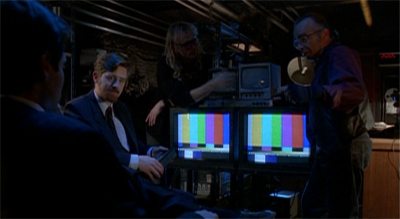
Wetwired is an oddity.

It is the penultimate episode of the third season, written by special effects supervisor Matt Beck. It is very much a conspiracy episode, albeit one lacking any real sense of forward moment and with only the loosest thematic ties to the rest of the show’s mythology. Unlike – say – Soft Light, this is not simply a “monster of the week” story with elements of the mythology grafted in. The show has largely move past those, which is why Avatar felt so weird.

More like

More like “terror vision”, am I right?

Instead, Wetwired is that strangest of government conspiracy stories. It is an episode dedicated almost exclusively to shady goings-on at the highest levels of government, but with no mention or inference of aliens or other sinister long-term plots. Wetwired stands out as something strange and hard to place; perhaps its closest analogue is The Pine Bluff Variant from towards the end of the fifth season.

The result is an oddity that is a little uneven and disjointed, an episode packed with clever ideas and concepts, but difficulty connecting them to each other.

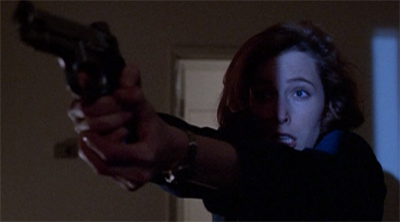
Scully has had it with Mulder's quips about her driving...

Scully has had it with Mulder’s quips about her driving…

Continue reading

The X-Files (Topps) #13 – One Player Only (Review)

This November (and a little of December), we’re taking a trip back in time to review the third season of The X-Files and the first (and only) season of Space: Above and Beyond.

After a twelve-issue opening mega-arc of interconnected stories about conspiracies-within-conspiracies and wheels-within-wheels, author Stefan Petrucha and artist Charles Adlard step back a little bit to close out their run with a series of standalone stories. The four issues (and three stories) that make up the rest of their run on Topps’ X-Files comic stand alone. They are connected by themes and subtext, but very clearly stand apart from what came before. Indeed, they play out almost like a postscript to the main body of work, a series of smaller bite-sized chunks.

In that light, it is interesting that One Player Only feels – superficially, at least – a lot more in step with the television show. The early issues of the comic had seen Petrucha and Adlard creating their own supporting cast and their own conspiracy, so as to avoid stepping on the toes of the production company. The Cigarette-Smoking Man was largely reduced to a number of cameos, with Skinner popping up once or twice along the way.

Ghosts in the machines?

Ghosts in the machines?

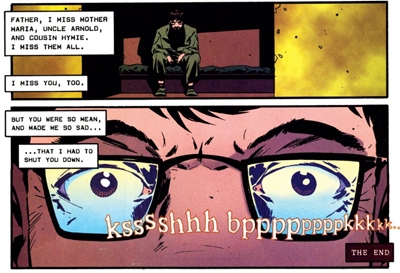
Not only does One Player Only feature a guest appearance from supporting characters like Mr. X or yhe Lone Gunmen, it also harks back to the structure and format of the first season of the show. On the most basic of levels, One Player Only feels like a more cyberpunk take on Ghost in the Machine, right down to the fact that Mulder is drawn into a murder at a tech company by an acquaintance from his days in the Violent Crimes Division. At one point, Mulder and Scully stumble on a ransacked house, for Mulder to deadpan, “Hm. Nothing new.”

However, if one peels back the layers, One Player Only is a fascinating piece that sets the tone for Petrucha and Adlard’s last three issues on the series, while infusing the comic with a host of fascinating cyberpunk stylings and body horror that seem to call forward to William Gibson’s future writing for the show.

Coding out...

Coding out…

Continue reading

Blood on Film: Violence and Morality…

I am always fascinated about discussions over violence in movies. Mostly because it’s one of those “hot button” issues which always comes up in some context or another and is typically portrayed as an argument with two extremes. This week, while promoting his new movie Faster, actor Billy Bob Thornton offered his own opinion of modern movie-making:

In our current state of affairs, especially in the entertainment business, we’re living in a time when we’re making — in my humble opinion — the worst movies in history.

They’re geared toward the video game-playing generation. And these video games, which I’m on my son about constantly, these games are people killing for fun, and I think traditionally in movies, there’s always been some kind of lesson in the violent movies.

In fairness, Thornton is a typically controversial figure (for example, recently alienating Canadian fans), but it’s an interesting idea to look at – the assumption that violence (and specifically how it is handled) can contribute to a movie’s quality (or lack thereof). Is he being just a little melodramatic?

Well, it is the second of December...

Continue reading

The History of the “R” Rated Blockbuster

It looks like The Wolfman, the first monster movie reboot due from universal, has just secured an ‘R’ rating State-side. In Ireland and the UK, we’re used to blockbusters receiving higher film ratings (12s, 15s, 18s), but in the US it’s unheard of for a major motion picture intended to make loads of money to go out with a rating higher than PG-13. It’s bizarre, as technically an adult can take a child to see an R-rated movie, whereas over here, back in the old days, it didn’t matter who you were with – if you weren’t the age on the poster, you didn’t get in. So what’s with this recent trent towards selling big budget movies with the R rating on them serving not as something to be downplayed by the studio, but actually used as a major selling point? Hell, we’re even seeing more redband trailers.

Because red is just sexier...

Continue reading

Actors & Politics: A Dangerous Combination…

There is an interesting article in The Guardian written by Samantha Morton, which lauds Nicole Kidman’s decision to announce that Hollywood treats women as sex objects and Matt Damon’s announcement that he won’t do excessively violent films. They are both valid points for discussion, but I’m never quite sure what to make of it when an artist makes a public anouncement like that, clearly politicising their work. Anyone who neede Nicole Kidman to tell them that Hollywood treats women as objects obviously hasn’t been paying attention to any film released ever, and I doubt anyone will be particularly surprised to here Matt Damon won’t turn up as a lead in Saw. That’s not to diminish their observation, but part of me is always uncomfortable abou the increasing politicalisation of actors and celebrities in our culture.

kidman

Not kidding around...

Continue reading

A Man’s Mann…

I have to confess I was not overly impressed with Public Enemies. In fairness, it was mostly down to the choices Mann made in filming the work – the high definition cameras and the insistence on shakey hand held movement. You might argue that it was a choice designed to place us in the real world of the Great Depression – to put us on the streets with Dillinger and immerse us in his world rather than the sanitised grandiose version of the 1930’s that typically finds its way on to our screens. This ignores one fundamental fact about Mann’s film making: it is no less grandiose or fantastic than those myths of times past. Mann is a film maker who works best exploring the dynamics of a masculine ideal that never existed. His male characters are drawn in the mold of a classic image that never actually existed.

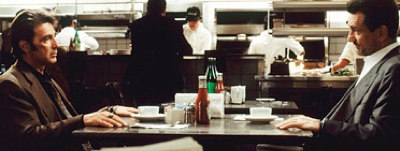
I'll bet Pacino ordered the Large Ham. Overdone. VERY LOUDLY!

I'll bet Pacino ordered the Large Ham. Overdone. VERY LOUDLY!

Continue reading