• Following Us

  • Categories

  • Check out the Archives


  • Awards & Nominations

The X-Files – Hellbound (Review)

This December, we’re taking a trip back in time to review the ninth season of The X-Files.

Your hand travelled
the Aztec trail
down my breast.
The sun popped out like the egg
of a platypus
and aspens pattered
their leafy Ur-language.
All this has happened before.

The jellied landscape
was furrowed with happiness.
You worshipped me
like the goddess of warm rain.

But in each corner of our eyes
stood one of Maxwell’s demons
loosening the molecules
of rise and fall
back and forth.

And in and out, round and about,
in and out,
through the cracked lens of the eye
unendingly,
surface behind glass
entropy mounted
in the random and senseless universe.

All this has happened before.
All this will happen again.

– Miroslav Holub, Lovers in August

Uncomfortable in his skin...

Uncomfortable in his skin…

Continue reading

Harsh Realm – Inga Fossa (Review)

This November, we’re taking a trip back in time to review the seventh season of The X-Files and the first (and only) season of Harsh Realm.

Inga Fossa is a noteworthy episode of Harsh Realm for a number of reasons.

In production terms, it closes out the loose three-episode introduction to the series. The Pilot, Leviathan and Inga Fossa were all written by Chris Carter and served as an introduction to the world and rules of Harsh Realm. Perhaps owing to the relative complexity of the show’s premise, Carter takes a bit of time to lay out and establish the core ideas of the show. It isn’t until the end of Inga Fossa that characters like Thomas Hobbes and Sophie have reached the status quo that will carry them through the rest of the first season.

Game on...

Game on…

However, all of this is ultimately irrelevant. Inga Fossa will always be notable for being the final episode of Harsh Realm to air on Fox. Chris Carter’s new show was infamously cancelled after only three episodes were broadcast. The six episodes that had been produced before cancellation were quietly shuffled off Fox’s 1999 schedule; they eventually aired on FX in mid-2000, to little fanfare. The cancellation was a shocking development. The ratings were spectacularly terrible, but Harsh Realm had been intended to establish Carter as the network’s idea-generating machine.

Something was very wrong.

"You can't $@!# in here, this is the war room!"

“You can’t $@!# in here, this is the war room!”

Continue reading

Star Trek: Enterprise – Azati Prime (Review)

Next year, Star Trek is fifty years old. We have some special stuff planned for that, but – in the meantime – we’re reviewing all of Star Trek: Enterprise this year as something of a prequel to that anniversary. This August, we’re doing the third season. Check back daily for the latest review.

If you can end on a high note, the audience will forgive a lot.

The third season of Star Trek: Enterprise is one of the boldest and most ambitious seasons of Star Trek ever produced; it is certainly the most adventurous season of the franchise to air outside of Star Trek: Deep Space Nine. However, on an episode-to-episode basis, the quality is quite variable. There are great episodes (Impulse, Twilight), underrated episodes (North Star, Exile), fun episodes (Stratagem), and experimental episodes (Harbinger), but there are also a lot of episodes that are more interesting in theory than in practice.

Explosive finalé...

Explosive finalé…

It becomes increasingly obvious over the course of the season that the writing staff did not plan the year-long arc far enough in advance and that the show struggles to figure out where it wants to go after the initial burst of speed wears off. There are even a couple of outright stinkers that rank with the worst that the franchise ever produced. However, there is a lot to be said for an ending. The third season of Enterprise hits a few speed bumps along the way, but it manages to rally for an impressive and largely satisfying conclusion.

Azati Prime begins the march towards the end of the season. It was the first episode to be filmed after the Christmas break, suggesting that it was the work of a revitalised writing staff and an energised production team. More than that, it was broadcast as the last episode before a six-week break in the broadcast schedule, suggesting that everybody involved knew exactly the kind of hit that they had on their hands. It injects an incredible energy into a show that might be racing towards its own apocalypse.

Future's end...

Future’s end…

Continue reading

Star Trek: Enterprise – Exile (Review)

Next year, Star Trek is fifty years old. We have some special stuff planned for that, but – in the meantime – we’re reviewing all of Star Trek: Enterprise this year as something of a prequel to that anniversary. This August, we’re doing the third season. Check back daily for the latest review.

If Impulse was Star Trek doing contemporary horror, then Exile is Star Trek doing gothic horror.

It is quite impressive how committed Exile is to its gothic horror trappings. Tarquin doesn’t just live alone in exile and project flattering images of himself; he lives in an honest-to-goodness gothic mansion lit by candles, where he dabbles in the occult while wearing what is a highly stylised dressing gown and between tending to the graves of his beloved(s). Exile does not skimp on its pulpy trappings. Like a lot of the early third season episodes, Exile would make for a satisfying dime-store paperback sci-fi novel; several images from the story would make a suitable cover.
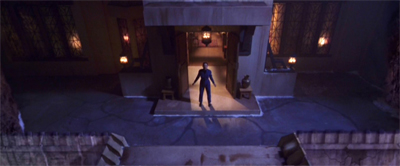
It was a dark and stormy night...

It was a dark and stormy night…

That said, it is quite difficult to pull off gothic science-fiction. The original Star Trek pulled it off on a number of occasions – most obviously with The Squire of Gothos. The later spin-offs have struggled getting the right balance of po-faced seriousness with heightened absurdity. Star Trek: The Next Generation attempted Sub Rosa in its final season, while Star Trek: Voyager had some early experiments with Janeway’s gothic horror fantasy. Neither could be deemed a resounding success, and Exile stumbles a bit in the execution.

There are a number of leaps that the plot doesn’t quite articulate as well as it might. It is hard to believe that Archer would leave Hoshi alone with Tarquin, even with a phase pistol tucked under her pillow. The revelation of Tarquin’s powers should terrify the crew; having the ability to alter another person’s perception across lightyears is utterly unlike anything these explorers have seen before. However, everybody seems to accept it at face value so that the plot can move along at a reasonable rate.

Somebody has a fixation...

Somebody has a fixation…

The way that Exile ties back into the larger arc is somewhat clumsy, right down to the convenient segue into The Shipment that comes in the final scene. In many ways, the structure of Exile recalls that of Extinction, an effectively stand-alone story that contains a very trite nods to the larger Xindi arc without any substantive connection. Despite the vital exposition that Tarquin provides in his final scene (and the subplot involving the spheres), Exile feels rather unnecessary in the larger scheme of things.

And yet, despite all that, Exile has something quite interesting to say. Written by Phyllis Strong, directed by Roxann Dawson and starring Linda Park, Exile is a very rare episode of Enterprise. It is a story with a very clear (and somewhat prescient) feminist subtext that has some very astute observations to make about certain facets of what might be deemed “nerd culture.” Specifically, male nerd culture.

He sees you when you're sleeping...

He sees you when you’re sleeping…

Continue reading

Millennium – Through a Glass Darkly (Review)

This July, we’re taking a trip back in time to review the sixth season of The X-Files and the third (and final) season of Millennium.

Through a Glass Darkly is a terrible piece of television.

There is no nice way to say it. There is no excusing it. Through a Glass Darkly is an absolutely wretched script directed in a cloying manner. It is cliché, it is clumsy, it is trite. It is manipulative and cynical. There are no redeeming features to Through a Glass Darkly beyond the fact that it makes Human Essence and Omerta look significantly better than they actually are. This is an abysmal production, and one of the worst forty-five minutes of television that Ten Thirteen has broadcast to this point. It is up there with Excelsis Dei.

"You are a paedophile, you are a nonce, you're a perv, you're a slot badger, you're a two pin din plug, you're a bush dodger, you're a small bean regarder, you're an unabummer, you're a nut administrator, you're a bent ref, you're the crazy world of Arthur Brown, you're a fence foal, you're a free willy, you're a chimney bottler, you're a bunty man, you're a shrub rocketeer..."

“You are a paedophile, you are a nonce, you’re a perv, you’re a slot badger, you’re a two pin din plug, you’re a bush dodger, you’re a small bean regarder, you’re a unabummer, you’re a nut administrator, you’re a bent ref, you’re the crazy world of Arthur Brown, you’re a fence foal, you’re a free willy, you’re a chimney bottler, you’re a bunty man, you’re a shrub rocketeer…”

Child sex abuse is an absolutely horrific reality. The world is not always a nice place, and the world is not always a safe place. In the late nineties, film and television were growing more comfortable with exploring and addressing issues of child abuse. However, it was something that needed to be handled with a great deal of care and skill. Millennium had already learned how difficult it could be to tell a story about child abuse, with Chris Carter’s well-intentioned but clumsy The Well-Worn Lock.

Through a Glass Darkly manages to retroactively make The Well-Worn Lock seem like a work of genius.

 "...this paedophile has disguised himself as a school in Sheffield."

“…this paedophile has disguised himself as a school in Sheffield.”

Continue reading

Millennium – Closure (Review)

This July, we’re taking a trip back in time to review the sixth season of The X-Files and the third (and final) season of Millennium.

Closure is the first time that Emma Hollis has come into focus.

The character has been featured in the opening credits since The Innocents, but has mostly existed in the background. The Innocents and Exegesis made it clear that Hollis was a young agent who could act under her own initiative, but she was very much a secondary figure in a narrative largely about Frank trying to work through the loss of his wife. She played a significant role in TEOTWAWKI simply by virtue of being able to work with both Frank Black and Agent Barry Baldwin. It was hard to get a read on her character beyond the very basic elements.

"Closure" in one word.

“Closure” in one word.

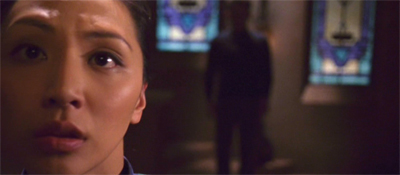
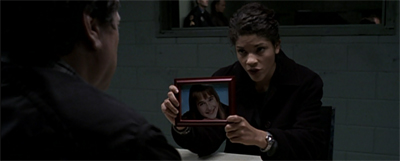
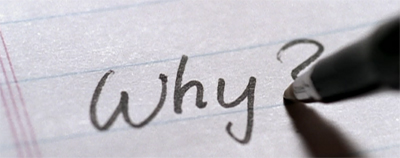
The opening scene of Closure makes it quite clear that his will be a Hollis-centric episode. While a senseless murder in a cheap hotel provides the sting leading into the credits, the teaser opens with Emma Hollis wandering through a graveyard and narrating to an unseen character. “I spend my days looking for reasons,” Hollis narrates. “The reasons people do what they do. It’s my job, it’s my way. I want to know why. Why it’s like this. Why good people die.” So it is quite clear where Closure is going from the outset.

Closure works reasonably well. It is much more modest episode than something like The Innocents, Exegesis, TEOTWAWKI, … Thirteen Years Later or Skull and Bones. It is an episode that feels like a conscious attempt to pull the show back towards the first season, hinting at an efficient serial killer procedural. Closure feels like a first season episode, and not just because of the procedural element. The decision to give Hollis a childhood trauma as motivation feels like a rather lazy way to flesh out her character. It is efficient, but it does feel a little too easy.

Smile!

Smile!

Continue reading

Non-Review Review: Big Game

Big Game is a rather unlikely combination. Jalmari Helander’s comedy action movie plays as a cocktail of Airforce One and E.T., a coming of age film blended with a old-fashioned action adventure film. It is a combination that works surprisingly well, allowing Big Game to be both playful and charming. Big Game feels like an homage to classic eighties and nineties cinema – the emotional beats are broad, the action is absurd, the irony is layered on pretty heavy. Big Game is always wry and self-aware, but never quite breaks character.

It is a potent mixture, and one that manages to hold itself together remarkably well across the film’s ninety-minute runtime. Big Game never takes itself too seriously, providing a light and exciting action adventure treat.

“I’m king… er… leader of the free world!”

Continue reading

Millennium – Season 1 (Review)

This February and March, we’re taking a trip back in time to review the fourth season of The X-Files and the first season of Millennium.

Millennium is a strange television show.

It is quite clear that Chris Carter and Fox both had a very different understanding about how best to follow on from the success of The X-Files. Fox clearly wanted another popular hit, a television show that it could plug comfortably into its 9pm Friday slot and grow into a multimedia franchise. The network spent a phenomenal amount of money promoting Millennium, with advertising and screenings and other publicity attempts. This approach paid off; The Pilot broke all sorts of records for Fox.

millennium-lamentation11

However, Millennium could not sustain those viewing figures. Over the first season, it haemorrhaged viewers. Chris Carter was not trying to present an accessible and popular pop hit; instead, Carter was taking advantage of the success of The X-Files to construct something decidedly more esoteric. Millennium is a tough show to watch. It is grim, unrelenting and oppressive. It is a show about darkness in the world that tends to roll up its sleeves and jump right in. Millennium has a clear idea of what it wants to be, but what it wants to be is alienating and uncomfortable.

On just about any level, the first season of Millennium is more accomplished than the first season of The X-Files. The production is more confident, the ideas are much bolder, the themes are much clearer. In fact, the first season of Millennium even holds up well when stacked against the fourth season of The X-Files on an episode-by-episode basis. But that’s not the problem. By definition, “Lance Henriksen fights serial killers and the concept of evil in America” will never be as popular as “David Duchovny and Gillian Anderson fight aliens and monsters and weird stuff!”

millennium-pilot11

The first season of Millennium is a show that offers a distinctive and uncompromising auteur vision which cares little for what the audience might want or expect. For better or worse, that approach would prevent Millennium from ever approaching the critical or popular support that The X-Files had already begun to accrue at the end of its own first season. The result is a television show that was never going to rival The X-Files as a pop culture phenomenon , but which serves as a bold philosophical statement from its creator.

“This is who we are,” the opening credits state, unapologetically. They seem to be speaking for the show as much for society.

millennium-bloodrelatives13 Continue reading

Millennium – Loin Like a Hunting Flame (Review)

This February and March, we’re taking a trip back in time to review the fourth season of The X-Files and the first season of Millennium.

Loin Like a Hunting Flame represents the peak of a particular type of Millennium story.

It is an episode towards which the season seems to have been building. It is an episode that rather explicitly and candidly ties together two of the show’s favourite subjects: sex and violence, in harmony together. Loin Like a Hunting Flame is something of a stalking horse for the rest of the season; it is the first season episode that most obviously embodies the excesses of any show like Millennium. Fetishised violence has been baked into Millennium since The Pilot opened with a stripper dancing in her own blood; here, it reaches a logical end point.

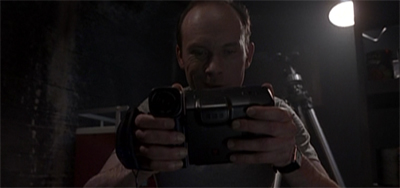
Candid camera!

Candid camera!

Loin Like a Hunting Flame is an episode that is guilty of just about any criticism that might be thrown at it. It is gratuitous; it is sensationalist; it is excessive. It tries to have things both ways, titillating the viewer with glimpse of “exotic” sexual liberation while warning them that those sexually liberated individuals will be punished for their perceived transgressions. Yes, Loin Like a Hunting Flame tries to say something a bit more nuance, but it flails around for most of its forty-five minute runtime like a dying fish.

In many respects, this could be treated as a catharsis for the series. After this point, Millennium turns a corner. The rest of the first season is a lot more ambitious in tone and scope. As much as Loin Like a Hunting Flame closes off a particularly evolutionary line of Millennium, Force Majeure and The Thin White Line push forwards towards a more adventurous show. Loin Like a Hunting Flame just has to work these issues out, once and for all, to their logical (and unsatisfying) conclusion.

Wholesome family fun...

Wholesome family fun…

Continue reading

Millennium – Pilot (Review)

This February and March, we’re taking a trip back in time to review the fourth season of The X-Files and the first season of Millennium.

You think you’re protecting me but you make it worse, Frank. You can’t shut the world out for me. You can’t ask me to pretend that I don’t know what you do.

Everyone pretends. We all make believe. These men I help catch – make us.

We’re raising a daughter, Frank. The real world starts to seep in. You can’t stop it.

I want you to make believe that I can.

Fade to Black...

Fade to Black…

Continue reading