• Following Us

  • Categories

  • Check out the Archives


  • Awards & Nominations

X-Men – Days of Future Past (Review/Retrospective)

This May, to celebrate the release of X-Men: Days of Future Past, we’re taking a look at some classic and modern X-Men (and X-Men-related) comics. Check back daily for the latest review.

What’s striking about Days of Future Past is how incredibly short it is.

That’s not to suggest that the comic “feels” small or has a shortage of ideas or anything like that. In Days of Future Past, writer Chris Claremont and artist John Byrne toss out a whole host of ideas that shape and define the entire X-Men mythos. These issues continue to inspire the X-Men comic book line. Without Days of Future Past, there would be no Age of Apocalypse. The franchise’s fiftieth anniversary “event”Battle of the Atom – is essentially a gigantic tribute to Days of Future Past.

Everything burns...

Everything burns…

In fact, the influence of this story extends beyond the X-Men as a comic book franchise. “Bad alternate future” may be a trope favoured by the X-Men comics, but it’s a staple of the genre and – arguably – the medium. There’s a reason that the iconic cover to the first issue of this story arc has been emulated so often, or that Alan Moore planned to riff on the story’s central idea for his proposed Twilight of the Superheroes. Days of Future Past is just a great story hook.

However, reading it today, it’s striking how short it is. All of this come from two issues.

The poster child for this sort of story...

The poster child for this sort of story…

Continue reading

Star Trek: The Next Generation – Captain’s Holiday (Review)

This January and February, we’ll be finishing up our look at the second season of Star Trek: The Next Generation and moving on to the third year of the show, both recently and lovingly remastered for high definition. Check back daily for the latest review.

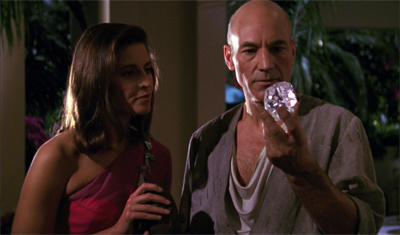
Captain’s Holiday is another one of those infamously troubled episodes from the third season that turned out fairly okay, considering all the meddling and tinkering unfolding in the background. That said, it’s more like Ensigns of Command than Yesterday’s Enterprise, but it’s still a watchable and entertaining episode of Star Trek: The Next Generation, and also probably the strongest comedy episode so far.

Then again, when the show’s other comedy “highlights” include The Outrageous Okona and Manhunt, you can see why this might seem like damning with faint praise.

A hidden gem?

A hidden gem?

Continue reading

Non-Review Review: Mr. Peabody & Sherman

Mr. Peabody & Sherman is solid family entertainment. Too scattershot and inconsistent to really rank among the best of the Dreamworks animated feature films, it does benefit from an endearing energy and momentum – as well as a charming central performance from Ty Burrell as the eponymous super-inventor dog genius. It’s perfectly inoffensive fun that manages to get quite a few laughs, even if it doesn’t tug the heart strings quite as well as it might want to.

A dog and his boy...

A dog and his boy…

Continue reading

Doctor Who: City of Death (Review)

To celebrate the fiftieth anniversary of the longest-running science-fiction show in the world, I’ll be taking weekly looks at some of my own personal favourite stories and arcs, from the old and new series, with a view to encapsulating the sublime, the clever and the fiendishly odd of the BBC’s Doctor Who.

City of Death originally aired in 1979.

It’s quite good.

Quite good? That’s one of the great treasures of the universe and you say “quite good”?

The world, Doctor, the world.

What are you talking about?

Not the universe in public, Doctor. It only calls attention.

I don’t care. It’s one of the great treasures of the universe!

Shsh!

I don’t care. Let them gawp, let them gape. What do I care?

– Romana and the Doctor discuss the Mona Lisa

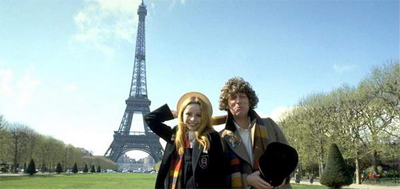
City of Death might divide fans of Doctor Who, with some regarding it as too silly or childish, but I think it’s easily the best Tom Baker serial the show produced, and probably the most entertaining serial for those unfamiliar with the classic show. It helps that the script combines some of the era’s best writers, with “David Agnew” serving to cover contributions from David Fisher, Douglas Adams and Graham Williams. I’ll concede that the farce tended to get a bit much towards the end of Adams’ tenure as script editor, but City of Deathpitches itself perfectly with some wonderful science-fiction concepts peppered over some fine location work, with a side of superb British wit.

From Paris with Love...

Continue reading

Non-Review Review: About Time

About Time is pretty much vintage Richard Curtis. I don’t mean that in a bad way – certainly not in an entirely bad way. Curtis knows how to structure a romance, has a gift for distinguishing characters in a large ensemble, and has the capacity to employ sentimentality to calculated and devastating effect. About Time has moments of brilliance and emotional punch, framing the main character’s inexplicable ability to time travel in delightful metaphorical terms.

At the same time, Curtis has his weaknesses. Most notably, there’s the sense that his lead characters are all variations on the same character – with more cynical pundits suggesting the base model might be Curtis himself. Similarly, his ensembles are constructed efficiently as a collection of quirky characters who do quirky things quirkily, living out the most quaintly British of lives involving afternoon tea and indulging in the most stereotypical of exclamations (“just a tick…”, “oh gosh…”, etc). There’s a sense that Curtis’ world exists inside old-fashioned post cards more than in anything approaching the real world.

More than that, though, Curtis labours his point just a little bit too much, as if worried the audience might miss the whole “we’re all travelling in time” metaphor and the “secret to being happy” philosophy if it isn’t explicitly articulated in a voice-over monologue set to an upbeat pop song.

Time enough at last...

Time enough at last…

Continue reading

Doctor Who: Day of the Daleks – Special Edition (Review)

To celebrate the fiftieth anniversary of the longest-running science-fiction show in the world, I’ll be taking weekly looks at some of my own personal favourite stories and arcs, from the old and new series, with a view to encapsulating the sublime, the clever and the fiendishly odd of the BBC’s Doctor Who.

Day of the Daleks originally aired in 1972.

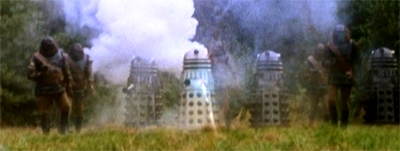
Day of the Daleks is a rather wonderful little story that’s been tucked away and forgotten about due its fairly lousy execution. After all, it’s hard to take a story particularly seriously when it suggests that the fate of the world will be decided by an assault on an old country house by three Daleks and a handful of extras. The wonderful people on the Doctor Who Restoration Team have done a wonderful job putting together a special edition of the adventure, using enhanced CGI effects and new footage to give the story the scale that it really deserves. After all, Day of the Daleksrepresents a bold attempt to do something new with the time travel at the very heart of the series.

Dawn of the Daleks...

Continue reading

Doctor Who: Timelash (Review)

To celebrate the fiftieth anniversary of the longest-running science-fiction show in the world, I’ll be taking weekly looks at some of my own personal favourite (and not-so-favourite) stories and arcs, from the old and new series, with a view to encapsulating the sublime, the clever and the fiendishly odd of the BBC’s Doctor Who.

Timelash originally aired in 1985.

I don’t trust you. You’re being too reasonable.

– Peri’s on to him

Timelash is on the short list of serials broadly agreed to be “the worst Doctor Who stories ever.” Given how prone science-fiction fans are to bickering about absolutely everything, and how impossible it is to find consensus, that’s really saying something. More than that, it ranks with quite a few Colin Baker stories among that list. I can’t help but wonder if part of the problem with Baker’s tenure isn’t a lack of classic episodes (Revelation of the Daleks and Vengeance on Varos surely count), but the batting average skewed by so many truly terrible stories.

Any season containing Timelash would be ridiculed, but it’s hard to imagine that any year of television containing Attack of the Cybermen, Timelash and The Mark of the Rani couldn’t help but raise questions about the show’s future at the BBC.

The face of evil...

The face of evil…

Continue reading

About Time: Time Travel Logic, Paradoxes and Looper…

I watched Looper again at the weekend. It’s still a pretty great movie, well-constructed and thoughtful. Of course, it still doesn’t feel like a proper “time travel” movie, because the time travel element doesn’t logically gel as easily as it otherwise would. After all, the original time line sees young!Joe kill old!Joe as soon as he appears. Therefore, old!Joe can’t logically kill Sara. If old!Joe doesn’t kill Sara, then why does Cyd become the Rainmaker? After all, we’re told (or it’s heavily implied) that young!Joe killing himself (and old!Joe) prevented Cyd from becoming the Rainmaker. So if this never happened in the time line where young!Joe grows into old!Joe, how did the Rainmaker come to be?

Oh no, I’ve gone cross-eyed.

This is the thing with time travel movies, and it’s something I’ve been thinking about. How important is internal consistency to a time travel movie? How necessary is it for a time travel movie to flow relatively logically from its own premise? At what point do we just stop trying to apply rules of logic and just enjoy the movie for what it is?

looper4

Continue reading

Non-Review Review: Looper

This movie was seen as part of Movie Fest, which was as much of a joy this year as it was last year. If not moreso.

Looper is a wonderful high-concept science-fiction film that makes a shrewd decision to avoid dwelling on temporal mechanics. A “time travel” movie, Looper is far more preoccupied with fascinating metaphysical questions about cycles of violence and cause-and-effect than it is with temporal paradoxes or the butterfly effect. In fact, I’d go so far as to suggest that it’s actually a lot easier to follow than director Rian Johnson’s earlier collaboration with Joseph Gordon-Levitt, Brick. It’s fast, it’s smart, and it’s very well put together. It’s a meticulously constructed and breathlessly engaging thriller, and one that never under-estimates its audience.

Little room for Levitt-y…

Continue reading

X-Men: The Age of Apocalypse Omnibus (Review/Retrospective)

With our month looking at Avengers comics officially over, we thought it might be fun to dig into that other iconic Marvel property, the X-Men. Join us for a month of X-Men related reviews and discussion.

The nineties represent a contentious time for fans of the X-Men franchise. The decade saw comic books explode into a huge market, with ridiculous sales and publicity, and the entire X-Men franchise rode that wave perfectly. Chris Claremont and Jim Lee’s adjectiveless X-Men #1 remains the biggest-selling comic book of all time, after all, and the franchise quickly secured itself as Marvel’s premiere comic book franchise. On the other hand, the line had been thrown into disarray by the departure of long-term steward Chris Claremont and its era-defining artist Jim Lee. The family of titles had struggled to find a footing through some uneven crossovers and events like X-Cutioner’s Song and Fatal Attractions. However, I think the decade produced one gem that can be considered as a true classic, along with the best of Claremont’s tenure and the work of Grant Morrison. The Age of Apocalypse might seem an odd choice to identify as one of the highlights of the X-Men saga, but I think it deserves very serious consideration.

Apocalypse now…

Continue reading