• Following Us

  • Categories

  • Check out the Archives


  • Awards & Nominations

Star Trek (Marvel Comics, 1980) #4-5 – The Haunting of Thallus!/The Haunting of the Enterprise! (Review)

The first Star Trek pilot, The Cage, was produced in 1964. To celebrate its fiftieth anniversary, this December we are reviewing the second season of the original Star Trek show. You can check out our first season reviews here. Check back daily for the latest review.

Marvel certainly had an unconventional approach to publishing Star Trek.

The company had licensed the comic book rights following the release of Star Trek: The Motion Picture. They had released a successful adaptation of the film as part of their Marvel Super Special line and had re-package the three-part adaptation as the first three issues of an on-going Star Trek comic book. Written by Marv Wolfman and illustrated by Dave Cockrum, it was clear that Marvel had big plans for Star Trek. However, it also quickly became clear that they had no idea where they wanted to go with the comic.

Here there be monsters...

Here there be monsters…

After all, they immediately followed up the big three-issue opening arc with a comic where the Enterprise discovered a haunted house floating in space. While it was certainly a catchy image, it wasn’t exactly a quintessential Star Trek premise. It seemed that Marvel had no idea what to do with the comic. Writer Marv Wolfman wrote the first of the two issues comprising the storyline, handing the second issue over to Mike W. Barr. He would only stick around for two issues before handing the comic over to Tom DeFalco. DeFalco wrote a single issue before moving on.

It is a rather disjointed comic book, one which lacks the strong narrative voices that DC would give to their late-eighties licensed Star Trek comics. Then again, it is probably easy enough to deduce all of this from the fact that the first original Star Trek storyline published by Marvel featured a haunted house floating in space.
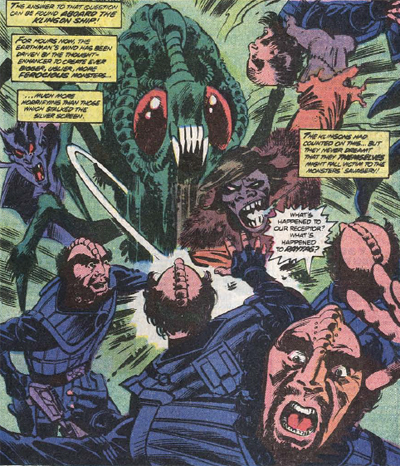
In space, everyone can hear you scream...

In space, everyone can hear you scream…

Continue reading

Star Trek – Operation — Annihilate!

To celebrate the release of Star Trek: Into Darkness this month, we’ll be running through the first season of the classic Star Trek all this month. Check back daily to get ready to boldly go. It’s only logical.

How do you follow The City on the Edge of Forever? The previous episode is one of the best-loved episodes of Star Trek ever produced, one of the great science-fiction television episodes of the sixties, and one of the best science-fiction romances ever written. It’s a gigantic and massively influential piece of television, one of the cornerstones of Star Trek and perhaps the best indicator of just how thoughtful and how genuine the franchise can be when it tries. So, what’s next? Where do we go from here? What is the next shot after that last scene of Kirk abandoning the Guardian of Forever on a desolate rock?

It’s always interesting to compare the first season of Star Trek to the first year of Star Trek: The Next Generation. The former can be counted among the very best of the show’s thirty televised seasons, while the latter can be counted among the worst. However, they do have something in common. They both probably should have ended an episode early, with The City on the Edge of Forever and Conspiracy serving as effective caps on each show’s first season, leaving the audience a chance to digest what they had seen.

Unfortunately, neither show ended on anything that could be measured among the strongest show of a given year. The Neutral Zone ended the first season of The Next Generation with a moralising whimper. While Operation — Annihilate! is quite entertaining on its own terms, it doesn’t rank among the best of the season. Still, it’s a solid pulpy science-fiction tale, which might not be the worst thing.

Man of action!

Man of action!

Continue reading

Star Trek – Shore Leave (Review)

To celebrate the release of Star Trek: Into Darkness this month, we’ll be running through the first season of the classic Star Trek all this month. Check back daily to get ready to boldly go. It’s only logical.

When I talk about the surreal sixties energy that really holds quite a bit of Star Trek together, it’s quite possible that it sounds like a back-handed compliment, a cheap and easy gig at a cult television show. However, I mean that sincerely. When I argue that the illogical and somewhat scattershot dynamism of the last act of Court Martial can barely hold the patchwork script together, it’s quite possible that I sound like I’m being sarcastic. However, my affection for the mad-cap mayhem particular to the first iteration of Star Trek is entirely genuine. Although it makes no sense, the climax to Court Martial isn’t the problem. Everything leading up to it is.

I think Shore Leave is pretty much the perfect iteration of this concept. It is, from start to finish, absolutely insane nonsense that threatens to fall apart if one concentrates too hard on any particular detail. However, it’s executed with enough energy and drive that it becomes a compelling and surreal piece of television, and one of the best illustrations of the kind of weirdness that the classic Star Trek could pull off almost effortlessly.

No bunny business...

No bunny business…

Continue reading

Star Trek – Errand of Vengeance: The Edge of the Sword by Kevin Ryan (Review)

To celebrate the release of Star Trek: Into Darkness this month, we’ll be running through the first season of the classic Star Trek all this month. Check back daily to get ready to boldly go. It’s only logical.

We’ll be supplementing our coverage of the episodes with some additional materials – mainly novels and comics and films. This is one such entry.

When you think about it, Star Trek finished its first season with its mythology reasonably well established. There were the Romulans, the Klingons and the Federation. (Oh, my!) We knew that Kirk had a brother on the colonies, who died in the season finalé. Vulcan was a hot desert planet. The Prime Directive existed, and we even got a taste of how Starfleet operated. However, these things all developed gradually over the course of the year, and early episodes couldn’t even seem to agree who exactly Kirk was working for.

The Federation was first mentioned in Arena and only fully named in A Taste of Armageddon. The Klingons were introduced in Errand of Mercy, with a cold war between the two galactic powers finally turning hot. Of course, it’s hard to write “finally” when they had only been introduced in this particular episode. So where were the Klingons during the show’s first year? How come we didn’t pick up any of the tension that must have been simmering?

Kevin Ryan’s Errand of Vengeance trilogy attempts to offer some context, suggesting that the Klingon threat had been brewing during the entire first season. It follows Jon Anderson, a new recruit to the ship’s security department, arriving just before the events of What Are Little Girls Made Of? Oh, and he’s a Klingon infiltrator.

tos-errandofvengeance1

Continue reading

Look! Star Trek Reimagined in the Pixar Style!

The wonderful folks over at The Minion Factory have reimagined the classic Star Trek characters in the style of Pixar. It’s a fun collection of images (feel free to also check out the artist’s superhero gallery), and rendered with obvious affection for the show’s decidedly sixties aesthetic. I especially love the affection demonstrated in chosing the background images. Anyway, take a look and click to enlarge.

My 12 for ’12: Shame & Silence

I’m counting down my top twelve films of the year between now and January, starting at #12 and heading to #1. I expect the list to be a little bit predictable, a little bit surprising, a little bit of everything. All films released in the UK and Ireland in 2012 qualify. Sound off below, and let me know if I’m on the money, or if I’m completely off the radar. And let me know your own picks or recommendations.

This is #2

Addiction stories are very tough to do right. It’s far too easy to get caught up in the melodrama of the cycle – the excess, the withdrawal, the relapse, the epiphany. It’s tempting to wallow in each of those stages, to structure them as acts in a drama. It’s hard to resist the urge to heighten absolutely everything, to dwell on the heat of obsession and desperation that surrounds any addiction.

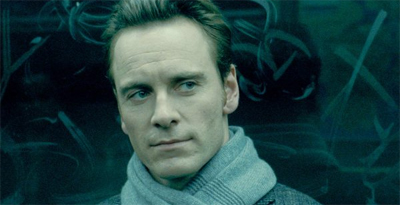
Director Steve McQueen and actor Michael Fassbender do a sensational job with Shame, avoiding these potential problems, offering a portrayal of addiction and personal collapse that is strangely understated and introverted rather than overwhelming or excessive. Indeed, the fact that the movie is about sex addiction might lead some potential viewers to worry. If ever an addiction lent itself to trashy and tasteless excess, one might imagine that sex would be that personal demon.

Instead, McQueen shows admirable restraint in tackling the topic. While he never blushes in presenting the depths of his lead’s degradation, he never sensationalises it. Instead, much like Brandon’s addiction, Shame is cold and clinical – and all the more powerful for it.

shame2

Continue reading

My 12 for ’12: Jeff Who Lives at Home & Living in Hope

I’m counting down my top twelve films of the year between now and January, starting at #12 and heading to #1. I expect the list to be a little bit predictable, a little bit surprising, a little bit of everything. All films released in the UK and Ireland in 2012 qualify. Sound off below, and let me know if I’m on the money, or if I’m completely off the radar. And let me know your own picks or recommendations.

This is #9

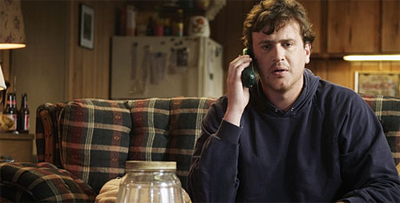
The eponymous Jeff, from Jeff Who Lives at Home, feels like something of a cousin to the Judd Atapow “manchild” that we’ve seen popularised in films like Knocked Up of The 40 Year Old Virgin. He’s unreliable, lazy and smokes a not inconsiderable amount of pot. His mother can’t even count on him to fix a shutter door on her birthday, although he is quick to offer seemingly vacuous philosophical insights garnered from Star Wars and Signs. His brother Pat is hardly a run-away success, trapped in a failing marriage and prone to sit around Hooters all day, but at least he has thrived when compared to Jeff. Jeff is, by all accounts, a fool whose own naivety leads him to get beaten and mugged within the first half-hour of the film.

However, at the heart of Jeff Who Lives at Home, is a surprisingly romantic idea. There’s the notion that the universe is somehow a far more compassionate and understanding place than we might suspect. Jeff’s logic and reasoning might be far from convincing, and it’s easy to be cynical. However, Jay and Mark Duplass craft a story that suggests sometimes things work out just right.

jeffwholivesathome3

Continue reading

Whatever Will Happen to the Caped Crusader? Thoughts on Batman After Nolan…

To celebrate the release of The Dark Knight Rises, July is “Batman month” here at the m0vie blog. Check back daily for comics, movies and television reviews and discussion of the Caped Crusader.

So, what now?

Christopher Nolan has rounded out his Batman trilogy with The Dark Knight Rises, tying up and resolving the arc he set up for Bruce Wayne in Batman Begins almost a decade ago. It has been a long and rewarding journey. I certainly think that Nolan’s accomplishments here deserve to be compared to other truly exceptional pop culture trilogies like The Lord of the Rings or even Star Wars. He told a complete story for the character, from the beginning through to the end. So, a week after he released the final part of his trilogy, people are wondering: what now? How do you follow a series of Batman movies like that? What next for the Dark Knight and Warner Brothers?

Speaking for myself, I can only hope that it’s something completely different.

Out of Nolan’s land…

Continue reading

The Politics of Nolan’s Batman Films…

To celebrate the release of The Dark Knight Rises, July is “Batman month” here at the m0vie blog. Check back daily for comics, movies and television reviews and discussion of the Caped Crusader.

I think it’s fair to say that Christopher Nolan’s Dark Knight trilogy is quite an accomplishment. I think there’s a valid argument to be made that the series can be successfully measured against other classic film trilogies like the original Star Wars trilogy or even the more recent Lord of the Rings trilogy. However, I think it’s also notable just how much political discourse and discussion the trilogy has generated, particularly for its political content. It’s quite impressive that Nolan’s three films about a masked pulp hero have provoked such debate, and I’d certainly argue that The Dark Knight and The Dark Knight Rises are easily two of the most politically complex and fascinating blockbusters in quite some time.

A caped social crusader?

Continue reading

That One Scene…

You know the one I’m talking about. It’s the one scene in a bad movie that really got you, that managed to suggest that maybe there was a bit more to the film than met the eye. If it came towards the start of the film, it probably built up expectations that the finished product couldn’t meet. If it appeared in the middle, it made sure that you didn’t quite nod off towards the end. If it closed out the movie, you probably left feeling more satisfied with the movie-going experience than you really should. Often, however, these sequences are just frustrating because they just end up teasing what could have been.

Mauled by critics...

Continue reading