• Following Us

  • Categories

  • Check out the Archives


  • Awards & Nominations

Doctor Who: Warriors’ Gate (Review)

To celebrate the fiftieth anniversary of the longest-running science-fiction show in the world, I’ll be taking weekly looks at some of my own personal favourite stories and arcs, from the old and new series, with a view to encapsulating the sublime, the clever and the fiendishly odd of the BBC’s Doctor Who.

Warrior’s Gate originally aired in 1980. It was the third instalment of the E-Space Trilogy.

We found it.

Yes, well, that’s one of the advantages of living in a rapidly shrinking micro-universe.

What are the others?

Other what?

Other advantages?

Ah, well, it’s difficult to say.

– Adric, the Doctor and Romana discuss modern living

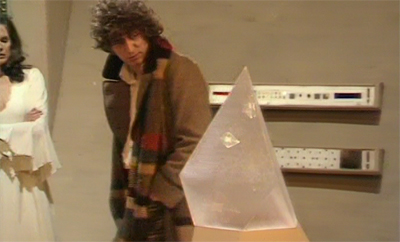
I’m actually very, very fond of Warriors’ Gate. It’s a piece of bold science-fiction that actually manages to accomplish what a lot of these stories in Tom Baker’s final season try to do. It offers an effective bit of speculative fiction while playing to the theme of entropy, decay and collapse. Both Stephen Gallagher’s fine script and Paul Joyce’s direction come together to produce a very thoughtful and clever Doctor Who story that manages to avoid a lot of the problems facing this era of the show.

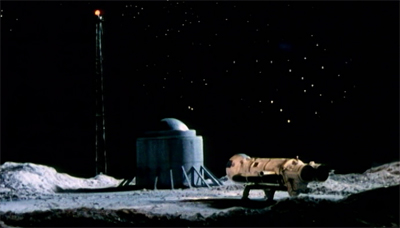
More than that, though, it turns some of those disadvantages into advantages. After all, when else is the show’s tiny production budget going to produce something this beautiful?

Shades of grey...

Shades of grey…

Continue reading

Star Trek – The Cage (Review)

To celebrate the release of Star Trek: Into Darkness this month, we’ll be running through the first season of the classic Star Trek all this month. Check back daily to get ready to boldly go. It’s only logical.

The Cage is fascinating. Looking at it now, it holds up phenomenally well a s apiece of sixties science-fiction. However, it feels like we’re watching a prototype of Star Trek. In many respects, The Cage feels like a rough sketch that captures some essentials, but is missing out on the finer details. Spock is there! But he smiles! The set design looks the same, but the characters are different. Some of the cast fill the same roles, but some are dramatically different. Watching The Cage, you can see a lot of the philosophy that Gene Roddenberry would bring to Star Trek, but it’s very difficult to imagine an on-going series spinning out of this adventure, let alone one that managed to become as iconic or influential as Star Trek would ever be.

Still, it’s pretty solid viewing. It’s entertaining on its own terms, but it’s also informative in the context of the series. It’s more like dry run or a test drive of the concept.

To boldly go... for some reworking...

To boldly go… for some reworking…

Continue reading

Doctor Who: The Armageddon Factor (Review)

To celebrate the fiftieth anniversary of the longest-running science-fiction show in the world, I’ll be taking weekly looks at some of my own personal favourite stories and arcs, from the old and new series, with a view to encapsulating the sublime, the clever and the fiendishly odd of the BBC’s Doctor Who.

The Armageddon Factor originally aired in 1979. It was the sixth and final part of The Key to Time saga.

The Key to Time was perhaps the first conscious attempt to tell a season-long story in Doctor Who. Sure, we’ve had elements of an arc before. The first season, for example, gave the Doctor himself a character arc where he evolved from cowardly curmudgeon into an unlikely heroic figure. Jon Pertwee’s second season was given the Master as a linking element. Tom Baker’s Doctor embarked in a pretty much unbroken series of adventures from Robot through to Terror of the Zygons, with the ending of one serial seemingly leading directly into the next. None of these were necessarily that ambitious and you could argue they evolved more by chance than by design.

So, The Key to Time represented a bit of a learning curve, an attempt to tie a season’s stories together using an over-arching concept. As I’ve discussed quite a bit in my reviews of the season, the result was a little clunky, with those concepts seemingly clumsily shoe-horned into a separate bunch of adventures. That leaves the finalé, The Armageddon Factor to do the heavy-lifting with regards to The Key to Time saga. Unfortunately, the pay-off feels a bit jumbled, over-wrought, disorganised and non-sensical, as it juggles a wealth of elements that never add up to more than the sum of their parts.

While a great many Doctor Who six-parters suffer from being too long, too padded, too stretched for their story and concepts, The Armageddon Game feels curiously over-stuffed, lacking a tight focus on the interesting elements and too many distractions clogging up the story.

The problems are crystal clear...

The problems are crystal clear…

Continue reading

Doctor Who: The Pirate Planet (Review)

To celebrate the fiftieth anniversary of the longest-running science-fiction show in the world, I’ll be taking weekly looks at some of my own personal favourite stories and arcs, from the old and new series, with a view to encapsulating the sublime, the clever and the fiendishly odd of the BBC’s Doctor Who.

The Pirate Planet originally aired in 1978. It was the second part of The Key to Time saga.

Excuse me, are you sure this planet’s meant to be here?

– The Doctor

I have to admit, I admire The Pirate Planet for its lofty aim. Douglas Adams’ script is vast and impressive and epic, incorporating and number of brilliant high concept ideas, traditional science-fiction story-telling devices, and healthy sense of humour into one Doctor Who story. Unfortunately, the production is restricted both by the technical limitations of the time, but also by the sense that there’s simply too much going on over the course of this four-episode adventure. Still, it’s as bold, fun and imaginative as any Doctor Whostory, and showcases the series at its most ambitious. There’s nothing wrong with that.

Pulling a fast one...

Continue reading

Doctor Who: The Deadly Assassin (Review)

To celebrate the fiftieth anniversary of the longest-running science-fiction show in the world, I’ll be taking weekly looks at some of my own personal favourite stories and arcs, from the old and new series, with a view to encapsulating the sublime, the clever and the fiendishly odd of the BBC’s Doctor Who.

The Deadly Assassin originally aired in 1976.

I deny this reality.

– the Doctor

The Deadly Assassin is a rather boldly experimental episode of Doctor Who. It’s the first story told without a companion character, and it also ventures quite forcefully into the realm of surrealism. It offers a rather bold deconstruction of the Time Lords, a rather cynical depiction of the aliens who had seemed all-powerful in stories like The War Games or The Three Doctors. More than that, though, The Deadly Assassin feels – appropriately enough – like a treatise on the inevitable death of Doctor Who.

Located in the middle of the fourteenth of twenty-six seasons, and broadcast thirteen years from both the start and the end of the show’s initial run, The Deadly Assassin seems to be positioned at the very heart of Doctor Who.

A rough outline of what's going on...

A rough outline of what’s going on…

Continue reading

Doctor Who: Frontier in Space (Review)

To celebrate the fiftieth anniversary of the longest-running science-fiction show in the world, I’ll be taking weekly looks at some of my own personal favourite stories and arcs, from the old and new series, with a view to encapsulating the sublime, the clever and the fiendishly odd of the BBC’s Doctor Who.

Frontier in Space originally aired in 1973.

To celebrate the tenth anniversary of the show, the four-part serial The Three Doctors was produced. However, it was also decided that Jon Pertwee’s fourth season in the role should also contain something quite a bit grander than the average Doctor Who serial. Clearly intended to rival the epic (and lost) Daleks’ Master Plan in terms of scale and scope, an epic twelve-part adventure was conceived that would run across two back-to-back serials. It would open with Frontier in Space, before easing gently into Terry Nation’s Planet of the Daleks.

Unfortunately the adventure was never quite able to measure up to the series’ earlier Dalek epic, primarily due to problems with the second serial. Still, though somewhat weakened by the necessity to dovetail into the story directly following, Frontier in Space remains a rather wonderful example of the series on its largest scale, offering epic space opera with large-scale consequences.

Lost in space…

Continue reading

Doctor Who: The Sound of Drums (Review)

To celebrate the fiftieth anniversary of the longest-running science-fiction show in the world, I’ll be taking weekly looks at some of my own personal favourite stories and arcs, from the old and new series, with a view to encapsulating the sublime, the clever and the fiendishly odd of the BBC’s Doctor Who.

The Sound of Drums originally aired in 2007.

Doctor.

Master.

I like it when you use my name.

You chose it. Psychiatrist’s field day.

As you chose yours. The man who makes people better. How sanctimonious is that?

– the Doctor and the Master

The Sound of Drums is really more interesting than it is successful. Building off Utopia as the second part of a three-part finalé, building the longest single story in the revived Doctor Who, The Sound of Drums does an excellent job moving the characters along and getting everything where it needs to be for the requisite cliffhanger. Unfortunately, Davies’ weaknesses when it comes to plotting are at play here. While Utopia took advantage of a leisurely pace and conventional plot in order to do some nice set-up, The Sound of Drums doesn’t have that luxury. Utopia came out of left-field, with the last ten minutes taking the audience by surprise. Now the audience knows the game is afoot, so the rules have changed.

The Sound of Drums kicks off with everything in full swing, and Davies has to ratchet up the tension from there. The result is that Davies does solid character work, but that the plot points and set-ups occasionally feel a bit forced. That’s especially true when it comes to the ideas that will be important to the resolution of The Last of the Time Lords.

The End of the World... oh, wait, we already did that one...

The End of the World… oh, wait, we already did that one…

Continue reading

Doctor Who: Resurrection of the Daleks (Review)

To celebrate the fiftieth anniversary of the longest-running science-fiction show in the world, I’ll be taking weekly looks at some of my own personal favourite stories and arcs, from the old and new series, with a view to encapsulating the sublime, the clever and the fiendishly odd of the BBC’s Doctor Who.

Resurrection of the Daleks originally aired in 1984.

The universe is at war, Doctor. Name one planet whose history is not littered with atrocities and ambition for empire. It is a universal way of life.

Which I do not accept.

Then you deny what is real.

– yes, in case you’re wondering, the show did let Davros win a philosophical debate with the Doctor

It’s a bit of a cliché to suggest that writer and script editor Eric Saward didn’t actually like Doctor Who. It’s a bit of sensationalist nonsense that appears quite frequently in discussing his contributions to the series. The evidence most often cited in favour of this admittedly exaggerated position points out that Saward had a tendency to marginalise the Doctor within his stories, to portray the character as inefficient or ineffective within the context of an increasingly cynical universe. This characterisation of the Doctor as inherently weak really came to a head during the Colin Baker period of the show, but you can see traces of it during the Peter Davison era, most notably in Earthshock.

However, Resurrection of the Daleks also provides a pretty compelling case study, if only because it makes a compelling case for the Doctor as a massive hypocrite and a coward. You have to worry when the script seems to side more with Davros’ outlook on life than with that of the title character.

Putting the Fifth Doctor to the test...

Putting the Fifth Doctor to the test…

Continue reading

Doctor Who: Dalek (Review)

To celebrate the fiftieth anniversary of the longest-running science-fiction show in the world, I’ll be taking weekly looks at some of my own personal favourite stories and arcs, from the old and new series, with a view to encapsulating the sublime, the clever and the fiendishly odd of the BBC’s Doctor Who.

Dalek originally aired in 2005.

I’m sorry. I’m so sorry! I swear, I just wanted you to talk!

Then hear me talk now. Exterminate! Exterminate! Exterminate!

– Van Statten and the Dalek

Dalek is a pretty effective reintroduction of the show’s most iconic villain. It’s also something of a tour de force for lead actor Christopher Eccleston and Dalek vocal performer Nicholas Briggs. It’s full of interesting ideas, and perhaps the biggest swipe the show would make at “superfans” this side of Love & Monsters. That said, Rob Shearman’s script is occasionally a bit clumsy in its execution, never quite managing to convince the audience that the Doctor might be turning into a Dalek, no matter how firmly it labours to point. Still, minor quibble aside, it’s a wonderful way of welcoming the Daleks back to the fold.

The loneliest Dalek...

The loneliest Dalek…

Continue reading

Non-Review Review: Oblivion

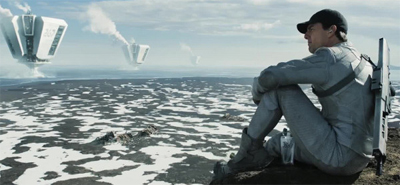
Director Joseph Kosinski wears his science-fiction interests on his sleeve. Tron: Legacy was obviously an update of an eighties science-fiction cult classic, and Oblivion feels like another form of pulpy homage. At its best, Oblivion feels like a spiritual successor to those wonderful cult science-fiction movies of the seventies and eighties, by way of classic version of The Outer Limits. Oblivion isn’t the strongest piece of science-fiction I’ve seen this year, nor the most ambitious, nor the most intelligent.

The movie is full of twists and turns, but few that any genre aficionado will fail to see coming. Instead, the movie largely works because it feels like an affectionate homage to those old-school post-apocalyptic pulpy sci-fi adventures. It’s cinematic nostalgia, but it’s lovingly crafted and skilfully rendered. Kosinski might not be the best storyteller working in the business, but he has a wonderful eye and keen sense of how to construct a beautiful scene.

On top (what remains of) the world...

On top (what remains of) the world…

Continue reading