• Following Us

  • Categories

  • Check out the Archives


  • Awards & Nominations

Non-Review Review: The Conjuring – The Devil Made Me Do It

It’s absurd to think that The Conjuring is probably the second most successful shared universe at Hollywood.

Of course, this is arguably more an indictment of the struggles that companies like Warner Bros. and Universal have faced in trying to launch competition for the Marvel Cinematic Universe, but it is still impressive that a gigantic homage to populist seventies horror has successfully grossed nearly two billion dollars across eight films. After all, this is a property anchored in a cinematic nostalgia which has succeeded through casting character actors appreciably older than most horror leads, notably Vera Farmiga and Patrick Wilson, but also Linda Cardellini, Anthony LaPaglia, Miranda Otto, Lili Taylor and Ron Livingston.
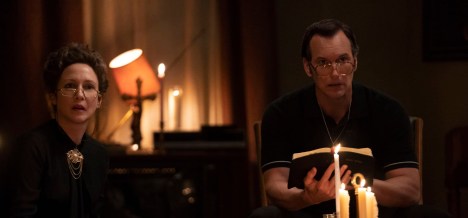
“Holy Plot! I mean, this plot… it’s full of holes…”

Following a variety of spin-offs and tie-ins including The Nun, The Curse of La Llorona and the separate Annabelle trilogy, The Conjuring: The Devil Made Me Do It is the third entry in the franchise’s cornerstone series. It is the first entry in that main series not to be directed by James Wan. Instead, Wan hands over directorial responsibilities to Michael Chaves, who helmed The Curse of La Llorona. Still, in terms of aesthetic and scale, The Devil Made Me Do It is recognisable as a continuation and development of the previous two entries in the trilogy.

Much like The Conjuring 2, The Devil Made Me Do It is a curious genre hybrid. It feels like a conscious effort to build a blockbuster horror movie, incorporating elements from more populist films and tying them back to the nuts-and-bolts mechanics of classic horror films. Like The Conjuring 2, this hybridisation is perhaps more interesting than it is effective. It doesn’t entirely work, but it certain merits investigation.

Continue reading

New Escapist Video! “Cruella – Review in 3 Minutes”

I’m thrilled to be launching 3-Minute Reviews on The Escapist. Over the coming weeks and months, I will be joining a set of contributors in adding these reviews to the channel. For the moment, I’m honoured to contribute a three-minute film review of Cruella, which released in cinemas and on Disney+ this weekend.

New Escapist Video! “Those Who Wish Me Dead – Review in 3 Minutes”

I’m thrilled to be launching 3-Minute Reviews on Escapist Movies. Over the coming weeks and months, I will be joining a set of contributors in adding these reviews to the channel. For the moment, I’m honoured to contribute a three-minute film review of Those Who Wish Me Dead, which released in cinemas and on HBO Max this weekend.


Non-Review Review: Spiral – From the Book of Saw

Spiral: From the Book of Saw is an interesting, if dysfunctional, franchise extension.

The obvious point of contrast is something like Jigsaw, the last attempt to restart the Saw franchise. Jigsaw was released in 2017, two years after Star Wars: Episode VII – The Force Awakens, and it bet big on a particular kind of nostalgia. It was a film that consciously aspired to evoke the memory of the Saw franchise among an audience that had probably seen an entry or two in the franchise a decade earlier and had vague memories of the experience.

Rocking the boat.

Jigsaw offered a much more polished take on the Saw template, eschewing the grimy green and grey aesthetic of the previous seven films in favour of a crisp sheen. Still, the film worked very hard to demonstrate its affection and veneration for the source material, even while offering superficial updates like moving the action into the countryside and swapping blades for lasers. The company logos at the start of Jigsaw appeared over a remix of Hello Zepp. Billy the Puppet got a makeover. Tobin Bell got considerable screentime as John Kramer, and the film tied itself to his back story and history.

Spiral takes a very different approach to its nostalgia. The film is the first in the series not to feature the character of John Kramer. Billy the Puppet has also been retired. While a variation on Hello Zepp does eventually play, Spiral holds it back and makes the audience wait for the pay-off. Spiral is very much part of the larger Saw franchise, and contains the requisite death traps and even brings back director Darren Lynn Bousman, but it feels like a consciously pared down and “back to basics” approach to the franchise that strips out a lot of the clutter that has accrued over the franchise’s long life span.

Bloody horrific.

This is most notable with the film’s sharp genre shift. While all of the earlier Saw movies had some procedural element that followed law enforcement’s efforts to track down and stop the serial killer, Spiral centres this thread. Spiral is arguably a forensic thriller with gory elements, rather than a gory horror with a dash of forensic thriller for flavour. It’s a clear attempt at a fresh start, with Spiral even relegating the Saw brand to the subtitle while leaning more heavily on the spiral and pig imagery that was largely secondary in the original franchise.

The result is fascinating, even if it doesn’t quite work. Spiral is arguably a “back to basics” take on the Saw franchise, going so back to basics that it draws more heavily from the serial killer thrillers that originally inspired Saw than it does from the Saw movies themselves.


Continue reading

Non-Review Review: Army of the Dead

Zack Snyder’s Army of the Dead arrives with relatively few expectations.

There’s something very refreshing and very appealing in this, particularly given the way that Snyder has become a cultural flashpoint due to his work on films like Man of Steel and Batman vs. Superman: Dawn of Justice, not to mention everything involving the production and release (and subsequent restoration) of Justice League. With all of that in the rear view mirror, it is exciting to sit down and watch as Zack Snyder movie that is… just a Zack Snyder movie.

Warding off evil.

Indeed, Army of the Dead is arguably something of a throwback for the director, marking a return to his earliest work. As a hyper-violent zombie action movie with a satirical edge, Army of the Dead invites comparisons to his first feature-length film, his remake of George A. Romero’s Dawn of the Dead. However, Army of the Dead is not a belated sequel or continuation. It is that rare modern big-budget genre film that stands as much on its own as it is possible for a high-concept zombie movie.

Army of the Dead is not a masterpiece by any stretch. It’s a little indulgent and overlong, suffering from the familiar pacing and tonal issues that affect many movies produced by Netflix. However, Army of the Dead is a fun and interesting genre if approached on its own terms. More than anything, freed from the constraints of established properties and shared universes and the ensuing scrutiny, Army of the Dead feels like Snyder is actually having fun. It is hard to begrudge it that.

Continue reading

New Escapist Video! “Jupiter’s Legacy – Review in 3 Minutes”

I’m thrilled to be launching 3-Minute Reviews on Escapist Movies. Over the coming weeks and months, I will be joining a set of contributors in adding these reviews to the channel. For the moment, I’m honoured to contribute a three-minute film review of the new Jupiter’s Legacy series that is now available on Netflix.

New Escapist Video! “Army of the Dead – Review in 3 Minutes”

I’m thrilled to be launching 3-Minute Reviews on Escapist Movies. Over the coming weeks and months, I will be joining a set of contributors in adding these reviews to the channel. For the moment, I’m honoured to contribute a three-minute film review of Zack Snyder’s Army of the Dead, with is releasing in cinemas on Friday and will be on Netflix next week.

230. The Father – This Just In (#142)

Hosted by Andrew Quinn and Darren Mooney, and this week with special guests Phil Bagnall and Stacy Grouden, The 250 is a fortnightly trip through some of the best (and worst) movies ever made, as voted for by Internet Movie Database Users.

This time, Florian Zeller’s The Father.

Anthony finds himself entering old age, and struggling with dementia. His world seems to shift around him. His home becomes increasingly foreign. The people that he loves are replaced with strangers. Can he find a way out of the labyrinth of his own mind?

At time of recording, it was ranked the 142nd best movie of all time on the Internet Movie Database.

Continue reading

Non-Review Review: Thunder Force

There is a recurring joke in Thunder Force about how one character cannot tell a joke. It feels like a metaphor for the film itself.

To be fair, it’s more than just the premise of that joke itself, it is also the execution. The opening section of Thunder Force offers something of an origin story for its two lead characters, Lydia and Emily. The two meet at school. At school, their only other friend is a geeky kid named Clyde. In these flashbacks, Clyde is introduced with an obvious crush on Lydia, and an inability to tell a joke properly. When the film rejoins Lydia in adulthood, Clyde is quickly reintroduced and still unable to tell a joke properly.

A thundering disappointment.

The basic law of comedy – or storytelling – would suggest that this is a plot point being set up so that it might pay off. It is the standard “rule of three.” A concept is introduced to the audience. It is then repeated to establish it. Then, finally, it is subverted. It is that third iteration of the concept that serves as a punchline. It’s the heart of the joke. Instead, Clyde just disappears from the film. His inability to tell a joke is ultimately just an inability to tell a joke. It eats up screentime in building this world, and doesn’t go anywhere.

There’s something almost fourth-wall-breaking in this. It’s a joke about how a character in this movie cannot tell a joke, told in such a way that it isn’t really a joke either. It’s a moment that captures so much of Thunder Force, albeit in an unflattering light. It is also, much like the rest of Thunder Force, painfully unfunny.

The script could use a punch-up.

Continue reading

Non-Review Review: Godzilla vs. Kong

Godzilla vs. Kong is in some ways an anticlimax, and not just because it’s arriving on HBO Max rather than as a cinematic blockbuster.

Clocking in at under two hours, Godzilla vs. Kong is technically the shortest entry in the Warner Brothers “Monsterverse” series. It comes in a few minutes shy of Kong: Skull Island and well short of both Godzilla and Godzilla: King of the Monsters. This is strange, given that Godzilla vs. Kong is nominally supposed to be the triumphant climax of this shared universe, the event towards which everything has been building. It’s strange that this clash of titans should up feeling so small.

That sinking feeling.

To be fair, there is a strong sense of an attempted course correction about Godzilla vs. Kong, especially in response to the overcrowded cacophony of King of the Monsters. In many ways, Godzilla vs. Kong is a smaller and more contained movie than King of the Monsters, notably hinging on three core monsters rather than an entire menagerie. It’s also to the credit of director Adam Wingard that Godzilla vs. Kong is a tighter, more contained and more focused film with a greater sense of internal coherence.

Unfortunately, though, there’s very littler surprise or wonder to be found in this titanic throwdown.

Continue reading